Gas Stations as NNN Investments: Misunderstood and Undervalued
Gas station and convenience store combinations are one of the highest-yielding NNN investment categories in Florida — and one of the most misunderstood. Most passive investors avoid them due to environmental concerns: underground storage tanks, potential contamination, Phase I ESA requirements. Those concerns are legitimate but manageable with proper due diligence. Investors who understand the environmental framework often find that gas station NNN assets offer risk-adjusted returns that are difficult to match in traditional single-tenant categories.
The category is not monolithic. There is an enormous difference between a corporate Wawa NNN lease and an unbranded independent operator running a cash-heavy c-store on a rural highway. Understanding the branded vs unbranded distinction — and the sub-tiers within branded — is the most important framework for evaluating any gas station investment opportunity in Florida.
For investors deploying 1031 exchange capital or building a passive NNN portfolio, gas station properties deserve a place in the evaluation universe. The key is knowing what you're buying.
Branded vs Unbranded: The Critical Distinction
The single most important variable in a gas station investment is whether the operator is a corporate brand, a dealer under a supply agreement, or a fully independent operator. Each carries a fundamentally different risk and return profile.
Corporate NNN — Wawa, Circle K, RaceTrac, Buc-ee's
Corporate-operated branded chains sign NNN leases directly as the operating entity, backed by their full corporate balance sheet. These are the most sought-after gas station investments and trade at the tightest cap rates. Wawa in particular has become one of the most coveted NNN assets in Florida — 20-year initial terms, 10% rent bumps every 5 years, and a brand that commands extraordinary consumer loyalty. Lease terms are long, tenant credit is strong, and the real estate tends to be in high-visibility, high-traffic locations.
- →Corporate NNN lease — full entity guarantee
- →Initial lease terms: 15–20 years
- →Rent bumps: 10% every 5 years (Wawa standard)
- →Cap rates: 4.75–6.0% depending on brand and location
- →Institutional buyer pool — liquid resale market
Dealer Supply Agreement — Shell, BP, Chevron, Sunoco
Major oil brands license their flags to independent dealer-operators via supply agreements. The dealer pays for the fuel brand, signage, and supply from the major, but operates the site independently. The NNN lease is with the dealer entity — not Shell or BP corporate. This is a critical distinction: you are getting a dealer's credit, not an oil major's credit. These properties offer higher yields than corporate NNN but carry meaningfully more operator risk.
- →Lease with dealer LLC or individual, not oil major
- →Oil brand can change at supply agreement renewal
- →Cap rates: 6.5–7.5% for established dealer sites
- →Financing can be more challenging — lender scrutiny on guarantor
- →Site quality and location matter more than the brand flag
Unbranded Independents
Fully independent operators with no brand affiliation. Highest yields in the category — 8–10%+ — reflecting genuine operator risk, limited financing options, and a narrow institutional buyer pool. These can make sense for experienced investors who know the specific market, the operator personally, and have the infrastructure to manage higher-risk assets. Rarely appropriate for passive 1031 exchange buyers seeking institutional-quality NNN income.
- →Cap rates: 8.0–10.0%+ (reflects full operator risk)
- →Limited conventional financing — often requires portfolio lender
- →Revenue verification more difficult — cash-heavy businesses
- →No brand covenant or supply agreement providing baseline quality
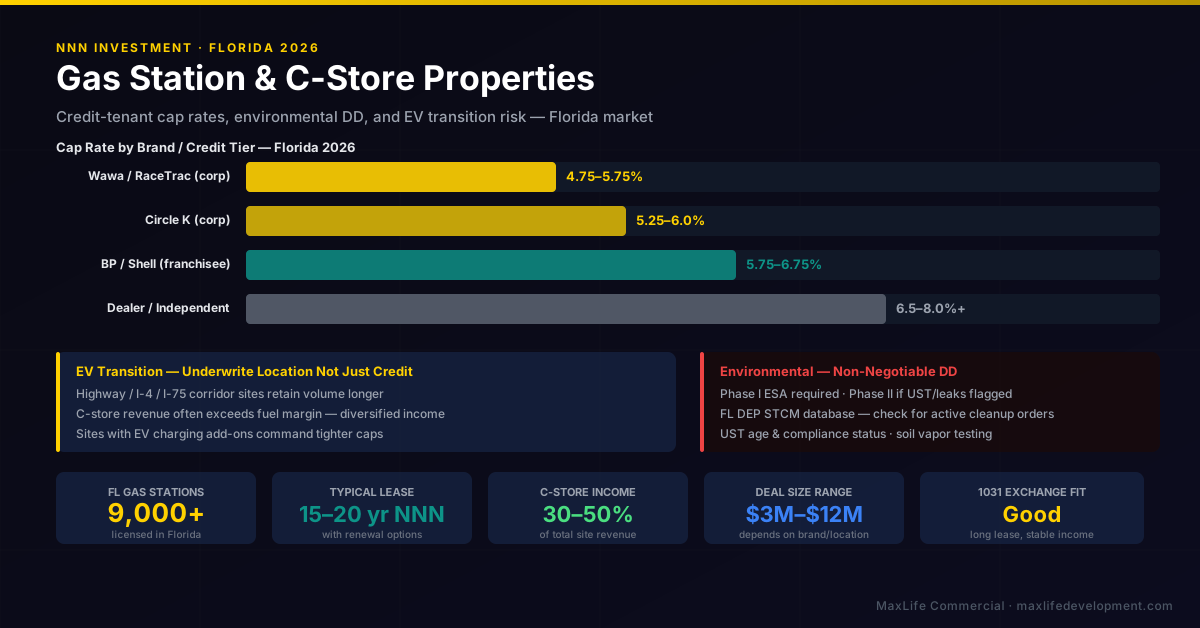
Cap Rates by Type (Florida 2026)
Florida gas station cap rates are driven by brand, operator type, and location quality. Here is where the market is pricing in 2026:
For broader NNN cap rate context across all property types, see our Orlando cap rates investor guide.
Wawa: Florida's Crown Jewel Gas Station Investment
Wawa deserves its own section because it is categorically different from other gas station NNN investments — and among the most sought-after NNN assets in Florida, full stop.
Wawa is expanding aggressively across Florida, currently operating 300+ locations statewide with continued new openings in Central Florida, Tampa Bay, and the Space Coast. Their standard Florida format is a large-format convenience store (5,000–6,000 SF) with 10–16 fueling positions, a branded food service program, and a consumer loyalty following that rivals fast-casual restaurant chains. Wawa regularly generates among the highest c-store sales per location in the industry.
New Wawa builds execute on 20-year corporate NNN leases with 10% rent bumps every 5 years — creating a predictable, growing income stream backed by one of the most recognizable brands in the Southeast. Institutional demand for Wawa NNN is intense: major 1031 DST (Delaware Statutory Trust) platforms and net lease REITs compete for every new construction Wawa that comes to market.
Wawa NNN Snapshot
The one caveat: Wawa is privately held, so lease guarantees come from Wawa, Inc. rather than a publicly rated entity. Lenders and sophisticated buyers are comfortable with this, but confirm the guarantor entity and request financials if available. Cap rates for Wawa in premier Florida locations (I-4 corridor, coastal markets, high-traffic arterials) trade at the tight end of the 4.75–5.5% range.
Get Off-Market CRE Deals in Your Inbox
Join our investor list for exclusive Central Florida opportunities, market reports, and deal analysis — delivered weekly. No spam, unsubscribe anytime.
Environmental Due Diligence: The #1 Risk
Environmental due diligence is not optional for gas station acquisitions — it is the defining risk factor in the asset class and the primary reason many investors avoid it entirely. Investors who master this process find opportunities; those who skip it create liability.
The core risk is underground storage tanks (USTs). Gas stations store petroleum products in USTs buried below grade. Older tanks — particularly single-wall steel tanks installed pre-1988 — are prone to corrosion and leaks that contaminate surrounding soil and groundwater. Federal EPA regulations mandated upgrades in the 1990s, but legacy contamination is widespread at older sites.
- →Phase I ESA: Always required. Reviews historical records, aerial photography, and site conditions to identify recognized environmental conditions (RECs). If any RECs are flagged, proceed to Phase II.
- →Phase II ESA: Soil and groundwater sampling to characterize contamination extent. Required whenever Phase I identifies RECs — which is common at gas station sites.
- →Florida DEP STCM Database: Check the Florida DEP Storage Tank Compliance Management (STCM) database before signing any LOI. Active and closed contamination cases are publicly searchable. A site with an open contamination case requires careful review of cleanup status and cost responsibility.
- →UST Age and Material: Pre-1988 USTs = high risk. Fiberglass double-wall tanks with interstitial monitoring = modern standard and substantially safer. Confirm tank age, material, and monitoring system through DEP records and the seller.
- →Remediation Cost Range: If contamination is found, remediation costs range from $50K for a minor fuel release to $1M+ for a significant plume. Lenders typically will not close on a site with an active remediation order — verify cleanup status before committing.
Corporate operators like Wawa and RaceTrac manage their USTs to current standards and maintain strong compliance records — another reason their properties command premium cap rates. Dealer-operated and independent sites require more scrutiny.
Ground Lease vs Fee Simple
Gas station investments can be structured as either fee simple (you own land and all improvements) or ground lease (you own only the land; the operator owns the canopy, pumps, and building). The distinction matters significantly for financing, cap rates, and end-of-lease value.
Fee Simple
You own the land, building, canopy, and all improvements. Higher cap rate than ground lease for the same operator and location (improvements add collateral value). Better financing terms. At lease expiration, you own everything — including the USTs and canopy, which creates both value and environmental responsibility. Most Wawa and RaceTrac transactions in Florida are fee simple.
Ground Lease
You own only the land. The operator owns the improvements. Ground leases trade at lower cap rates because improvement value is not included in your asset — you are essentially lending money against land only. At lease expiration, improvements revert to you or must be removed by the tenant (lease-specific). Ground leases typically run 20–50 years with multiple renewal options. For gas stations, Chick-fil-A-style ground lease structures are rare — most are fee simple.
For a deeper dive into this structure across all NNN property types, see our ground lease vs fee simple guide.
Florida Gas Station Investment Corridors
Not all Florida gas station locations are equal. High-volume corridors produce the highest c-store sales and the strongest tenant performance — which translates into lower default risk and more durable asset values.
US-192 — Kissimmee / Osceola County
One of the highest-traffic tourism corridors in the state, connecting US-27 to I-95 through the Disney/theme park belt. Wawa, RaceTrac, and Circle K all have high-volume locations here. Tourist and resident traffic combined. Strong c-store metrics.
US-27 — Haines City to Clermont
Heavy truck and commuter volume connecting Polk County to Orange County. Fuel volumes are consistently high. Grow corridor with expanding residential development behind it. Dealer-operated sites on this corridor are undervalued relative to actual traffic.
I-95 Interchange Sites
Interstate interchange gas stations are among the highest-volume in the state. Captive audience, no pricing sensitivity, high out-of-state traveler volume. Premium locations command the tightest cap rates in the category.
Space Coast — US-1 Corridor
Brevard County's US-1 runs through Melbourne, Palm Bay, and Titusville with heavy commuter volume from the aerospace workforce. Wawa and RaceTrac are expanding here. Strong demographics with aerospace-wage employment base supporting c-store spend.
I-4 Corridor — Sanford to Lakeland
The backbone of Central Florida commerce. High-traffic interchanges at SR-46, US-92, SR-535, and US-27 in Polk County represent some of the strongest gas station investment opportunities in the state.
EV Risk: Real but Long-Tailed
Every sophisticated investor asking about gas station properties raises the same question: what about electric vehicles? It is a legitimate long-term question. Here is how to think about it for Florida investments in 2026.
The EV risk is real but long-tailed. Florida's EV adoption rate lags the national average — the state's lower-income demographics, large rural geography, and heat-related battery performance issues slow the transition. Modern gas station c-stores generate 70%+ of gross profit from food, beverages, tobacco, and lottery — not fuel margin. That c-store revenue is largely insulated from EV displacement. Long NNN lease terms (15–20 years) mean that investors underwriting acquisitions today have 10–15 years of protected income before EV transition risk materially impacts tenant performance. The highest risk is to fuel-only sites with no meaningful c-store component — avoid those entirely.
Wawa and RaceTrac are both investing in EV charging infrastructure at their Florida locations, hedging their own fuel volume risk. This dual-fuel/EV charging model may become the standard for large-format c-stores over the next decade — which actually supports the real estate value of premium site locations as charging demand creates new foot traffic.
How Gas Station Investments Compare to Other NNN
Where do gas station properties fit in the broader NNN investment universe?
Wawa vs Dollar General
Wawa trades at a 4.75–5.5% cap vs Dollar General at 5.5–6.5%. Wawa has stronger consumer brand, higher sales volumes, and equivalent corporate covenant. Dollar General has more transparent public financials. Wawa wins on operator quality; DG wins on market liquidity.
Dealer gas station vs Car Wash NNN
Both are alternative NNN categories with operator risk. Dealer gas station (6.5–7.5%) and car wash (6.0–7.0%) trade in similar cap rate territory. Gas station has more environmental risk; car wash has more format-obsolescence risk (full-service converting to express).
Unbranded C-Store vs Self-Storage
Both cap at 8–10%+. Self-storage is typically managed through a REIT or operator agreement; unbranded c-stores are true single-tenant NNN. Self-storage has more tenant diversification (many customers); c-store has simpler structure. Both require specialized knowledge to underwrite well.
For the full NNN comparison framework, see our ultimate guide to NNN investing.
NNN Asset Profile
Gas Station NNN Investment Profile
Looking for Gas Station Properties in Florida?
MaxLife Commercial tracks branded and unbranded gas station NNN opportunities across Central Florida. Whether you're targeting a Wawa corporate NNN or a high-yield dealer-operated site, we can help you find and evaluate the right investment.
Frequently Asked Questions
Are gas stations good NNN investments in Florida?
Gas station and convenience store NNN properties are among the highest-yielding NNN categories in Florida. Branded corporate operators like Wawa and RaceTrac offer investment-grade credit at 4.75–5.75% cap rates. The key is thorough environmental due diligence — underground storage tank risk is real and must be properly vetted before any acquisition.
What cap rate should I expect on a Florida gas station property?
Wawa and RaceTrac corporate NNN: 4.75–5.75%. Circle K corporate NNN: 5.25–6.0%. Major oil brand dealer supply agreements: 6.5–7.5%. Unbranded independent c-stores: 8.0–10.0%+. Corporate NNN trades substantially tighter than dealer-operated product due to credit and lease structure differences.
What environmental due diligence is required for gas station properties?
A Phase I Environmental Site Assessment is mandatory. If it flags recognized environmental conditions (RECs) — which is common — a Phase II with soil and groundwater sampling is required. Check the Florida DEP STCM database for UST records. Pre-1988 single-wall steel tanks are high-risk. Remediation costs range from $50K to $1M+.
What is the difference between a ground lease and fee simple gas station investment?
In a ground lease you own only the land — the operator owns the canopy, pumps, and building. Ground leases trade at lower cap rates because improvement value is not in your asset. Fee simple means you own land and all improvements, providing more collateral and more upside at lease expiration. Most Florida Wawa and RaceTrac deals are fee simple.
How does EV adoption affect gas station investments in Florida?
EV risk is real but long-tailed. Florida's EV adoption lags the national average, and modern c-stores generate 70%+ of gross profit from food, beverages, and non-fuel sales. Long NNN leases (15–20 years) protect near-term income. The highest risk is to fuel-only sites with no c-store component — avoid those. Major brands like Wawa are investing in EV charging infrastructure as a hedge.
Related Articles
Orlando NNN Properties for Sale 2026
National credit tenants, cap rates, and acquisition strategy for NNN investors in Central Florida.
Car Wash Investment Properties Florida 2026
Express tunnel car wash cap rates, sale-leasebacks, and site selection in Florida.
Ground Lease vs. Fee Simple
When ground leases outperform fee simple ownership — and when they don't.
The Ultimate Guide to NNN Investing
How to source, underwrite, and close NNN properties across Florida.
1031 Exchange Orlando Guide
NNN properties are the most popular 1031 replacement asset — here's how the process works.
Cap Rate vs. Cash-on-Cash Return
Two numbers every NNN investor quotes — and why leverage changes everything.