What Is a Cap Rate and Why It Matters
The capitalization rate -- or cap rate -- is the most widely used metric in commercial real estate investing. It expresses the relationship between a property's net operating income and its purchase price as a percentage. If a property generates $100,000 in annual NOI and sells for $1,500,000, the cap rate is 6.67%. The formula is simple: Cap Rate = NOI / Purchase Price.
Cap rates serve two critical functions. First, they allow you to compare the relative value of different properties on an apples-to-apples basis regardless of size, location, or property type. Second, they reflect the market's perception of risk. A lower cap rate signals lower perceived risk and higher demand, while a higher cap rate indicates greater risk or less competition for that asset type.
It is important to recognize that cap rates are a snapshot metric. They represent the yield at a single point in time based on current income and current price. They do not account for future rent growth, capital expenditures, or financing structure. Two properties with identical cap rates can deliver vastly different total returns depending on the trajectory of their income, the quality of their tenant base, and the capital required to maintain the asset over a hold period. That is why experienced investors treat the cap rate as a starting point for analysis rather than the final word on value.
Net operating income itself deserves scrutiny. NOI is calculated as gross rental income minus operating expenses, but the way sellers present NOI can vary. Some offering memorandums use trailing twelve-month actuals, while others project forward-looking pro forma income that assumes full occupancy and market rents. Always verify whether a quoted cap rate is based on actual in-place income or an optimistic projection. The difference between an in-place cap rate and a pro forma cap rate can be 100 to 200 basis points on properties with vacancy or below-market leases.
Understanding Orlando's cap rate environment is essential whether you are acquiring your first commercial property or building a diversified portfolio. Cap rates in Central Florida have compressed over the past decade as population growth, tourism expansion, and infrastructure investment have driven demand across every property type. Use our Deal Analyzer to model cap rates and returns on any property you are evaluating.
Orlando Cap Rates by Property Type
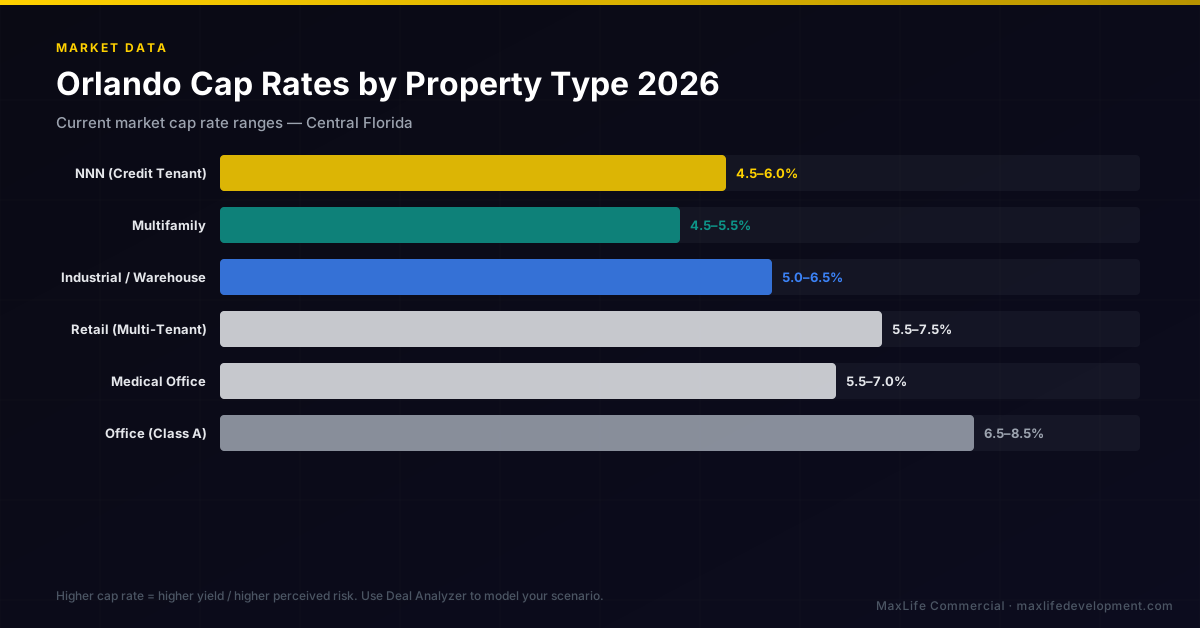
Cap rates vary significantly across property types in Orlando. The ranges below reflect current market conditions for stabilized assets in core and suburban locations throughout the metro area. For the full, quarterly-updated breakdown by property type and submarket, see our Orlando commercial real estate cap rates research hub — the live data set this guide is built on.
| Property Type | Cap Rate Range | Risk Profile | Typical Buyer |
|---|---|---|---|
| NNN (Net Lease) | 5.5% - 7.0% | Low | 1031 Exchange / Passive |
| Multifamily | 5.0% - 6.5% | Low - Moderate | Institutional / Syndicator |
| Industrial | 5.5% - 7.0% | Low - Moderate | Institutional / Private |
| Retail | 6.5% - 8.0% | Moderate | Private / Value-Add |
| Office | 7.0% - 9.0% | Moderate - High | Opportunistic / Value-Add |
These ranges represent stabilized assets with typical occupancy and lease terms. Distressed properties, value-add opportunities, and development sites will trade outside these bands. Below is a detailed breakdown of each property type with the specific factors that push cap rates toward the high or low end of each range.
NNN Properties -- 5.5% to 7.0%
Single-tenant net lease properties anchored by credit tenants such as Dollar General, Walgreens, and AutoZone trade at some of the tightest cap rates in the market. Investors pay a premium for the predictability of long-term leases with minimal management responsibility. Properties with 10 or more years of remaining lease term from investment-grade tenants typically trade at the low end of this range, while shorter lease terms or regional tenants push cap rates higher.
Rent escalation structure is another key variable. NNN properties with built-in annual rent increases of 1.5% to 2.0% command tighter cap rates than flat leases because investors are paying for embedded income growth. A Dollar General with 12 years remaining and 1.5% annual bumps might trade at a 5.6% cap rate, while a similar property with a flat lease and only five years left could trade closer to 6.8%. The spread between those two scenarios reflects both lease duration risk and the present value of future rent growth.
Location within the Orlando metro also matters for NNN pricing. A Chick-fil-A ground lease on International Drive or along the 192 corridor near Disney will trade at a meaningfully tighter cap rate than a similar fast-food NNN property in a tertiary location like Clermont or Poinciana. The underlying real estate value and re-tenanting potential of high-traffic sites give investors confidence that residual value exists beyond the current lease term.
Browse available Orlando NNN properties to see how current listings compare to these benchmarks.
Retail -- 6.5% to 8.0%
Multi-tenant retail centers, strip malls, and outparcel developments in Orlando generally trade at higher cap rates than NNN properties due to the added management complexity and leasing risk. Grocery-anchored centers with stable occupancy sit at the lower end, while unanchored strip centers in secondary corridors command higher yields to compensate for vacancy exposure.
Tenant mix quality is one of the strongest predictors of where a retail center falls within this cap rate range. A center anchored by Publix or Aldi with a complementary mix of service-oriented tenants -- medical offices, hair salons, fitness studios -- will trade at a meaningfully tighter cap rate than a center reliant on discretionary retail tenants that are vulnerable to e-commerce disruption. Necessity-based retail has proven resilient through multiple economic cycles and commands a pricing premium from investors.
Lease structure also affects retail cap rates in Orlando. Centers with staggered lease expirations spread across multiple years present lower risk than properties where a large percentage of the rent roll expires within the same 12-month window. Investors should also pay attention to co-tenancy clauses, percentage rent provisions, and CAM reimbursement structures, as these can materially affect effective NOI and therefore the true economic cap rate of the investment.
The retail sector in Orlando benefits from the metro's strong population growth and tourism-driven consumer spending. Read more in our Orlando retail real estate guide.
Multifamily -- 5.0% to 6.5%
Apartment communities in Orlando remain among the most competitive asset classes in the metro. Strong in-migration, household formation, and rent growth have compressed multifamily cap rates significantly. Class A properties in prime locations like Lake Nona, Winter Park, and downtown Orlando trade near the lower bound, while Class B and C value-add opportunities in secondary submarkets offer higher entry yields with upside potential.
The value-add multifamily strategy remains one of the most popular investment approaches in Orlando. Properties built in the 1990s and early 2000s in submarkets like Kissimmee, Sanford, and Pine Hills often trade at cap rates between 5.8% and 6.5% with significant room to renovate units and push rents $150 to $300 per month higher. Interior upgrades including new flooring, countertops, fixtures, and in-unit washers and dryers typically cost $8,000 to $15,000 per unit and can generate a return on investment exceeding 25% annually through the resulting rent premiums.
Submarket selection is critical for multifamily investors in Orlando. Properties near major employment centers -- Orlando Health, AdventHealth, the University of Central Florida, and the Lake Nona Medical City -- tend to maintain higher occupancy and stronger rent growth than those in areas with limited employment density. Proximity to SunRail stations is also becoming a meaningful differentiator as transit-oriented living gains traction among Orlando renters.
Our Orlando multifamily investment guide covers the full landscape of apartment investing in Central Florida.
Industrial -- 5.5% to 7.0%
Industrial and logistics properties have seen the most cap rate compression of any Orlando property type over the past five years. E-commerce growth, supply chain restructuring, and limited new construction have created persistent demand for warehouse and distribution space. Properties near Orlando International Airport and along the I-4 logistics corridor trade at the tightest cap rates.
Building specifications drive cap rate differentiation within the industrial sector. Modern Class A distribution facilities with 32-foot clear heights, cross-dock configurations, and ESFR sprinkler systems attract national logistics tenants willing to sign long-term leases, resulting in cap rates at the low end of the range. Older flex industrial and small-bay warehouse properties with lower clear heights and fewer dock doors trade at wider cap rates but often present compelling value-add opportunities through lease-up and tenant improvement programs.
The Orlando industrial market has also benefited from Central Florida's emergence as a regional distribution hub. Proximity to Port Canaveral, Jacksonville's JAXPORT, and Tampa's Port gives Orlando-based distribution facilities access to multiple shipping routes. Amazon, FedEx, and UPS have all expanded their Orlando-area footprints in recent years, and this institutional demand has pulled cap rates tighter across the entire industrial submarket. Investors looking at adjacent markets should also consider industrial opportunities in Brevard County, where cap rates remain slightly wider than core Orlando.
Explore the sector further in our Orlando industrial real estate guide.
Office -- 7.0% to 9.0%
Office cap rates in Orlando reflect the ongoing uncertainty in the sector following the shift to hybrid and remote work. Class A office buildings in prime locations with long-term tenants trade closer to 7.0%, while suburban and Class B office properties with shorter lease terms or higher vacancy trade at significantly wider cap rates. Investors targeting the office sector are pricing in both leasing risk and the capital expenditures often needed to attract and retain tenants.
Despite the challenges, medical office buildings and single-tenant office properties leased to government or healthcare tenants continue to perform well, often trading at cap rates closer to the NNN range.
Adaptive reuse is emerging as a strategy for office properties in Orlando that face persistent vacancy. Some investors are acquiring Class B and C office buildings at cap rates above 8.5% with plans to convert them to medical office, coworking, or even residential use. The math on these conversions depends heavily on zoning flexibility, construction costs, and the spread between the acquisition cap rate and the stabilized cap rate of the target use. Properties in mixed-use corridors like Mills 50, the Milk District, and Maitland Center are attracting the most interest for repositioning strategies.
How Interest Rates Affect Orlando Cap Rates
The relationship between interest rates and cap rates is one of the most important dynamics in commercial real estate. When the Federal Reserve raises the federal funds rate, the cost of commercial mortgage debt increases. This directly affects buyer purchasing power and, over time, pushes cap rates upward as investors demand higher unlevered yields to maintain acceptable leveraged returns. The reverse holds true in falling rate environments -- cheaper debt allows buyers to accept lower cap rates while still achieving their target cash-on-cash returns.
The spread between cap rates and the 10-year Treasury yield is a useful barometer for gauging relative value. Historically, Orlando commercial properties have traded at a spread of 200 to 350 basis points above the 10-year Treasury. When this spread compresses below 200 basis points, it suggests the market may be overheated and cap rates are too tight relative to the risk-free rate. When the spread expands beyond 350 basis points, it can signal a buying opportunity where private market pricing has not yet caught up to favorable financing conditions.
Orlando experienced this dynamic firsthand between 2022 and 2024 when aggressive Fed rate hikes pushed commercial mortgage rates above 7.0% for many borrowers. Transaction volume dropped sharply as bid-ask spreads widened. Sellers anchored to pre-rate-hike valuations were reluctant to accept the higher cap rates that buyers needed to make deals pencil. As rates began to stabilize, transaction activity resumed and a new pricing equilibrium emerged with cap rates approximately 75 to 125 basis points wider than the 2021 lows across most property types.
For investors evaluating deals today, the key question is whether current cap rates adequately compensate for the prevailing cost of debt. Positive leverage -- where the cap rate exceeds the mortgage constant -- remains achievable across most Orlando property types, particularly for borrowers who can secure favorable terms through relationship lenders or agency programs. Our Deal Analyzer lets you stress-test different interest rate scenarios against current cap rates so you can evaluate how sensitive your returns are to financing costs.
Historical Cap Rate Trends in Central Florida
Orlando cap rates have followed a broad compression trend over the past decade, interrupted by periodic corrections tied to interest rate cycles and macroeconomic events. Between 2015 and 2019, steady job growth, population gains, and low interest rates drove cap rates tighter across all property types. Industrial and multifamily saw the most aggressive compression, with average cap rates falling roughly 150 basis points during that period.
| Property Type | 2018 Avg | 2021 Avg | 2024 Avg | 2026 Avg |
|---|---|---|---|---|
| NNN | 6.25% | 5.50% | 6.10% | 6.25% |
| Multifamily | 5.75% | 4.50% | 5.50% | 5.75% |
| Industrial | 6.50% | 5.25% | 6.00% | 6.25% |
| Retail | 7.50% | 6.75% | 7.25% | 7.25% |
| Office | 7.25% | 6.50% | 7.75% | 8.00% |
The COVID-19 pandemic in 2020 created a brief dislocation, but Orlando's recovery was faster than most Sun Belt metros. Stimulus-fueled demand and a wave of institutional capital seeking yield pushed cap rates to historic lows in 2021 and early 2022. Multifamily assets in prime Orlando submarkets traded below 4.5% during this period -- levels that left almost no margin for error if rent growth stalled or interest rates rose, which is exactly what happened.
The rate-hike cycle of 2022 through 2024 forced a recalibration. Cap rates expanded 75 to 150 basis points from the lows depending on property type, with office experiencing the most significant widening due to structural demand concerns layered on top of the financing cost increase. Industrial and multifamily cap rates expanded more modestly because fundamental demand remained strong even as capital became more expensive.
Looking at the current environment, cap rates across most Orlando property types appear to have stabilized. Transaction volume is recovering as buyers and sellers converge on realistic pricing. For investors with a long-term horizon, periods of cap rate expansion have historically been among the best entry points in Orlando, as the metro's demographic tailwinds eventually re-compress cap rates as market conditions normalize. Investors considering adjacent Central Florida markets should review opportunities in Lake County, where cap rates often run 50 to 100 basis points wider than core Orlando for comparable property types.
Factors Driving Orlando Cap Rate Trends
Several macroeconomic and local factors shape where cap rates land in Orlando. Interest rates are the most influential external force. When the cost of debt rises, cap rates tend to expand as buyers require higher yields to maintain acceptable cash-on-cash returns. Conversely, falling rates compress cap rates as cheaper financing allows investors to pay more for the same income stream.
Orlando's demographic tailwinds provide a strong foundation for cap rate stability. The metro area continues to attract over 1,000 new residents per week, driven by employment growth in healthcare, technology, aerospace, and tourism. This population growth fuels demand for housing, retail services, logistics space, and office -- supporting occupancy and rent growth across all property types.
Supply and demand dynamics at the submarket level also play a meaningful role. When new construction outpaces absorption -- as happened in several Orlando multifamily submarkets in 2024 and 2025 -- concessions rise, effective rents soften, and cap rates expand as investors adjust their income expectations downward. Conversely, property types like industrial where new supply has remained constrained relative to demand have maintained tighter cap rates even through rising rate environments. Monitoring the construction pipeline and absorption trends for each property type is essential for anticipating where cap rates are headed.
Employment diversification strengthens Orlando's case as a cap rate compression market over the long term. While tourism and hospitality remain the largest employment sector, the metro's growing presence in defense contracting, simulation technology, life sciences, and fintech reduces the economic concentration risk that historically concerned some institutional investors. As employer diversity improves, more national and global investors are allocating capital to Orlando, increasing competition for assets and supporting tighter cap rates.
Infrastructure investment also plays a role. The expansion of SunRail commuter service, the Brightline high-speed rail connection to South Florida, and ongoing highway improvements along I-4 and the 417 corridor are reshaping accessibility and unlocking new development nodes. Investors who track these infrastructure catalysts can identify submarkets where cap rates are likely to compress as connectivity improves. See cap rate comparisons for adjacent markets in our Brevard County and Lake County market pages.
Cap Rate vs Cash-on-Cash Return
One of the most common mistakes new CRE investors make is conflating cap rate with cash-on-cash return. While both are expressed as percentages, they measure fundamentally different things. The cap rate is an unlevered metric -- it tells you what the property earns relative to its total value without accounting for financing. Cash-on-cash return measures the actual return on the equity you invest after debt service.
For example, a property with a 6.5% cap rate purchased with 70% leverage at a 5.5% interest rate might deliver a 9% to 11% cash-on-cash return depending on the amortization schedule and loan terms. Leverage amplifies returns when the cap rate exceeds the cost of debt -- a concept known as positive leverage. When interest rates exceed the cap rate, leverage works against you and cash-on-cash returns fall below the cap rate.
| Scenario | Cap Rate | Mortgage Rate | LTV | Cash-on-Cash |
|---|---|---|---|---|
| Strong Positive Leverage | 7.0% | 5.5% | 70% | 10.5% |
| Moderate Positive Leverage | 6.5% | 6.0% | 65% | 7.4% |
| Neutral Leverage | 6.5% | 6.5% | 70% | 6.5% |
| Negative Leverage | 5.5% | 6.5% | 70% | 3.2% |
The table above illustrates how the interplay between cap rates, mortgage rates, and leverage ratios determines actual investor returns. In the current Orlando market, most property types still offer positive leverage opportunities, but the margin is thinner than it was during the low-rate environment of 2020 and 2021. Investors should model multiple financing scenarios before committing to a deal, including the possibility that rates move against them during the hold period.
Another important distinction is that cap rates ignore principal paydown and appreciation. A property purchased at a 6.0% cap rate that delivers only a 7.5% cash-on-cash return may still produce a 12% to 15% total return when you account for mortgage amortization building equity and property value increasing over time. Total return analysis gives a more complete picture of investment performance than any single metric.
Smart investors use both metrics together. The cap rate helps you compare properties and assess relative value. The cash-on-cash return tells you how hard your actual dollars are working. Our Deal Analyzer calculates both metrics automatically so you can evaluate any Orlando commercial property with confidence.
Using Cap Rates to Find Value in Orlando
The cap rate is not just a valuation tool -- it is a lens for identifying opportunity. When a property trades at a cap rate significantly above the market average for its type and location, it signals either a mispricing or an elevated risk factor that the market has identified. Your job as an investor is to determine which one it is.
Value-add strategies in Orlando often target properties trading at wider cap rates due to below-market rents, deferred maintenance, or management inefficiency. By stabilizing the asset -- raising rents to market, improving occupancy, or reducing operating expenses -- you can increase NOI and effectively compress the cap rate, creating significant equity through forced appreciation.
Submarket arbitrage is another strategy that cap rate analysis enables. Different Orlando submarkets can exhibit meaningfully different cap rates for similar property types based on investor perception, liquidity, and growth trajectory. Emerging corridors like the Apopka-Wekiva area, the Narcoossee Road corridor south of Lake Nona, and the US-27 growth path through Four Corners may offer cap rate premiums of 50 to 100 basis points over established submarkets like Winter Park or Maitland. If the demographic fundamentals support convergence, acquiring in these higher-cap-rate submarkets can generate outsized returns as the market recognizes and prices in the growth.
Cap rate analysis is also valuable for portfolio construction. By blending assets across the cap rate spectrum -- lower-cap-rate stabilized NNN properties for income and stability alongside higher-cap-rate value-add retail or office deals for upside -- investors can build a diversified portfolio that balances risk and return. This approach is particularly effective in Orlando where the breadth of property types and submarkets provides ample opportunity to construct a balanced allocation.
For investors seeking stability over upside, acquiring properties at market cap rates with strong tenants and long lease terms remains a proven strategy in Orlando. NNN properties and core multifamily assets deliver predictable returns that are particularly attractive for 1031 exchange buyers who prioritize capital preservation and income continuity over speculative gains.
CRE Glossary Quick Reference
Key terms used throughout this guide. Click for full definitions.
Need more terms? Browse the full CRE Glossary with 70+ definitions.
Browse Properties by Asset Class
Apply the cap rate ranges in this guide to current Florida property inventory.
Analyze Orlando Cap Rates for Your Next Deal
MaxLife Commercial provides cap rate analysis, deal underwriting, and acquisition support for commercial investors across Central Florida.
Contact UsGet Off-Market CRE Deals in Your Inbox
Join our investor list for exclusive Central Florida opportunities, market reports, and deal analysis — delivered weekly. No spam, unsubscribe anytime.