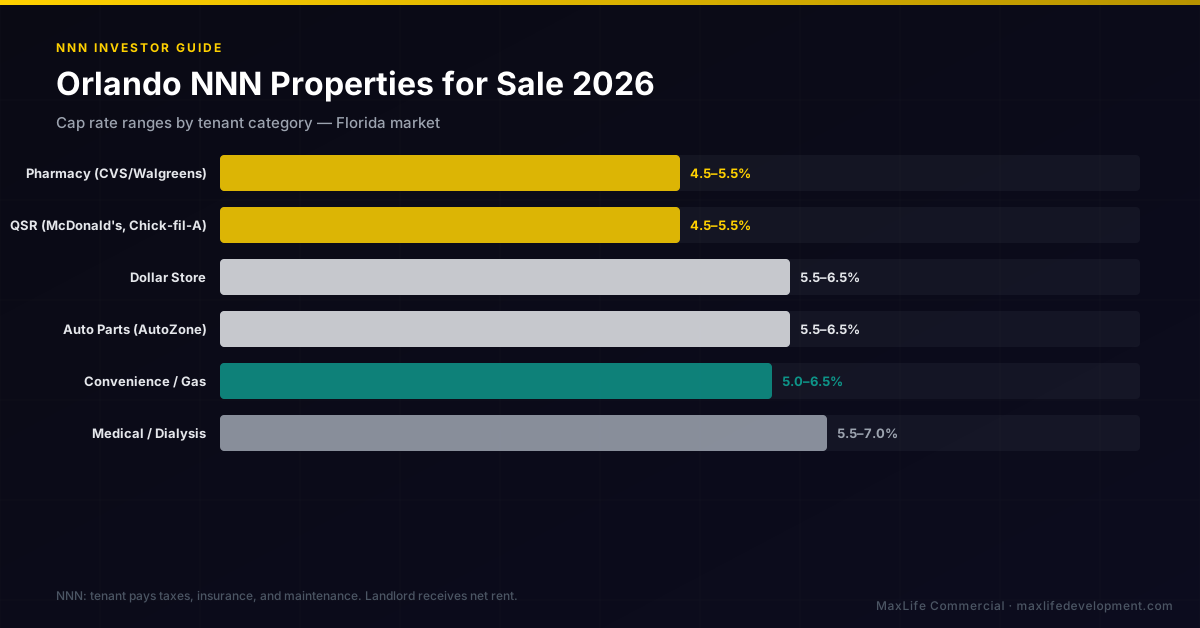
Why Orlando Is a Strong NNN Market
Orlando offers one of the most attractive markets in the southeastern United States for triple net lease investment. The metro's combination of strong population growth, expanding retail and commercial infrastructure, and a diversified economic base creates ideal conditions for NNN property investors seeking stable, long-term income with minimal management responsibility.
National retailers and service providers continue to expand their footprints across Central Florida, driven by the same demographic tailwinds that benefit the broader Orlando commercial real estate market. New residential communities in growth corridors like Lake Nona, Horizon West, and the Kissimmee-St. Cloud area are creating demand for the retail and service infrastructure that NNN tenants provide.
For 1031 exchange buyers, retirees seeking passive income, and institutional investors building net lease portfolios, Orlando provides a deep and liquid market with properties available across a wide range of price points, tenant types, and cap rates. The market's size and diversity mean that investors can find opportunities that match their specific investment criteria, whether they are targeting a single asset or assembling a portfolio.
The Orlando metro area adds roughly 1,500 new residents per week, making it one of the fastest-growing metropolitan areas in the country. That sustained population influx translates directly into demand for convenience retail, quick-service restaurants, medical services, and auto parts stores — precisely the tenant categories that dominate the NNN investment landscape. Tenants like Dollar General, 7-Eleven, and Starbucks use sophisticated site-selection models that favor high-growth corridors, and Orlando consistently ranks among their top expansion markets.
Orlando's economic base has also diversified well beyond tourism. The metro is now home to major operations in defense technology, medical devices, fintech, and simulation training. Employers such as Lockheed Martin, Siemens Energy, and the expanding medical campuses around Lake Nona create a stable employment foundation that supports consumer spending across the region. That economic resilience gives NNN investors confidence that their tenants will continue to generate healthy store-level revenue regardless of short-term tourism fluctuations.
Orlando NNN Market Snapshot
Florida's lack of a state income tax is another structural advantage that draws both investors and residents to the Orlando market. For NNN investors who reside in Florida, rental income from net lease properties is not subject to state-level taxation, improving after-tax yields relative to comparable properties in states like California, New York, or New Jersey. This tax advantage also supports continued population migration, which in turn drives the tenant demand that underpins NNN property values.
Top NNN Tenants Active in Orlando
The quality and creditworthiness of the tenant is the single most important factor in evaluating a NNN investment. Orlando's market features a broad mix of national and regional tenants operating under long-term triple net leases. Understanding which tenants are most active in the market helps investors identify opportunities and assess risk.
Investment-grade tenants — those with publicly traded parent companies or strong credit ratings — command the tightest cap rates because they present the lowest default risk. A NNN property leased to Walgreens or Chick-fil-A carries fundamentally different risk than one leased to a regional restaurant chain or local business.
That said, non-investment-grade tenants can offer attractive yields for investors willing to accept moderately higher risk. Regional operators with strong unit-level economics and long operating histories can be excellent NNN tenants, particularly when the lease terms include corporate or personal guarantees. For a deeper understanding of how NNN leases are structured, see our guide to triple net leases.
Dollar General is one of the most prolific NNN tenants nationally and has a significant presence across Central Florida, with new stores opening in both suburban growth corridors and underserved rural communities in Osceola and Lake counties. A typical Dollar General NNN property in the Orlando metro sells for $1.2 million to $1.8 million with initial lease terms of 15 years and cap rates in the 5.5% to 6.5% range. The tenant typically occupies a purpose-built 9,000 to 10,000 square foot building on a fee-simple parcel, making these assets straightforward from a real estate and re-tenanting perspective.
Walgreens and CVS remain staple NNN investments in Orlando, though the pharmacy sector has undergone significant consolidation. Walgreens properties with long remaining lease terms (10+ years) trade at cap rates between 4.75% and 5.50%, reflecting the tenant's investment-grade credit and the essential nature of pharmacy services. Investors should pay close attention to individual store performance and the remaining lease term, as shorter-duration pharmacy leases carry meaningful re-tenanting risk given the large building footprints (typically 13,000 to 15,000 square feet).
Tenant Comparison: Cap Rate vs. Lease Term
Quick-service restaurant (QSR) tenants represent another major category in Orlando's NNN market. Chick-fil-A ground leases are among the most sought-after NNN investments in the country, trading at cap rates as low as 4.00% due to the brand's extraordinary unit-level sales and corporate guarantee structure. Starbucks drive-through locations along high-traffic corridors like International Drive, Colonial Drive, and the US-192 tourist corridor also attract strong investor demand, typically trading at 4.50% to 5.25% cap rates with 10-year initial lease terms and multiple renewal options.
How to Evaluate an Orlando NNN Property
Evaluating a NNN property requires a systematic approach that goes beyond just the cap rate. While yield is important, the long-term performance of a net lease investment depends on multiple factors that affect both income durability and residual property value.
- Tenant Credit QualityReview the tenant's financial statements, credit rating, and industry position. Publicly traded tenants provide the most transparency, but privately held tenants can be evaluated through guarantor financials and unit-level performance data.
- Remaining Lease TermLonger remaining lease terms provide more income certainty and are valued more highly by the market. A property with 15 years remaining trades very differently than one with 5 years left, even with the same tenant.
- Rent Escalation StructureBuilt-in rent increases protect against inflation and drive income growth. Look for leases with annual escalations of 1-2% or periodic bumps every 5 years. Flat leases with no escalations lose purchasing power over time.
- Location FundamentalsEven with a strong tenant, the real estate must be in a viable location. Evaluate traffic counts, visibility, access, surrounding demographics, and the competitive retail landscape. Strong locations are easier to re-tenant if the current lease expires.
- Landlord ResponsibilitiesNot all NNN leases are truly triple net. Review the lease for any landlord carve-outs related to roof, structure, parking lot, or capital expenditure obligations. These carve-outs can significantly impact net cash flow.
Use our Deal Analyzer to model NNN investment scenarios with different cap rates, lease terms, and escalation structures to see how each variable impacts your total return.
Beyond the lease itself, investors should evaluate the real estate from a residual value perspective. Ask what the property would be worth if the tenant vacated at lease expiration. Properties in strong retail corridors with good visibility, adequate parking, and flexible building layouts hold their value far better than properties in secondary locations or with unusual building configurations. A 9,000 square foot Dollar General box on a well-trafficked road can be readily converted to another retail use, while a build-to-suit medical facility in an office park presents significantly more re-tenanting complexity.
Environmental and structural due diligence is equally important. Investors should order a Phase I Environmental Site Assessment, review the property condition report, and verify that the roof, HVAC systems, and parking lot are in good condition. Even though the tenant bears responsibility for maintenance under a true NNN lease, deferred maintenance can become the landlord's problem at lease expiration or if the tenant defaults. Understanding the physical condition of the asset protects against unexpected capital calls that erode returns.
NNN Lease Terms and Rent Escalations
The lease is the engine of a NNN investment, and understanding its structure is critical to projecting long-term returns. NNN leases in the Orlando market typically follow one of several standard frameworks depending on the tenant category and the age of the lease. Newer leases executed in the current interest rate environment tend to feature more landlord-favorable escalation structures than leases written during the low-rate era of 2010-2021.
Initial lease terms for investment-grade tenants generally range from 10 to 20 years, with renewal options extending the total possible occupancy to 40 or even 60 years. Dollar General typically signs 15-year initial terms with three to four 5-year renewal options. AutoZone favors 15 to 20-year initial terms. Walgreens and CVS have historically executed 20 to 25-year primary terms, though newer leases trend shorter at 15 years. Chick-fil-A ground leases typically run 20 years with multiple 5-year renewal options at the tenant's election.
Common Rent Escalation Structures in Orlando NNN Leases
Rent escalations have a compounding effect on total return that many investors underestimate. A NNN lease with 1.5% annual rent bumps will produce roughly 16% more cumulative rental income over a 10-year hold period compared to a flat lease at the same starting rent. Over 15 years, that gap widens to approximately 25%. Investors should model these escalation structures carefully when comparing properties, because a property with a slightly lower starting cap rate but strong annual bumps may deliver superior total returns compared to a higher-cap-rate asset with flat rent. Our Deal Analyzer allows you to compare these scenarios side by side.
Renewal option rent is another often-overlooked element. Some leases set renewal rent at fair market value, which introduces uncertainty but can benefit landlords in appreciating markets. Others fix renewal rent at a predetermined bump over the final year of the prior term, typically 5% to 10%. For investors focused on income predictability, fixed renewal rents are preferable. For those in rapidly appreciating Orlando submarkets, fair market value resets may offer meaningful upside at the cost of less certainty during underwriting.
NNN Cap Rates in Orlando
Cap rates for NNN properties in Orlando are influenced by tenant credit quality, remaining lease term, location, and property condition. As a general framework, the market currently prices NNN investments along the following lines:
Investment-Grade / Long-Term
4.5% - 5.5%Properties leased to publicly traded or investment-grade tenants with 10+ years remaining. Examples: Walgreens, Dollar General, Chase Bank.
National Credit / Mid-Term
5.5% - 6.5%Properties leased to strong national tenants with 5-10 years remaining. Examples: AutoZone, Starbucks, Wawa.
Regional / Shorter-Term
6.5% - 8.0%+Properties leased to regional or local tenants, or properties with less than 5 years remaining on the lease. Higher yield reflects higher re-tenanting risk.
These ranges shift over time with interest rate movements and market conditions. For the most current data across all property types, visit our Orlando cap rates investor guide. Investors pursuing 1031 exchanges should also review our 1031 exchange guide for Orlando to understand how NNN properties fit into tax-deferred investment strategies.
Cap rate compression has been a defining trend in the Orlando NNN market over the past several years. As institutional capital has increasingly targeted net lease assets for their bond-like income characteristics, pricing for top-tier tenants has tightened considerably. A Chick-fil-A ground lease in a prime Orlando corridor might trade at a 4.00% to 4.50% cap rate — a price point that reflects both the tenant's creditworthiness and the intense buyer competition for best-in-class NNN assets.
The spread between NNN cap rates and the 10-year Treasury yield is a useful benchmark for assessing relative value. Historically, NNN cap rates have traded at a 150 to 250 basis point premium to the 10-year Treasury. When that spread narrows, it may signal that NNN assets are relatively expensive; when it widens, opportunities for above-average risk-adjusted returns may emerge. Monitoring this spread helps investors time their acquisitions and set realistic return expectations. For a detailed breakdown, see our cap rates guide.
Orlando NNN Submarkets to Watch
Not all NNN opportunities in Orlando are created equal, and the submarket in which a property sits has a meaningful impact on both current yield and long-term value appreciation. Investors who understand Orlando's growth patterns can position themselves in corridors where tenant demand is strengthening and property values are rising, rather than chasing yield in stagnant or declining areas.
High-Growth NNN Corridors
The International Drive and tourist corridor remains a strong submarket for NNN investments, though pricing reflects the premium location. Properties along I-Drive benefit from the combination of 75 million annual visitors and a substantial local workforce population. Starbucks, 7-Eleven, and fast-casual restaurant tenants along this corridor generate some of the highest per-unit sales volumes in their respective chains, which translates into lower tenant default risk and stronger renewal probability.
East Orlando along the SR-417 corridor and around the University of Central Florida campus is another area to watch. UCF's enrollment of over 70,000 students creates a built-in consumer base, and the surrounding residential growth in Avalon Park, Waterford Lakes, and the Narcoossee Road corridor continues to attract national retailers. AutoZone, Advance Auto Parts, and Tractor Supply have all added locations in this submarket over the past 24 months.
For investors looking beyond the core Orlando metro, the Clermont and south Lake County corridor along US-27 offers NNN assets at wider cap rates, typically 50 to 75 basis points above comparable properties inside the I-4 beltway. The trade-off is a somewhat less liquid market, but the demographic growth trends in west Orange and south Lake counties are strong enough to support healthy tenant performance. Learn more about these growth areas in our Orlando commercial real estate market overview.
How to Buy NNN Properties in Orlando
Acquiring NNN properties in Orlando begins with defining your investment criteria. Determine your target price range, preferred tenant types, minimum remaining lease term, and acceptable cap rate range. These parameters will guide your search and help you move quickly when the right opportunity becomes available.
NNN properties are sourced through a combination of broker networks, direct marketing to property owners, online listing platforms, and off-market relationships. The most desirable properties — those with investment-grade tenants, long lease terms, and prime locations — often trade quickly and may not be widely marketed. Working with an advisor who has deep relationships in the NNN space can provide access to off-market and pre-market opportunities.
Due diligence timelines for NNN acquisitions typically run 30 to 45 days. During this period, investors should review the full lease document (including all amendments and guarantees), order a Phase I Environmental Site Assessment, obtain a property condition report, verify the tenant's rent payment history, and confirm that all property taxes, insurance, and CAM obligations are current. Title and survey review is equally important — verify that there are no encroachments, easement conflicts, or access issues that could impair the property's value or the tenant's operations.
Financing NNN acquisitions has become more straightforward as lenders have grown comfortable with the asset class. Typical loan structures for investment-grade NNN properties include 65% to 75% loan-to-value ratios with 25 to 30-year amortization periods. Many lenders offer non-recourse debt for NNN properties above $1.5 million in value, which limits the borrower's personal liability to the collateral itself. For 1031 exchange buyers, coordinating the identification and closing timelines with your qualified intermediary is critical — the 45-day identification period and 180-day closing deadline leave no room for delays.
Our guide to buying commercial property in Orlando walks through the full acquisition process from initial screening through due diligence and closing. MaxLife Commercial's NNN investment services team specializes in helping investors identify, evaluate, and close on net lease properties across Central Florida.
Find Your Next NNN Investment
MaxLife Commercial specializes in NNN property acquisitions and dispositions across Central Florida. Whether you are a 1031 exchange buyer or building a passive income portfolio, we can help you find the right property.
Contact UsRelated Articles
What Is a Triple Net (NNN) Lease?
NNN lease fundamentals — expense pass-throughs, tenant obligations, and investment structure.
The Ultimate Guide to NNN Investing
How to source, underwrite, and close NNN properties across Florida.
1031 Exchange Orlando Guide
NNN properties are the most popular 1031 replacement asset — here's how the process works.
Cap Rate vs. Cash-on-Cash Return
Two numbers every NNN investor quotes — and why leverage changes everything.
How to Evaluate a CRE Deal
IRR, DSCR, cap rate, and equity multiple — the complete underwriting framework.
Ground Lease vs. Fee Simple
When ground leases outperform fee simple ownership — and when they don't.
Get Off-Market CRE Deals in Your Inbox
Join our investor list for exclusive Central Florida opportunities, market reports, and deal analysis — delivered weekly. No spam, unsubscribe anytime.