What Is a 1031 Exchange
A 1031 exchange, named after Section 1031 of the Internal Revenue Code, allows real estate investors to defer federal capital gains taxes when they sell an investment property and reinvest the proceeds into a like-kind replacement property. Instead of paying taxes at the time of sale, the tax liability is rolled forward into the new property, preserving your full equity for reinvestment.
The term "like-kind" is broader than most investors realize. Any type of investment real estate can be exchanged for any other type. You can sell a single-tenant NNN property and acquire a multifamily apartment building, trade raw land for an industrial warehouse, or exchange an office building for a retail center. The key requirement is that both the relinquished property and the replacement property must be held for investment or used in a trade or business -- personal residences do not qualify.
For Orlando commercial real estate investors, the 1031 exchange is one of the most powerful wealth-building tools available. It allows you to move up in asset size, shift into different property types as your strategy evolves, or relocate your investment into higher-growth markets without surrendering a portion of your equity to taxes. Explore current Orlando NNN properties for sale that make strong replacement property candidates.
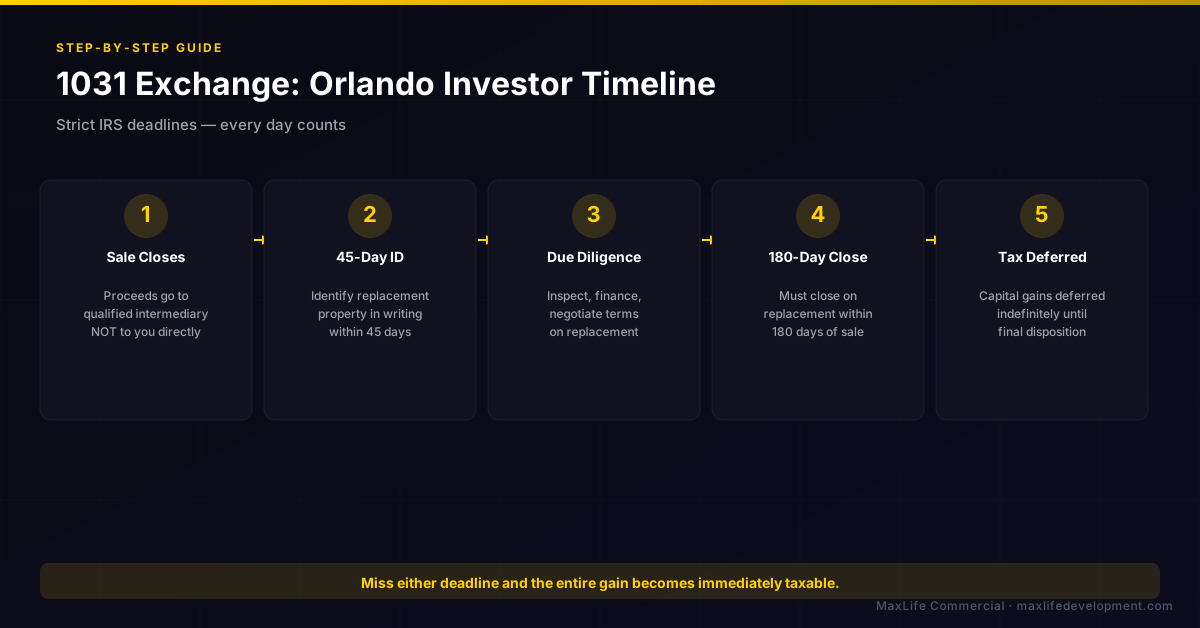
1031 Exchange Timeline at a Glance
Day 0
Property Sold
Close on relinquished property. Clock starts.
Day 45
ID Deadline
Identify up to 3 replacement properties in writing.
Day 180
Close Deadline
Complete purchase of replacement property.
1031 Exchange Rules and Timelines
The IRS imposes strict deadlines on 1031 exchanges that cannot be extended for any reason. From the date you close on the sale of your relinquished property, you have 45 calendar days to identify up to three potential replacement properties in writing to your qualified intermediary. This is known as the identification period, and it is the most stressful phase of the exchange for most investors.
You then have a total of 180 calendar days from the sale closing to complete the purchase of your replacement property. Both deadlines are absolute -- if you miss either one, the exchange fails and you owe capital gains taxes on the original sale. There are no extensions for weekends, holidays, or market conditions.
A qualified intermediary must facilitate the exchange. You cannot touch the sale proceeds at any point during the process. The intermediary holds the funds in escrow and directs them to the closing of your replacement property. If you receive the funds directly, even briefly, the exchange is disqualified.
To fully defer all capital gains, you must reinvest the entire net sale proceeds into the replacement property and acquire a property of equal or greater value. Any cash you pull out -- known as "boot" -- is taxable. Similarly, if you reduce your mortgage debt without replacing it with equivalent or greater debt on the new property, the debt reduction may also be treated as boot.
How Much Can a 1031 Exchange Save You?
The tax savings from a properly executed 1031 exchange can be substantial. When you sell commercial real estate at a profit, you face multiple layers of taxation: federal capital gains tax (typically 15-20%), depreciation recapture tax (25% on previously claimed depreciation), state income tax (0% in Florida, but potentially 10%+ if selling property in high-tax states), and the 3.8% Net Investment Income Tax for high earners. Combined, these taxes can consume 25-35% of your profit on a sale.
Example: $1M Gain on Orlando Commercial Property
| Tax Component | Without 1031 | With 1031 |
|---|---|---|
| Federal Capital Gains (20%) | $200,000 | $0 (deferred) |
| Depreciation Recapture (25%) | $62,500 | $0 (deferred) |
| NIIT (3.8%) | $38,000 | $0 (deferred) |
| State Tax (FL = 0%) | $0 | $0 |
| Total Tax | $300,500 | $0 |
| Equity Available to Reinvest | $699,500 | $1,000,000 |
Illustrative example. Assumes $250K depreciation taken, 20% CG rate, 3.8% NIIT. Consult your CPA for your specific situation.
In this example, the investor preserves an additional $300,500 in equity by executing a 1031 exchange instead of a taxable sale. That extra capital compounds over the life of the replacement property, generating additional cash flow, appreciation, and future equity. Over a 10-year hold, the compounding effect of keeping that $300K invested can add hundreds of thousands of dollars to the investor's total return.
Use our Deal Analyzer to model the before-tax and after-tax returns on any replacement property you are considering. The calculator shows IRR, equity multiple, cash-on-cash return, and total profit for any commercial NNN, multifamily, or SFR deal.
Why Orlando Is Ideal for Replacement Properties
Orlando has become one of the most popular 1031 exchange destination markets in the Southeast, and for good reason. The metro's combination of population growth, economic diversification, and favorable state tax policy creates an attractive environment for exchange buyers looking to park capital in stable, income-producing assets.
Florida has no state income tax, which means the income from your replacement property is not diminished by state-level taxation. For investors exchanging out of high-tax states like California, New York, or New Jersey, this alone can represent a meaningful increase in after-tax cash flow. Combined with Orlando's competitive cap rates, the net return advantage over coastal markets is substantial.
The depth and breadth of Orlando's commercial market also makes it easier to find suitable replacement properties within the 45-day identification window. From NNN retail pads and industrial distribution facilities to multifamily communities and medical office buildings, the Orlando commercial real estate market offers enough inventory and diversity to match virtually any exchange requirement.
Popular Replacement Property Types in Orlando
Orlando's commercial market is deep enough to accommodate virtually any 1031 exchange strategy. Here are the most popular replacement property types for exchange buyers in the Central Florida market.
NNN Retail Properties
The most popular choice for 1031 buyers seeking passive income. National tenants like Dollar General, Walgreens, and Starbucks provide 10-20 year leases with built-in rent bumps.
Cap rates: 5.5% - 7.0%
Multifamily
Apartment buildings in growing submarkets like Lake Nona, Downtown Orlando, and Kissimmee. Strong rent growth and value-add upside for active investors.
Cap rates: 5.0% - 6.5%
Industrial / Logistics
Warehouse and distribution properties along the I-4 corridor and near Orlando International Airport. E-commerce growth drives demand.
Cap rates: 5.5% - 7.0%
Medical Office
Growing demand near Lake Nona Medical City, AdventHealth campuses, and the Orlando Health network. Long lease terms with creditworthy tenants.
Cap rates: 6.0% - 7.5%
Browse our current opportunities to see available properties that may qualify as replacement assets for your 1031 exchange. For a deeper look at specific property types, read our guides on Orlando NNN properties, multifamily investing, and industrial real estate.
1031 Exchange Strategies for Orlando Investors
The most common exchange strategy in Orlando is the direct swap -- selling one property and acquiring another of equal or greater value. This works well when you have a clear target in mind, such as trading a management-intensive multifamily property for a passive NNN investment. Many investors approaching retirement use this strategy to simplify their portfolio without triggering a taxable event. MaxLife's NNN investment services help exchange buyers identify and close on suitable replacement properties.
Consolidation exchanges allow you to sell multiple smaller properties and combine the proceeds into a single larger asset. This is particularly effective for investors who own several residential rentals and want to scale into commercial real estate. Selling four single-family rentals and exchanging into a 24-unit apartment building or a NNN-leased retail property consolidates management, improves cash flow efficiency, and positions you for institutional-quality appreciation.
Reverse exchanges are another option when you find the perfect replacement property before your current property sells. In a reverse exchange, an exchange accommodation titleholder acquires the replacement property on your behalf while you work to sell the relinquished property within the 180-day window. Reverse exchanges are more complex and expensive, but they eliminate the risk of losing a prime acquisition to the identification deadline. Learn more about buying commercial property in Orlando to understand the full acquisition process.
Florida Tax Advantages for 1031 Exchange Buyers
One of the most compelling reasons to exchange into Orlando commercial real estate is Florida's tax environment. Florida has no state income tax, no estate tax, and offers homestead protections that are among the strongest in the nation. For investors exchanging out of high-tax states, moving their real estate portfolio to Florida can produce significant after-tax savings that compound over the life of the investment.
Consider an investor selling a commercial property in California, where the combined state and federal capital gains rate can exceed 33%. By executing a 1031 exchange into a Florida property, they defer the entire federal tax liability and permanently escape the California state tax on future income from the replacement property. The ongoing income from a Florida property is also free from state income tax, increasing annual cash flow by 10-13% compared to an identical investment in California, New York, or other high-tax states.
Florida's business-friendly regulatory environment also extends to property taxes, which tend to be lower than comparable markets in the Northeast or West Coast. Orange County's effective property tax rate is competitive, and Florida's Save Our Homes cap limits annual assessment increases for homestead properties — though commercial properties are assessed at market value, the overall property tax burden remains manageable relative to the income these properties generate.
These state-level advantages, combined with Orlando's strong population growth and economic fundamentals, explain why the Orlando market consistently attracts 1031 exchange capital from across the country. Investors are not just deferring taxes — they are repositioning into a growth market with a permanently lower tax burden on operating income.
The Role of a Qualified Intermediary
A qualified intermediary is the cornerstone of any successful 1031 exchange. This third-party entity holds your sale proceeds, prepares the exchange documentation, and ensures that the transaction complies with IRS requirements. You cannot act as your own intermediary, and certain related parties — including your attorney, CPA, real estate agent, or anyone who has acted as your agent within the past two years — are disqualified from serving in this role.
When selecting a qualified intermediary, prioritize financial stability and operational security. Your exchange funds should be held in segregated, FDIC-insured accounts — never commingled with the intermediary's operating funds or other clients' proceeds. Ask about fidelity bond coverage, errors and omissions insurance, and whether the intermediary has experienced any fund losses. The intermediary industry is largely unregulated at the federal level, so due diligence on your part is essential.
Establish your intermediary relationship before listing your relinquished property for sale. The exchange agreement must be in place before closing, and the intermediary needs time to review the purchase agreement and coordinate with the title company. Last-minute intermediary arrangements create unnecessary risk and can delay closing. Most experienced Orlando commercial real estate brokers can recommend reputable qualified intermediaries who regularly handle Central Florida exchanges.
Common 1031 Mistakes to Avoid
The most frequent mistake is poor timing. Investors often list their property for sale without lining up potential replacement properties, then scramble during the 45-day identification period. Start evaluating replacement options well before your relinquished property closes. Work with a commercial real estate advisor who can source off-market deals and have a pipeline of candidates ready when the clock starts.
Failing to account for boot is another common error. If your replacement property costs less than the net sale proceeds from your relinquished property, the difference is taxable. The same applies if you reduce your mortgage balance without offsetting it with additional cash equity. Run the exchange math carefully with your CPA and qualified intermediary before closing on either side of the transaction.
Choosing the wrong qualified intermediary can also derail an exchange. Your intermediary holds your sale proceeds in trust -- if they mismanage or commingle those funds, your exchange is at risk. Use an established, well-capitalized intermediary with segregated accounts and appropriate insurance coverage. Ask for references and verify their track record before signing the exchange agreement.
Finally, do not let the exchange deadline force you into a bad deal. It is better to pay capital gains taxes on a profitable sale than to acquire an overpriced or poorly located replacement property simply to meet the 180-day deadline. Use our Deal Analyzer to stress-test any replacement property before committing your exchange capital.
Related Reading
1031 Exchange Replacement Properties
Qualified 1031 exchange replacement properties across Orlando and Central Florida.
NNN Properties in Florida
Single-tenant triple-net leases — the most common 1031 replacement asset class.
Investment Property & NNN Services
Sourcing and underwriting investment property and 1031 replacement opportunities in Orlando.
Off-Market Commercial Deals in Orlando
Early access to income-producing commercial properties for 1031 identification.
Planning a 1031 Exchange in Orlando?
MaxLife Commercial helps investors identify replacement properties, coordinate exchange timelines, and close with confidence across Central Florida.
Contact UsGet Off-Market CRE Deals in Your Inbox
Join our investor list for exclusive Central Florida opportunities, market reports, and deal analysis — delivered weekly. No spam, unsubscribe anytime.