The Short Answer
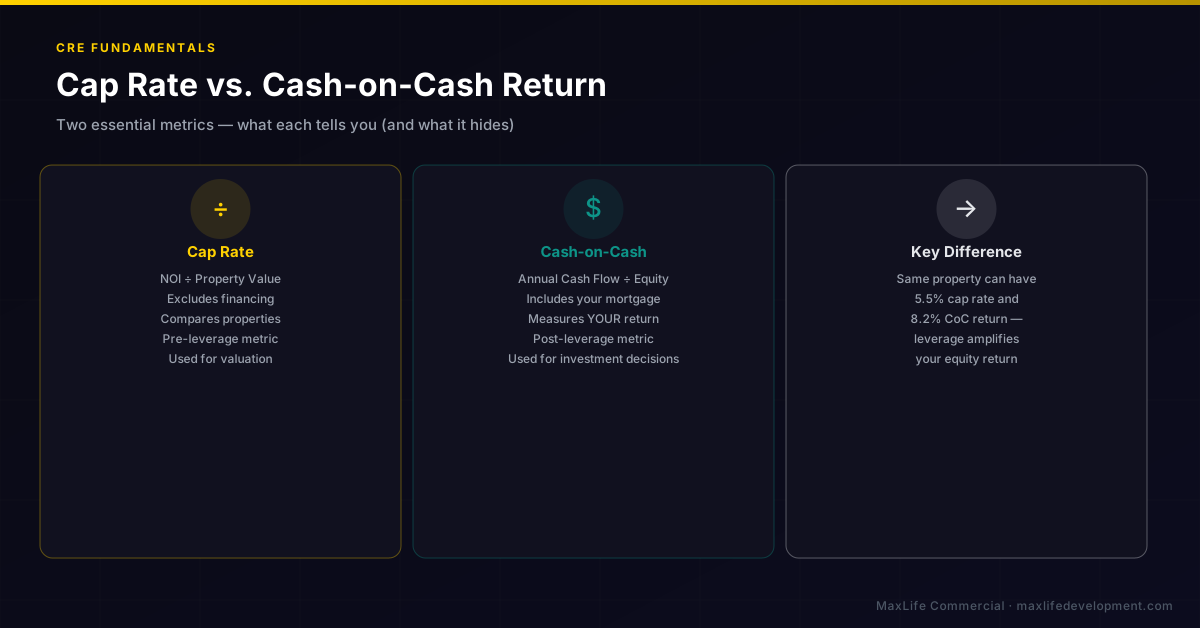
Cap rate measures the unlevered return of the property — what it would yield in cash if you paid 100% cash.
Cash-on-cash return measures the levered return on your cash — what you're actually earning on the equity you invested.
The Formulas
Cap Rate
Cap Rate = Net Operating Income (NOI) / Purchase PriceCash-on-Cash Return
CoC = Annual Pre-Tax Cash Flow / Total Cash InvestedWorked Example
You buy a Dollar General NNN property:
- Purchase price: $1,800,000
- Annual NOI: $108,000
- Down payment (35%): $630,000
- Loan ($1.17M at 6.5%, 25yr amort): $94,620/yr debt service
Cap Rate
$108,000 / $1,800,000 = 6.0%
Cash-on-Cash
Cash flow = NOI – Debt Service = $108,000 – $94,620 = $13,380
Cash invested = Down payment + closing costs = $630,000 + $50,000 = $680,000
$13,380 / $680,000 = 1.97%
Same property, two radically different numbers. The cap rate (6%) tells you the unlevered yield. The cash-on-cash (2%) tells you what you're actually getting on your $680K after debt service.
When Does Leverage Help?
Leverage increases cash-on-cash return when the cap rate exceeds the borrowing cost — a concept called positive leverage. In our example, the 6% cap rate vs. 6.5% borrowing cost creates negative leverage — debt is hurting, not helping.
At current interest rates (early 2026), most NNN deals have minimal or negative leverage from traditional bank financing. That's why many NNN investors are now buying all-cash or with minimal leverage — the economics only work when cap rates compress (likely as rates decline) or you accept lower current yield in exchange for long-term appreciation.
Which Metric to Use When
| Situation | Use |
|---|---|
| Comparing properties at purchase | Cap Rate (levels playing field) |
| Evaluating your actual ROI | Cash-on-Cash |
| Deciding how much to offer | Cap Rate (based on market) |
| Deciding whether to use debt | Both (compare) |
| Comparing to other asset classes (stocks, bonds) | Cash-on-Cash |
| Underwriting new BTS development | Cap Rate (exit valuation) |
| Tax returns and depreciation | Neither — use after-tax cash flow |
Other Metrics Worth Knowing
Internal Rate of Return (IRR)
Measures total return (cash flow + sale proceeds) over the full hold period, time-weighted.
Debt Service Coverage Ratio (DSCR)
NOI / Debt Service. Lenders require 1.20–1.30+ typically. Key to loan approval.
Equity Multiple
Total cash distributions / cash invested. Simple multiplier — 2x means you doubled your money over the hold.
Yield on Cost
For development: Stabilized NOI / Total Development Cost. Used to measure the development spread vs. market cap rate.
The Bottom Line
Cap rate is about the property. Cash-on-cash is about your money. Both matter. When someone tells you a deal is a "7 cap," that's an unlevered number. Ask for the cash-on-cash after debt service — that's what actually hits your pocket each month.
Related Articles
Orlando Cap Rates Investor Guide
Current cap rate benchmarks by asset class across the Orlando metro.
How to Evaluate a CRE Deal
Beyond cap rate — IRR, DSCR, and equity multiple in a complete underwriting.
AI Deal Analyzer: AutoZone Case Study
A real OM run through the AI deal analyzer — the negative leverage problem it caught in seconds.
What Is a Triple Net (NNN) Lease?
NNN lease structure, tenant obligations, and why cap rates alone mislead NNN buyers.
NNN vs Multifamily Investing
Cap rate vs cash-on-cash in practice — how each asset class performs differently under leverage.
The Ultimate Guide to NNN Investing
Complete NNN underwriting framework from sourcing through closing.