Car Washes: The Hottest Alternative NNN Sector
Express tunnel car washes have dominated the alternative NNN investment conversation for three consecutive years — and for good reason. The subscription-based membership model (unlimited wash plans) converts one-time customers into monthly recurring revenue, which is the kind of income profile institutional investors pay premium multiples for. Cars get dirty regardless of economic conditions, making car wash revenue meaningfully recession-resistant. And the format is highly automated, with low labor requirements compared to almost any other retail or service business of comparable size.
The investment thesis has been supercharged by PE-backed consolidation. Operators like Mister Car Wash, Zips Car Wash, and Take 5 Oil Change have raised billions in institutional capital and are actively expanding across the Southeast — including aggressively in Florida. Their expansion is largely funded through sale-leaseback transactions, where they sell new or recently built sites to individual and institutional investors and lease them back under long-term absolute NNN leases.
For passive income investors — particularly those deploying 1031 exchange capital — car wash sale-leasebacks offer a compelling combination of yield, lease length, and operator scale that is hard to replicate in traditional single-tenant NNN categories.
Three Car Wash Types and Their Investment Profiles
Not all car wash investments are equal. The format determines the business model, operator risk, and the cap rate you should expect.
Express Tunnel (IEQ)
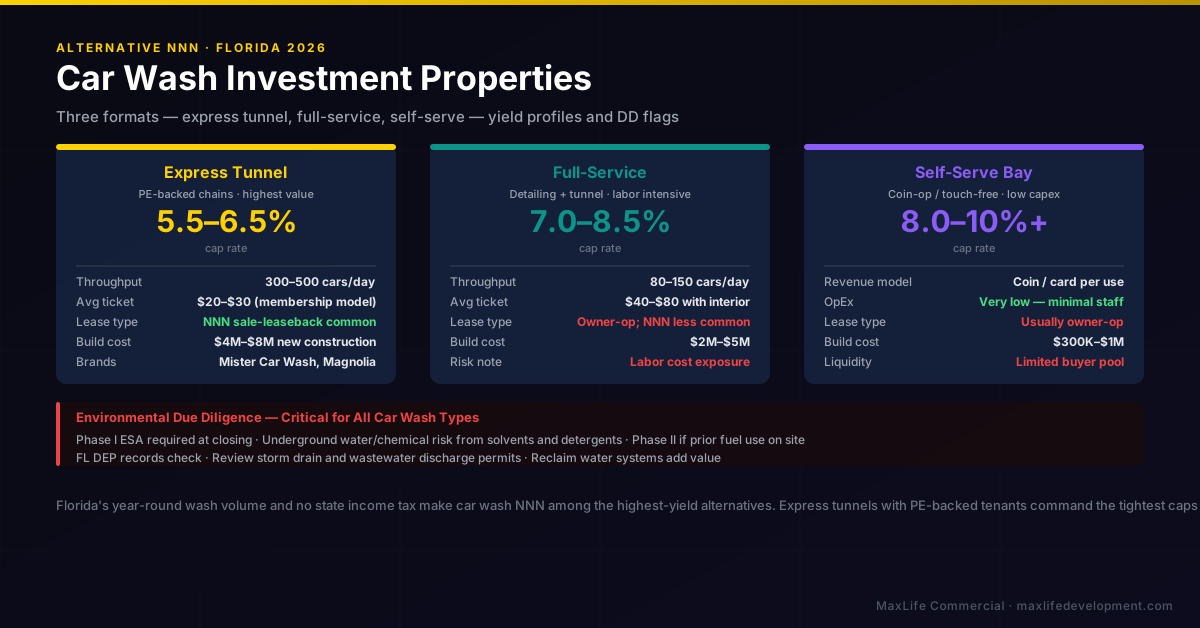
The dominant format. These are 8,000–10,000 SF buildings with a 120+ ft fully automated conveyor tunnel. Vehicles enter, are guided through, and exit in 3–5 minutes with no attendant labor on the wash itself. Membership subscription revenue (unlimited wash clubs) now accounts for 60–80% of revenue at mature express tunnel sites. Build costs run $2–5M depending on land and site complexity.
- →Typical site cost: $2–5M (land + build)
- →Cap rates on sale-leaseback: 5.5–6.5% (brand-name operator)
- →Established sites (3–5 yr membership ramp): 6.0–7.0%
- →Lease structure: 15–20 yr absolute NNN
- →Rent bumps: 1.5–2.5% annual or 10% every 5 yrs
Full-Service / Flex-Serve
Full-service car washes are the older model: tunnel washes with attendants who vacuum interiors, towel dry, and upsell add-on services. Labor intensity is 3–5x higher than express tunnel, margins are lower, and the format is actively being phased out by operators pivoting to express. These assets are declining in value and trade at wider cap rates reflecting the operational obsolescence risk.
- →Higher labor costs — significant management intensity
- →Cap rates: 6.5–8.5%
- →Re-tenanting risk if operator converts or closes
- →Older vintage buildings may carry deferred maintenance
Self-Serve Wand Bays
Coin- or card-operated wand bays where customers wash their own vehicles. Entry-level investment at $200–600K for a small multi-bay facility. These are highly location-dependent and a declining market segment as express tunnel has taken over convenience car washing. Revenue is weather-sensitive and highly variable. Best suited for investors who understand the local market intimately.
- →Lowest cost entry: $200–600K
- →Cap rates: 8.0–10.0%+ (reflects risk and market decline)
- →Income highly dependent on local competition and visibility
- →Minimal institutional buyer pool — less liquid exit
Cap Rates by Format (Florida 2026)
Car wash cap rates in Florida are compressed by institutional demand, particularly for brand-name express tunnel operators. Here is where the market is pricing in 2026:
Spread between formats reflects operator creditworthiness, lease structure, and re-tenanting risk. For cap rate context across all NNN product types, see our Orlando cap rates investor guide.
Sale-Leaseback Structure
The vast majority of car wash CRE transacts as a sale-leaseback. Understanding the structure is critical before you underwrite any deal.
In a typical transaction, the car wash operator sells a newly built or recently stabilized site to a passive investor for $2–4M. Simultaneously, the operator signs a 15–20 year absolute NNN lease as the tenant — meaning they are responsible for all property taxes, insurance, and maintenance. The investor collects rent with zero landlord management responsibility. The operator uses the sale proceeds to fund further expansion.
Typical Sale-Leaseback Terms
- →Sale price: $2–4M (new construction express tunnel)
- →Initial lease term: 15–20 years, absolute NNN
- →Rent bumps: 1.5–2.5% annually, or 10% every 5 years
- →Renewal options: typically 3–5 options at 5 years each
- →Landlord obligations: none (roof, structure, parking = tenant)
- →Guarantee: corporate guarantee from operating entity
One nuance: PE-backed operators often guarantee leases through an operating entity, not the parent PE fund. Always confirm the credit of the actual lease guarantor. A corporate guarantee from Mister Car Wash, Inc. (NYSE: MCW) is materially different from a guarantee by a special purpose LLC.
Get Off-Market CRE Deals in Your Inbox
Join our investor list for exclusive Central Florida opportunities, market reports, and deal analysis — delivered weekly. No spam, unsubscribe anytime.
What Makes a Great Car Wash Site
Car wash operators use sophisticated site selection models. When you're evaluating a car wash investment, you should apply the same lens — because the real estate value is only as durable as the tenant's ability to operate profitably at that location.
- →Traffic Volume: 30,000+ vehicles per day on the primary road. Corner locations at signalized intersections outperform mid-block. The operator needs visibility and drive-by impulse.
- →Pad Configuration: Corner or standalone pad site, not inline strip center. Easy ingress and egress. Stacking room for 15–20+ vehicles in queue before the tunnel entrance — critical for throughput at peak hours.
- →Site Size: Minimum 1 acre, ideally 1.25–1.75 acres for a full express tunnel with adequate stacking and vacuum stations.
- →Residential Density: Strong residential rooftops within a 3-mile trade area. Membership model depends on repeat local customers, not one-time passers-by.
- →Competitive Landscape: Avoid sites directly competing with Mister Car Wash or Zips on the same corner or adjacent parcel. Operator co-location risk can crater membership count and thus NOI.
Florida Car Wash Market
Florida is one of the strongest car wash markets in the country, and the structural reasons are durable. The warm climate means year-round usage — there is no seasonal winter slowdown that hammers markets in the Northeast and Midwest. A Florida express tunnel runs 365 days a year at near-full capacity, while a comparable site in Ohio loses 3–4 months of volume to ice, snow, and below-freezing temperatures.
Florida's population growth engine is also a direct demand driver. Growing suburban markets — Wesley Chapel, Clermont, St. Cloud, Apopka, Horizon West — are seeing aggressive new express tunnel openings as operators follow rooftops. The I-4 corridor from Daytona to Tampa remains the densest concentration of express car wash development in the state.
Central Florida submarkets like Osceola County, south Lake County, and eastern Orange County offer some of the best risk-adjusted entry points — strong traffic and demographic growth, but cap rates that have not yet fully compressed to core Orlando levels. For a full breakdown of growth submarkets, see our Central Florida submarket guide.
Due Diligence for Car Wash Investments
Car wash due diligence has several categories that differ from standard NNN retail. Do not skip them.
- →Verify Membership Count: Ask the operator for monthly wash count data and active membership numbers. A site with 1,500+ active subscriptions has fundamentally different lease risk than one ramping from 400.
- →Lease Structure Review: Confirm absolute NNN — no roof/structure carve-outs to landlord. Review rent escalation schedule, renewal option rent, and assignment/subletting rights.
- →Operator Track Record: How long has the operator been in business? How many locations? Unit-level AUVs (average unit volumes) are available for publicly traded operators and should be requested for private ones.
- →Environmental: Phase I/II: Car wash sites frequently have spill history — chemical detergents, petroleum from vehicles, and reclaim water systems. Phase I ESA is mandatory. Phase II if any recognized environmental conditions (RECs) are flagged.
- →Water Usage and Permits: Florida DEP water use permits and water reclaim/recycling systems. Express tunnels use 100–150 gallons per wash without reclaim; modern sites recycle 80%+. Verify municipal water approval and reclaim system compliance.
Car Wash vs Other Alternative NNN
How does a car wash investment stack up against other NNN categories you may be evaluating?
Dollar General has stronger investment-grade credit (S&P BBB) and more liquid resale market. Car wash offers 50–100 bps higher cap rate but carries more operator risk. DG wins on credit; car wash wins on yield.
QSR brands carry decades of consumer recognition and corporate covenant strength. Car wash operators have operational control over a single-use asset. QSR ground leases often trade 100–150 bps tighter than car wash NNN of comparable quality.
Self-storage NNN leases are rare — most storage is owner-operated. Car wash sale-leasebacks offer true passive income. Storage offers better diversification of tenant (many customers vs one operator) but requires more active asset management or a REIT structure.
Bottom line: Car wash investments generate higher cash-on-cash returns than most investment-grade single-tenant NNN, but carry more operator risk than a Dollar General or AutoZone. The right car wash investment — brand-name operator, strong site, mature membership base, absolute NNN lease — is a compelling passive income vehicle at current Florida cap rates. Use our Deal Analyzer to stress-test the numbers before you sign an LOI.
Car Wash Formats
Car Wash Types for NNN Investors
Looking for Car Wash Properties in Florida?
MaxLife Commercial tracks car wash sale-leaseback opportunities across Central Florida. Whether you're deploying 1031 exchange capital or building a passive income NNN portfolio, we can help you identify and evaluate the right deal.
Frequently Asked Questions
Are car washes good investments in Florida?
Yes — express tunnel car washes are among the strongest-performing alternative NNN investments in Florida. Florida's warm climate means year-round usage with no winter slowdown, and the subscription membership model creates predictable recurring revenue. Sale-leaseback transactions with PE-backed operators offer investors passive NNN income at 5.5–7.0% cap rates.
What cap rate should I expect on a Florida car wash investment?
New construction express tunnel NNN with a brand-name operator: 5.5–6.5%. Established express tunnel (3–5 yr, stable membership): 6.0–7.0%. Full-service older vintage: 7.0–8.5%. Self-serve wand bays: 8.0–10.0%+. Operator credit quality and lease structure drive the spread within each category.
What makes a good car wash location in Florida?
30,000+ VPD on the primary road, corner or standalone pad with easy ingress/egress and stacking room, 1–2 acres minimum, strong residential density in the trade area, and no direct head-to-head competition from Mister Car Wash or Zips on the same corner.
What is the difference between express tunnel and full-service car wash investments?
Express tunnel car washes are automated, subscription-based, low-labor, and high-margin — the dominant format with the strongest investor demand. Full-service car washes require significantly more labor, are being phased out by operators, and carry more operational risk at 7.0–8.5% cap rates.
How does a car wash sale-leaseback work?
The operator sells the real estate to an investor for $2–4M and signs a 15–20 year absolute NNN lease. The operator continues running the car wash; the investor receives passive rent with no management obligations. Rent bumps of 1.5–2.5% annually or 10% every 5 years are standard.
Related Articles
Orlando NNN Properties for Sale 2026
National credit tenants, cap rates, and acquisition strategy for NNN investors in Central Florida.
The Ultimate Guide to NNN Investing
How to source, underwrite, and close NNN properties across Florida.
Ground Lease vs. Fee Simple
When ground leases outperform fee simple ownership — and when they don't.
1031 Exchange Orlando Guide
NNN properties are the most popular 1031 replacement asset — here's how the process works.
Cap Rate vs. Cash-on-Cash Return
Two numbers every NNN investor quotes — and why leverage changes everything.
Florida CRE Investor Guide
The structural case for Florida commercial real estate — growth drivers, tax advantages, and strategy.