What's the Difference?
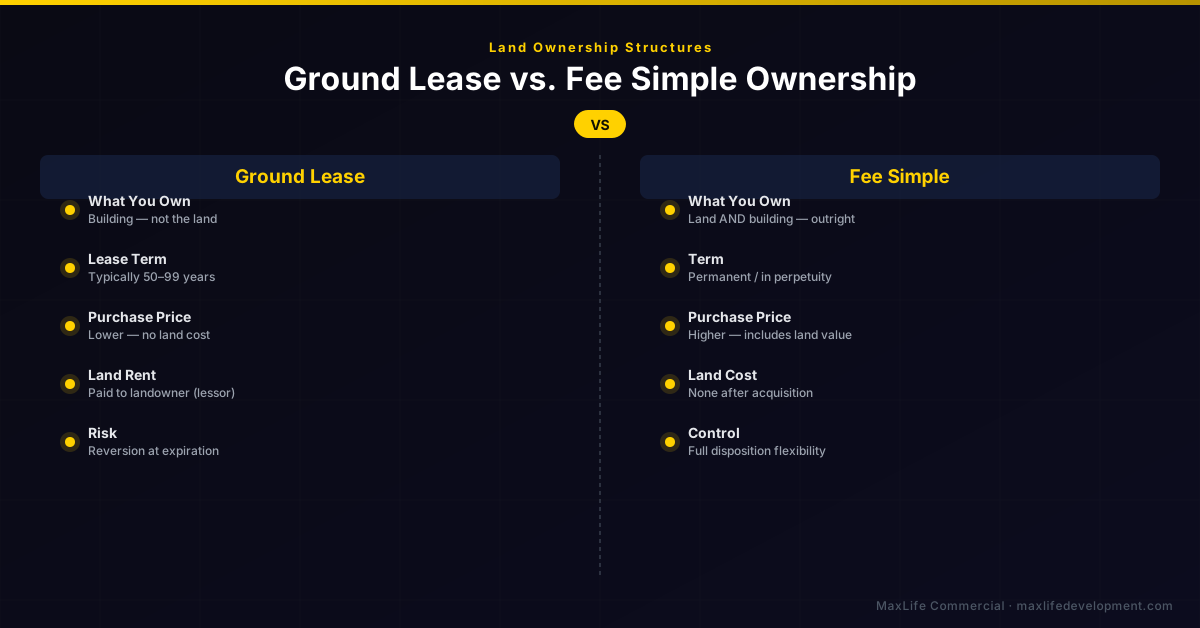
Fee simple ownership is what most people think of when they buy real estate: you own both the land and the building. If you sell, you sell everything. If the tenant leaves, you have an empty building on land you own.
Ground lease structure splits the ownership: one party owns the land (the lessor), a different party owns the building improvements (the lessee / tenant). The land owner leases the land to the tenant for a long term — typically 40-99 years — while the tenant builds, owns, and operates the building.
Why Tenants Choose Ground Leases
Major NNN tenants like McDonald's, Chase Bank, Chick-fil-A, and some pharmacy chains prefer ground leases for specific reasons:
- Control over the building: They can modify, expand, or rebuild without landlord approval.
- Tax benefits: Building depreciation belongs to the tenant (lessee).
- Capital efficiency: Land stays on the balance sheet of the investor, not the tenant.
- Easier lease restructuring: If the site needs redevelopment, tenant has more flexibility.
Head-to-Head Comparison
| Factor | Ground Lease | Fee Simple |
|---|---|---|
| Ownership | Land only | Land + building |
| Typical Cap Rate | 50–75 bps TIGHTER than fee simple | Market-rate |
| Tenant Risk | Lower (only leasing land) | Full building risk |
| Building Depreciation | Tenant claims | Owner claims (39-year) |
| Reversion Value | Land + improvements at lease end | N/A (you always own) |
| Typical Term | 40–99 years | Full ownership |
| Financing | Simpler for land | Standard CRE financing |
| Environmental Liability | Lower (tenant operates) | Full owner liability |
| Control | Limited during lease term | Full control |
| Best For | Passive income, long horizon | Value-add, development, full ownership |
Why Investors Love Ground Leases
From the landlord's perspective, ground leases are the safest structure in commercial real estate. You're renting land, not a building. Land doesn't depreciate, doesn't need maintenance, and doesn't become functionally obsolete. If the tenant defaults, you get the land back plus the building improvements at the end of the lease (called the reversion).
This is why ground leases — particularly for McDonald's, Chick-fil-A, Starbucks, and Chase Bank — trade at the tightest cap rates in commercial real estate (3.75-5%). Investors accept lower current yield in exchange for essentially risk-free land ownership with inflation-protected rent bumps.
The Reversion Value Upside
At the end of a ground lease (in 40-99 years), the building improvements typically revert to the land owner — free. This can be extraordinarily valuable if the building was well-constructed and the location has appreciated.
Example: A 50-year ground lease on a Chase Bank at a signalized corner in Orlando. In year 50, you get not only 50 years of rent payments (with bumps), but also a building that, even at end-of-life, may have redevelopment value of $1M+. The multi-generational wealth-building potential is significant.
When Fee Simple Wins
Ground lease isn't always better. Fee simple wins when:
- You want depreciation benefits for the building (39-year schedule)
- You want cash-on-cash yield (fee simple typically 50-100 bps higher)
- You want control to modify, redevelop, or reposition the asset
- You're doing a value-add play
- You want to 1031 exchange into something comparable (ground leases are specialized)
Which Structure Fits You?
If you want truly passive, minimal-risk commercial real estate and you're willing to accept tighter current yield, ground leases are the gold standard. If you want higher current yield, depreciation benefits, and control over the asset, fee simple is the better fit. Most diversified CRE portfolios include both — the stability of ground lease income balanced against the higher yield and control of fee simple assets.
Related Articles
What Is a Triple Net (NNN) Lease?
NNN lease structure, expense pass-throughs, and how ground leases compare to fee simple NNN.
Orlando Cap Rates Investor Guide
Cap rate benchmarks across asset classes — including where ground leases fit in the yield spectrum.
How to Buy Commercial Property in Orlando
Complete acquisition framework — sourcing, due diligence, financing, and closing.
Orlando NNN Properties for Sale
Active NNN inventory and market conditions across the Orlando metro.
1031 Exchange Orlando Guide
How to defer capital gains on commercial property sales through a like-kind exchange.
The Ultimate Guide to NNN Investing
Everything you need to know about investing in triple net lease properties in Florida.