Watch the Guide
Why NNN Analysis Is Different
Residential real estate is valued by comparable sales — what did the house next door sell for? Commercial real estate, and NNN in particular, is valued by income. The market does not care what a neighboring Dollar General sold for; it cares what this Dollar General earns, how long the lease runs, and whether the underlying real estate has standalone value when the tenant eventually leaves.
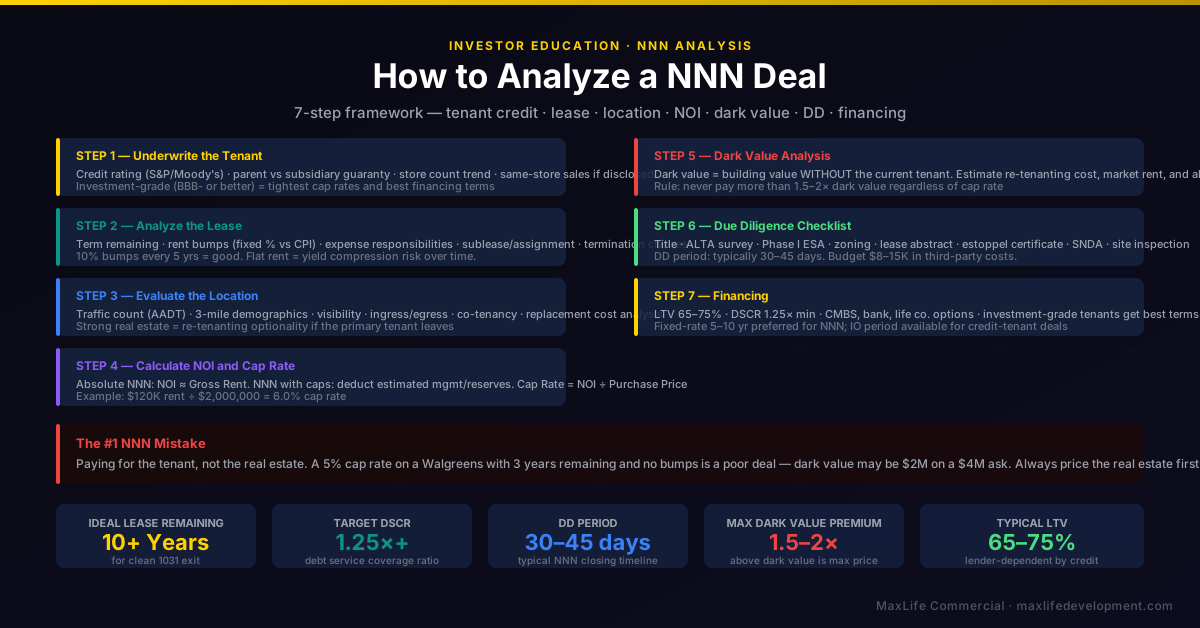
That means NNN underwriting requires a disciplined seven-step process: underwrite the tenant, analyze the lease, evaluate the location, calculate NOI and cap rate, stress-test the dark scenario, complete due diligence, and arrange financing. Skipping any step is how investors overpay for a credit rating and end up holding a vacant building in a secondary location with no re-tenanting prospects.
Step 1: Underwrite the Tenant
Your income depends entirely on one tenant. Start there. Key factors to evaluate:
- →Credit rating. Investment-grade (BBB- or better from S&P/Moody's) is the standard for institutional-quality NNN. A single notch below investment grade widens cap rates significantly and introduces real default risk.
- →Store count and system health. A 20,000-location chain closing 200 underperformers is different from a 400-location regional operator with deteriorating same-store sales. Check recent earnings reports and press releases.
- →Parent guaranty vs. subsidiary lease. Some large chains sign leases through operating subsidiaries rather than the parent entity. A Walgreens subsidiary guarantee is not the same as a Walgreens Boots Alliance corporate guarantee — confirm who is on the hook.
- →Same-store sales (if available). Fast-food franchise NNN deals sometimes include same-store sales data in the offering memorandum. Declining same-store sales in a profitable location suggest the tenant may choose not to renew at the end of the term.
Step 2: Analyze the Lease
The lease is the asset. A strong tenant on a weak lease is still a weak investment. Read every page — do not rely on the broker's lease abstract alone.
- →Term remaining. 10+ years is ideal for maximum marketability and financing. Under 7 years, you will face cap rate expansion at resale and lender scrutiny.
- →Renewal options.Most NNN leases include 4–6 five-year renewal options at the tenant's election. Options are not guaranteed — they are rights, not obligations. Never underwrite renewal options as committed term.
- →Rent bumps. Fixed percentage bumps (typically 5–10% every 5 years) are more predictable than CPI-indexed escalations. Annual 1.5–2% bumps are the gold standard for income growth.
- →Expense responsibilities.Confirm in writing who pays taxes, insurance, maintenance, roof, and structure. "NNN" in the listing title does not guarantee absolute net — some leases retain landlord roof/structure obligations.
- →Termination clauses and co-tenancy. Some leases allow early termination if a co-anchor vacates, if sales drop below a floor, or after a specific date. These clauses can dramatically shorten effective lease term.
Step 3: Evaluate the Location
Location determines dark value. A Dollar General on a hard corner with 40,000 vehicles per day in a growing suburb is worth significantly more than the same lease in a declining rural market. Evaluate:
- →Traffic count. 25,000+ VPD is the threshold for most national tenants. Higher traffic commands tighter cap rates and stronger re-tenanting prospects.
- →Demographics. Population within 1, 3, and 5-mile rings — density, household income, and 5-year growth projections. Growing trade areas attract tenants; shrinking ones accelerate departures.
- →Visibility and ingress/egress. A Chick-fil-A pad site with excellent street visibility and dedicated deceleration lanes is a different asset from one buried in a strip center with shared access.
- →Nearby anchors. Grocery-anchored, Walmart-anchored, and Costco-anchored locations create persistent traffic that benefits outparcel NNN tenants and supports re-tenanting if the current operator leaves.
- →Replacement cost analysis. What would it cost to build this building today on this land? If you can buy below replacement cost, the location math is in your favor.
Step 4: Calculate NOI and Cap Rate
For absolute NNN properties, NOI essentially equals in-place rent — the tenant covers all operating expenses. The formula:
Gross Annual Rent: $120,000
Less: Vacancy Allowance (1–2% even for NNN): − $1,500
Less: Management/Admin Reserve: − $1,200
NOI: $117,300
Purchase Price: $1,955,000
Cap Rate = NOI / Price = 6.0%
Always apply a small vacancy allowance even on NNN properties — it accounts for the period between lease expiration and re-tenanting, and it keeps your underwriting honest. Never underwrite at 100% economic occupancy unless the lease is absolute NNN with substantial term remaining.
For market cap rate context by property type and submarket, see our Orlando cap rates investor guide and the cap rates data hub.
Get Off-Market CRE Deals in Your Inbox
Join our investor list for exclusive Central Florida opportunities, market reports, and deal analysis — delivered weekly. No spam, unsubscribe anytime.
Step 5: Stress-Test the Deal — Dark Value
The #1 mistake NNN buyers make: paying for the tenant, not the real estate. Always underwrite the dark value before closing. If the tenant leaves tomorrow, what is this building worth — and can you cover the debt service while you re-tenant it?
Dark value is the property's worth assuming the tenant vacates. It has two components:
- →Land value. What would this parcel sell for as vacant land in the current market? High-traffic corners in growing markets retain strong land values even without a building.
- →Building value (re-tenanted). What NOI could a replacement tenant generate, and at what cap rate does that trade? A 10,000 SF AutoZone building in a prime location could attract a medical tenant, urgent care, or a competing auto parts retailer at comparable rent.
- →Re-tenanting costs. Budget for 6–18 months of vacancy, tenant improvement allowance ($20–50/SF for conversion), and leasing commissions (4–6% of new lease value). These costs reduce your effective dark value.
If the purchase price significantly exceeds dark value, you are paying a premium for the lease — not the real estate. That is acceptable if the tenant is pristine and the term is long, but it creates real risk as the lease shortens. Never close on a NNN deal without completing this analysis. Learn more about cap rate vs cash-on-cash return to build a complete picture of returns.
Step 6: Due Diligence Checklist
Even on "passive" NNN properties, thorough due diligence is non-negotiable. A typical 30–45 day due diligence period should cover:
The estoppel certificate is critical — it is a signed statement from the tenant confirming lease terms, rent in effect, and that no defaults exist. Lenders require it, and it protects you if the seller misrepresented lease terms in the offering memorandum.
Step 7: Financing
NNN is among the easiest commercial property types to finance. Lenders understand the income stream and love investment-grade tenants. Typical 2026 parameters:
- →LTV: 65–75% for investment-grade tenants; 60–65% for sub-IG or shorter term
- →DSCR: 1.25x minimum; most lenders target 1.30x+ on stabilized NNN
- →Term / amortization: 5–10 year fixed rate, 25-year amortization is standard
- →Loan sources: Community banks and credit unions for deals under $3M; life insurance companies and CMBS for larger, long-term, investment-grade deals
- →Recourse: Personal guarantee typical under $3M; non-recourse available on institutional-quality assets with strong tenants and lease term
Loan term should align with lease term. If you are buying a property with 12 years remaining, a 10-year fixed loan makes sense. If the lease has only 7 years left, lenders will shorten the loan term — or require a larger down payment to compensate for lease rollover risk.
Ready to Underwrite Your Next NNN Deal?
Ryan Solberg at MaxLife Commercial sources NNN investment properties across Central Florida — on-market and off-market. Whether you're a first-time NNN buyer or a 1031 exchange investor on a timeline, we can walk you through the analysis on any specific deal.
Talk to Ryan SolbergFrequently Asked Questions
What makes a good NNN deal?
A strong NNN deal combines an investment-grade tenant (BBB- or better), a long remaining lease term (10+ years), rent bumps built into the lease, a high-traffic location with strong demographics, and a price that supports the dark value if the tenant ever vacates. The cap rate should reflect genuine real estate value — not just the creditworthiness of the tenant.
How do you read a NNN lease?
Start with the rent schedule and escalation clauses to understand income over the full term. Then confirm expense responsibilities — who pays taxes, insurance, maintenance, roof, and structure. Check for co-tenancy clauses, exclusivity provisions, renewal options, and termination rights. Obtain a lease abstract from your attorney summarizing every material clause before proceeding to closing.
What is dark value in NNN investing?
Dark value is the estimated market value of a property assuming the current tenant vacates — the building 'goes dark.' It includes the underlying land value plus the depreciated building value, or the value the property would command if re-leased to a new tenant. A well-located NNN property should have a dark value that supports the purchase price independently of the current tenant.
How long does NNN due diligence take?
A typical NNN due diligence period runs 30–45 days. This covers lease review, tenant estoppel, title commitment, Phase I environmental, ALTA survey, property condition assessment, zoning verification, and financing application. Well-organized sellers who provide a full due diligence package at the outset can compress this timeline to 21–30 days.
Related Articles
Ultimate Guide to NNN Investing
Everything about triple net lease investing — from lease basics to building a multi-property portfolio.
What Is a Triple Net (NNN) Lease?
The fundamentals — how NNN leases work and who pays what.
Cap Rate vs Cash-on-Cash Return
Two key metrics every NNN investor needs to understand before closing a deal.
Net Lease Investing in Florida
Why Florida is one of the strongest states for NNN acquisitions.
Orlando NNN Properties for Sale
Current NNN investment inventory across Central Florida's top submarkets.
1031 Exchange Orlando Guide
Use a 1031 exchange to roll capital gains into a passive NNN replacement property.