What Is Net Lease Investing?
Net lease investing involves purchasing commercial real estate where the tenant pays some or all of the operating expenses in addition to base rent — creating a more passive income stream for the landlord. The “net” refers to expenses that are netted out of the landlord's obligations.
In practice, most Florida net lease investors focus on single-tenant retail buildings leased to national credit tenants — Dollar General, AutoZone, Walgreens, Starbucks, Chick-fil-A, and fast-food franchises — on long-term absolute NNN leases of 10–20 years. These properties require zero landlord management and produce predictable monthly rent checks with built-in escalations.
NNN vs. Double Net vs. Absolute Net: Florida Distinctions
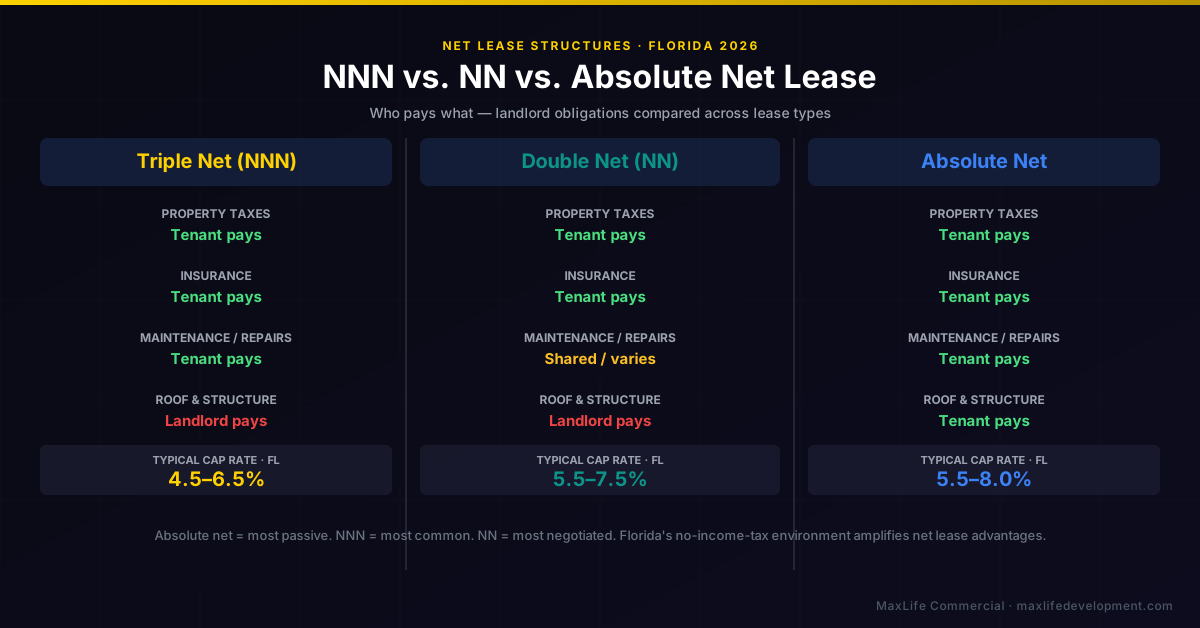
The term “net lease” covers several lease structures that differ in how much the tenant vs. landlord pays. Florida institutional buyers use precise language:
Absolute NNN (Absolute Triple Net)
The highest-passive structure available. The tenant pays all expenses without exception — including roof, structure, parking lot replacement, and taxes. The landlord receives a net check for the lease term with zero obligations. Most national fast-food QSR franchises (McDonald's, Burger King, Taco Bell, Chick-fil-A) and drug stores in Florida use absolute NNN leases.
NNN (Triple Net)
The most common Florida net lease structure. Tenant pays property taxes, insurance, and CAM (maintenance). The landlord retains responsibility for structural elements like roof and foundation. In practice, most 'NNN' listings in Florida are actually NN or modified NNN — always verify the lease language before signing.
NN (Double Net)
The tenant pays property taxes and insurance; the landlord pays maintenance. Less common in Florida's single-tenant retail market but prevalent in multi-tenant strip centers and some older flex industrial leases. Slightly higher landlord obligation vs. NNN.
Net (Single Net)
Tenant pays property taxes only. The landlord pays insurance and maintenance. Uncommon in Florida's investment-grade net lease market — more often seen in industrial and office leases with smaller tenants.
Florida Net Lease Cap Rates in 2026
Cap rates on Florida net lease properties in 2026 are primarily driven by tenant credit, remaining lease term, rent escalations, and location. Here are current market benchmarks:
| Tenant / Category | Cap Rate Range | Notes |
|---|---|---|
| Chick-fil-A / McDonald's (QSR Absolute NNN) | 4.5% – 5.25% | Strongest credit QSR; ground leases often below 5.0% |
| Walgreens / CVS (Pharmacy NNN) | 5.5% – 6.75% | Lease term remaining is the biggest driver; short-term trades wide |
| Dollar General / Dollar Tree | 5.5% – 6.5% | New construction with 15-year leases at the tight end; re-leased assets wider |
| AutoZone / O'Reilly / Advance Auto | 5.75% – 6.5% | Consistent Florida performer; high remaining lease term preferred |
| Starbucks / Panera (Coffee / Bakery) | 5.0% – 6.0% | Drive-through Starbucks in Florida are premium NNN assets |
| Wawa / 7-Eleven (C-Store NNN) | 4.75% – 5.75% | Wawa is dominant in Central FL; corporate ground leases at the tight end |
| Bank (Chase, Wells Fargo, BofA) | 5.0% – 6.0% | Limited new supply; strong credit; bank closures risk considered |
| Urgent Care / Medical (NN/NNN) | 5.75% – 7.0% | Health system backed vs. franchise operated; credit varies significantly |
May 2026. Ranges reflect 10+ year remaining lease terms in Florida primary and secondary markets. Short remaining term, below-market rent, or secondary locations trade outside these ranges.
Why Florida Is the #1 Net Lease Market
- No state income tax: Florida has no state income tax on rental income. A California investor paying 13.3% state income tax on rental income in CA — and 0% in Florida — effectively gains 13.3% more after-tax cash flow on the same net lease investment. This structural advantage makes Florida net lease the preferred out-of-state CRE investment for CA, NY, and NJ investors.
- Deep credit tenant inventory: Florida's 22 million residents and tourism economy support a higher concentration of national credit tenants than most states — Wawa is exclusively Florida-dominant in the Southeast, McDonald's operates 700+ Florida locations, and Dollar General has built hundreds of Florida stores since 2018.
- Population-driven occupancy: Florida's net migration of 365,000+ per year creates organic demand for neighborhood retail — dollar stores, quick-service restaurants, convenience, and service retail. This structural demand reduces vacancy risk vs. static or shrinking markets.
- 1031 exchange destination: Florida net lease is the most common replacement property for 1031 exchangors exiting multifamily or commercial property in high-tax states. The combination of credit tenant security, passive income, and no state tax is uniquely compelling for exchange buyers.
- Liquid exit market: Florida net lease trades constantly. National buyers, 1031 exchangors, and regional investors create a deep bid pool that keeps cap rate spreads narrow and exit timelines short vs. net lease markets in secondary states.
How to Evaluate a Florida Net Lease Investment
Net lease investing looks simple on the surface — monthly rent from a recognizable brand — but the risk-return profile varies significantly based on these five factors:
- 1Tenant Credit Quality: Corporate-guaranteed leases (company-operated locations) are stronger than franchisee-guaranteed leases. A McDonald's corporate NNN is different from a McDonald's franchisee NNN — the former is backed by one of the strongest balance sheets in the world; the latter is backed by the franchisee's personal and business assets. Verify who guarantees the lease, not just the brand name.
- 2Remaining Lease Term: Net lease value is primarily a function of remaining lease term. A Dollar General with 15 years remaining on a 15-year lease at market rent trades at 5.5%–6.0%. The same building with 3 years remaining and no renewal commitment trades at 7.5%+. Understand the rent commencement date, option periods, and renewal rent structure before underwriting.
- 3Rent Escalations: Fixed rent bumps of 10% every 5 years or 1.5%–2% annually are standard in Florida NNN leases. Flat rent for 20 years erodes your real purchasing power significantly — always model inflation-adjusted yield. Florida NNN deals with 10% bumps every 5 years are meaningfully more valuable than flat rents at the same going-in cap.
- 4Location Quality: Not all McDonald's are equal. A free-standing McDonald's on a major Florida intersection (US-192, US-27, I-4 interchange) has stronger credit than an end-cap in a struggling shopping center. Location quality matters for re-leasing optionality if the tenant vacates — a well-located building can be re-tenanted; a stranded location cannot.
- 5Rent-to-Sales Ratio: Healthy tenants typically pay rent equal to 5–12% of their store sales. Dollar stores run thin margins — operators typically underwrite to 8–12% occupancy cost. If you can obtain sales data, or comparable store performance, compare rent to estimated store volume. Tenants paying 15%+ of sales in rent are at elevated non-renewal risk.
Best Florida Markets for Net Lease
Net lease properties trade across all Florida markets, but these submarkets consistently produce the best combination of cap rates, tenant quality, and exit liquidity:
I-4 Corridor (Lakeland–Orlando–Tampa)
The highest concentration of NNN retail activity in Florida. Dollar General, AutoZone, and QSR inventory is especially deep on the US-27 and US-92 corridors through Polk County.
Space Coast (Brevard County)
Emerging net lease value market with high household income. NASA and defense employment drives demand for credit tenant retail. Cap rates 25–50 bps wider than primary Orlando on comparable assets.
SR-436 / SR-434 East Orlando
Dense suburban corridors with high daily traffic counts — critical for QSR and C-store NNN underwriting. Strong cap rates for mid-term lease assets.
US-192 / Kissimmee-St. Cloud
Tourism-adjacent and workforce-serving corridor. Dollar General and C-store NNN at slightly wider cap rates than primary Orlando. Tenant quality is consistent; location is more secondary.
US-27 / Haines City–Davenport
High-growth residential-led market with strong QSR and dollar store demand. Some of the widest NNN cap rates in Metro Orlando due to secondary location perception.
Jacksonville
Widest NNN cap rates in Florida for comparable credit — 50–100 bps wider than Orlando. Excellent for yield-focused buyers less focused on maximum appreciation.
Ready to Buy Florida Net Lease?
MaxLife Commercial sources NNN retail, absolute net lease, and multi-tenant strip center investment properties across Florida. We work with passive investors, 1031 exchangors, and first-time net lease buyers — and our buyer representation is free.
Related Articles
Ultimate Guide to NNN Investing
Deep dive into NNN investing strategy, underwriting, and portfolio construction.
What Is a Triple Net (NNN) Lease?
Definitions, structures, and landlord vs. tenant obligations explained.
Orlando NNN Properties for Sale 2026
Market conditions and deal sourcing guide for Orlando NNN investors.
NNN vs Multifamily Investing
Two passive income strategies — compare risk, return, and management intensity.
1031 Exchange Orlando Guide
Net lease is the #1 1031 replacement property. Here's how the exchange works.
Florida CRE Investor Guide 2026
Complete overview of Florida commercial real estate investing.