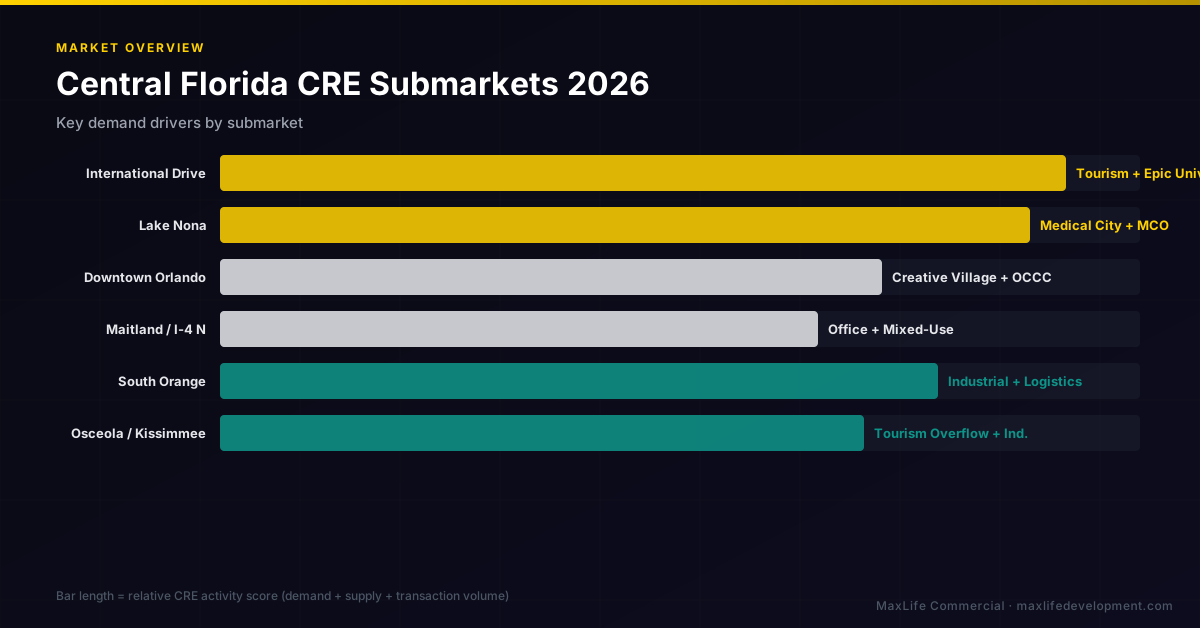
Why Central Florida Is a Submarket Story
Central Florida commercial real estate isn't a single market — it's a dozen distinct submarkets with different tenants, different rent dynamics, different growth drivers, and different risk profiles. An investor looking at an average cap rate for "Orlando" is missing the real story: the spread between a Lake Nona medical office and a secondary suburban retail center can be hundreds of basis points, and the right investment thesis for one is the wrong thesis for the other.
The same goes for tenants. A retail concept that thrives on I-Drive may fail in Winter Park. An office user that needs Class A and amenities will be miserable in a Polk County flex building. Getting the submarket right is often more important than getting the building right. This article walks through the Central Florida submarkets we work in most often and what makes each one distinct.
Downtown Orlando & the CBD
The Orlando Central Business District is the financial and legal core of the metro, anchored by Orange County government, federal courts, and the region's largest concentration of Class A office product. Downtown is the natural home for law firms, financial services, and professional services tenants that need to be near the courts and municipal offices. It also has a growing residential and entertainment base that is slowly transforming the after-hours economy.
For investors, Downtown is a tale of two markets: newer Class A product is performing well, while older Class B office continues to work through a structural repricing that started in 2020. Multifamily infill and adaptive reuse projects are some of the most compelling Downtown opportunities for forward-looking investors.
Lake Nona & Medical City
Lake Nona is arguably Central Florida's most important commercial real estate story of the last 15 years. Anchored by Medical City — a 650-acre medical and life-sciences campus that includes UCF College of Medicine, Nemours Children's Hospital, the VA Medical Center, and Sanford Burnham Prebys Medical Discovery Institute — Lake Nona has transformed from greenfield land to one of the most valuable submarkets in the region.
Demand is strongest for medical office, life-science research space, Class A multifamily, and the retail and hospitality that supports the workforce. Lake Nona land values have appreciated dramatically, and cap rates for Class A product here trade at a premium to the broader Orlando market. For investors who can still find entry points, Lake Nona remains a high-conviction submarket.
International Drive & the Tourism Corridor
International Drive (I-Drive) is the spine of Orlando's tourism economy — the corridor between Universal Studios, SeaWorld, and the Orange County Convention Center, serving the 75 million visitors who come through Orlando each year. I-Drive is dominated by hospitality, retail, dining, experiential entertainment, and the commercial infrastructure that supports the tourism industry.
For retail and hospitality investors, I-Drive offers high foot traffic and tourism-driven revenue that is resilient through most economic cycles. The tradeoff is that cap rates are compressed and entry prices are high. For investors with conviction in long-run tourism fundamentals, I-Drive remains a core submarket.
Brevard County & the Space Coast
Brevard County is Central Florida's fastest-growing commercial real estate market that most investors are still sleeping on. The resurgence of the space industry — led by SpaceX, Blue Origin, L3Harris, and Northrop Grumman — has driven population growth, job creation, and commercial demand across the I-95 corridor from Titusville through Melbourne and Palm Bay.
The Space Coast offers a lower cost basis than Orlando with strong growth fundamentals, making it attractive for value-add and development strategies. Industrial demand driven by aerospace and manufacturing is particularly compelling. Our Brevard County investment property outlook has a deeper dive on the Space Coast story.
Maitland, Winter Park & the Northeast Suburbs
The northeast suburban submarkets — Maitland, Winter Park, Altamonte Springs, and Longwood — are Orlando's mature suburban office and retail markets. Tenant retention is historically strong, demographics are excellent, and these submarkets are preferred by professional services firms, medical practices, and tenants that serve affluent residential communities.
These submarkets are less volatile than core Orlando and offer steady cash flow for investors focused on stability over growth. Class B office can be particularly attractive for value-add investors willing to reposition and re-tenant.
Lake County & the Western Growth Corridor
Lake County — including Clermont, Leesburg, and Mount Dora — is one of the fastest-growing counties in Florida by population. Residential development has exploded along the US-27 and 429 corridors, creating demand for grocery-anchored retail, medical office, and supporting commercial services. Land for development remains more affordable here than in Orange County, which makes Lake County attractive for developers and patient investors willing to bet on the path of growth.
Polk County & the I-4 Industrial Corridor
Polk County — anchored by Lakeland and Winter Haven — has become one of the most important industrial submarkets in Florida. Its midway location between Orlando and Tampa makes it ideal for statewide distribution, and land availability has attracted large-scale warehouse and logistics development. Industrial rent growth in Polk County has outperformed most other Florida submarkets over the past five years.
For industrial investors and users, Polk County is often the right answer when Orlando proper is too expensive or too supply-constrained. See our industrial property for sale in Central Florida page for current opportunities across the I-4 corridor.
How to Choose the Right Submarket
The right submarket depends entirely on your strategy. Core stability investors should focus on Lake Nona, Downtown Class A, and the mature northeast suburbs. Growth investors should look at the Space Coast, Lake County, and Polk County where land and entry pricing remain reasonable. Value-add opportunities exist across the metro in Class B office, suburban retail, and older multifamily where repositioning can unlock significant upside.
For tenants, the decision is simpler: pick the submarket where your customers already are, where your employees want to work, and where the physical inventory matches your operational needs. Working with a broker who covers the whole Central Florida region — not just one submarket — is the fastest way to avoid the classic mistake of paying Downtown rent for a business that would have thrived in Maitland or Lake Mary.
Related Articles
Orlando CRE Market Report 2026
Cap rates, sector outlooks, and investment strategies across Central Florida's top submarkets.
Brevard County Investment Property Outlook
The Space Coast CRE market — aerospace growth, cap rates, and investment opportunities.
Orlando Cap Rates Investor Guide
Current cap rate benchmarks by property type across the Orlando metro and adjacent markets.
Lake County Commercial Real Estate Guide
Market overview and investment opportunities in Lake County — one of Florida's fastest-growing corridors.
How to Buy Commercial Property in Orlando
Step-by-step guide to sourcing, underwriting, and closing commercial real estate in the Orlando metro.
Florida CRE Investor Guide
The statewide framework for investing in Florida commercial real estate — markets, tax advantages, and strategy.
Investing or Leasing Across Central Florida?
MaxLife Commercial covers the full Central Florida region — Orlando, the Space Coast, Lake County, and Polk County. Tell us your strategy and we'll find the right submarket and the right property.
Get Off-Market CRE Deals in Your Inbox
Join our investor list for exclusive Central Florida opportunities, market reports, and deal analysis — delivered weekly. No spam, unsubscribe anytime.