Why Florida is the Ideal Self-Storage Market
Self-storage demand is driven by life transitions — moving, divorce, downsizing, military deployment, and death in the family. Florida concentrates virtually every one of these demand drivers in a single state. The result is a market with structural supply/demand dynamics that are more favorable than almost any other state.
- →Transient Population: Florida adds hundreds of thousands of net new residents annually. People moving from out of state frequently need storage during the transition period — often 3–12 months — as they settle into new homes.
- →Snowbirds: Seasonal residents from the Northeast and Midwest store furniture, vehicles, and personal property in Florida during summers spent elsewhere. Many maintain year-round Florida storage units even when not in residence.
- →Military: Florida's major bases — NAS Jacksonville, Patrick SFB (Space Coast), MacDill AFB (Tampa), Naval Air Station Pensacola — generate consistent demand from service members on deployment storing household goods and vehicles.
- →Coastal Lifestyle: Boats, jet skis, kayaks, paddleboards, and RVs require storage that residential properties rarely accommodate. Florida's HOA proliferation further restricts on-site vehicle storage, funneling demand to commercial storage facilities year-round.
- →Life Events: Florida's retirement-heavy demographic generates consistent demand from downsizing, estate liquidation, and assisted living transitions — three of the most durable storage demand drivers regardless of economic conditions.
Asset Classes: Climate-Controlled, Traditional, and Boat/RV
Not all self-storage investments are comparable. The asset class determines your rents, your tenant base, your capex requirements, and the institutional buyer pool when you eventually sell.
Class A Climate-Controlled Storage
Multi-story or single-story buildings with interior, climate-controlled units. HVAC maintains 55–80°F year-round — critical in Florida where summer heat and humidity destroy furniture, electronics, and documents stored in non-climate units. Class A facilities typically feature modern security (digital access, video surveillance), online reservations, and revenue management software. These are the institutional standard and attract REIT and private equity buyers.
- →New construction cap rate: 4.5–5.5% (stabilized, primary market)
- →Stabilized Class A in secondary market: 5.5–6.5%
- →Rent premium over traditional: 30–50% per SF
- →Institutional buyer pool — high liquidity on exit
- →Construction cost: $60–100/SF depending on structure type
Class B Traditional Storage
Single-story drive-up units without climate control. Lower rents, lower construction costs, and typically owner-operated. The value-add opportunity here is adding climate control to existing rows, upgrading security, and implementing revenue management pricing to close the gap between street rates and in-place rates that many mom-and-pop operators allow to drift.
- →Cap rates: 7.0–9.0% on in-place NOI (value-add upside)
- →Lower construction cost and lower barrier to entry
- →Conversion opportunity: adding climate control to existing units
- →Smaller institutional buyer pool — regional and private capital market
Boat and RV Storage (Florida Premium)
Covered and uncovered outdoor storage for boats, RVs, fifth wheels, and trailers. Florida's year-round boating season and 1,400+ miles of coastline create demand that is structurally higher than virtually any other state. Covered storage (carport-style or fully enclosed) commands significant rent premiums and attracts boat owners protecting high-value assets.
- →Uncovered outdoor: 6.0–7.0% cap rates
- →Covered carport: 6.5–7.5% cap rates
- →Enclosed/indoor boat storage: 7.0–8.0% cap rates
- →Rent premium for covered vs. uncovered: 30–50%
- →HOA restrictions on residential boat/RV parking funnel demand to commercial facilities
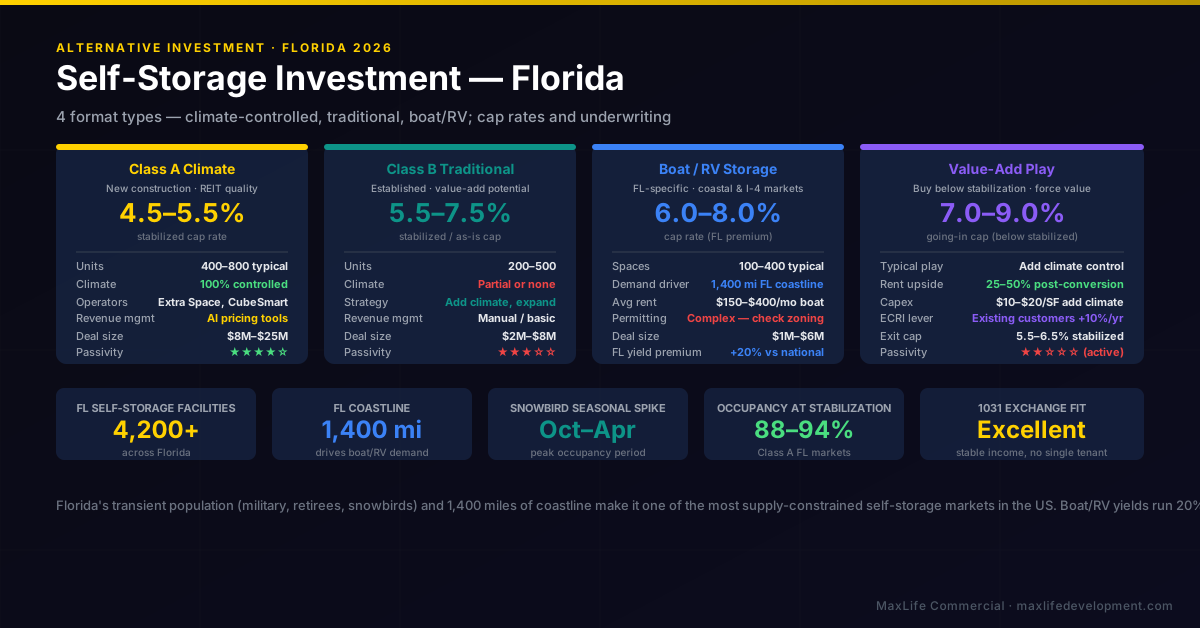
Florida's 1,400+ miles of coastline drive outsized demand for boat and RV storage — cap rates of 6–8% sit approximately 20% above the national average, and new covered-storage construction costs limit supply growth.
Cap Rates by Asset Class (Florida 2026)
Self-storage cap rates in Florida reflect asset quality, location, stabilization status, and operator profile. Here is the full range across asset classes in mid-2026:
For context on how storage cap rates compare to NNN retail and industrial across Central Florida, see our Orlando cap rates investor guide.
National Operators vs. Regional and Owner-Operated
The self-storage industry has undergone significant consolidation over the past decade. National REITs and institutional operators now control a meaningful share of the Florida market, but regional and independent operators still hold the majority of non-Class-A product.
National Operators in Florida
- →Extra Space Storage (NYSE: EXR) — largest self-storage REIT; extensive Florida presence; acquired Life Storage in 2023
- →Public Storage (NYSE: PSA) — original market leader; strong brand in major metros
- →CubeSmart (NYSE: CUBE) — premium urban and suburban positioning
- →StorageMart — private; aggressive acquirer of mid-size independent facilities
- →National Storage Affiliates (NYSE: NSA) — REIT aggregating regional operators
For individual investors, the opportunity is almost always in assets that are too small or operationally complex for REITs: Class B facilities below 50,000 net rentable SF, owner-operated boat/RV storage, and facilities in secondary markets where institutional capital has not yet arrived. These assets often trade at a 150–250 bps cap rate premium to institutional-quality product.
A well-executed value-add acquisition — implementing revenue management pricing, converting outdoor to covered storage, and professionalizing operations — can compress cap rates from 8.0% to 6.0–6.5% within 24–36 months, generating significant equity appreciation alongside current income.
Get Off-Market CRE Deals in Your Inbox
Join our investor list for exclusive Central Florida opportunities, market reports, and deal analysis — delivered weekly. No spam, unsubscribe anytime.
Key Florida Markets for Self-Storage Investment
Florida's self-storage market is not uniform. Each region has distinct demand drivers and competitive dynamics.
- →I-4 Corridor (Orlando to Tampa): The highest-growth corridor in Florida. Suburban expansion in Polk County, Osceola, and Hillsborough is outpacing supply in many submarkets. Strong demand from new residential construction, transient household formation, and the tourism workforce.
- →Coastal Markets (Naples, Sarasota, St. Pete): Affluent coastal communities with high boat ownership, HOA restrictions on RV/boat parking, and strong snowbird populations. Premium rents for covered and climate-controlled product. Naples / Collier County is one of the tightest self-storage markets in the state.
- →Military Markets (Jacksonville, Pensacola): Military deployment cycles generate consistent demand that is counter-cyclical to the general economy. Facilities near NAS Jacksonville, NAS Pensacola, and Mayport Naval Station maintain high occupancy regardless of broader market conditions.
- →Space Coast (Brevard County): Rapid aerospace and tech employment growth (SpaceX, Blue Origin, Lockheed) is driving household formation in a market that has been undersupplied in Class A storage. Patrick SFB adds military demand on top of the civilian growth story.
How to Underwrite a Self-Storage Acquisition
Self-storage underwriting differs meaningfully from single-tenant NNN analysis. The income is diversified across hundreds of month-to-month tenants, which reduces single-tenant risk but requires analysis of aggregate metrics.
- →Occupancy History: Request at least 36 months of occupancy data, both physical (unit count) and economic (actual revenue as a percentage of gross potential rent). A facility at 92% physical occupancy but 80% economic occupancy has a significant bad debt or concession problem.
- →Street Rates vs. In-Place Rates: Pull the current street rates from the operator's website or a service like SpareFoot and compare to actual in-place rents by unit size. A gap of more than 10–15% indicates either rent upside (good) or market softness (bad) — context determines which.
- →ECRI Track Record: Existing Customer Rate Increases are the primary same-store revenue growth lever for mature storage facilities. Ask for ECRI history over the past 3 years. National operators apply ECRI aggressively (often 8–15% annually to long-term tenants); many independent operators never do it. A facility that has not implemented ECRI has significant embedded revenue upside.
- →Unit Mix: What percentage of net rentable square footage is climate-controlled vs. traditional? What is the unit size distribution (5x5, 5x10, 10x10, 10x20, 10x30)? Facilities with limited 10x30 units in boat/RV-demand markets are leaving revenue on the table.
- →Competitive Landscape: Map every competing facility within 3 miles. Check their occupancy (SpareFoot, Storable, or simply call them as a mystery shopper). Facilities in undersupplied submarkets sustain occupancy and rates; facilities with new Class A competitors nearby face rate pressure.
Value-Add Plays in Florida Self-Storage
The most compelling self-storage opportunities in Florida combine current income with identifiable value-add upside. Here are the playbooks institutional and private investors execute most successfully.
- →Adding Climate Control: Converting existing drive-up units to climate-controlled by enclosing rows and adding HVAC can increase rent per SF by 30–50%. In Florida's heat and humidity, tenants strongly prefer climate-controlled for anything beyond lawn equipment and non-sensitive items. Conversion cost: $8–15/SF depending on scope.
- →Converting Outdoor to Covered Boat/RV Storage: Adding carport-style canopies over outdoor parking converts low-yield outdoor spaces to premium covered storage at a 30–50% rent premium. Steel canopy structures run $20–35/SF; payback periods of 3–5 years are common in coastal Florida markets.
- →Revenue Management Implementation: Deploying revenue management software (Storable, Sitelink, or national operator algorithms) at an owner-operated facility typically increases revenue 8–15% in year one with no physical capital investment. This includes rate optimization, ECRI implementation, and online reservation conversion.
- →Third-Party Management: Engaging a professional third-party manager (StorageMart, Absolute Storage, or a regional operator) to manage a newly acquired facility can capture operational upside without requiring the investor to build an internal operations team.
Revenue Management: The Technology Advantage
One of the most underappreciated aspects of self-storage investing is how dramatically revenue management technology has widened the performance gap between institutional operators and independent owners.
National operators like Extra Space Storage, Public Storage, and CubeSmart deploy dynamic pricing algorithms that adjust street rates daily based on occupancy, demand signals, competitor rates, and seasonal patterns. They also run systematic ECRI programs — typically sending existing customers rate increase notices every 6–12 months — which compounds revenue growth across the entire tenant base regardless of vacancy.
Independent operators who lack these systems are effectively leaving 10–25% of potential revenue uncaptured. When you acquire such a facility and implement professional revenue management, that gap becomes your upside. For investors deploying 1031 exchange capital into value-add storage, this operational lever is often the difference between a market-rate return and a genuinely compelling risk-adjusted outcome.
1031 Exchange Fit, Financing, and Exit
Self-storage is one of the most flexible asset classes for 1031 exchange investors. Unlike single-tenant NNN, which is a pure credit play, storage offers current yield plus identifiable operational upside — a combination that suits investors who want more than a mailbox investment but less than active property management.
- →SBA 7(a) and 504 Financing: Owner-operated self-storage facilities with 51%+ owner occupancy qualify for SBA 7(a) and SBA 504 loans — enabling low down payment acquisition (10%) with long amortization (25 years). Ideal for first-time storage buyers or operators expanding their portfolio.
- →CMBS and Bank Financing: Stabilized Class A storage in primary markets qualifies for CMBS at competitive rates. Class B value-add typically finances through regional banks or credit unions with shorter 5–7 year terms and interest-only periods during the value-add phase.
- →Exit Options: Stabilized Class A storage in primary Florida markets has an active REIT buyer pool — Extra Space, Public Storage, and CubeSmart are consistent acquirers. Class B value-add exits to regional operators or private capital aggregators once stabilized. Boat/RV storage trades to a smaller but growing pool of specialized buyers.
For broader context on passive income from Florida commercial real estate, self-storage sits in a unique middle ground — more operational than NNN, far less intensive than multifamily, and with revenue characteristics that hold up well across economic cycles.
Looking for Self-Storage Investments in Florida?
MaxLife Commercial tracks Class B value-add storage, boat and RV storage, and off-market storage opportunities across Central Florida and the I-4 corridor. Ryan Solberg can help you identify, underwrite, and close the right deal for your investment objectives.
Frequently Asked Questions
What cap rates should I expect on a Florida self-storage investment?
New Class A climate-controlled in a primary market: 4.5–5.5% stabilized. Stabilized Class A in secondary markets: 5.5–6.5%. Boat and RV storage: 6.0–8.0% depending on covered vs. uncovered. Class B value-add: 7.0–9.0% on in-place NOI, with significant upside as occupancy and street rates improve.
Do boat and RV storage facilities in Florida yield more than traditional self-storage?
Yes — Florida boat and RV storage typically yields 6.0–8.0% cap rates, approximately 20% above the national average. Florida's 1,400+ miles of coastline and year-round boating season create outsized demand that supports premium rents. Covered and enclosed storage commands an additional 30–50% rent premium over uncovered outdoor spaces.
How do I find self-storage investment deals in Florida?
Self-storage deals are sourced through sector-specialist CRE brokers, LoopNet and CoStar listings, direct owner outreach to facilities in your target submarket, and REIT/institutional disposition pipelines when large operators prune underperforming assets. Off-market deals are common — smaller family-owned facilities in secondary markets often sell without formal broker representation. MaxLife Commercial can help identify and evaluate Florida self-storage opportunities.
What should I underwrite when buying a self-storage facility in Florida?
Key metrics: 36 months of occupancy history; street rates vs. in-place rates (gap = upside or risk); ECRI track record (existing customer rate increases are the primary revenue growth lever); unit mix (% climate-controlled vs. traditional, unit size distribution); and competitive landscape within 3 miles. A facility at 85–90% economic occupancy with in-place rates 10–15% below street rates is a classic value-add opportunity.
Related Articles
Car Wash Investment Properties Florida
Express tunnel car washes — cap rates, sale-leasebacks, and site selection in Florida.
Net Lease Investing in Florida
The case for NNN real estate in Florida — tenant credit, cap rates, and how to source deals.
1031 Exchange Orlando Guide
NNN and alternative assets are the most popular 1031 replacement properties — here's how the process works.
The Ultimate Guide to NNN Investing
How to source, underwrite, and close NNN properties across Florida.
Passive Income from Florida CRE
How NNN and alternative assets generate truly passive income for investors.
Orlando Cap Rates Investor Guide
Current cap rates across NNN, industrial, retail, and alternative assets in the Orlando market.