Why Florida Is a Passive Income Powerhouse
Florida's CRE market offers a compounding advantage that no other major US state can match: zero state income tax combined with one of the fastest-growing tenant bases in the country. For passive income investors, that combination is transformative. Every dollar of net operating income you collect is taxed only at the federal level — your California counterpart pays an additional 13.3% to Sacramento on top of that same income.
Florida adds approximately 300,000 net new residents each year. Those residents need gas stations, dollar stores, medical offices, logistics warehouses, and apartments — all of which support the tenant base that pays your rent. Unlike many passive income markets where population is flat or declining, Florida tenant demand continues to grow year after year, supporting occupancy and rent levels across every commercial asset class.
The state's warm climate keeps businesses operating year-round, which matters for retail and service tenants whose sales drive lease renewals. And Florida's robust 1031 exchange activity — investors from California, New York, and New Jersey constantly trading appreciated properties into Florida replacements — keeps deal flow steady and creates competitive pricing in both directions. Sellers find ready buyers; buyers find quality inventory.
The full federal depreciation benefit — cost segregation, bonus depreciation, straight-line — applies to Florida investment property without any state-level clawback or limitation. For investors in the highest federal tax brackets, a single Florida CRE acquisition can shelter a significant portion of their investment income in year one.
Strategy 1: Triple Net (NNN) Properties
NNN properties are the most passive commercial real estate investment available to private investors. Under an absolute triple net lease, the tenant pays property taxes, building insurance, and all maintenance — including roof, structure, HVAC, and parking. The landlord receives a monthly check and does nothing else for the duration of the lease, which typically runs 10 to 25 years.
National credit tenants — Dollar General, Starbucks, Walgreens, AutoZone, Taco Bell, CVS, 7-Eleven — sign these leases because the structure helps their balance sheets. They get to operate in a building they don't own while maintaining operational control. You get a long-term income stream backed by a corporate parent with investment-grade credit ratings and billions in revenue.
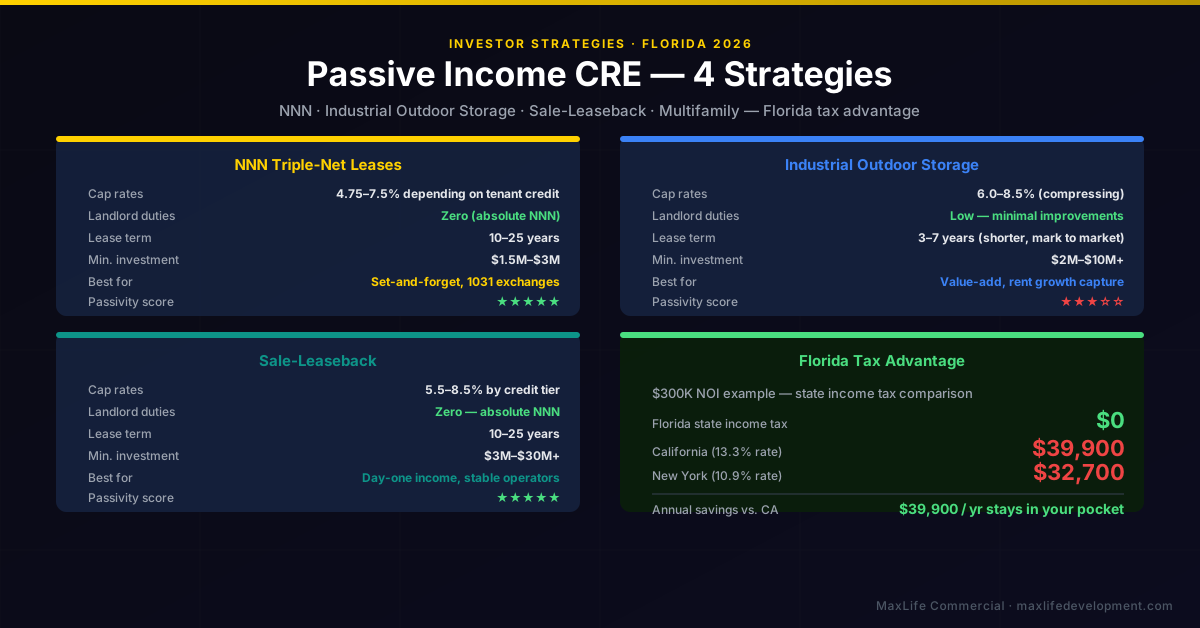
Cap rates on NNN properties in Florida range from 4.5% to 7.5% depending on tenant credit quality, remaining lease term, and market. A brand-new Starbucks with 15 years remaining in Orlando might trade at 4.75%. A Dollar General in a secondary Florida market with seven years of term might trade at 6.5–7.0%. Higher cap rate typically means more residual risk at lease expiration, not necessarily a worse investment — it depends on your exit strategy.
NNN At a Glance
- →Minimum investment: $1–2M for most corporate-credit tenants
- →Cap rates: 4.5–7.5% depending on tenant, term, and market
- →Lease length: 10–25 years with fixed rent bumps
- →Management: None — truly passive during the lease term
- →Best for: 1031 exchange buyers, retirees, high-income professionals
The primary risk in NNN investing is tenant concentration: you have one tenant in one building. If that tenant closes or goes bankrupt, your income drops to zero. This is why credit quality and lease duration matter so much at acquisition — and why national brands with thousands of locations are preferred over regional operators. Florida's strong population growth helps on re-leasing risk: if a tenant vacates, there are typically other users competing for well-located retail pad sites.
Strategy 2: Industrial Outdoor Storage (IOS)
Industrial outdoor storage is one of the most underappreciated passive income strategies in Florida CRE. An IOS site is typically a fenced, paved yard used for storing trucks, trailers, shipping containers, construction equipment, or last-mile fleet vehicles. The improvements are minimal — chain link fence, gate, lighting, some pavement — which means minimal capex risk for the landlord and no aging building systems to maintain.
Tenants are third-party logistics (3PL) companies, construction contractors, container depots, and last-mile delivery operators — businesses that need secure, accessible outdoor space near population centers and highways. Florida's port activity (Port of Tampa, Port Canaveral, Port Everglades) and I-4 corridor logistics demand have made IOS sites increasingly competitive, with institutional investors now entering a market that was largely ignored five years ago.
Leases are typically 3–5 year NNN structures, with the tenant responsible for maintaining the yard surface and fence. Management intensity is minimal — the tenant operates the site and handles day-to-day operations. The landlord's primary focus is lease renewals and maintaining the perimeter. Appreciation in IOS is largely land-driven: as industrial land near population centers becomes scarcer, the sites appreciate even without any building improvements.
IOS At a Glance
- →Entry price: $500K–$3M for smaller to mid-size yards
- →Cap rates: 6.75–8.0% — among the highest in industrial CRE
- →Lease length: 3–5 years NNN, tenant maintains the yard
- →Capex: Minimal — no building systems to replace
- →Upside: Land scarcity appreciation near population centers
Get Florida CRE Passive Income Deals in Your Inbox
NNN, IOS, and sale-leaseback opportunities across Central Florida — delivered to investors on our list before they hit the open market.
Strategy 3: Sale-Leaseback Investments
A sale-leaseback is a transaction in which you purchase a property from an operating business that simultaneously signs a long-term NNN lease back — so on day one of ownership, you have a tenant in place. There is no lease-up period, no vacancy, and no uncertainty about whether the property will perform. The seller-tenant typically signs a 10–25 year lease because they need the liquidity from the sale to reinvest in their core business operations.
Sale-leasebacks are common in auto dealerships, car washes, medical practices, quick-service restaurants (QSRs), and owner-operated retail. The seller gets cash to grow their business; you get a long-term, passive income stream from a tenant who is deeply motivated to stay — because it is their own operating business.
Cap rates on sale-leaseback deals range from 5.5% to 8.5% depending on the credit of the operating tenant, the lease length, the market, and the asset type. Corporate-guaranteed QSR sale-leasebacks from a large franchisee trade closer to 5.5–6.5%. Single-location medical practice or small operator deals trade in the 7.5–8.5% range, reflecting the higher tenant risk.
Why Sale-Leasebacks Pair Well with 1031 Exchanges
When you're executing a 1031 exchange, one of the hardest challenges is identifying a replacement property with immediate, reliable income — because you can't afford a period of vacancy or lease-up uncertainty when you're working against an exchange deadline. Sale-leaseback deals solve this exactly: the tenant is already identified, the lease is already signed at closing, and income begins immediately. For 1031 buyers who want passive income without management complexity, sale-leasebacks are among the cleanest structures available.
Strategy 4: Passive Multifamily (Syndications or Small Apartment)
Multifamily is less passive than NNN — but it delivers more appreciation upside and stronger total returns over multi-year holds. Florida's multifamily fundamentals in 2026 remain solid: migration-driven demand supports occupancy, and while rent growth has moderated from the 2021–2022 peaks, it remains positive across most Florida metros driven by continued in-migration.
Stabilized Florida multifamily trades at 4.75–5.75% cap rates in major markets (Orlando, Tampa, Jacksonville, Miami). Value-add opportunities — older properties with below-market rents that can be renovated to push rents — still exist but require more diligent underwriting in 2026 as construction costs remain elevated.
For investors who want truly passive multifamily exposure, limited partnership syndications offer a compelling structure: a sponsor (general partner) manages all acquisition, financing, operations, and disposition. You contribute capital as an LP and receive quarterly distributions. Typical minimum LP investment is $50,000–$100,000, and preferred returns are often structured at 6–8% before the GP participates in upside. The tradeoff is illiquidity — your capital is locked for the hold period (typically 5–7 years).
Multifamily Access Points
- →Direct ownership (small multifamily): 4–20 units. Requires a property manager. More control, more involvement. Depreciation and tax benefits flow directly to you.
- →LP syndication (truly passive): Minimum $50K–$100K. Sponsor manages everything. Quarterly distributions. No direct tax reporting — receives K-1.
- →Multifamily REIT: Publicly traded, liquid. No tax benefits of direct ownership. Returns are strong long-term but no depreciation shelter.
Side-by-Side: All 4 Strategies Compared
No single strategy is right for every investor. Here is how all four compare across the dimensions that matter most for passive income investors.
NNN Single-Tenant
Industrial Outdoor Storage (IOS)
Sale-Leaseback
Multifamily (Syndication / Direct)
The Florida Tax Advantage: The Real Return Multiplier
Florida's zero state income tax is not just a talking point — it is a real return multiplier that compounds over time. California investors pay 13.3% in state income tax on top of their federal obligation. New York investors pay 10.9%. New Jersey investors pay 10.75%. Florida investors pay zero.
This gap widens further when you factor in cost segregation and bonus depreciation. A cost segregation study on a newly acquired commercial property reclassifies HVAC, electrical, flooring, land improvements, and other components from the standard 39-year schedule to 5, 7, or 15-year schedules. With bonus depreciation (still partially available in 2026), much of that reclassified value can be deducted in year one — creating a large paper loss that shelters passive income. In Florida, that tax shelter works at full federal efficiency with no state-level clawback.
Real Numbers: $5M NNN at 6% Cap
Over a 10-year hold, the Florida investor keeps $399,000 more than the California investor on the same property — just from state tax savings alone, before any federal depreciation benefit.
When you layer cost segregation on top of Florida's zero-tax advantage, it is possible for a Florida CRE investor to shelter most or all of year-one cash flow at the federal level while keeping all of it at the state level. For high-income professionals — doctors, attorneys, business owners — who qualify as real estate professionals or have passive income to offset, this is one of the most powerful legal tax strategies available in the US tax code.
Getting Started: 3 Paths into Florida Passive CRE
The right path depends on your capital, timeline, and whether you have an existing property to exchange from. Here are the three most common entry points.
Path 1: Direct Ownership — Work with a Specialized CRE Broker
If you're acquiring an NNN, IOS, or sale-leaseback property directly, you need a broker who specializes in passive income commercial real estate — not a generalist. The right broker will help you evaluate tenant credit, lease structure, market rent exposure at expiration, and financing options. They'll also source off-market deals before they hit LoopNet.
Talk to Ryan About Your Investment GoalsPath 2: 1031 Exchange into Florida NNN
If you have appreciated multifamily, land, or other commercial real estate, a 1031 exchange lets you defer capital gains tax while repositioning into a passive Florida NNN or sale-leaseback. The 45-day identification and 180-day closing windows require a broker who moves fast and has inventory ready.
Learn About 1031 Exchanges into FloridaPath 3: Model the Returns Before You Commit
Before approaching a seller or broker, run the numbers on any passive income scenario using our Deal Analyzer. Model different cap rates, leverage levels, hold periods, and exit assumptions. Understand your cash-on-cash return, equity multiple, and IRR before you spend a dollar on due diligence.
Open the Deal AnalyzerReady to Build Florida Passive Income?
MaxLife Commercial specializes in passive income commercial real estate across Central Florida and the broader Florida market. We work with NNN buyers, 1031 exchange investors, and IOS acquirers — and we source deals that never make it to LoopNet. If you're serious about building passive income from Florida CRE, let's talk.
Frequently Asked Questions
How much money do I need to invest in passive commercial real estate?
Entry points vary by strategy. Industrial outdoor storage yards start around $500K–$1M for smaller sites. NNN single-tenant properties typically start at $1–2M for corporate-credit tenants. Sale-leaseback deals range from $1M to $10M+. Passive multifamily LP syndications often accept minimums of $50,000–$100,000, making them the most accessible entry point.
Is NNN really passive income, or are there hidden landlord responsibilities?
An absolute NNN lease is genuinely passive during the lease term — the tenant pays property taxes, insurance, and all maintenance including roof and structure. The key is to read the lease carefully: some leases labeled 'NNN' still have landlord carve-outs for roof and structure. National credit-tenant deals are typically the purest passive income structures available in commercial real estate.
What is the best passive CRE investment in Florida in 2026?
It depends on your capital and goals. For pure passivity, NNN with national credit tenants is the gold standard. For higher yield with minimal management, industrial outdoor storage at 6.75–8.0% cap rates is compelling. For day-one occupancy certainty with no lease-up risk, sale-leasebacks are ideal. Most experienced investors blend two or more of these strategies.
How does cost segregation help passive CRE investors in Florida?
Cost segregation reclassifies components of a commercial property to shorter depreciation schedules (5, 7, 15 years vs. the standard 39). Combined with bonus depreciation, this can generate a large paper loss in year one. In Florida, that shelter works at full federal efficiency with zero state-level income tax, making the combined effect significantly more powerful than in high-tax states.
NNN vs. multifamily: which generates better passive income?
NNN wins on passivity — no tenant calls, no maintenance, no leasing during the lease term. Multifamily delivers more total return over 5–10 year holds through rent growth and value-add, but requires meaningful management even with a property manager. The typical progression is multifamily for wealth-building, NNN for passive retirement income.
Can I use a 1031 exchange to buy a Florida passive income property?
Yes — NNN and sale-leaseback properties are among the most popular 1031 exchange replacements because they offer immediate, passive income with long leases and no management burden. Florida is a particularly attractive exchange destination because there is no state income tax on rental income or eventual gain from the replacement property.
Related Articles
The Ultimate Guide to NNN Investing
Everything you need to source, underwrite, and close NNN properties in Florida.
NNN vs Multifamily Investing
Cap rates, management, risk, and total return compared side by side.
1031 Exchange Orlando Guide
Exchange appreciated real estate into Florida passive income properties.
Florida CRE Investor Guide 2026
Markets, tax advantages, asset classes, and financing across the Sunshine State.
Orlando NNN Properties for Sale
Active NNN listings in Orlando and Central Florida with cap rate data.
Why Investors Choose Florida CRE
Tax advantages, migration tailwinds, and the full case for Florida CRE.