What Is a Commercial Sale-Leaseback?
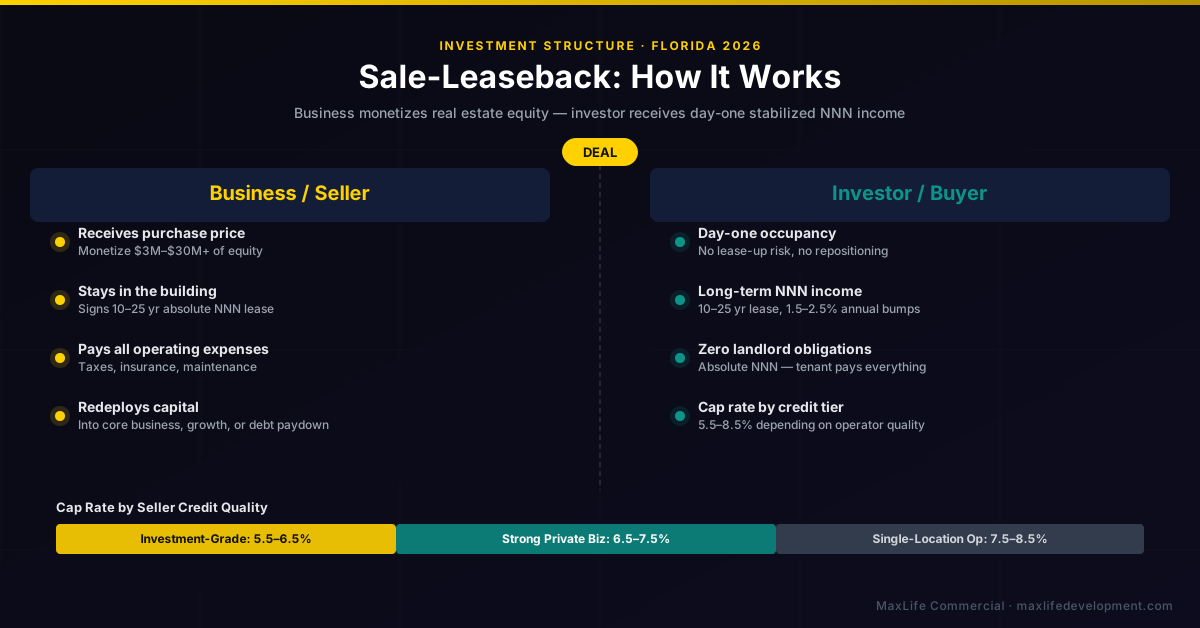
A commercial sale-leaseback is a two-part transaction that happens simultaneously: a business sells the real estate it occupies to an investor, and at closing, that same business signs a long-term lease to remain as the tenant. The seller gets cash — often $3 million to $30 million or more — while retaining full operational control of the space. The buyer gets a stabilized income-producing property with an immediate, creditworthy occupant and a long-term NNN lease in place.
The structure is elegant because it aligns two different needs at the same moment. The business owner often has the majority of their net worth locked in an illiquid commercial building when that capital would generate far more value redeployed into the core business, used to retire debt, or reinvested in growth. The investor wants exactly what the seller no longer needs: a passive, long-term income stream backed by a creditworthy operator.
Sale-leasebacks are not new — Fortune 500 companies have used them for decades to optimize balance sheets. What has changed is their increasing prevalence among mid-market Florida businesses, where owners of dealerships, medical practices, industrial facilities, and restaurant chains are recognizing that owning their real estate may not be the best use of their capital.
Why Florida Businesses Do Sale-Leasebacks
Florida's business environment — strong population growth, active M&A market, and a deep pool of commercial real estate investors — creates particularly favorable conditions for sale-leaseback transactions. Business owners pursuing leasebacks in Florida typically cite several motivating factors:
Monetize Real Estate Equity
Many Florida business owners have owned their commercial property for 10 to 25 years and have accumulated $3 million to $30 million or more in equity. That equity is earning a real estate return — often 3 to 6% — when it could be earning a business return of 15 to 25%+ if redeployed into expansion, acquisitions, or core operations. The leaseback converts illiquid real estate equity into liquid capital without disrupting operations.
Improve the Balance Sheet
Removing real estate from the balance sheet — and replacing the mortgage debt with an operating lease obligation — can dramatically improve a company's financial ratios. For businesses pursuing bank financing, PE investment, or a sale of the operating company, a cleaner balance sheet with higher EBITDA (before lease expense) often results in better terms and higher valuations.
Tax Advantages
For the seller, the proceeds from a sale-leaseback may be treated as capital gains if the property has been held for more than one year — potentially at long-term capital gains rates rather than ordinary income rates. Additionally, going forward, the full rent payment becomes a deductible operating expense rather than just the interest portion of a mortgage payment. Consult a CPA and tax attorney for your specific situation.
No Disruption to Operations
Unlike a conventional property sale that results in relocation, a sale-leaseback allows the business to remain in place under a structured, long-term lease. The business continues operating from the same location, serving the same customers, with the same staff. From a day-to-day operational standpoint, nothing changes except the ownership line on the deed.
- →Unlock $3M–$30M+ in illiquid real estate equity
- →Redeploy capital into core business at higher returns
- →Retire debt and strengthen the balance sheet
- →No operational disruption — remain in place as tenant
- →Potential capital gains tax treatment on sale proceeds
- →Full rent deductibility as operating expense going forward
The Investor's Perspective
For CRE investors, sale-leasebacks offer a compelling combination of stability, income predictability, and reduced repositioning risk that is difficult to replicate in other transaction types.
The defining characteristic of a sale-leaseback from the buyer's side is that you acquire a property with an immediate, contractual occupant. There is no lease-up risk, no tenant search, no construction period, and no vacancy. Day one of ownership, the rent is flowing. In a market where vacant commercial properties can sit for months or years before tenanting, that day-one income certainty commands a meaningful premium.
Long-term NNN leases — typically 10 to 25 years with built-in rent escalations — provide income visibility that most other CRE investment types cannot match. The investor underwrites the deal knowing their income stream with contractual precision: base rent on day one, rent bumps at defined intervals, renewal options at defined terms, and a tenant that is responsible for taxes, insurance, and maintenance.
Importantly, the credit analysis for a sale-leaseback focuses on the operating business rather than the real estate alone. A Dollar General in a tertiary market has institutional demand because the credit is Dollar General's balance sheet, not the market. Similarly, a strong regional medical group or auto dealership group can support institutional pricing even in a secondary location because the investor is underwriting the business performance, not just the real estate fundamentals.
Get Off-Market CRE Deals in Your Inbox
Join our investor list for exclusive Central Florida opportunities, market reports, and deal analysis — delivered weekly. No spam, unsubscribe anytime.
How Sale-Leaseback Deals Are Structured
A well-structured sale-leaseback requires simultaneous negotiation of two documents: the purchase and sale agreement and the lease. The seller's leverage diminishes once the property transfers — the time to negotiate favorable lease terms is before the closing, not after.
Purchase Price & Fair Market Value
Sale-leaseback purchase prices are typically determined by applying a market cap rate to the proposed rent — the inverse of how conventional acquisitions are priced. The seller proposes a rent that reflects fair market value for the space, the buyer applies their required cap rate to determine the purchase price, and negotiation occurs around both. A seller who wants more proceeds may accept a higher rent; a buyer who needs more yield may push for a higher rent relative to the price.
Lease Structure — Absolute NNN
Most institutional sale-leasebacks use an absolute NNN lease structure in which the tenant (the former owner) is responsible for all property taxes, insurance, and maintenance — including roof, structure, and parking lot. This is the most passive structure for the investor and the most common institutional format. Smaller, private transactions may negotiate modified NNN terms.
Term, Options & Rent Bumps
Primary lease terms for sale-leasebacks typically run 10 to 25 years, with multiple renewal option periods. Annual rent escalations of 1.5% to 2.5% are standard; CPI-linked bumps are also common in longer leases. The seller often negotiates the right to purchase the property back at defined intervals — a repurchase option — as a condition of the sale.
- →Purchase price negotiated simultaneously with lease terms
- →Absolute NNN lease — tenant pays all taxes, insurance, maintenance
- →10–25 year primary term with multiple renewal options
- →Annual rent bumps of 1.5–2.5% or CPI-linked escalation
- →Seller may negotiate repurchase option at defined terms
- →Personal guarantee from business owner may be required by buyer
Typical Florida Sale-Leaseback Tenants
Sale-leasebacks are most common in industries where the real estate is essential to operations, the business has been in place long enough to have accumulated significant equity, and the operator has strong incentives to remain in that specific location. Florida's economy produces a steady pipeline of sale-leaseback candidates across several sectors:
Auto Dealerships
Florida's auto dealership groups — including regional operators and national platform players like Lithia, AutoNation, and Sonic Automotive — are active sale-leaseback participants. Dealership real estate is expensive, location-specific, and often carries significant equity. Dealership leasebacks typically command cap rates of 6.0–7.0% depending on the brand and operator credit.
Medical Practices & Dental Chains
Medical and dental practices own their office real estate far more often than general businesses, having purchased during low-rate periods. As practices are acquired by PE-backed groups or preparing for succession, sale-leasebacks are a natural part of the transaction. Medical office leasebacks can command tighter cap rates (6.0–6.75%) when the tenant is a creditworthy health system or large multi-location group.
Quick-Service Restaurants (QSRs)
Franchisee-owned QSR locations — Chick-fil-A, McDonald's, Burger King, Wingstop — are among the most liquid sale-leaseback categories. National brand recognition, strong traffic, and long lease commitments make QSR leasebacks attractive to institutional buyers. Cap rates vary significantly by brand and franchisee credit.
Gas Stations & Convenience Stores
Single-location and multi-site c-store operators in Florida frequently use sale-leasebacks to fund expansion. The fuel and convenience category is a major NNN investment sector with established cap rate benchmarks and active institutional demand.
Industrial Users
Florida manufacturers, distributors, and logistics operators who own their warehouse and flex space are increasingly pursuing sale-leasebacks as industrial values have risen significantly. Industrial leasebacks are attractive because the tenant has operational dependency on the specific location and infrastructure.
Cap Rate Expectations for Florida Sale-Leasebacks
Sale-leaseback cap rates in Florida reflect three primary variables: tenant credit quality, lease term remaining, and whether the tenant is a publicly traded company with a published credit rating or a private business underwritten from financial statements.
Investment-Grade Public Company
5.5% – 6.5%Publicly traded company with BBB- or better credit rating. Long-term absolute NNN lease (15+ years). Institutional-quality pricing with the tightest cap rates in the sale-leaseback category.
Private Business with Strong Financials
6.5% – 7.5%Regional operator with 3+ years of audited financials showing healthy rent coverage (1.5x+), multi-location operations, and 10-20 year lease commitment. Primary private market for Florida sale-leasebacks.
Shorter Lease / Single-Location Operator
7.5% – 8.5%10-year primary term or single-location operator without multi-site financial strength. Higher cap rate reflects concentration risk and reduced buyer pool at this credit level.
Cap rates are influenced by the 10-year Treasury rate, which sets the risk-free baseline that CRE investors price spreads against. As of May 2026, sale-leaseback cap rates have stabilized after the upward movement of 2023–2024, and transaction volume is recovering as both buyers and sellers adjust to the new rate environment.
Due Diligence on a Sale-Leaseback — Evaluate the Business, Not Just the Real Estate
Sale-leaseback due diligence has a different emphasis than conventional acquisition due diligence. The real estate itself is typically straightforward — the building was purpose-built for the tenant's use, maintained by the operator, and physically in better condition than most third-party-tenanted properties. The risk in a sale-leaseback is the business, not the building.
Financial Statement Review
Request three years of audited or reviewed financial statements from the tenant business. For private operators without audited financials, tax returns and internally prepared financials with CPA compilation are minimum acceptable documentation. Analyze revenue trends, EBITDA margins, debt levels, and cash flow consistency. A business with declining revenue is a tenant in deteriorating condition, regardless of the lease term on the document.
Rent Coverage Ratio
Calculate the rent coverage ratio: EBITDA (or operating income) ÷ annual rent. A ratio above 2.0x is strong. A ratio of 1.5x is acceptable for well-established businesses. Below 1.2x, the rent burden is approaching an unsustainable level and represents meaningful default risk. Be conservative — use trailing 12-month actuals, not forward projections.
Industry Tailwinds & Business Longevity
A 15-year lease on a business in structural decline is a problem that gets worse over time. Evaluate the industry: Is it growing or contracting? Are there disruptive threats (e.g., EV transition for an ICE-focused dealership)? Does the tenant have competitive advantages that will sustain the business through the lease term? The best sale-leaseback tenants are in essential, defensible businesses — healthcare, food, automotive services, industrial — with demonstrated multi-year profitability.
- →3 years audited or CPA-reviewed financial statements
- →Rent coverage ratio — minimum 1.5x at time of closing
- →Revenue trend — growing, stable, or declining?
- →Industry analysis — structural growth or headwinds?
- →Business longevity — years operating, owner tenure, management depth
- →Personal guarantee from principals if private operator
- →Property condition — even though tenant owns the building, inspect it
1031 Exchange + Sale-Leaseback — A Powerful Combination
One of the most common — and most effective — uses of a sale-leaseback acquisition is as the replacement property in a 1031 exchange. The structure is straightforward: an investor sells an appreciated property (multifamily, commercial, land), executes a 1031 exchange through a qualified intermediary, and acquires a sale-leaseback as the replacement property within the 180-day exchange window.
The combination works because sale-leasebacks offer the two things 1031 exchange buyers need most: immediate occupancy (no lease-up risk during the exchange window) and long-term, passive NNN income. The investor defers the capital gains tax from the sale and converts the proceeds into a contractual income stream backed by an operating business.
For investors transitioning from active multifamily management to passive income, the 1031-into-sale-leaseback is one of the most effective portfolio simplification tools available.
Explore a Sale-Leaseback for Your Business or Portfolio
Whether you're a Florida business owner evaluating a leaseback of your commercial property or an investor looking to acquire a stabilized NNN asset, MaxLife Commercial can help you structure the transaction, evaluate the economics, and connect with qualified counterparties.
Frequently Asked Questions
What is a sale-leaseback in commercial real estate?
A commercial sale-leaseback is a transaction in which a business sells its real estate to an investor and simultaneously signs a long-term lease to remain as the occupant. The seller converts illiquid real estate equity into cash while retaining operational control. The buyer acquires a stabilized, income-producing property with an immediate, creditworthy tenant in place.
Is a sale-leaseback a good investment?
Sale-leasebacks can be excellent investments when the tenant business is financially sound, the lease is structured as absolute NNN, and the rent-to-revenue ratio is sustainable. The key due diligence focus shifts to the operating business — evaluating financial statements, rent coverage ratio (target 1.5x+), and industry tailwinds matters as much as the real estate fundamentals.
What cap rate do sale-leaseback properties trade at in Florida?
Florida sale-leaseback cap rates range from approximately 5.5% for investment-grade public company tenants with long-term leases to 8.5%+ for single-location private operators with shorter terms. Private businesses with strong financials typically trade in the 6.5–7.5% range. Cap rates are driven by tenant credit quality, lease term, and lease structure.
How long does a sale-leaseback take to close in Florida?
A commercial sale-leaseback in Florida typically takes 60 to 120 days from initial engagement to closing. This includes 2–4 weeks to negotiate the purchase agreement and lease simultaneously, 30–45 days of buyer due diligence, and 2–4 weeks for financing and closing. Working with a broker who has structured sale-leasebacks before reduces the timeline and avoids common pitfalls.
Can a 1031 exchange be used to acquire a sale-leaseback property?
Yes — sale-leaseback properties qualify as like-kind replacement property for 1031 exchange purposes. Investors who sell appreciated real estate can defer capital gains tax by exchanging into a sale-leaseback, which offers immediate occupancy and long-term NNN income. This combination of tax deferral and passive income makes sale-leasebacks popular 1031 replacement targets.
What is the rent coverage ratio and why does it matter?
The rent coverage ratio measures how many times a tenant's operating income covers the annual rent obligation. A ratio above 1.5x is generally acceptable — meaning the business generates $1.50 in operating income for every $1.00 of rent. Ratios below 1.2x indicate the rent burden may be unsustainable, increasing default risk. Always use trailing 12-month actuals, not projections.
Related Articles
Ultimate Guide to NNN Investing
Everything you need to know about NNN investment properties — from lease basics to building a multi-property portfolio.
1031 Exchange Orlando Guide
Defer capital gains by exchanging into NNN or sale-leaseback replacement property in the Orlando market.
What Is a Triple Net (NNN) Lease?
NNN lease fundamentals — expense pass-throughs, tenant obligations, and how absolute NNN structures work.
Florida CRE Due Diligence Checklist 2026
5-phase due diligence process for Florida commercial buyers — legal, financial, physical, environmental, and market review.
How to Evaluate a CRE Deal
IRR, DSCR, and equity multiple — the underwriting framework for any commercial property including sale-leasebacks.
Cap Rate vs Cash-on-Cash Return
Two key return metrics every CRE investor needs to understand before underwriting a sale-leaseback.