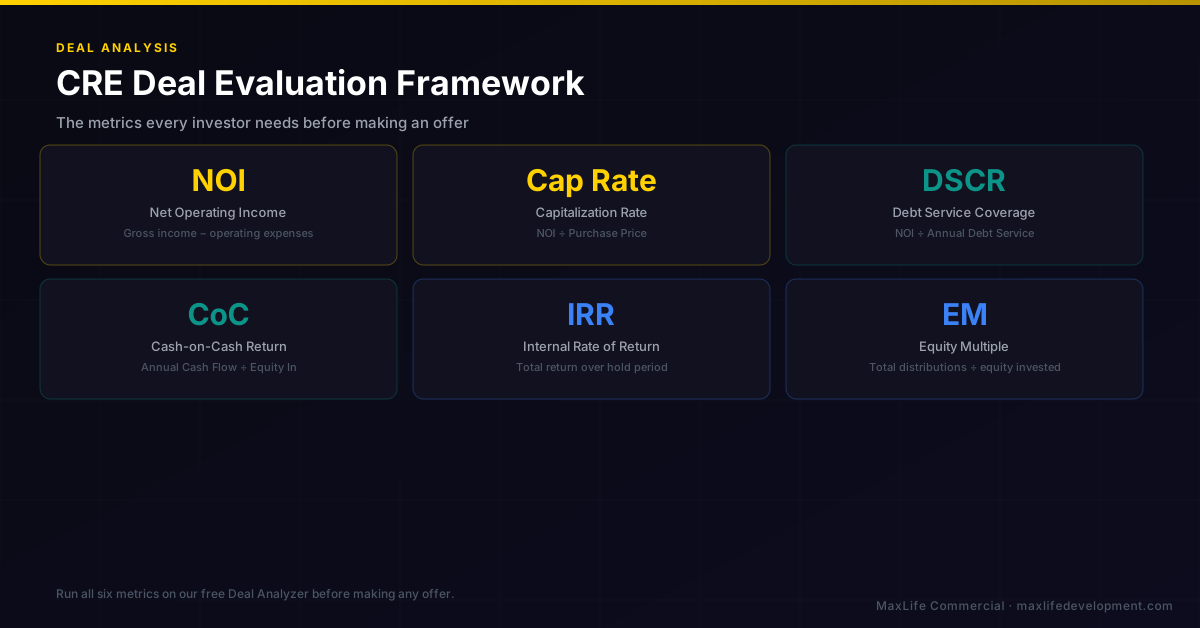
How to Evaluate a Commercial Real Estate Deal: The Complete Investor's Framework
A step-by-step guide to analyzing commercial property investments using the metrics, ratios, and due diligence processes that institutional investors rely on. From cap rate to DSCR, tenant credit to lease analysis, this is the framework you need.
Why a Systematic Evaluation Framework Matters
Commercial real estate investing is not a game of gut instinct. The most successful CRE investors use a disciplined, systematic approach to evaluate every deal they consider, and they walk away from far more opportunities than they pursue. The difference between a good investment and a costly mistake often comes down to the rigor of the analysis performed before the purchase agreement is signed.
Unlike residential real estate, where comparable sales are the primary valuation method, commercial properties are valued primarily on their income-producing potential. This means the evaluation process is fundamentally different. You are not just buying a building — you are buying a stream of cash flows, and the quality, durability, and growth potential of those cash flows determines the value of the investment. Understanding how to properly analyze those cash flows, and the risks that could impair them, is the foundation of commercial real estate investing.
This guide walks through every major metric, ratio, and analytical framework used by professional CRE investors. Whether you are evaluating your first commercial property or your fiftieth, this systematic approach will help you make better decisions and avoid the most common pitfalls that trap inexperienced investors. Use our deal analyzer tool to run these calculations on any property you are considering.
Net Operating Income (NOI): The Foundation of CRE Valuation
Net Operating Income is the single most important number in commercial real estate analysis. NOI represents the property's total revenue minus all operating expenses, before debt service and capital expenditures. Every other metric in this guide either derives from or relates back to NOI, so getting this number right is essential.
Calculating NOI requires a thorough understanding of both the revenue and expense sides of the property's operations. On the revenue side, you need to account for all sources of income: base rent, percentage rent, CAM reimbursements, parking income, storage income, antenna or billboard revenue, and any other miscellaneous income the property generates. You also need to subtract vacancy and collection loss — the amount of potential revenue that is lost due to unoccupied space and tenants who fail to pay.
On the expense side, operating expenses include property taxes, insurance, utilities, management fees, maintenance and repairs, landscaping, common area maintenance, and any other costs required to operate the property. Operating expenses explicitly exclude debt service (mortgage payments), capital expenditures (roof replacement, HVAC replacement, parking lot resurfacing), depreciation, and income taxes. These items are important in the overall investment analysis but are not part of the NOI calculation.
NOI Formula
NOI = Gross Potential Income - Vacancy Loss - Operating Expenses
Example: A 10,000 SF retail property leased at $25/SF NNN generates $250,000 in gross potential income. At 5% vacancy, effective gross income is $237,500. After $12,000 in non-reimbursable operating expenses, NOI is $225,500.
Common NOI Mistakes to Avoid
The most common error in NOI analysis is using the seller's pro forma numbers without verification. Sellers naturally present the most optimistic view of their property's income, and pro forma projections frequently overstate revenue and understate expenses. Always reconstruct NOI from source documents: actual leases, tax bills, insurance policies, utility bills, and maintenance contracts. The gap between pro forma NOI and actual trailing NOI can be substantial, and it directly affects the true value of the property.
Another critical mistake is failing to normalize expenses. A seller who has self-managed the property may show artificially low management costs. A property with a recently reassessed tax value may show lower property taxes than a new buyer will actually pay. Insurance costs may be understated if the current owner is part of a larger portfolio policy. Adjusting for these normalization items ensures your NOI reflects the true cost of ownership.
Capitalization Rate (Cap Rate): Measuring Return and Risk
The capitalization rate is the most widely used metric in commercial real estate. It represents the relationship between a property's NOI and its purchase price or market value. The cap rate is calculated by dividing the annual NOI by the purchase price, expressed as a percentage. A property generating $100,000 in NOI purchased for $1,500,000 has a cap rate of 6.67%.
Cap rates serve two functions. First, they provide a standardized way to compare the relative value of different properties. A 7.0% cap rate retail property in Clermont can be meaningfully compared to a 5.5% cap rate retail property in Winter Park because the metric normalizes for differences in property size, price, and income. Second, cap rates reflect the market's perception of risk. Lower cap rates indicate lower perceived risk (and higher demand), while higher cap rates indicate higher perceived risk. For a deeper dive, read our Orlando cap rates investor guide.
| Property Type | Typical Cap Rate | Risk Level | Typical Investor |
|---|---|---|---|
| Single-Tenant NNN (Credit) | 5.0% - 6.5% | Low | 1031 Exchange / Passive |
| Multi-Tenant Retail | 6.5% - 8.0% | Moderate | Active / Value-Add |
| Medical Office | 6.0% - 7.5% | Low - Moderate | Income / Institutional |
| Industrial / Warehouse | 5.5% - 7.5% | Low - Moderate | Institutional / REIT |
| Office (Suburban) | 7.0% - 9.0% | Moderate - High | Value-Add / Opportunistic |
| Multifamily | 5.0% - 6.5% | Low | Institutional / Syndicator |
Going-In Cap Rate vs. Exit Cap Rate
Sophisticated investors think about cap rates in two dimensions. The going-in cap rate is the yield at purchase based on current NOI. The exit cap rate is the assumed yield at the time of sale, which directly affects the projected sale price. If you buy a property at a 7.0% cap rate and sell it five years later at a 6.5% cap rate (cap rate compression), the property has appreciated beyond just the NOI growth — you have benefited from both income growth and valuation multiple expansion. Conversely, if cap rates expand to 7.5% at exit, the property may be worth less than you paid even if NOI has grown.
Cash-on-Cash Return: Measuring Actual Equity Returns
While cap rate measures the unlevered return of a property, cash-on-cash return measures the actual return on the equity you invest. This metric is critically important because most commercial real estate purchases are financed with debt, and the impact of leverage on returns can be dramatic — in both directions.
Cash-on-cash return is calculated by dividing the annual pre-tax cash flow (NOI minus debt service) by the total cash invested (down payment plus closing costs, loan fees, and any immediate capital expenditures). A property that generates $50,000 in annual cash flow after debt service on a $400,000 total cash investment has a cash-on-cash return of 12.5%.
Cash-on-Cash Formula
Cash-on-Cash = Annual Pre-Tax Cash Flow / Total Cash Invested
Example: $2M purchase with 25% down ($500K), $25K closing costs. NOI of $140,000 minus $95,000 annual debt service = $45,000 cash flow. Cash-on-cash: $45,000 / $525,000 = 8.57%.
The Leverage Effect on Cash-on-Cash Returns
The relationship between cap rate and interest rate determines whether leverage helps or hurts your returns. When the cap rate exceeds the cost of debt (positive leverage), increasing leverage increases your cash-on-cash return. When the cost of debt exceeds the cap rate (negative leverage), borrowing actually reduces your return below what you would earn with an all-cash purchase. In today's interest rate environment, understanding this dynamic is essential.
| Scenario | Cap Rate | Mortgage Rate | LTV | Cash-on-Cash |
|---|---|---|---|---|
| All Cash | 7.0% | N/A | 0% | 7.0% |
| Positive Leverage | 7.0% | 5.5% | 65% | 9.8% |
| Neutral Leverage | 7.0% | 7.0% | 65% | 7.0% |
| Negative Leverage | 7.0% | 8.0% | 65% | 5.1% |
Debt Service Coverage Ratio (DSCR): The Lender's Metric
The Debt Service Coverage Ratio measures how much cushion exists between the property's NOI and the required debt payments. It is calculated by dividing NOI by the annual debt service (principal plus interest). A DSCR of 1.25x means the property generates 25% more income than needed to service the debt. Most commercial lenders require a minimum DSCR of 1.20x to 1.30x, and some require higher ratios for riskier property types.
DSCR is not just a lender requirement — it is a critical risk metric for investors as well. A property with a 1.10x DSCR is running on thin margins. Any decline in occupancy, unexpected expense, or tenant default could push the property into negative cash flow, forcing the owner to inject capital or risk default. Conversely, a property with a 1.50x DSCR has substantial cushion to absorb downturns without distress.
< 1.0x
Negative Cash Flow
1.0x - 1.2x
Tight / Risky
1.2x - 1.4x
Adequate / Standard
> 1.4x
Strong / Conservative
When evaluating a deal, always stress-test the DSCR under adverse scenarios. What happens to DSCR if the largest tenant vacates? What if operating expenses increase 10%? What if the property sits at 80% occupancy for a year during lease-up? If the DSCR drops below 1.0x in any reasonable stress scenario, you need to understand how you would fund the shortfall and whether the investment still makes sense.
Price Per Square Foot: The Replacement Cost Benchmark
Price per square foot is a straightforward metric that divides the purchase price by the total building area (or in the case of land, by the total lot area). While it should never be the primary basis for a purchase decision, price per square foot serves as a useful sanity check and comparison tool, particularly when benchmarked against replacement cost.
Replacement cost is the estimated cost to build the same property from scratch at current construction prices, including land, hard costs, soft costs, and developer profit. If you can acquire an existing, income-producing property at a significant discount to replacement cost, you have a built-in margin of safety. It would be uneconomical for a competitor to build a competing property next door, which protects your competitive position and supports long-term value.
| Property Type | Avg Purchase Price/SF | Replacement Cost/SF | Discount to Replacement |
|---|---|---|---|
| Retail Strip Center | $180 - $280 | $250 - $350 | 15% - 30% |
| Medical Office | $220 - $350 | $300 - $450 | 10% - 25% |
| Industrial / Flex | $100 - $180 | $130 - $200 | 10% - 25% |
| Suburban Office | $130 - $220 | $250 - $350 | 25% - 45% |
Vacancy Rate Analysis: Current, Historical, and Market
Vacancy analysis is one of the most underappreciated aspects of deal evaluation. Inexperienced investors often accept the current vacancy rate at face value without considering the broader context. A property that is 95% occupied may seem safe, but if the market vacancy rate is 98% and the property's largest tenant's lease expires in 18 months, the risk profile changes dramatically.
Proper vacancy analysis requires examining three dimensions: the property's current and historical vacancy, the submarket vacancy rate for the specific property type, and the vacancy trend (is the market tightening or loosening?). You also need to understand the lease expiration schedule to forecast future vacancy risk. A property where 40% of leases expire within two years carries significantly more risk than one where lease expirations are spread evenly over a 10-year period.
In the Central Florida market specifically, vacancy rates vary widely by submarket and property type. Industrial vacancy remains historically tight at 3-5% across the Orlando metro. Retail vacancy is healthy at 4-6% in most submarkets but varies significantly by corridor. Office vacancy remains elevated at 12-18% as the market continues to adjust to post-pandemic demand patterns. Understanding these dynamics is essential for calibrating your underwriting assumptions.
Tenant Credit Quality: Underwriting the Income Stream
The quality and reliability of your rental income is only as good as the tenants paying it. Tenant credit analysis is the process of evaluating the financial strength, business viability, and payment reliability of the tenants in a commercial property. This analysis is critical because a lease with a creditworthy tenant is fundamentally a different asset than the same lease with a financially weak tenant — even if the rental rate is identical.
For investment-grade tenants (publicly traded companies or those with credit ratings from Moody's or S&P), credit analysis is relatively straightforward. You can review public financial statements, credit ratings, and analyst reports to assess the tenant's financial health. For NNN properties leased to investment-grade tenants like Walgreens, Dollar General, or Starbucks, the tenant's corporate credit essentially becomes the primary underwriting metric. Learn more about NNN investing in our guide to NNN leases.
For local and regional tenants, credit analysis requires more work. Request financial statements (at least two to three years of tax returns or profit-and-loss statements), check bank references, review their payment history with the current landlord, and evaluate the overall health of their industry. A local restaurant tenant paying $30 per square foot is not equivalent to a Chick-fil-A paying the same rate, and your underwriting should reflect this difference.
Investment Grade
Walgreens, Dollar General, FedEx, Starbucks
Lowest risk. Cap rate reflects credit quality. Lease is essentially a corporate bond.
Regional / Franchise
Multi-unit franchisees, regional medical groups, banks
Moderate risk. Evaluate operator financials and franchise agreement terms.
Local / Independent
Local restaurants, boutiques, professional services
Highest risk. Require personal guarantees, larger security deposits, shorter lease terms.
Lease Term Analysis: Reading Between the Lines
The lease is the legal document that defines your income stream, and understanding every provision is essential. Beyond the headline rental rate, a commercial lease contains numerous provisions that can significantly impact property value, cash flow, and risk. The most important elements to analyze include the lease term and renewal options, rent escalation structure, expense responsibility (gross, modified gross, or NNN), tenant improvement allowances, early termination rights, co-tenancy clauses, and exclusivity provisions.
Lease term directly affects value. A single-tenant NNN property with 15 years remaining on the lease is worth significantly more than the same property with 3 years remaining, because the longer lease provides greater income certainty. The rule of thumb is that every year of remaining lease term adds approximately 25 to 50 basis points of cap rate compression (lower cap rate = higher value). This relationship is why investors pursuing commercial property purchases in Orlando pay close attention to remaining lease term.
Critical Lease Provisions to Review
| Provision | What to Look For | Impact on Value |
|---|---|---|
| Rent Escalations | Fixed $ increases, CPI-based, or percentage bumps | Built-in NOI growth. 2-3% annual bumps are standard. |
| Renewal Options | Number of options, renewal rental rate (fair market or fixed) | Fair market renewals better for landlord. Fixed renewals can be below market. |
| Early Termination | Kick-out clauses, sales thresholds, termination fees | Reduces income certainty. Significant negative impact on value. |
| CAM / Expense Caps | Caps on controllable or total expense reimbursements | Expense caps shift cost risk to landlord. Negotiate carefully. |
| Assignment / Subletting | Tenant's right to assign or sublet without consent | Unrestricted assignment can bring in weaker tenants. |
| Co-Tenancy Clause | Rent reduction if anchor tenant leaves | Major risk in multi-tenant centers. Can trigger rent cascades. |
The Complete Due Diligence Checklist
Due diligence is the process of verifying every assumption in your underwriting and identifying issues that could affect the property's value, income, or your ability to operate it successfully. A thorough due diligence process is your last line of defense before committing capital, and cutting corners here is one of the most expensive mistakes an investor can make.
The due diligence period in a commercial real estate purchase agreement is typically 30 to 60 days, though complex transactions may require longer. During this period, you should be reviewing documents, conducting inspections, and verifying information on multiple parallel tracks. The following checklist covers the major categories.
Financial Due Diligence
Trailing 12-month P&L, rent roll verification, lease abstracts, accounts receivable aging, historical occupancy, CAM reconciliation, tax bill review, insurance loss history
Physical Due Diligence
Property condition report, environmental (Phase I ESA), roof inspection, HVAC assessment, ADA compliance, parking lot condition, fire/life safety systems, structural inspection
Legal Due Diligence
Title search and commitment, survey review, zoning verification, building code compliance, lease review (all leases in full), estoppel certificates from all tenants, HOA/CC&R review
Market Due Diligence
Comparable sales analysis, comparable lease analysis, market vacancy and absorption data, planned competitive supply, demographic trends, infrastructure projects, zoning changes in pipeline
Red Flags That Should Make You Walk Away
Not every deal is a good deal, and the best investors are those who know when to walk away. Over years of evaluating commercial properties in Central Florida, certain red flags consistently signal deals that are more likely to result in losses than gains. Here are the warning signs that should trigger serious concern or an outright pass.
Critical Red Flags
- Seller refuses to provide trailing financials. If the seller cannot or will not provide at least 24 months of actual operating statements, there is likely something they do not want you to see.
- Pro forma NOI significantly exceeds trailing NOI. A gap of more than 10-15% should be scrutinized carefully. Sellers frequently inflate pro forma assumptions.
- Concentrated tenant risk. If a single tenant represents more than 50% of the property's income and that tenant is not investment-grade, the risk profile may be unacceptable.
- Deferred maintenance exceeding 10% of purchase price. A property with $200K in deferred maintenance on a $1.5M purchase requires careful underwriting of true all-in cost.
- Environmental concerns. Phase I ESA findings that recommend a Phase II investigation should be taken very seriously. Remediation costs can exceed property value.
- Below-market leases with long terms. If the largest tenant has a below-market lease with 10+ years remaining and no escalation, you are locked into under-performance.
- Declining market fundamentals. A property in a submarket experiencing population decline, major employer loss, or increasing competitive supply faces structural headwinds.
- Seller urgency without explanation. When a seller pressures you to close quickly without a legitimate reason, they may be trying to prevent you from discovering problems during due diligence.
Putting It All Together: A Sample Deal Analysis
To illustrate how these metrics work together, consider a hypothetical multi-tenant retail property in suburban Orlando. The asking price is $2,200,000 for a 12,000 square foot strip center with four tenants. Here is how you would apply the framework.
| Metric | Calculation | Result |
|---|---|---|
| Gross Potential Income | 12,000 SF x $28/SF avg | $336,000 |
| Vacancy & Credit Loss (5%) | $336,000 x 5% | ($16,800) |
| Effective Gross Income | $336,000 - $16,800 | $319,200 |
| Operating Expenses | Non-reimbursable: mgmt, reserves | ($165,000 landlord share after NNN) |
| NOI | $319,200 - $165,000 adjusted | $154,200 |
| Cap Rate | $154,200 / $2,200,000 | 7.01% |
| Price Per SF | $2,200,000 / 12,000 SF | $183/SF |
| Cash-on-Cash (65% LTV, 6.5% rate) | Cash flow / equity invested | 8.4% |
| DSCR | $154,200 / $114,500 debt service | 1.35x |
This hypothetical deal shows healthy metrics across the board: a 7.01% cap rate that exceeds the cost of debt, a strong 1.35x DSCR, an 8.4% cash-on-cash return, and a per-square-foot price well below replacement cost. The next step would be to evaluate tenant credit quality, lease expiration risk, and the physical condition of the property through the due diligence process described above.
To run this type of analysis on any property you are evaluating, use our deal analyzer tool. It will calculate all of these metrics automatically and allow you to stress-test under different scenarios. For personalized guidance on evaluating commercial real estate deals in Central Florida, explore our commercial real estate services.
Need Help Evaluating a Deal?
Our team analyzes hundreds of commercial real estate deals across Central Florida every year. Let us help you evaluate your next opportunity with institutional-quality analysis.
Related Articles
Orlando Cap Rates: Investor Guide
Cap rate benchmarks by asset class across the Orlando metro area.
What Is a Triple Net (NNN) Lease?
NNN lease fundamentals — expense pass-throughs, tenant obligations, and investment structure.
How to Buy Commercial Property in Orlando
Complete acquisition framework — sourcing, due diligence, financing, and closing.
Cap Rate vs. Cash-on-Cash Return
Two numbers every investor quotes but most confuse — and why leverage changes everything.
AI Deal Analyzer: AutoZone Case Study
A real OM through the AI analyzer — the negative leverage problem it caught in 10 seconds.
Florida CRE Investor Guide
Why Florida — population growth, tax advantages, and asset class fundamentals.
Get Off-Market CRE Deals in Your Inbox
Join our investor list for exclusive Central Florida opportunities, market reports, and deal analysis — delivered weekly. No spam, unsubscribe anytime.