Why Florida Strip Centers Are a Durable Investment
Strip centers and community retail remain one of Florida's most liquid commercial real estate asset classes — and among the most resilient against structural headwinds. Unlike enclosed malls or big-box anchored power centers, service-oriented neighborhood retail simply cannot be Amazon'd. Hair salons, nail studios, dentists, urgent care clinics, insurance offices, and fitness studios all require a physical presence in the community they serve. Consumers cannot click a button to get their teeth cleaned or their car inspected.
Florida's structural population growth amplifies this dynamic. The state adds more than 1,000 net new households per day — each one a new rooftop that needs neighborhood retail services within a few miles. Submarkets like Wesley Chapel, Lakewood Ranch, Lake Nona, and Estero are adding residents faster than retail supply can follow, creating persistent demand for neighborhood strip centers and community-anchored retail.
For investors, Florida strip centers are also one of the strongest 1031 exchange targets in the Southeast. The buyer pool is deep — ranging from private family offices to institutional separate accounts — which keeps cap rates competitive and exit liquidity strong. A well-located, service-tenanted strip center in a growing Florida corridor is a generational hold or a predictable five- to ten-year value creation play.
Types of Florida Retail Centers
Not all retail is priced the same. Understanding what you're buying — and how each format is underwritten — is the foundation of a successful retail investment strategy.
Single-Tenant NNN Pad
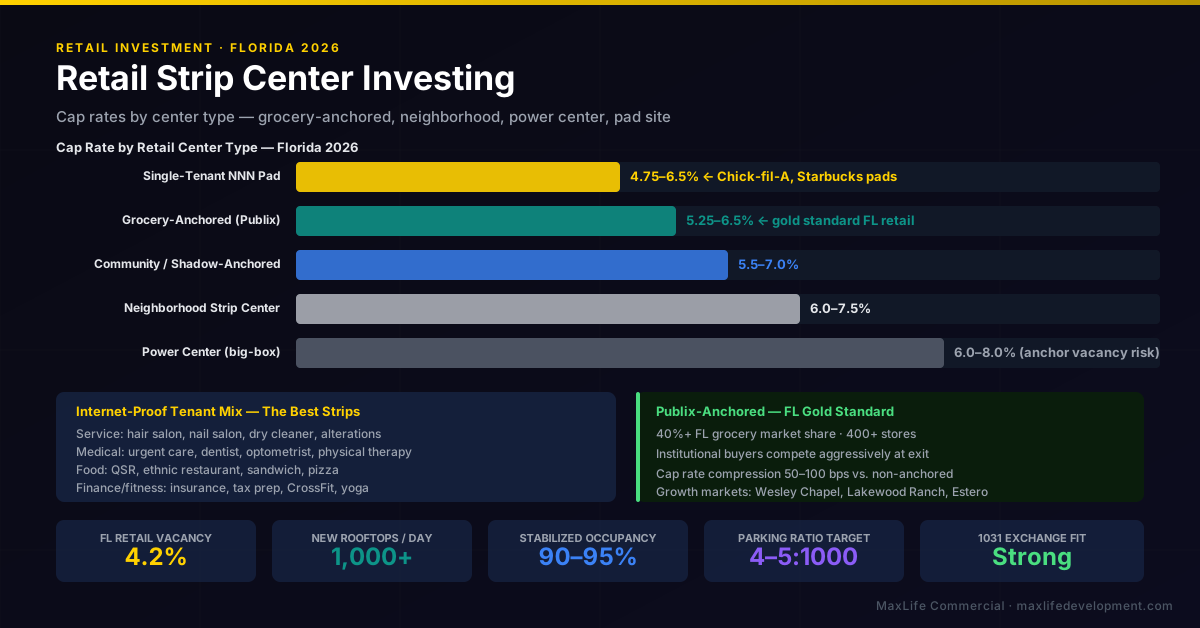
Freestanding outparcels leased to a single national credit tenant — Starbucks, Chick-fil-A, Walgreens, CVS, AutoZone. Usually located at a hard corner with high traffic visibility. Cap rates run 4.75–6.5% depending on tenant credit and remaining lease term. The easiest format to own: true passive income with no management required.
- →Cap rates: 4.75–6.5%
- →Absolute NNN or NN — tenant handles taxes, insurance, maintenance
- →Lease terms: 10–20 years with 10% bumps every 5 years
- →Best 1031 target for investors exiting active management
Neighborhood Strip Center (5,000–30,000 SF)
The core of the Florida retail investment market. Multi-tenant inline retail with 5–10 service-oriented local and regional tenants. No major anchor required. These centers run best when 70%+ of tenants are internet-proof service businesses. Higher management intensity than NNN pads, but value-add upside is significant.
- →Cap rates: 6.0–7.5%
- →Typical deal size: $1.5M–$6M
- →Best value-add play in Florida retail
- →5–10 tenants; re-leasing drives cap rate compression
Community Center / Shadow-Anchored (30,000–150,000 SF)
Larger centers either anchored directly by a grocer or big-box (Target, HomeGoods) or located adjacent to one — a "shadow anchor" that drives foot traffic without being on your title. These are more complex to underwrite and manage but benefit from anchor-driven traffic that supports inline tenant performance and rent growth.
- →Cap rates: 5.5–7.0%
- →Institutional buyer pool — liquid at exit
- →CAM complexity higher; verify recovery ratios
- →Co-tenancy clauses: understand anchor departure triggers
Grocery-Anchored Center (Publix, Aldi, Winn-Dixie)
The gold standard of Florida retail investment. Centers anchored by Publix — which commands 40%+ of Florida grocery market share — generate the most consistent foot traffic of any retail format. Inline tenants benefit from daily grocery trips; occupancy and renewal rates routinely outperform all other retail categories. Publix does not pay percentage rent, but the foot traffic more than compensates inline tenants.
- →Cap rates: 5.25–6.5%
- →Publix: 400+ Florida stores, 40%+ state market share
- →Highest renewal rates of any Florida retail anchor
- →Institutional buyer demand strongest in this category
Power Center (Big-Box: Walmart, Home Depot, Ross)
Large-format centers anchored by national category-killers. Well-located power centers with essential retailers continue to perform, but this format carries the most structural risk from e-commerce. Big-box vacancy is difficult and expensive to backfill. Underwrite anchor renewal probability carefully.
- →Cap rates: 6.0–8.0%
- →Higher yield reflects big-box vacancy risk
- →Re-tenanting a 50,000+ SF box is a multi-year capital event
- →Best positioned with home improvement, grocery, or fitness anchor
Florida Retail Fundamentals 2026
Florida's retail market is operating from a position of genuine structural strength — not a cyclical uptick, but durable supply-demand imbalance driven by population and tourism.
- →Vacancy: Florida retail vacancy sits at 4.2% — below the national average of 4.9%. Well-leased grocery-anchored centers in growth corridors routinely run below 2% vacancy.
- →Population Growth: 1,000+ net new households per day statewide creates continuous new demand for neighborhood retail. The growth is concentrated in suburban markets where strip center supply is still catching up.
- →Tourism: 75M+ annual visitors contribute restaurant, service, and retail spending that supplements resident demand — particularly in Central Florida and coastal markets.
- →Cap Rate Geography: Coastal markets (Naples, Sarasota, Palm Beach) command 50–100 bps tighter caps than inland Central Florida. Growth suburban corridors (Wesley Chapel, Lake Nona) are compressing rapidly.
- →Publix Dominance: With 400+ Florida stores and 40%+ market share, Publix is the single most powerful anchor in Florida retail. A Publix-anchored center is the closest thing to investment-grade residential in CRE.
Building an Internet-Proof Tenant Mix
The best Florida strip centers are built around tenants who will never lose a sale to Amazon Prime. When you underwrite or reposition a strip center, the tenant mix is the most important driver of long-term occupancy and rent growth.
An ideal neighborhood strip center mix by category:
Service
Hair salon, nail salon, dry cleaner, alterations, pet grooming
Medical / Health
Urgent care, dentist, optometrist, physical therapy, chiropractic
Food & Beverage
QSR, pizza, sandwich, ethnic restaurant, coffee (non-chain fills best)
Personal Finance
Insurance office, tax prep, bank branch, title company
Fitness
Yoga studio, martial arts, CrossFit, dance, pilates
Anchor / Shadow
Publix, Aldi, CVS, Dollar General (outparcel or shadow)
Medical tenants deserve special emphasis. Urgent care, dental, and physical therapy bring longer lease terms (5–10 years), significant tenant improvement investment that makes them sticky, and higher credit quality than most retail tenants. A strip center that is 30–40% medical-adjacent has materially lower vacancy risk across economic cycles.
Underwriting a Florida Strip Center
Strip center underwriting is more nuanced than single-tenant NNN. Seven metrics drive every investment decision:
- →Occupancy: 90%+ is stabilized. 85–90% is a value-add opportunity with manageable lease-up risk. Below 80% signals distress — price accordingly and budget for 12–18 months of carrying costs.
- →WALT (Weighted Average Lease Term): 3+ years preferred. Beware of a portfolio of leases all expiring in the same 12-month window — that concentration creates serious re-leasing and income risk simultaneously.
- →Rent Per SF vs. Market: Pull Colliers, CBRE, or LoopNet market rent comparables. Leases 15–20% below market signal value-add upside on renewal. Above-market leases may not renew at current rates — underwrite the rolldown.
- →Expense Ratio & CAM Recovery: NNN and modified gross leases push expenses to tenants. Verify the CAM recovery rate — a strip center recovering 90%+ of operating expenses is significantly more valuable than one at 70%.
- →Anchor Dependency: If a grocer or anchor leaves, can in-line rents sustain the pro-forma? Stress-test NOI without the anchor. Co-tenancy clauses that let inline tenants reduce rent or terminate after anchor departure are a red flag.
- →Traffic Count & Parking: A main-road strip center needs 15,000–30,000+ AADT. Parking ratio of 4–5 per 1,000 SF is standard — below 4:1 will cost you medical and restaurant tenants.
- →Deferred Maintenance: Roof, HVAC units, and parking lot are the three biggest capital items. Always get an independent property condition assessment. Budget $3–8 per SF for a full parking lot resurface; $8–15 per SF for roof replacement.
Get Off-Market CRE Deals in Your Inbox
Join our investor list for exclusive Central Florida opportunities, market reports, and deal analysis — delivered weekly. No spam, unsubscribe anytime.
Value-Add Plays in Florida Strip Centers
Strip centers offer more value-creation levers than any other retail format. The best Central Florida value-add opportunities in 2026:
- →Re-tenanting with Service / Medical: Replace legacy retail with urgent care, dental, or physical therapy. Medical tenants sign longer leases (7–10 yr), pay for their own TI build-out, and rarely leave. This single move can compress cap rates by 50–100 bps.
- →Adding QSR Outparcels: McDonald's, Chick-fil-A, or Starbucks pad ground leases on excess parking land generate pure yield at 4.75–5.5% — while simultaneously driving traffic that benefits your inline tenants.
- →Splitting Oversized Vacancies: A former 10,000 SF grocery box can be demised into three or four suites — urgent care, fitness studio, and two service bays — often at 2x the rent per SF versus a single-tenant lease.
- →EV Charging Station Integration: Partnering with ChargePoint or Tesla on a portion of the parking lot brings a rent-paying tenant, qualifies for federal tax credits under the IRA, and generates daily dwell traffic that benefits food and service tenants.
- →NNN Lease Conversions: Converting gross leases (landlord pays operating expenses) to NNN on renewal shifts $4–8 per SF in annual expenses to tenants. A 20,000 SF strip center converting to NNN can add $80,000–$160,000 in annual NOI with no capital outlay.
Financing Florida Strip Centers
Strip center financing is well-supported by multiple capital sources. CMBS, local bank, regional bank, and SBA 504 are all available for the right deal structure.
- →LTV: Typical 65–70% for stabilized assets. Lenders may cap at 65% if a single anchor occupies 40%+ of GLA and has fewer than 7 years remaining — anchor concentration risk.
- →DSCR: 1.25x minimum; most lenders prefer 1.30x on value-add assets. Underwrite conservatively — do not include lease-up assumptions in your debt sizing.
- →Interest Rate Environment: In 2026, 10-year fixed rates on retail sit 150–200 bps above the 10-year Treasury. CMBS executes efficiently on stabilized grocery-anchored product above $5M.
- →Anchor Lease Term: Lender comfort is often directly tied to the anchor's remaining lease term. A Publix with 12 years remaining is a very different lending conversation than one with 3 years.
Publix-anchored strip centers in Florida's suburban growth markets are the closest thing to investment-grade residential in commercial real estate — consistent foot traffic, high renewal rates, and institutional buyer interest at exit.
1031 Exchange Fit and Exit Strategy
Florida strip centers are among the most liquid CRE assets in the Southeast. The buyer pool spans private investors, family offices, REITs, and institutional separate accounts. For investors exiting apartment buildings, industrial, or multi-family portfolios via 1031 exchange, a Florida strip center is one of the strongest downstream replacement property options — passive income, no operational complexity, and a deep market of co-investors you can sell to in 5–10 years.
Growth corridor markets that have historically delivered cap rate compression over 7–10 year holds: Wesley Chapel, Lake Nona, Lakewood Ranch (Sarasota), and Estero/Fort Myers. Investors who bought neighborhood strips in these submarkets in 2015–2018 at 7.5–8.0% caps have seen values double as the market repriced to 5.5–6.5% on the same NOI.
For a step-by-step look at how NNN and retail properties work within a 1031 exchange, see our 1031 Exchange Orlando Guide. To analyze a specific deal before going under contract, use our Deal Analyzer.
Retail Investment
Grocery-Anchored Retail Centers
Looking for Strip Centers in Florida?
Ryan Solberg and MaxLife Commercial specialize in retail investment properties across Central Florida — from neighborhood strip centers to grocery-anchored community centers. Whether you're acquiring, repositioning, or selling, we bring the deal flow and market knowledge to get it done.
Frequently Asked Questions
What are typical cap rates for retail strip centers in Florida in 2026?
Cap rates vary by format. Single-tenant NNN pads: 4.75–6.5%. Neighborhood strip centers (5,000–30,000 SF): 6.0–7.5%. Shadow-anchored community centers: 5.5–7.0%. Grocery-anchored centers (Publix, Aldi): 5.25–6.5%. Power centers (big-box): 6.0–8.0%. Coastal markets command 50–100 bps tighter caps versus inland.
Are grocery-anchored strip centers better investments than non-anchored retail in Florida?
Generally yes. Publix commands 40%+ Florida grocery market share, drives consistent foot traffic, and creates an institutional buyer pool at exit. Non-anchored neighborhood strips offer higher yields (6.5–7.5%) but require more active tenant management and carry more re-leasing risk.
How do I find retail strip centers for sale in Florida?
On-market properties appear on LoopNet, CoStar, and Crexi. The best deals move off-market through broker relationships and direct owner outreach. MaxLife Commercial tracks off-market strip center opportunities across Central Florida — contact us to get on the deal flow list.
What makes a strip center a good investment in Florida?
The strongest Florida strip centers share: 90%+ occupancy, internet-proof service tenant mix (medical, personal care, food, finance), WALT of 3+ years, NNN leases with strong CAM recovery, 15,000–30,000+ AADT traffic, 4–5:1,000 SF parking, and proximity to a grocery anchor or shadow anchor in a population growth corridor.
Related Articles
Best Orlando Retail Submarkets 2026
Strip centers, outparcels, anchored retail, and NNN across Central Florida's top corridors.
Orlando NNN Properties for Sale 2026
National credit tenants, cap rates, and acquisition strategy for NNN investors in Central Florida.
The Ultimate Guide to NNN Investing
How to source, underwrite, and close NNN properties across Florida.
1031 Exchange Orlando Guide
Strip centers are among the best 1031 replacement assets — here's how the process works.
Cap Rate vs. Cash-on-Cash Return
Two numbers every retail investor quotes — and why leverage changes everything.
Florida CRE Investor Guide
The structural case for Florida commercial real estate — growth drivers, tax advantages, and strategy.