Retail Market Overview
Orlando's retail real estate market benefits from a combination of factors that few metros can match: a massive tourism industry that drives foot traffic to commercial corridors, a rapidly growing resident population that sustains neighborhood and community retail, and a business-friendly regulatory environment that supports new development. The result is a retail market with diverse investment opportunities across a wide range of property types and price points.
While the broader narrative around retail real estate nationally has focused on challenges facing enclosed malls and big-box stores, Orlando's open-air retail formats have performed well. Strip centers, grocery-anchored shopping centers, and single-tenant net lease properties have seen stable or improving occupancy, supported by population growth and the continued expansion of service-oriented retailers that are resistant to e-commerce disruption.
The metro area's retail inventory totals roughly 130 million square feet spread across Orange, Seminole, Osceola, and Lake counties. Vacancy rates for well-located retail properties have hovered between 4% and 6% in recent years, with grocery-anchored centers and high-traffic corridor strip centers often running below 3% vacancy. Net absorption has been consistently positive, driven by both organic tenant expansion and new-to-market brands establishing their first Central Florida locations.
Orlando's population growth rate has outpaced the national average for over a decade. The metro adds an estimated 1,500 new residents per week, which translates directly into demand for neighborhood retail services such as grocery stores, medical offices, restaurants, fitness centers, and personal care businesses. This resident-driven demand creates a durable floor under retail occupancy that distinguishes Orlando from metros where retail performance depends more heavily on discretionary spending alone.
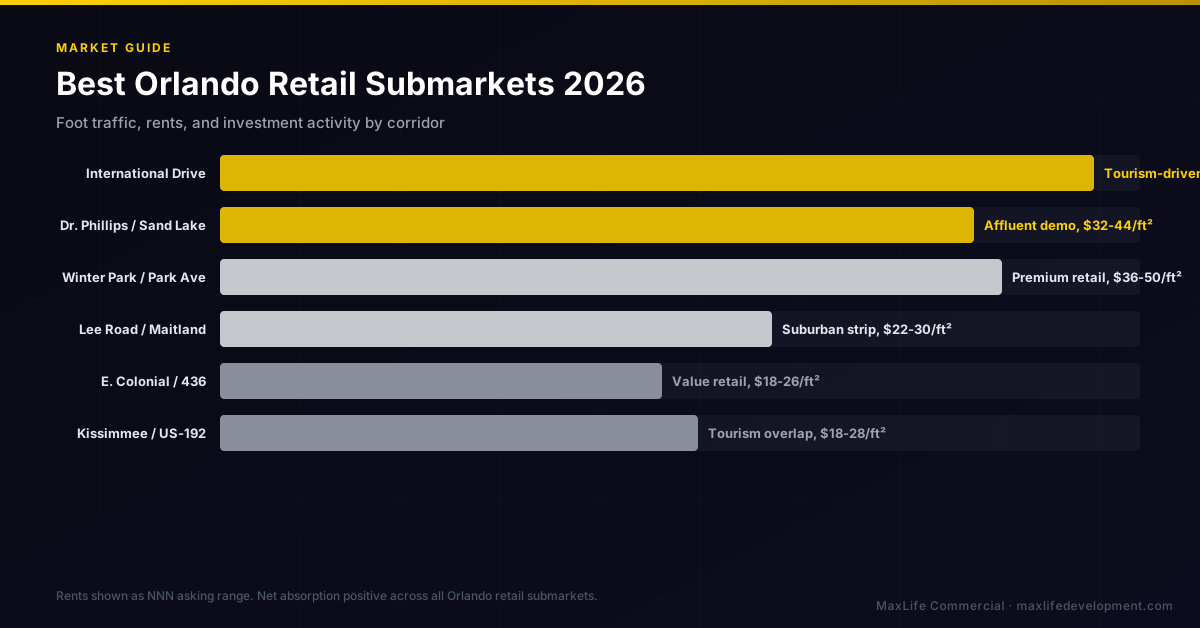
The Orlando commercial real estate market offers retail investors access to a large, liquid market with strong demographic tailwinds. Whether you are targeting single-tenant NNN properties or multi-tenant strip centers, the metro provides a deep pool of available opportunities. Average asking rents for inline retail space across the metro range from $18 to $35 per square foot on a triple net basis, with premium corridor locations commanding $40 or more per square foot for high-visibility endcap and outparcel positions.
Retail Property Types in Orlando
Understanding the different categories of retail real estate is essential for identifying investments that align with your risk tolerance, return objectives, and management capacity. Each property type carries its own set of characteristics.
Single-Tenant Net Lease (NNN)
Freestanding buildings leased to a single tenant on a triple net basis. National credit tenants like pharmacies, quick-service restaurants, auto parts stores, and dollar stores are common. These properties offer the most passive form of retail investment with predictable income streams.
Strip Centers
Small to mid-size multi-tenant retail buildings, typically 5,000 to 30,000 square feet, anchored by a mix of local and regional tenants. Strip centers require more active management than NNN properties but can offer higher yields and value-add upside through releasing and renovation.
Grocery-Anchored Shopping Centers
Larger retail centers anchored by a major grocery chain such as Publix, Walmart Neighborhood Market, or Aldi. The grocery anchor drives consistent foot traffic that benefits inline tenants and supports stable occupancy. These properties are highly sought by institutional investors.
Outparcels
Freestanding pad sites located at the perimeter of larger shopping centers, often along major roadways with high visibility and traffic counts. Outparcels are frequently leased to quick-service restaurants, banks, and coffee shops on NNN terms.
Power Centers and Big Box
Large-format retail centers anchored by national retailers. While these properties face more disruption risk from e-commerce, well-located power centers with experiential tenants and essential retailers continue to perform in the Orlando market.
For investors new to retail, single-tenant NNN properties provide the simplest entry point. Our guide to triple net leases explains how NNN lease structures work and what to evaluate before making an investment.
In the Orlando market, single-tenant NNN retail properties typically trade between $1.2 million and $4.5 million for freestanding quick-service restaurants and pharmacies. Common tenants include Walgreens, CVS, Dollar General, Dollar Tree, Starbucks, Chick-fil-A, Taco Bell, and Wawa. Properties leased to tenants with investment-grade credit ratings (BBB- or higher) command tighter cap rates and greater buyer competition, while franchisee-guaranteed leases offer higher yields with correspondingly higher risk.
Multi-tenant strip centers in Orlando typically range from $1.5 million to $8 million, depending on size, occupancy, and location. Value-add investors frequently target strip centers with below-market rents, deferred maintenance, or vacancy that can be addressed through releasing, renovation, and improved property management. A well-executed value-add strategy on a strip center can compress cap rates by 100 to 200 basis points over a three- to five-year hold period, generating attractive total returns through both income growth and appreciation. Use our Deal Analyzer to model these scenarios before committing capital.
Top Retail Corridors and Submarkets
Retail property performance is heavily influenced by location, and Orlando offers several high-performing corridors that attract strong tenant interest and command premium rents. Traffic counts, population density, household income, and proximity to major employers all factor into corridor quality.
International Drive
One of the highest-traffic retail corridors in Florida, International Drive benefits from tens of millions of annual tourist visitors. Retail properties here serve both tourist and resident populations, with strong demand from restaurants, entertainment concepts, and specialty retail.
Colonial Drive (SR 50)
A major east-west arterial that bisects the metro, Colonial Drive serves a dense resident population with neighborhood retail, services, and dining. Traffic counts exceed 50,000 vehicles per day in many segments, supporting strong tenant demand.
US-192 / Kissimmee
The US-192 corridor in Kissimmee has evolved from a tourism-focused strip into a major retail destination serving the rapidly growing Osceola County population. New retail development and redevelopment activity has accelerated along this corridor.
Narcoossee Road / Lake Nona
The growth of Lake Nona has created significant retail demand along Narcoossee Road and the surrounding area. New grocery-anchored centers and outparcels have been developed to serve the expanding residential and employment base.
Beyond these primary corridors, several secondary submarkets deserve attention from retail investors. The Semoran Boulevard (SR 436) corridor running through Casselberry, Altamonte Springs, and south into Orange County carries daily traffic counts above 45,000 vehicles and supports a dense concentration of strip centers and outparcels. Sand Lake Road, connecting International Drive to the Orlando International Airport, has emerged as a dining and retail destination with rents approaching $35 to $45 per square foot for prime pad sites. The Apopka-Vineland Road corridor near the attractions area and Windermere continues to benefit from residential growth in the western suburbs, with new Publix-anchored centers and quick-service restaurant outparcels under construction.
Horizon West, located in southwest Orange County, represents one of the fastest-growing planned communities in the country. The area has attracted significant new retail development including Hamlin Town Center, which features a mix of national and regional tenants serving the tens of thousands of new homes delivered in the surrounding master-planned communities. Retail vacancy in Horizon West is among the lowest in the metro, and asking rents for new construction inline space start at $28 to $32 per square foot NNN.
Our International Drive market page provides additional detail on one of the most dynamic retail corridors in the Southeast. Investors focused on NNN retail along these corridors can also explore our Orlando NNN properties guide for current opportunities.
Retail Lease Structures in Orlando
Lease structure is one of the most critical variables in retail real estate investment, and Orlando's retail market features the full spectrum of lease types. Understanding the differences between triple net (NNN), modified gross, and percentage rent leases is essential for accurately underwriting income, forecasting expenses, and comparing properties on an apples-to-apples basis.
Triple net leases are the dominant structure for single-tenant retail properties in the Orlando market. Under a NNN lease, the tenant is responsible for property taxes, insurance, and common area maintenance (CAM) in addition to base rent. This effectively shifts operating expense risk from the landlord to the tenant, creating a predictable net income stream for investors. National credit tenants such as Walgreens, AutoZone, O'Reilly Auto Parts, and 7-Eleven typically execute absolute NNN leases with 10- to 20-year initial terms and contractual rent increases of 1.5% to 2% annually or 10% every five years.
Multi-tenant strip centers and shopping centers in Orlando more commonly use modified gross or NNN structures with landlord- managed CAM billing. In these arrangements, the landlord collects base rent plus a pro-rata share of operating expenses from each tenant. Typical CAM charges for Orlando strip centers range from $4 to $8 per square foot, covering property taxes, insurance, landscaping, parking lot maintenance, and management fees. Investors should pay close attention to CAM reconciliation practices and whether the landlord retains an administrative fee, typically 10% to 15% of total CAM costs.
Percentage rent clauses are less common in Orlando strip centers but appear frequently in grocery-anchored and power center leases with national tenants. Under a percentage rent structure, the tenant pays base rent plus a percentage of gross sales above a defined breakpoint. For example, a restaurant tenant might pay 6% of annual gross sales exceeding $1.2 million in addition to base rent. These clauses provide investors with upside participation in tenant performance and serve as a natural hedge against inflation over long lease terms.
For investors evaluating Orlando NNN properties for sale, lease analysis should extend beyond the base rent figure. Key metrics include the remaining lease term, the presence and structure of renewal options, rent escalation schedules, tenant termination rights, co-tenancy clauses in multi-tenant properties, and assignment provisions. A 15-year absolute NNN lease with 2% annual bumps to a BBB-rated tenant represents a fundamentally different risk and return profile than a 5-year modified gross lease with a local franchisee. Our Deal Analyzer can help you model the cash flow differences across these structures.
Tourism-Driven vs. Population-Driven Retail
One of the most important distinctions in Orlando retail real estate is the difference between tourism-driven and population-driven retail properties. The metro's unique position as both a major tourist destination and a rapidly growing residential market creates two distinct demand drivers that affect property performance, tenant mix, lease terms, and investment risk in meaningfully different ways.
Tourism-driven retail is concentrated along the International Drive corridor, the US-192 gateway to Walt Disney World, and the areas immediately surrounding the major theme park complexes. These properties benefit from Orlando's approximately 75 million annual visitors, generating foot traffic volumes that far exceed what the local resident population alone could support. Tenants in tourism-driven locations skew toward restaurants, souvenir shops, entertainment venues, and experiential concepts. Rents in prime tourism corridors can reach $50 to $70 per square foot for high-visibility restaurant and retail pad sites, reflecting the outsized sales volumes these locations can produce.
However, tourism-driven retail carries unique risks. Revenue is seasonal, with peak periods during summer and holidays and softer months in September and January. External disruptions such as hurricanes, public health events, or economic downturns can sharply reduce visitor counts and tenant sales in ways that do not affect population-driven retail to the same degree. Investors in tourism-corridor properties should underwrite conservatively, stress-test cash flows against historical demand volatility, and favor tenants with strong balance sheets capable of weathering seasonal and cyclical swings.
Population-driven retail, by contrast, is anchored by the daily spending needs of Orlando's resident base. Grocery stores, medical offices, veterinary clinics, dry cleaners, hair salons, fitness centers, and quick-service restaurants generate revenue from repeat local customers rather than transient visitors. These properties tend to be located in suburban growth corridors like Lake Nona, Horizon West, Winter Garden, and the Kissimmee-St. Cloud area. Occupancy is typically more stable, lease terms are often longer for anchor tenants, and cash flows are less volatile across economic cycles.
The most resilient retail investments in the Orlando market often blend both demand drivers. A grocery-anchored center on Sand Lake Road, for instance, draws its primary customer base from nearby residents but also captures spending from convention attendees and tourists visiting the nearby attractions. Understanding where a property falls on the tourism-to-residential demand spectrum, and how that affects tenant performance, is fundamental to accurate underwriting. Explore how these dynamics affect pricing across the Orlando commercial real estate market in our full market overview.
Retail Investment Strategy and Cap Rates
Retail cap rates in Orlando vary significantly by property type, tenant quality, lease term, and location. Single-tenant NNN properties leased to investment-grade credit tenants with long remaining lease terms trade at the lowest cap rates, often in the 4.5-5.5% range. Multi-tenant strip centers and unanchored retail properties offer higher yields, typically in the 6.5-8.5% range, reflecting the additional management intensity and leasing risk.
Grocery-anchored shopping centers in Orlando typically trade at cap rates between 5.5% and 7.0%, positioning them between the safety of credit-tenant NNN and the higher yields of unanchored strip centers. Publix-anchored centers are particularly sought after due to the chain's dominant market share in Florida, strong same-store sales performance, and reputation for driving consistent foot traffic. A Publix-anchored center with strong inline occupancy in a growing submarket like Lake Nona or Horizon West will trade at a meaningful premium to a comparable center anchored by a less dominant grocer.
Value-add retail investments represent a compelling strategy in the current Orlando market. Properties with near-term lease expirations, below-market rents, or correctable vacancy offer the opportunity to acquire at higher going-in cap rates and drive cap rate compression through active management. For example, a 12,000-square-foot strip center on Semoran Boulevard purchased at an 8.0% cap rate with two vacant suites could be stabilized at a 6.5% cap rate within 18 to 24 months through targeted leasing and modest tenant improvement investment, generating significant equity creation on a leveraged basis.
Successful retail investors in Orlando focus on properties with strong traffic counts, established tenant mixes, and lease structures that provide income growth. Look for properties with built-in rent escalations, percentage rent clauses tied to tenant sales, and staggered lease expirations that reduce the risk of simultaneous vacancy.
For a comprehensive look at cap rate trends across all commercial property types in the Orlando metro, visit our Orlando cap rates investor guide. Use our Deal Analyzer to model retail investment scenarios and compare returns across different property types and lease structures.
Retail Market Outlook
The outlook for Orlando retail real estate is cautiously optimistic. While the sector faces ongoing structural shifts driven by e-commerce and changing consumer preferences, the formats that have adapted — service-oriented tenants, experiential retail, grocery-anchored centers, and essential-service NNN properties — continue to perform well in the Orlando market.
Population growth remains the primary tailwind. As Orlando continues to add residents, the demand for neighborhood goods and services grows proportionally. New residential communities in Lake Nona, Horizon West, and the Kissimmee-St. Cloud corridor are creating retail voids that developers and investors are working to fill, presenting near-term acquisition and development opportunities.
Construction activity in the retail sector has been disciplined compared to previous cycles. Developers are primarily building grocery-anchored and necessity-based retail rather than speculative power centers or lifestyle projects, which limits new supply and supports occupancy for existing properties. The cost of new construction, which has risen to $250 to $350 per square foot for ground-up retail in desirable Orlando submarkets, creates a replacement cost floor that supports values for existing well-located properties. When the cost to build new exceeds the cost to acquire existing stabilized assets, investors benefit from a natural value backstop.
The continued expansion of the Orlando International Airport, including the new Terminal C that opened in 2022 and the planned Brightline high-speed rail connection, will further boost the metro's accessibility and reinforce its position as a leading tourism and business destination. These infrastructure investments support long-term retail demand by increasing both visitor counts and the desirability of the metro for new residents and employers. The recently completed I-4 Ultimate reconstruction project has also improved traffic flow through the core of the metro, benefiting retail corridors along and adjacent to the interstate.
Investors who focus on well-located properties with e-commerce-resistant tenant mixes and strong lease structures are well-positioned to generate attractive risk-adjusted returns in the Orlando retail market. The key is selectivity — not all retail is created equal, and the gap between winning and losing properties continues to widen. Properties anchored by grocery, medical, and essential-service tenants in growing suburban corridors offer the strongest combination of income stability and long-term appreciation potential in the current Orlando commercial real estate landscape.
Related Reading
Retail Space for Rent in Orlando
Tenant representation for endcap, inline, freestanding, and anchored retail across Orlando's top submarkets.
Off-Market Commercial Deals in Orlando
Get early access to retail and investment-grade commercial properties before they hit the public market.
NNN Properties in Florida
Single-tenant triple-net retail investments across Orlando and Central Florida.
Build-to-Suit Development in Orlando
Custom retail development for QSR, service retail, and franchise expansion across Orlando.
Browse Retail Properties for Sale
Florida retail property categories — from single-tenant NNN to institutional shopping centers.
All Retail Properties
Every retail category — NNN, strip centers, shopping centers, and pads.
Freestanding NNN
Single-tenant net lease pads — drug stores, dollar stores, QSR, banks.
Strip Centers
Unanchored multi-tenant retail with the highest yields in Florida CRE.
Shopping Centers
Grocery-anchored neighborhood centers and community retail across Florida.
Explore Orlando Retail Investments
MaxLife Commercial helps investors source, evaluate, and acquire retail properties across Central Florida. From NNN single-tenant assets to multi-tenant strip centers, we cover the full spectrum of retail investment opportunities.
Contact UsGet Off-Market CRE Deals in Your Inbox
Join our investor list for exclusive Central Florida opportunities, market reports, and deal analysis — delivered weekly. No spam, unsubscribe anytime.