QSR Real Estate: The Backbone of NNN Markets
Quick-service restaurant (QSR) properties — McDonald's, Chick-fil-A, Starbucks, Taco Bell, Wendy's, Burger King, Popeyes, and Chipotle — represent the most liquid, most recognizable, and most actively traded segment of the NNN investment market. For investors and 1031 exchangors alike, QSR NNN properties carry a level of brand familiarity that no other tenant category can match: everyone knows what a McDonald's is, everyone understands the business model, and everyone can evaluate the site.
That familiarity creates a uniquely deep buyer pool at exit. A well-located QSR NNN property in a Florida growth corridor attracts institutional buyers, 1031 exchangors, family offices, and private investors simultaneously — producing the kind of liquidity that most commercial real estate categories only aspire to. The combination of brand credit, drive-through dominance (QSR drive-throughs generate 60% to 70% of revenue at most locations), and strong site selection discipline by the chains themselves makes QSR NNN one of the most defensible income streams in the investment property market.
Florida is one of the highest-density QSR markets in the United States. McDonald's operates 700+ Florida locations. Chick-fil-A has built aggressively across Central Florida's growth corridors. Starbucks has a significant presence on every major tourist corridor, suburban retail node, and highway interchange. Taco Bell, Wendy's, Burger King, and Popeyes collectively account for hundreds of additional NNN properties generating investment activity across the state each year.
QSR NNN Market Overview — Florida 2026
Ground Lease vs Fee Simple: The Critical Distinction
Before evaluating any QSR NNN property, investors must understand whether they are buying a ground lease or a fee simple interest — because these are fundamentally different investments with different risk profiles, cap rates, and exit dynamics.
Ground Lease
In a ground lease, you own the land and the tenant owns the building. The tenant constructs the improvement at their expense, operates the restaurant, and pays you ground rent for the use of your land. At the end of the lease term, the building reverts to either the landlord or the tenant depending on the specific lease structure.
Chick-fil-A always uses ground leases. Chick-fil-A owns and builds every restaurant — they do not franchise the real estate. As a Chick-fil-A ground lease investor, you own the land underneath the restaurant and collect ground rent. When the lease expires, the building belongs to Chick-fil-A — not you. This is a pure land investment with the Chick-fil-A lease providing the income stream.
McDonald's offers a mix of ground leases and fee simple transactions. Starbucks primarily sells fee simple freestanding properties or inline spaces. Ground leases trade at lower cap rates than fee simple because you own a less complete interest — you own land but not the improvement. Ground lease cap rates for top QSR brands run 5.0% to 6.0%, compared to 5.5% to 7.0% for fee simple.
Fee Simple
In a fee simple QSR property, you own both the land and the building. This is the conventional commercial real estate structure. Fee simple QSR NNN properties provide a more complete real estate interest, which is why they trade at wider cap rates than comparable ground leases — a higher yield compensates for the investor owning a depreciating improvement.
Fee simple QSR properties also offer better re-tenanting optionality if the original tenant vacates. A freestanding 2,500 SF drive-through building you own outright can be re-leased to any QSR, coffee chain, or fast-casual concept. A ground lease where the building reverts to the tenant provides no such optionality.
Ground Lease vs Fee Simple Comparison
| Ground Lease | Fee Simple | |
|---|---|---|
| You own | Land only | Land + building |
| Cap rates | Lower (tighter) | Higher (wider) |
| Re-tenanting optionality | Limited | Full |
| Example | Chick-fil-A | Starbucks, Taco Bell |
Cap Rates by QSR Brand — Florida 2026
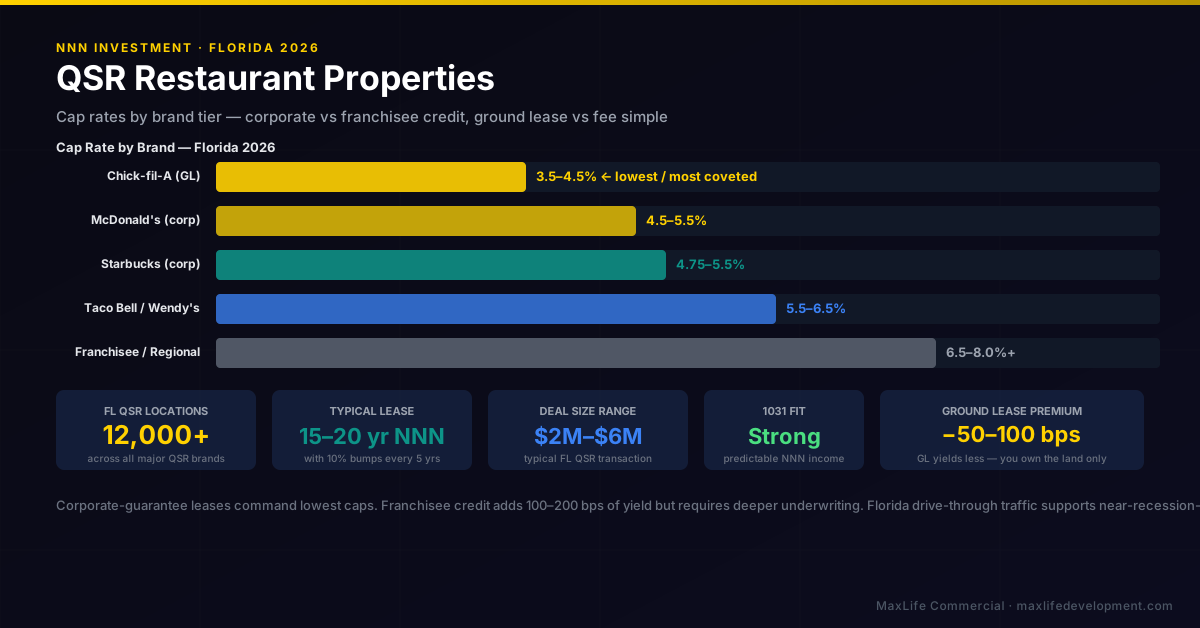
QSR NNN cap rates in Florida span the widest range of any single property category in the net lease market — from Chick-fil-A ground leases at 3.5% to regional QSR concepts at 8.0%+. The spread reflects real differences in tenant credit, unit-level sales, lease structure, and buyer demand.
Chick-fil-A (Ground Lease)
3.5% – 4.5%Strongest credit, highest AUV ($9M+/location), intense buyer demand, and corporate guarantee from Chick-fil-A, Inc. Ground lease structure — you own land only. Rarely available; competes with institutional buyers at every offering.
McDonald's (Fee Simple, Corporate Lease)
4.5% – 5.5%One of the strongest corporate credit guarantees in QSR. Fee simple properties you own land and building. Corporate-operated locations backed by McDonald's Corporation. Florida locations in suburban growth corridors are highly liquid at exit.
Starbucks (Fee Simple)
4.75% – 5.5%Strong investment-grade credit. Drive-through Florida locations command the tightest pricing. 10-year initial terms with 10% bumps every 5 years. Tourist corridor locations (I-Drive, US-192) and suburban growth pods are top performers.
Chipotle (Fee Simple)
4.75% – 5.5%Investment-grade credit, growing national platform, long lease terms. Chipotle's high AUV and corporate guarantee make it a QSR NNN near-peer to Starbucks. Drive-through Chipotles ('Chipotlanes') command tighter pricing.
Taco Bell / Wendy's (Corporate or Franchisee)
5.5% – 6.5%Wider cap rates reflecting franchisee credit risk on most locations. Yum! Brands (Taco Bell) and Wendy's International are investment-grade at the corporate level, but most Florida locations are franchisee-operated. Verify lease guarantor carefully.
Burger King / Popeyes
5.75% – 7.0%Restaurant Brands International owns both brands. Corporate guarantee is investment-grade but most locations are franchised. Cap rates reflect franchisee credit concentration. Well-located Florida locations near tourist corridors or I-4 are on the tight end.
Smaller / Regional QSR
6.5% – 8.0%+Non-investment-grade or private QSR brands (Wingstop, Shake Shack, regional concepts). Higher yield compensates for weaker tenant credit and less liquid exit market. These can be compelling for yield-focused buyers who understand the specific brand and franchisee.
May 2026. Florida cap rates for properties with 10+ years of remaining lease term and market-rate rent. Franchisee leases, shorter terms, and secondary locations trade outside these ranges.
QSR Lease Structure
QSR lease structures vary significantly by brand, lease vintage, and whether the tenant is a corporate operator or franchisee. Understanding the lease is as important as understanding the tenant.
Corporate vs. Franchisee Leases
A corporate QSR lease is executed by the parent company — McDonald's Corporation, Yum! Brands (for Taco Bell and KFC), Restaurant Brands International (for Burger King and Popeyes), or Chick-fil-A, Inc. These leases are backed by billion-dollar balance sheets and investment-grade credit. Cap rates reflect this strength.
A franchisee lease is executed by the individual franchise operator — typically an LLC with a personal guarantee from the owner. Credit quality varies enormously. A 200-unit McDonald's franchisee generating $400M in annual revenue is a very different credit from a single-unit Burger King operator with one location. Always request the guarantor's unit count, average unit volume (AUV), and financial statements during due diligence.
Lease Terms and Rent Bumps
- →McDonald's / Chick-fil-A: 20-year initial terms are standard for these premier brands. Multiple 5-year renewal options. Chick-fil-A ground leases: ground rent typically set as a percentage of restaurant sales or at fixed annual rates with periodic bumps.
- →Starbucks: 10-year initial terms with multiple 5-year renewal options. 10% rent bumps every 5 years is the most common escalation structure for standalone Florida locations.
- →Taco Bell / Wendy's / Burger King: 10-to-15-year initial terms. Rent escalations range from 10% every 5 years to 1.5% to 2% annually depending on the vintage and franchise group negotiating leverage.
- →Popeyes / Church's: 10-year initial terms standard. Franchisee credit is the primary underwriting driver — verify the operator's unit count and AUV before buying.
Lease Structure Pro Tip
Always verify whether the lease is absolute NNN, NNN, or NN. Some QSR leases — particularly older Burger King and Popeyes leases — retain landlord responsibility for structural elements (roof, foundation). A property marketed as “NNN Burger King” may actually carry landlord obligations that reduce the truly passive income yield. Confirm the expense allocation in the actual lease document, not the offering memorandum.
Get Off-Market CRE Deals in Your Inbox
Join our investor list for exclusive Central Florida opportunities, market reports, and deal analysis — delivered weekly. No spam, unsubscribe anytime.
What Makes a Great QSR NNN Site
QSR brands deploy sophisticated site selection analytics before signing a lease — but investors still need to understand what makes a QSR location excellent, average, or problematic. The underlying real estate quality determines both the tenant's long-term performance and the investor's ability to re-tenant the property if the original lease expires without renewal.
- →Corner / hard-corner location: QSR properties on hard corners (intersection of two major roads) command the highest traffic capture and strongest brand visibility. Hard-corner QSR in a Florida suburban growth corridor is the gold standard. Pad sites to grocery-anchored centers are a close second — they benefit from grocery traffic while maintaining QSR independence.
- →Traffic count (VPD): The minimum threshold for investment-grade QSR underwriting is 30,000 vehicles per day (VPD) on the primary road. The best Florida QSR locations see 50,000+ VPD. Confirm traffic counts from FDOT or the offering memorandum — actual counts, not estimates.
- →Drive-through configuration: New-build QSR standards call for a minimum of two dedicated drive-through lanes. Single-lane drive-throughs create bottlenecks that reduce revenue during peak hours. Properties with two or more drive-through lanes command premiums and are preferred by both brands and investors.
- →Ingress and egress: Confirm the property has adequate access from the primary road. Signalized access (a dedicated traffic light) is significantly more valuable than unsignalized access. Properties requiring customers to navigate complex turn restrictions or median barriers underperform comparably located sites with clean access.
- →Dense residential trade area: QSR performance correlates directly with household density within a 1- to 3-mile radius. Florida growth markets with 20,000+ rooftops within 3 miles provide the demand base that sustains long-term tenant performance and renewal probability.
- →New construction or recent renovation: Newly constructed QSR properties feature current brand standards — dual drive-through lanes, modern kitchen configurations, digital menu boards, and efficient traffic flow. Older buildings (pre-2010) may require significant renovation at lease renewal, which can create capital calls even under absolute NNN leases if the tenant chooses not to renew.
Florida QSR Market Concentration
QSR NNN activity in Florida is concentrated in corridors where population growth, tourist traffic, and suburban expansion converge. Understanding which Florida markets produce the most QSR NNN transaction activity helps investors source inventory and evaluate exit liquidity.
I-4 Corridor (Kissimmee, Sanford, Daytona Beach)
The highest QSR density corridor in Florida. Proximity to Disney, Universal, and I-4 interchanges drives extraordinary drive-through volume. McDonald's, Starbucks, Taco Bell, Popeyes, and Chick-fil-A all have multiple locations in this corridor. Cap rates are tightest of any Florida secondary market.
Tourist Corridors (I-Drive, US-192 Osceola)
High-volume stores driven by 75M+ annual Orlando visitors. QSR stores on International Drive and US-192 generate some of the highest per-unit sales volumes in their respective chains. This translates into extremely low non-renewal risk and strong investor demand.
Lake Nona / Medical City (SE Orlando)
One of the fastest-growing mixed-use communities in the country. QSR brands are expanding rapidly to serve a 70,000+ household residential population and major medical campus employees. New construction activity is high — good source of freshly constructed fee simple QSR NNN inventory.
Clermont / Wesley Chapel / Land O' Lakes
High-growth suburban markets on the Tampa-Orlando growth corridor. Strong residential pipelines are driving aggressive QSR expansion by all major brands. New construction fee simple NNN properties at slightly wider cap rates than primary Orlando.
Jacksonville Metro
Florida's fastest-growing major city by population. QSR NNN properties trade 50 to 75 basis points wider than comparable Orlando assets due to lower institutional buyer attention. Excellent for yield-focused investors who are comfortable with a secondary-market exit pool.
Tampa Bay (Wesley Chapel, Brandon, Riverview)
High-income suburban markets with strong QSR demand. Wesley Chapel in particular has seen explosive population growth — Chick-fil-A, Chipotle, and Starbucks have all added locations in the past 24 months. Cap rates approximate I-4 corridor pricing.
QSR NNN Risks Every Investor Should Know
QSR NNN properties are not risk-free investments. Investors who understand the specific risks — and how to mitigate them — make better decisions and avoid costly mistakes.
Franchisee credit risk
The most common mistake in QSR NNN investing is paying investment-grade cap rates for a franchisee lease. Verify who guarantees the lease. A single-unit Taco Bell franchisee is not Yum! Brands. Request the guarantor's financial statements, unit count, and AUV during due diligence. Large multi-unit operators (50+ locations) provide meaningful credit; small operators are personal credit plays.
Demolition clauses
Some QSR leases — particularly older McDonald's and Burger King leases — contain demolition clauses that give the tenant the right to demolish the building at lease expiration. If a tenant exercises a demolition clause, you are left with bare land and no building. Verify whether any demolition clause exists and what conditions trigger it before closing.
Chick-fil-A ground lease expiration
When a Chick-fil-A ground lease expires, the building reverts to Chick-fil-A — not to you. You are left with bare land. Chick-fil-A typically renews ground leases at strong locations, but investors must underwrite this residual risk explicitly. Ground lease investors should model scenarios where Chick-fil-A does not renew and assess what the bare land is worth.
Cap rate compression sensitivity at 3%–4% yields
Chick-fil-A ground leases trading at 3.5% to 4.0% cap rates are extremely sensitive to interest rate movements. A 100 basis point increase in the 10-year Treasury rate can theoretically compress a 3.75% cap rate QSR property's value by 20% or more. Investors buying at historically tight cap rates should have long hold horizons and strong conviction in the income stream's durability.
Brand disruption and format evolution
QSR formats are evolving rapidly — ghost kitchens, digital-only ordering, and delivery-first concepts are changing the physical footprint requirements of fast food brands. A McDonald's signed in 2010 may have a very different physical configuration than the brand's 2026 preferred format. Re-tenanting a mismatched footprint can be challenging and expensive.
QSR as a 1031 Exchange Target
QSR NNN properties are among the most popular 1031 exchange replacement property classes for several reasons that go beyond simple yield: the brands are universally recognizable, the income is predictable, and the exit market is among the deepest in commercial real estate. For 1031 buyers who need to explain a replacement property investment to family members, advisors, or future heirs, “I own the McDonald's on Route 192 in Kissimmee” is an extremely communicable investment thesis.
Why QSR Is the Top 1031 Exchange Target
A retired apartment investor in Central Florida sells a 20-unit multifamily building for $4.2M after decades of active management. They use a 1031 exchange to acquire a fee simple Starbucks drive-through in a Lake Nona growth corridor at a 5.0% cap rate — $2.1M purchase price. The exchange defers the capital gain, the investor collects $105K annually in passive income with zero management obligations, and the 10-year Starbucks lease with 10% bumps every 5 years provides income predictability through 2036. No tenants to manage, no maintenance calls, no rent roll to track. At lease expiration, the deep QSR buyer pool provides a liquid exit at competitive cap rates.
The primary challenge for 1031 exchange buyers targeting QSR NNN — particularly Chick-fil-A and McDonald's corporate — is inventory scarcity. These properties are rarely available and compete against institutional buyers with pre-established broker relationships. Working with a broker who has deep NNN relationships is essential for 1031 buyers on a 45-day identification deadline.
Use our Deal Analyzer to model QSR NNN cash flow, 1031 exchange equity scenarios, and hold period returns for specific cap rates and rent escalation structures.
Looking for a QSR NNN Property in Florida?
MaxLife Commercial sources Chick-fil-A, McDonald's, Starbucks, and QSR NNN properties across Florida — on-market and off-market. Whether you're a 1031 exchange buyer on a deadline, a passive income investor, or assembling a multi-property NNN portfolio, we can help you find and evaluate the right asset.
Frequently Asked Questions
What cap rate do Chick-fil-A properties sell for in Florida?
Chick-fil-A ground leases in Florida trade at 3.5% to 4.5% cap rates in 2026. The extraordinary unit-level sales volume ($9M+ per location average), corporate guarantee, and intense institutional buyer demand compress cap rates to near-treasury levels. Florida locations in high-growth suburban corridors regularly trade below 4.0%.
What is the difference between a Chick-fil-A ground lease and a McDonald's fee simple?
In a Chick-fil-A ground lease you own only the land — Chick-fil-A owns and maintains the building, and the building reverts to Chick-fil-A at lease expiration. In a McDonald's fee simple you own both the land and the building, giving you a more complete real estate interest and better re-tenanting optionality if McDonald's vacates.
Are corporate or franchisee QSR leases better?
Corporate leases backed by McDonald's Corporation, Yum! Brands, or Chick-fil-A, Inc. are significantly stronger than franchisee leases — they carry investment-grade corporate credit and trade at tighter cap rates. Franchisee leases can be excellent investments for large, financially strong franchise groups, but require more credit diligence than corporate leases.
What makes a QSR site a good investment?
The best QSR NNN sites have hard-corner or prominent pad locations with 30,000+ VPD traffic counts, minimum 2 dedicated drive-through lanes, strong ingress and egress (ideally signalized), dense residential trade areas, and new or recently renovated construction. These site characteristics support strong tenant performance and maximize re-tenanting optionality if the original lease expires.
Are QSR NNN properties good for 1031 exchanges?
Yes — QSR NNN properties are among the top 1031 exchange replacement asset classes. Brand recognition makes them easy to communicate to advisors and family members, long lease terms provide income predictability, and deep national buyer demand at exit provides strong liquidity when you eventually sell. The main challenge is finding available Chick-fil-A or McDonald's corporate inventory within the 45-day identification window.
What happens when a Chick-fil-A ground lease expires?
When a Chick-fil-A ground lease expires, the building belongs to Chick-fil-A — not you. You are left with bare land. Chick-fil-A typically renews at strong locations and has historically maintained a very high renewal rate, but investors must explicitly underwrite the residual land value scenario where Chick-fil-A does not renew and quantify the risk in their analysis.
Related Articles
Dollar Store NNN Investing in Florida 2026
Dollar General, Dollar Tree, and Family Dollar NNN properties — cap rates, lease structures, and where to find deals.
Ground Lease vs Fee Simple
The critical structural distinction every QSR NNN investor needs to understand before buying.
Ultimate Guide to NNN Investing
Complete NNN investing framework — lease structures, underwriting, financing, and portfolio strategy.
Net Lease Investing in Florida 2026
Why Florida is the #1 net lease market — cap rates, tenant categories, and best submarkets.
1031 Exchange Orlando Guide
QSR NNN is a top 1031 replacement property — here is how the exchange process works.
Cap Rate vs Cash-on-Cash Return
Two metrics every QSR NNN investor needs — and why leverage changes the equation.