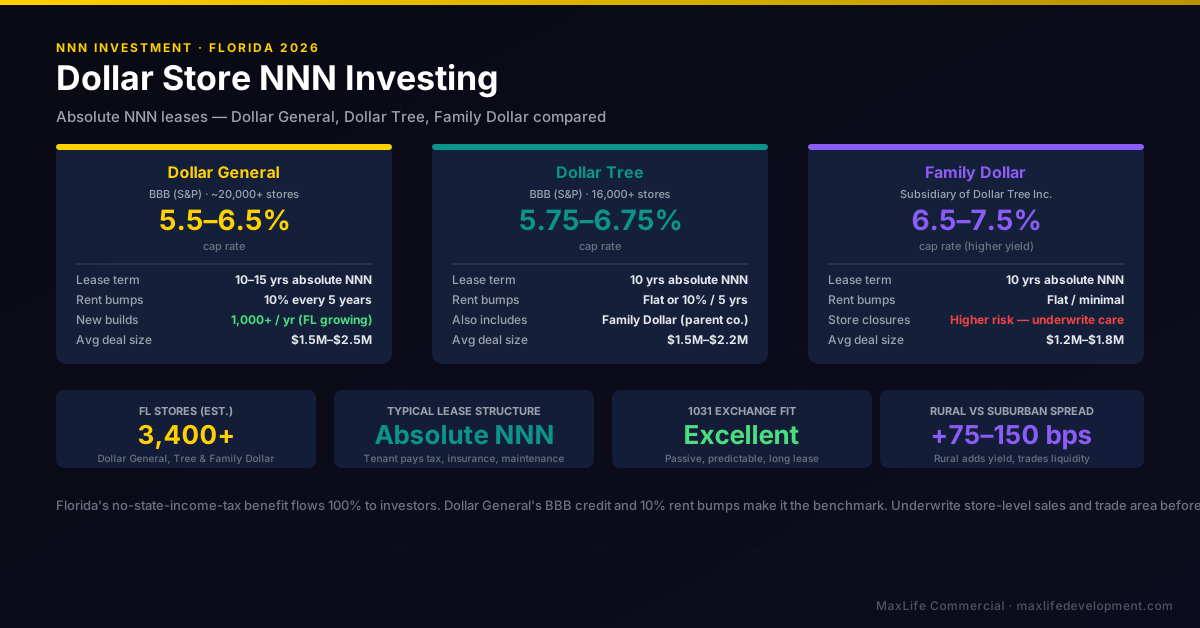
Why Dollar Stores Dominate the NNN Market
Three brands — Dollar General, Dollar Tree, and Family Dollar — operate over 35,000 locations across the United States, making them the single largest category of freestanding NNN retail properties in the country. For NNN investors, dollar stores represent a compelling combination of credit quality, lease length, and operational simplicity that few other tenant categories can match.
What sets dollar stores apart from other NNN tenants is their recession-resistant business model. Unlike restaurants, clothing retailers, or electronics stores, dollar store sales actually increase during economic downturns as consumers trade down from supermarkets and discount chains. During the 2008–2009 recession and again during the inflation surge of 2021–2023, dollar store same-store sales grew while other retailers contracted. For an NNN investor, this means your tenant is most likely to keep paying rent precisely when the rest of the economy is struggling.
Dollar store leases are structured as absolute NNN: the tenant pays property taxes, insurance, maintenance, roof, and structure — the landlord collects a check and has no obligations. Initial terms run 10 to 15 years with multiple 5-year renewal options. Dollar General's standard lease includes 10% rent bumps every 5 years, providing income growth that outpaces typical inflation over a 15-year hold.
Florida is one of the most active dollar store expansion markets in the country. With 3,000+ locations already open and 150+ new stores opening each year across rural markets, suburban corridors, and underserved communities, Florida's dollar store pipeline generates a steady stream of new NNN investment inventory priced from $1.2 million to $2.5 million per property.
Dollar Store Market Snapshot — Florida 2026
Dollar General vs Dollar Tree vs Family Dollar: Credit Comparison
Not all dollar store NNN properties are equal. The three major brands differ meaningfully in credit quality, financial strength, lease structure, and expansion trajectory — all of which affect cap rates and long-term investment risk.
Dollar General (DG)
Dollar General is the strongest credit of the three and the preferred dollar store NNN investment for most institutional and individual investors. S&P rates Dollar General BBB, with over $37 billion in annual revenue and a market capitalization exceeding $20 billion. Dollar General operates exclusively company-owned stores — there are no franchisees — meaning every lease is backed directly by the corporate balance sheet. Dollar General's standard lease includes a 15-year initial term, three 5-year renewal options, and 10% rent bumps at each 5-year anniversary. Cap rates for Dollar General NNN in Florida range from 5.5% to 6.5% depending on location and remaining term.
Dollar Tree
Dollar Tree carries a BBB credit rating from S&P and generates over $30 billion in annual revenue. Dollar Tree also owns Family Dollar, giving it a combined store count exceeding 16,000 locations nationally. Dollar Tree leases are corporate-guaranteed and structured as NNN with 10-year initial terms and multiple renewal options. Cap rates for Dollar Tree NNN in Florida typically run 5.75% to 6.75% — slightly wider than Dollar General due to slightly weaker credit metrics and shorter standard lease terms.
Family Dollar
Family Dollar is the weakest credit of the three. Now owned by Dollar Tree, Family Dollar has undergone significant store closures and a repositioning of its model over the past several years. While leases are backed by Dollar Tree's parent company guarantee, the Family Dollar brand itself is in strategic contraction in some markets. Investors should pay close attention to specific store performance and location when evaluating Family Dollar assets. Cap rates reflect the higher risk: 6.5% to 7.5% in Florida, with older vintage properties or those in declining markets trading even wider.
| Brand | S&P Rating | Revenue | FL Cap Rate |
|---|---|---|---|
| Dollar General | BBB | $37B+ | 5.5% – 6.5% |
| Dollar Tree | BBB | $30B+ | 5.75% – 6.75% |
| Family Dollar | Parent DT | Part of DT | 6.5% – 7.5% |
May 2026. Florida cap rates reflect new construction or recent vintage with 10+ years remaining lease term and market-rate rent.
Lease Structure Deep-Dive
Understanding the lease structure is the most important step in evaluating any dollar store NNN investment. The economics of these properties depend almost entirely on the lease — its term, rent bumps, renewal structure, and tenant obligations.
- →Absolute NNN: The tenant pays property taxes, insurance, maintenance, roof, and structure — the landlord has zero obligations during the lease term. This is the standard structure for new-construction Dollar General and Dollar Tree leases executed since approximately 2015.
- →Initial term: Dollar General standard is 15 years. Dollar Tree is 10 years. Family Dollar is 10 years. Always confirm the rent commencement date — some leases have construction periods that count against the initial term.
- →Renewal options: Three to four 5-year renewal options are standard. Renewal rent is typically set at a fixed 10% bump over the last contract year of the prior term — not fair market value — providing income predictability through the full lease life.
- →Rent bumps: Dollar General's standard lease includes a 10% rent increase at the 5-year anniversary and at each renewal option commencement. This is the most landlord-favorable escalation structure in the dollar store category. Dollar Tree leases vary — confirm the specific bump schedule in each lease.
- →No co-tenancy clauses: Dollar store leases do not contain co-tenancy provisions, meaning rent continues regardless of what happens to neighboring tenants. No percentage rent. No kickout rights during the primary term.
- →Corporate guaranty: All three chains operate exclusively with corporate leases — there are no dollar store franchisees. The lease is directly with Dollar General Corporation, Dollar Tree, Inc., or Family Dollar Stores, Inc.
Due Diligence Tip
Always read the original lease plus all amendments before closing. Some Dollar General properties that were built under older lease templates (pre-2010) may retain landlord responsibility for roof and structure. Confirm whether you are buying an absolute NNN or a modified NNN — the distinction has real economic consequences over a 15-year hold.
Cap Rates by Location Type
Within Florida, dollar store cap rates vary significantly by location type. Understanding how the market prices rural vs. suburban vs. urban assets helps investors target the right risk-return profile for their portfolio.
Rural / Small Town (e.g., Palatka, Lake City, Live Oak, Inverness)
6.0% – 7.5%Highest yields available in the dollar store category. These locations serve underbanked and under-retailed communities where Dollar General often is the only national retail presence. Competition for these assets is lower, prices are more accessible ($1.2M–$1.6M), and lease quality is identical to suburban assets. Trade-off: less liquidity on exit and more limited buyer pool vs. suburban properties.
Suburban / I-4 Corridor (e.g., Lakeland, Kissimmee, Sanford, Ocala)
5.5% – 6.5%The most liquid segment of the Florida dollar store market. Higher buyer demand from 1031 exchangors and institutional buyers compresses cap rates vs. rural assets. These properties carry stronger re-tenanting optionality if the dollar store vacates due to higher traffic and more conventional real estate fundamentals. Prices typically range from $1.5M to $2.2M.
Urban Infill (e.g., Tampa, Orlando, St. Petersburg)
5.25% – 6.0%The tightest cap rates and highest prices in the dollar store category. Urban infill locations often have strong underlying land value that provides a valuation floor independent of the dollar store lease. Limited availability — new construction in urban markets is constrained by land costs. Most buyers acquiring these assets are focused on long-term land value appreciation as much as current yield.
New Construction (15-yr term, market rent, absolute NNN)
5.25% – 5.75%Developer sale-leaseback transactions with brand-new 15-year Dollar General leases at market rent. The tightest segment for dollar stores. Buyers get maximum lease term, highest rent, and absolute NNN — but pay the highest prices. These properties appeal to 1031 exchange buyers and institutions seeking maximum passivity.
Older Vintage / Short Remaining Term (< 5 years)
7.5% – 8.5%Properties with 3 to 5 years of primary term remaining trade at significant discounts reflecting re-tenanting risk. Dollar General may renew — and historically has a high renewal rate — but the lease uncertainty is real and the market prices it. Sophisticated investors can find value here by buying at 8% cap rates on properties where Dollar General renews, converting short-term yield into a re-priced long-term asset.
Get Off-Market CRE Deals in Your Inbox
Join our investor list for exclusive Central Florida opportunities, market reports, and deal analysis — delivered weekly. No spam, unsubscribe anytime.
Florida Dollar Store Market — Where to Find Deals
Florida's dollar store NNN market is deep and active, but deal quality and cap rates vary significantly by submarket. Understanding where to look — and what to expect in each corridor — is essential for sourcing properties that match your investment criteria.
The I-4 corridor running from Tampa through Lakeland, Kissimmee, and into Orlando has hundreds of dollar store locations, with a mix of new-construction assets and mid-vintage properties with 7 to 12 years of remaining term. The combination of population density, high transaction volume, and institutional buyer attention makes the I-4 corridor the most liquid submarket for dollar store NNN dispositions in the state.
Rural North Florida — including markets like Ocala, Gainesville, Lake City, Palatka, Live Oak, and Madison — is where yield-focused investors find the highest cap rates. Dollar General has been particularly aggressive in rural North Florida, placing stores in communities of 2,000 to 10,000 residents where the stores serve as anchor retail for the entire trade area. Cap rates in these markets run 6.0% to 7.5% for assets with 10+ years of remaining term.
The Space Coast (Brevard County) and the Treasure Coast (Martin, St. Lucie counties) represent a mid-range option — cap rates typically 25 to 50 basis points wider than suburban Orlando on comparable assets, with a smaller buyer pool but solid tenant demand driven by growing residential populations.
Miami, Broward, and Palm Beach counties are the tightest markets — cap rates compress to 5.25% to 5.75% for comparable assets, and inventory is limited. Investors in South Florida dollar stores are often paying for underlying land value as much as current income, and competition from local wealth and 1031 buyers is intense.
Rural North FL (Ocala, Lake City, Palatka)
6.0% – 7.5%Highest yields; DG dominant; strong rural anchor demand
I-4 Corridor (Lakeland, Kissimmee, Sanford)
5.5% – 6.5%Most liquid; mix of vintage and new construction
Space Coast (Brevard County)
5.75% – 6.75%Mid-range yields; growing residential base
South FL (Miami, Broward, Palm Beach)
5.25% – 5.75%Tightest cap rates; limited inventory; land value driven
Northeast FL (Jacksonville, St. Johns County)
5.75% – 6.75%Strong growth corridor; wider caps than Orlando
SW Florida (Fort Myers, Naples, Sarasota)
5.5% – 6.5%Affluent trade areas; DG locations smaller format
Due Diligence on a Dollar Store NNN Property
Dollar store NNN acquisitions are among the most straightforward commercial real estate due diligence processes — but straightforward does not mean simple. Here is what every serious buyer should verify before closing.
- →Corporate vs. franchisee lease: Confirm the lease is executed directly by Dollar General Corporation, Dollar Tree, Inc., or Family Dollar Stores, Inc. All three brands operate exclusively with corporate leases — if you are told it is a franchisee lease, that is a red flag and likely a misrepresentation.
- →Remaining primary term and renewal structure: Confirm the rent commencement date, primary term expiration, and all renewal option periods and their rent amounts. A property with 15 years of primary term is very different from one with 3 years remaining — even if both are listed as “NNN Dollar General.”
- →Absolute NNN confirmation: Read the lease to confirm it is truly absolute NNN with no landlord carve-outs for roof or structure. Some listings describe properties as “NNN” when the lease retains landlord responsibility for structural elements.
- →Store-level sales data: Dollar General reports some store-level data to landlords on request. When available, compare store sales to the base rent — a healthy occupancy cost ratio is 8% to 12%. Stores paying 15%+ of sales in rent face higher non-renewal risk.
- →Site characteristics: Confirm building size (9,000–12,000 SF is standard), parcel size (1 to 2 acres minimum), freestanding ownership, adequate parking, and appropriate ingress/egress. Newer Dollar General models include drive-through windows — these command slight premium pricing.
- →Phase I Environmental and PCA: Even with an absolute NNN lease, environmental issues discovered during ownership can become the landlord's problem in certain circumstances. A Property Condition Assessment confirms the building is in good physical condition at acquisition.
Dollar Store NNN and the 1031 Exchange
Dollar store NNN properties are among the most popular 1031 exchange replacement properties in the United States — and for good reason. The combination of credit tenant security, long lease terms, passive income, and accessible price points ($1.2M to $2.5M) makes them ideal for investors rolling out of apartments, land, retail centers, or industrial properties into a truly passive income stream.
For a 1031 exchange buyer working against the 45-day identification and 180-day closing deadlines, dollar store NNN inventory is relatively deep and predictable — unlike Chick-fil-A ground leases or Starbucks drive-throughs, which can be scarce and hotly contested. Dollar General in particular has a large national inventory of properties available at any given time, giving 1031 buyers real selection.
Typical 1031 Exchange Scenario
A Florida apartment investor sells a 12-unit building for $2.8M, triggering a significant capital gain. Using a 1031 exchange, they identify a new-construction Dollar General in suburban Ocala at a 6.25% cap rate — $1.65M purchase price. The exchange eliminates the tax liability, the investor collects approximately $103K in annual rent with zero management responsibility, and the 15-year absolute NNN lease provides income predictability through 2041. Rent bumps to 10% every 5 years grow annual income to roughly $136K by year 15. No tenants, no toilets, no management calls.
Use our Deal Analyzer to model dollar store NNN cash flow, 1031 exchange scenarios, and hold period returns. For a comprehensive overview of the exchange process, see our 1031 exchange guide.
Dollar Store Market
Dollar Store NNN Market Overview
Ready to Find a Dollar Store NNN Property?
MaxLife Commercial sources Dollar General, Dollar Tree, and Family Dollar NNN properties across Florida — both on-market and off-market. Whether you're a 1031 exchange buyer on a deadline or building a passive NNN portfolio, we can identify properties that match your criteria.
Frequently Asked Questions
Is Dollar General or Dollar Tree a better NNN investment?
Dollar General is generally the stronger NNN investment due to its BBB S&P rating, $37B+ in revenue, independent brand ownership, and more consistent same-store sales growth through economic cycles. Dollar General also has the most landlord-favorable standard lease — 15-year initial term, 10% bumps every 5 years, absolute NNN. Dollar Tree is a solid alternative but carries slightly wider cap rates reflecting its shorter standard lease terms and the ongoing Family Dollar integration challenges.
What cap rate should I expect on a Dollar General NNN in Florida?
New construction Dollar General NNN properties in suburban Florida markets trade at 5.5% to 6.25% cap rates in 2026. Rural North Florida assets run 6.0% to 6.5%. Urban infill locations compress to 5.25% to 5.75%. Properties with less than 5 years of remaining term trade at 7.5% to 8.5%.
Are dollar store NNN leases truly passive?
Yes — corporate dollar store leases are among the most passive investment structures in commercial real estate. The tenant handles all taxes, insurance, maintenance, roof, and structure under an absolute NNN lease. The landlord's only activity is depositing rent checks and reviewing annual tenant financials. There are no management calls, no maintenance coordination, and no expense pass-through accounting.
How long are dollar store NNN leases?
Dollar General standard leases have a 15-year initial term with three to four 5-year renewal options, giving potential total occupancy of 30 to 35 years. Dollar Tree initial terms run 10 years. Family Dollar initial terms are typically 10 years. Renewal options are at the tenant's election with fixed rent bumps — not fair market value resets.
Are dollar store NNN properties good for 1031 exchanges?
Absolutely. Dollar store NNN is one of the top 1031 replacement property categories nationally. The combination of investment-grade credit, long leases, passive income, accessible price points ($1.2M to $2.5M), and deep national inventory makes dollar stores easy to source within 1031 timelines. Dollar General in particular is frequently used as a 1031 replacement for apartment investors seeking to eliminate management responsibility.
Where in Florida can I find dollar store NNN properties?
Dollar store NNN properties are available across all of Florida. The highest concentration of available inventory is in rural North Florida (Ocala, Gainesville, Lake City, Palatka), the I-4 corridor (Lakeland, Kissimmee, Sanford, Daytona), and suburban growth markets in Northeast Florida (St. Johns County, Clay County). South Florida has the tightest cap rates and lowest inventory. Contact MaxLife Commercial for current available properties matching your criteria.
Related Articles
Ultimate Guide to NNN Investing
Complete NNN investing framework — lease structures, underwriting, financing, and portfolio strategy.
Net Lease Investing in Florida 2026
Why Florida is the #1 net lease market and how to evaluate properties across the state.
1031 Exchange Orlando Guide
How to defer capital gains by exchanging into a dollar store NNN replacement property.
QSR Restaurant Properties Florida 2026
McDonald's, Chick-fil-A, Starbucks, and Taco Bell NNN properties — cap rates and investment guide.
Cap Rate vs Cash-on-Cash Return
Two metrics every NNN investor needs — and why leverage changes the equation.
Ground Lease vs Fee Simple
Understand the difference before you buy a Chick-fil-A or dollar store property.