Orlando Metro Overview
Orlando is the third fastest-growing major metro in the United States, with a population of 2.7 million and counting. The region adds approximately 1,200 new residents per week, driven by domestic in-migration from the Northeast and Midwest and international immigration through one of the nation's busiest international airports. That demographic momentum feeds every segment of commercial real estate — retail, industrial, multifamily, office, and healthcare.
Orlando's reputation as the #1 tourist destination in the world — drawing 75 million visitors annually — creates a permanent consumer base that commercial operators cannot ignore. But the city's economy has diversified well beyond hospitality. Major employment sectors include defense and aerospace (Lockheed Martin, Northrop Grumman, L3Harris Technologies), healthcare (AdventHealth, Orlando Health, Nemours Children's Health), technology and simulation (UCF's Research Park, the I-4 tech corridor), and financial services.
This employment diversification has made Orlando increasingly attractive to institutional capital that previously viewed the market as too tourism-dependent. Cap rates have compressed across all property types over the past decade, and the metro now competes directly with Tampa, Jacksonville, and Miami for major investment allocations.
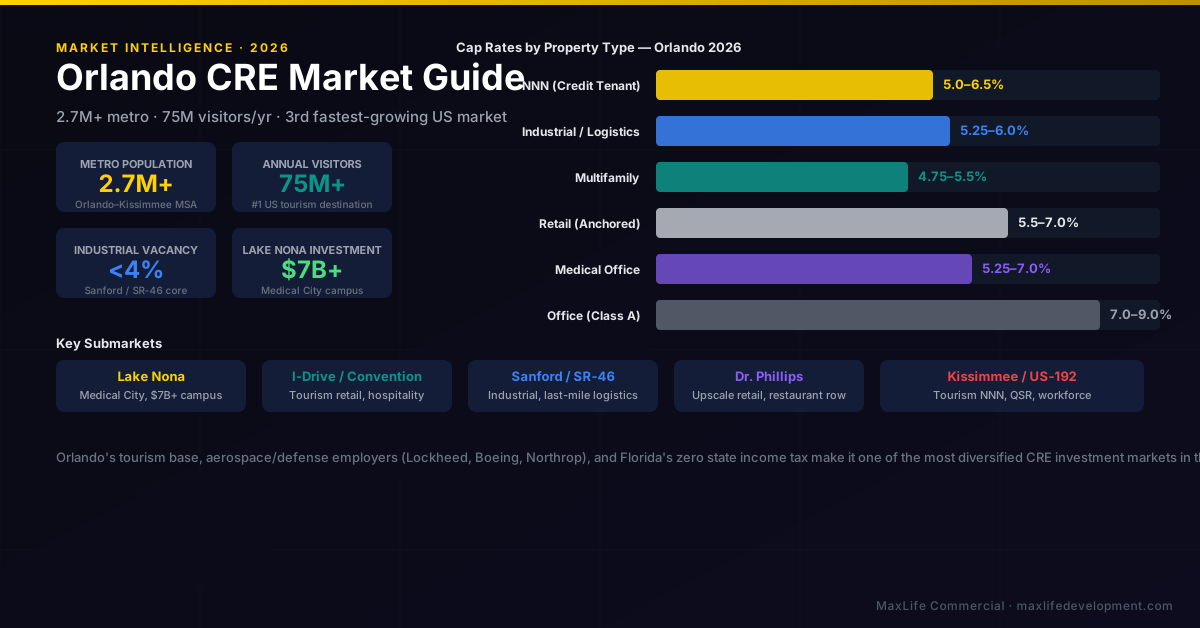
Cap Rates by Property Type — 2026
Cap rates have stabilized across Orlando's major property types after the 2022–2024 expansion cycle. Current market ranges for stabilized assets:
| Property Type | Cap Rate Range | Trend |
|---|---|---|
| NNN / Credit Tenant Retail | 5.0% – 6.5% | Stable |
| Industrial / Warehouse | 5.25% – 6.0% | Tightening |
| Multifamily | 4.75% – 5.5% | Stable |
| Retail (Anchored Centers) | 5.5% – 7.0% | Stable |
| Medical Office (MOB) | 5.75% – 7.0% | Tightening |
| Office (Class A) | 7.0% – 9.0% | Widening |
For deep-dive cap rate analysis by submarket and property type, see our Orlando cap rates investor guide and the cap rates data hub. Current submarket profiles, stats, and listings live on the Orlando CRE market hub.
Key Submarkets
Orlando's commercial market is a collection of distinct submarkets, each with its own demand drivers, tenant mix, and cap rate profile. Understanding submarket fundamentals is essential before allocating capital.
International Drive / Convention Center
The entertainment spine of Central Florida. I-Drive generates more than $10B in annual tourist spending and hosts 200+ hotels, major attractions, and the Orange County Convention Center — one of the largest in the US. Retail, QSR, and hospitality-related commercial assets dominate. NNN ground leases in this corridor trade tightly — investors pay for the irreplaceable tourism traffic.
Read the full guide →Lake Nona — Medical City
The fastest-growing submarket in Florida. Lake Nona's Medical City campus has attracted $7B+ in healthcare investment including UCF Health, Nemours Children's Hospital, the VA Medical Center, and the USTA National Campus. Tavistock's master-planned community drives residential and retail demand. Medical office building (MOB) cap rates here trail the broader market by 25–50 bps.
Sanford / SR-46 Corridor
Orlando's premier industrial and last-mile logistics submarket. The I-4 / 417 interchange at Sanford provides unmatched distribution access to Central and North Florida. Amazon, FedEx, and regional 3PLs have absorbed significant square footage here. Vacancy in core industrial product remains under 4% with strong rent growth.
Read the full guide →Downtown Orlando / Creative Village
The UCF downtown campus at Creative Village anchors a mixed-use tech corridor that is reshaping the urban core. Office demand is tenant-quality dependent — tech and healthcare tenants are filling Class A space while older suburban office struggles. Retail and F&B around Church Street and the Milk District show strong performance.
Dr. Phillips / Sand Lake Road
Upscale retail, Restaurant Row, and professional office. The Dr. Phillips corridor commands premium retail rents and tight vacancy in well-tenanted strip centers. Restaurant Row along Sand Lake is one of the highest-volume restaurant corridors in Florida — outparcel NNN pads here are rarely available and trade at sub-5.5% cap rates.
Kissimmee / US-192
Tourism-adjacent retail, QSR, and workforce housing pressure. US-192 is the gateway corridor to Walt Disney World and generates persistent traffic for fast food, convenience, and value retail. Cap rates run slightly wider than core Orlando due to market depth, but the tourism-driven consumer base is resilient.
Get Off-Market CRE Deals in Your Inbox
Join our investor list for exclusive Central Florida opportunities, market reports, and deal analysis — delivered weekly. No spam, unsubscribe anytime.
Industrial & Logistics — Strongest Fundamentals in the Metro
Orlando industrial has been the standout performer of the past five years. E-commerce growth, supply chain restructuring, and population-driven last-mile demand have pushed vacancy to historic lows in core submarkets. Sanford, the OIA-adjacent submarket, and the US-192 distribution corridor all show sub-4% vacancy for modern bulk product.
Amazon, FedEx, UPS, and regional grocery and pharmacy distribution networks have all expanded in Central Florida. Cap rates for well-leased industrial product — 5.25–6.0% — remain among the tightest in Florida, reflecting both the income stability and the fundamental scarcity of Class A distribution space near the I-4 / 417 interchange.
- →Core vacancy: under 4% for 32'+ clear height, cross-dock, ESFR product
- →Rent growth: 8–12% annually in core submarkets 2023–2025; moderating to 4–6% in 2026
- →Investor demand: institutional and private family office buyers competing for stabilized product
Retail — Tourism Strength and Grocery Anchor Resilience
Orlando retail has bifurcated sharply. Premium malls — Millenia, The Florida Mall, and the Premium Outlets — continue to outperform national benchmarks driven by tourist spending. Grocery-anchored neighborhood centers with strong service-tenant mixes (medical, fitness, salon, urgent care) maintain occupancy above 95% and trade at 5.5–6.5% cap rates.
NNN outparcels along Sand Lake Road, SR-535, and US-192 — occupied by Chick-fil-A, Wawa, Starbucks, and national QSR operators — represent some of the tightest-trading retail assets in Florida. Street-level tourist retail along I-Drive and US-192 remains strong despite post-pandemic normalization in spending patterns.
Unanchored strip centers in secondary locations face more pressure. Investors underwriting value-add retail in these corridors should model lease-up timelines conservatively and verify co-tenancy clause exposure before closing. See the full Orlando retail real estate guide for detailed submarket analysis.
Healthcare Real Estate — Lake Nona and Beyond
Lake Nona's Medical City has attracted $7B+ in healthcare investment — making it the fastest-growing medical submarket in the Southeast. MOB demand here is structural, not cyclical.
Healthcare is Orlando's most resilient commercial real estate segment. The metro is home to two of Florida's largest hospital systems — AdventHealth and Orlando Health — plus Nemours Children's Health, the VA Medical Center, and UCF Health. These anchor institutions drive medical office building (MOB) demand across Lake Nona, Sand Lake, and the I-Drive medical corridor.
MOB cap rates in Orlando range from 5.75–7.0% depending on building age, tenant credit, and proximity to anchor hospitals. Single-tenant MOBs with long-term leases from AdventHealth or Orlando Health trade at the tightest end of this range — healthcare tenants rarely vacate and signing one creates a near-NNN risk profile.
For investors interested in healthcare real estate, see our Central Florida medical office investing guide.
1031 Exchange Activity in Orlando
Orlando is one of the most active 1031 exchange markets in the country. The combination of Florida's no-state-income-tax environment, strong growth fundamentals, and deep inventory of NNN replacement properties makes Central Florida a natural destination for investors completing 1031 exchanges from across the US.
1031 buyers typically target NNN retail (Walgreens, AutoZone, Dollar General) and multi-tenant retail centers as replacement properties — both offer the combination of immediate income, tenant creditworthiness, and passive management that fits the profile of sellers trading out of active apartment or retail management situations.
- →Florida has no state income tax — every dollar of rental income stays in the investor's pocket
- →45-day identification window favors markets with deep NNN inventory like Central Florida
- →NNN properties close in 30–45 days — compatible with 180-day exchange deadlines
For a full walkthrough of the exchange process, see our 1031 exchange Orlando guide.
Invest in Orlando Commercial Real Estate
Ryan Solberg and MaxLife Commercial specialize in NNN investments, industrial, retail, and land across Central Florida. Whether you're a first-time commercial buyer or completing a 1031 exchange, we can source the right property and guide you through the full acquisition process.
Talk to Ryan SolbergFrequently Asked Questions
What is the best commercial real estate investment in Orlando?
The best CRE investment in Orlando depends on your goals. For passive income, NNN retail with credit tenants (5.0–6.5% cap rates) remains the top choice for 1031 exchange buyers. For growth, industrial/logistics near OIA and the I-4 corridor offers strong fundamentals with sub-4% vacancy. Medical office in Lake Nona Medical City is a high-conviction long-term play given the $7B+ healthcare campus investment in that submarket.
What are Orlando commercial real estate cap rates in 2026?
Orlando cap rates in 2026 by property type: NNN/credit tenant retail 5.0–6.5%, industrial/warehouse 5.25–6.0%, multifamily 4.75–5.5%, anchored retail 5.5–7.0%, Class A office 7.0–9.0%. Rates have stabilized after the 2022–2024 expansion cycle, with most asset classes showing positive leverage for buyers who can secure 6.5–7.5% financing.
What are the best commercial real estate submarkets in Orlando?
Top Orlando CRE submarkets in 2026: Lake Nona for medical office and industrial (fastest-growing submarket in FL); Sanford/SR-46 for last-mile logistics; International Drive for tourism retail and hospitality; Dr. Phillips/Sand Lake for upscale retail and professional office; Downtown/Creative Village for mixed-use and tech office. Each submarket has distinct cap rate profiles and demand drivers.
How does Orlando compare to Tampa for commercial real estate?
Orlando and Tampa are the two largest CRE markets in Central Florida. Orlando generally trades 25–50 basis points tighter than Tampa Bay for comparable stabilized product, driven by stronger tourism demand, faster population growth, and deeper institutional buyer activity. Tampa has a larger port and more mature industrial base, while Orlando leads in healthcare real estate (Lake Nona), tourism retail, and NNN ground lease transactions.
Related Articles
Orlando Cap Rates: Investor Guide 2026
Deep-dive cap rate analysis by property type and submarket across Central Florida.
Orlando Industrial Real Estate Guide
Industrial and logistics market fundamentals, submarkets, and investment opportunities.
Orlando Retail Commercial Real Estate
Retail market conditions, NNN outparcels, and grocery-anchored center performance.
Medical Office Investing in Central Florida
Lake Nona, AdventHealth, and the MOB investment opportunity in Orlando's healthcare sector.
1031 Exchange Orlando Guide
How to complete a 1031 exchange into NNN or multi-tenant retail in Central Florida.
Orlando vs Tampa CRE Market
Side-by-side comparison of cap rates, submarkets, and investment strategy.