Why Orlando Industrial Is Surging
Orlando's industrial real estate sector has experienced remarkable growth driven by the expansion of e-commerce fulfillment, third-party logistics, and the region's strategic position as a distribution hub for the southeastern United States. Central Florida's access to major interstate corridors including I-4, the Florida Turnpike, and State Road 429 makes it an ideal location for companies that need to move goods efficiently across the state and beyond.
Population growth has been a catalyst as well. The greater Orlando metropolitan area continues to add tens of thousands of new residents each year, creating sustained demand for consumer goods and the warehouse infrastructure needed to support last-mile delivery. National retailers and logistics operators have responded by leasing and building facilities throughout Orange, Seminole, and Osceola counties.
The region's labor pool strengthens the case for industrial investment. With more than 1.7 million workers in the Orlando-Kissimmee-Sanford MSA, employers have access to a deep bench of warehouse, logistics, and light-manufacturing talent. The presence of the University of Central Florida and Valencia College supplies a steady pipeline of graduates trained in supply chain management and engineering disciplines, which helps industrial tenants staff their operations without the wage pressure seen in tighter labor markets like South Florida.
Infrastructure spending by the Florida Department of Transportation has further reinforced Orlando's industrial appeal. The widening of I-4 through the I-4 Ultimate project, capacity improvements along SR-429, and the expansion of the State Road 417 (Central Florida GreeneWay) interchange network have reduced freight travel times and opened new land parcels to development. Port Canaveral, located roughly 60 miles east, provides an additional logistics channel for importers and exporters who want to avoid the congestion at South Florida seaports.
For investors, this combination of population growth, infrastructure investment, and tenant demand has translated into strong occupancy rates and rising rents. The Orlando commercial real estate market has rewarded industrial investors with consistent returns, and the outlook for the sector remains positive heading into the second half of the decade. Compared to gateway industrial markets such as Dallas, Atlanta, and the Inland Empire, Orlando offers comparatively lower land costs per acre and a favorable tax environment with no state income tax, both of which improve yield-on-cost for ground-up development and value-add repositioning strategies.
Key Industrial Submarkets
Understanding where to invest is just as important as understanding what to invest in. Orlando's industrial market is spread across several distinct submarkets, each with its own characteristics, tenant profiles, and investment dynamics.
West Orange County / Apopka
One of the fastest-growing industrial corridors in Central Florida, anchored by proximity to SR-429 and the Western Beltway. New speculative warehouse construction has accelerated here, attracting distribution and light manufacturing tenants. Recent deliveries include buildings ranging from 100,000 to over 400,000 square feet along Ocoee-Apopka Road and West Colonial Drive. Asking rents in new Class A product in this corridor typically range from $9.50 to $12.00 per square foot NNN.
Airport / McCoy Area
The area surrounding Orlando International Airport offers proximity to air cargo facilities and the Beachline Expressway (SR-528). This submarket is popular with logistics companies, freight forwarders, and time-sensitive distribution operations. The Tradeport Drive and Cargo Road corridors house more than 3 million square feet of warehouse and distribution space. Vacancy here tends to run below the metro average due to the irreplaceable airport adjacency.
South Orlando / Osceola County
Emerging industrial development along the US-192 and Poinciana corridors benefits from lower land costs and proximity to the rapidly growing communities in Osceola County. Flex and small-bay warehouse space is in high demand here. Land along Simpson Road and Boggy Creek Road has attracted speculative developers, and projects in the 20,000 to 80,000 square foot range are leasing quickly to small and mid-size tenants.
Sanford / North Seminole County
Established industrial nodes along US-17/92 and near the Orlando Sanford International Airport serve the northern portion of the metro. This submarket offers a mix of older value-add properties and newer Class A distribution centers. Investors can find multi-tenant buildings from the 1980s and 1990s at prices well below replacement cost, making it an attractive corridor for investors seeking to renovate and re-lease at higher rents.
Lake Nona / Southeast Orlando
The growth around Lake Nona has spurred industrial development to support the medical, technology, and residential communities expanding in this area. Narcoossee Road and Boggy Creek Road serve as primary access routes. As the Lake Nona Medical City and related mixed-use projects continue to expand, demand for light industrial and flex space from healthcare suppliers, life science companies, and tech-adjacent businesses continues to grow.
Each of these submarkets offers different risk-return profiles. Investors targeting newer Class A distribution space will find opportunities in the western and southern corridors, while those seeking value-add repositioning plays may look toward older inventory in Sanford or near the airport. Our Lake Nona market overview provides additional detail on the southeastern corridor.
Beyond these primary nodes, investors should also monitor emerging micro-submarkets along the SR-429 extension into Lake County and along the US-27 corridor south of Clermont. As land costs escalate in core Orange County, developers are pushing west and south to find sites that pencil for speculative construction. These fringe corridors may carry more lease-up risk, but they also offer higher yield-on-cost for investors willing to take on development exposure.
Submarket selection is one of the most consequential decisions in an industrial investment strategy. Running a detailed cash flow projection on properties in competing corridors is the best way to compare risk-adjusted returns. Use our Deal Analyzer to model rent growth, vacancy assumptions, and cap rate scenarios for any submarket in the Orlando metro.
Industrial Property Types and Investment Profiles
Industrial real estate encompasses several distinct property types, each serving different tenant needs and offering different return characteristics. Understanding these categories is essential for building a targeted investment strategy.
Warehouse / Distribution
Large-footprint buildings designed for storage and distribution. Typically 50,000 to 500,000+ square feet with high clear heights, dock-high loading, and trailer parking. These properties attract national logistics tenants and e-commerce operators. In Orlando, Class A distribution buildings with 32-foot-plus clear heights and ESFR sprinkler systems command the highest rents, often $10.00 to $13.00 per square foot NNN depending on location and vintage.
Flex / R&D Space
Hybrid buildings that combine office and warehouse space, often in a ratio of 30-50% office to 50-70% warehouse. Flex space appeals to technology companies, light manufacturers, and service businesses that need both workspace and storage. Multi-tenant flex buildings in Orlando typically range from 10,000 to 60,000 square feet total, with individual suites as small as 1,500 square feet. Rents often fall between $12.00 and $16.00 per square foot gross, reflecting the higher office finish.
Light Manufacturing
Purpose-built or adapted facilities for assembly, packaging, and light production. These properties often require specialized power, ventilation, or floor load capacity, which can create barriers to entry and support higher rents. In Central Florida, light manufacturing tenants include food processing companies, building materials fabricators, and aerospace component suppliers tied to the defense and space industries along the Space Coast.
Cold Storage
Temperature-controlled facilities for food distribution, pharmaceuticals, and perishable goods. Cold storage commands premium rents due to the significant capital expenditure required for refrigeration systems and insulation. Orlando's tourism industry, which serves over 75 million visitors annually, creates outsized demand for cold chain logistics to supply hotels, theme parks, and restaurants throughout the region.
Warehouse and distribution assets have seen the strongest demand in recent years, driven by e-commerce growth and supply chain reconfiguration. However, flex space offers attractive yields for investors willing to manage multi-tenant buildings, and cold storage remains a niche with strong fundamentals. Review our Orlando cap rates guide for current pricing benchmarks across these property types.
Small-bay industrial is another segment worth monitoring. Buildings in the 5,000 to 15,000 square foot range with grade-level roll-up doors appeal to contractors, service companies, and small distributors. These properties are often owner-occupied, which creates a deep buyer pool when it comes time to exit. In Orlando, small-bay industrial parks along John Young Parkway, Orange Blossom Trail, and Silver Star Road have demonstrated strong occupancy even during periods of broader economic uncertainty.
Regardless of which property type you target, aligning the building's specifications with the needs of the most probable tenant is essential. A warehouse with 24-foot clear heights may suit a local distributor, but it will not attract the national e-commerce operators who require 32 feet or more. Matching building to tenant is the foundation of successful industrial investing. Our commercial real estate services team can advise you on which specifications are most in-demand for each Orlando submarket.
Industrial Lease Structures in Orlando
Understanding lease structures is critical to underwriting an industrial investment accurately. The type of lease in place determines how operating expenses flow between landlord and tenant, which directly affects net operating income and, by extension, property value.
The most common industrial lease structure in the Orlando market is the triple net (NNN) lease. Under a NNN lease, the tenant pays base rent plus all three major operating expense categories: real estate taxes, property insurance, and common area maintenance (CAM). This structure shifts virtually all variable operating costs to the tenant, giving the landlord a predictable net income stream. NNN leases are standard for single-tenant warehouse and distribution buildings, and they are the preferred structure for national credit tenants.
Modified gross leases are more common in multi-tenant flex and small-bay industrial buildings. Under a modified gross structure, the landlord typically pays a base year amount of operating expenses, and tenants reimburse increases above that base year. This structure simplifies billing for smaller tenants but exposes the landlord to expense creep if taxes or insurance rise faster than pass-through provisions allow.
Lease terms in Orlando's industrial market vary by property type and tenant profile. National distribution tenants often sign leases of seven to fifteen years with built-in annual escalations of 2.5% to 3.5%. Multi-tenant flex buildings, by contrast, tend to have shorter terms of three to five years, which gives the landlord more frequent opportunities to mark rents to market but also increases rollover risk and leasing costs.
Investors should pay close attention to renewal options, termination rights, and tenant improvement allowances embedded in existing leases. A below-market lease with a five-year renewal option at a fixed rate can suppress a property's value for years. Conversely, a lease approaching expiration with in-place rents 15% to 20% below market represents a tangible value-add opportunity. Use our Deal Analyzer to model lease rollover scenarios and quantify the impact of mark-to-market rent adjustments on property valuation.
Key Industrial Tenants and Demand Drivers
Tenant demand is the engine that drives industrial real estate performance. In Orlando, several categories of tenants generate the bulk of leasing activity, and understanding these demand drivers helps investors anticipate which submarkets and building types will outperform.
E-commerce and last-mile logistics operators represent the largest and fastest-growing source of demand. Amazon operates multiple fulfillment and sortation centers across the metro, including large-format facilities exceeding 800,000 square feet. FedEx, UPS, and regional carriers have expanded their footprints to serve the growing residential population, and third-party logistics providers (3PLs) such as XPO Logistics and Ryder have built significant operations in the I-4 corridor to support omnichannel retailers.
The tourism and hospitality supply chain is a demand driver unique to Orlando. Theme parks, hotels, and convention venues require a constant flow of food, beverage, merchandise, linens, and maintenance supplies. This creates steady demand for both dry warehouse and cold storage space in the airport and south Orlando submarkets. Unlike e-commerce, which can be cyclical, tourism supply chain demand is remarkably consistent in a market that welcomes visitors year-round.
Construction and building materials distributors have expanded their Orlando warehouse presence in response to the region's residential and commercial construction boom. Roofing suppliers, plumbing distributors, electrical wholesalers, and flooring companies need 10,000 to 50,000 square foot warehouses with yard storage for trucks and materials. These tenants gravitate toward small-bay industrial parks along major arterials like Orange Blossom Trail, West Colonial Drive, and East Semoran Boulevard.
The defense and aerospace sector, anchored by facilities at Cape Canaveral, Patrick Space Force Base, and contractors throughout Brevard and Orange counties, also contributes to industrial demand. Manufacturers of precision components, satellite systems, and simulation equipment lease specialized industrial space in the Sanford and East Orlando corridors. These tenants often sign long-term leases and invest heavily in tenant improvements, making them attractive occupants for investors seeking stable, long-duration income. For a broader view of investment returns in the region, see our Orlando cap rates investor guide.
How to Evaluate an Industrial Investment
Underwriting an industrial property requires attention to several factors that directly impact cash flow, appreciation potential, and long-term value. Whether you are acquiring a stabilized asset or pursuing a value-add opportunity, the following criteria should be central to your analysis.
- Location and AccessProximity to interstate interchanges, airport facilities, and population centers drives tenant demand. Properties within one mile of a major highway interchange command premium rents. In Orlando, interchanges along I-4 at Sand Lake Road, Kirkman Road, and Maitland Boulevard are among the most sought-after locations. Access to SR-429, SR-417, and the Florida Turnpike is equally important for distribution tenants serving the broader Central Florida region.
- Building SpecificationsClear height, column spacing, dock doors, trailer parking, and power capacity all affect which tenants can occupy the space. Modern distribution tenants require 28-36 foot clear heights at minimum. Column spacing of 50 by 52 feet or wider is preferred for racking efficiency. The number and configuration of dock doors relative to building square footage matters as well; a general benchmark is one dock door per 5,000 to 10,000 square feet of warehouse area.
- Lease Structure and TermIndustrial leases are typically structured as NNN or modified gross. Longer lease terms with creditworthy tenants reduce risk, while shorter terms may offer repositioning opportunities at higher rents. Evaluate annual escalation clauses carefully; a lease with flat rent over a seven-year term erodes real returns in an inflationary environment, while a lease with 3% annual bumps compounds meaningfully over time.
- Tenant CreditworthinessEvaluate the financial strength of the tenant or tenants in place. National credit tenants provide more income security than local operators, though they often come at lower cap rates. Request financial statements, review payment history, and assess the tenant's industry trajectory. A tenant in a declining industry may be creditworthy today but a vacancy risk in three to five years.
- Market Vacancy and Rent GrowthCompare the property's in-place rents to market rates. Positive rent spreads on upcoming lease expirations indicate built-in upside. Track submarket vacancy rates and absorption trends over a multi-year period rather than relying on a single quarter's data point. The Orlando industrial market has generally maintained vacancy rates in the 4% to 6% range in core submarkets, well below the level that would signal tenant leverage.
Beyond these core criteria, investors should also evaluate environmental considerations. Phase I Environmental Site Assessments are standard in industrial transactions, and properties with a history of manufacturing or chemical storage may require Phase II testing. Remediation costs can be substantial and should be factored into your acquisition pricing. Zoning is another consideration; confirm that the property's zoning designation permits the intended industrial use and check whether any overlay districts or planned land use changes could affect operations.
Capital expenditure planning is essential for older industrial buildings. Roof replacement on a 100,000 square foot warehouse can cost $400,000 to $700,000 depending on the system. HVAC replacement, parking lot resurfacing, and dock leveler refurbishment are additional line items that can erode returns if not budgeted properly during underwriting. Always obtain a property condition report from a qualified engineer before finalizing your acquisition price.
Our step-by-step guide to buying commercial property in Orlando walks through the full acquisition process from initial screening to closing. You can also use our Deal Analyzer to model cash flow scenarios and compare properties side by side.
Orlando Industrial Market Outlook
The outlook for Orlando industrial real estate remains strong heading into the latter half of 2026 and beyond. Several macro-level trends are working in the market's favor: continued population migration to Central Florida, expansion of e-commerce penetration driving last-mile logistics demand, and ongoing investment in transportation infrastructure including highway widening projects and port improvements.
New construction has picked up in response to demand, particularly in the western and southern corridors of the metro. While some observers have raised concerns about potential oversupply in specific submarkets, absorption has kept pace with deliveries in most areas. Vacancy rates across the metro remain well below historical averages, and rental rate growth has continued at a healthy pace.
Interest rates remain a factor for industrial investors to monitor. Higher borrowing costs have compressed leveraged returns and slowed transaction volume relative to the peak years of 2021 and 2022. However, the impact on industrial has been less pronounced than on office or retail because industrial fundamentals remain strong and lenders view the sector favorably. Loan-to-value ratios of 60% to 70% are achievable for well-located, well-leased industrial assets, and debt service coverage ratios remain healthy given current rent levels and occupancy rates.
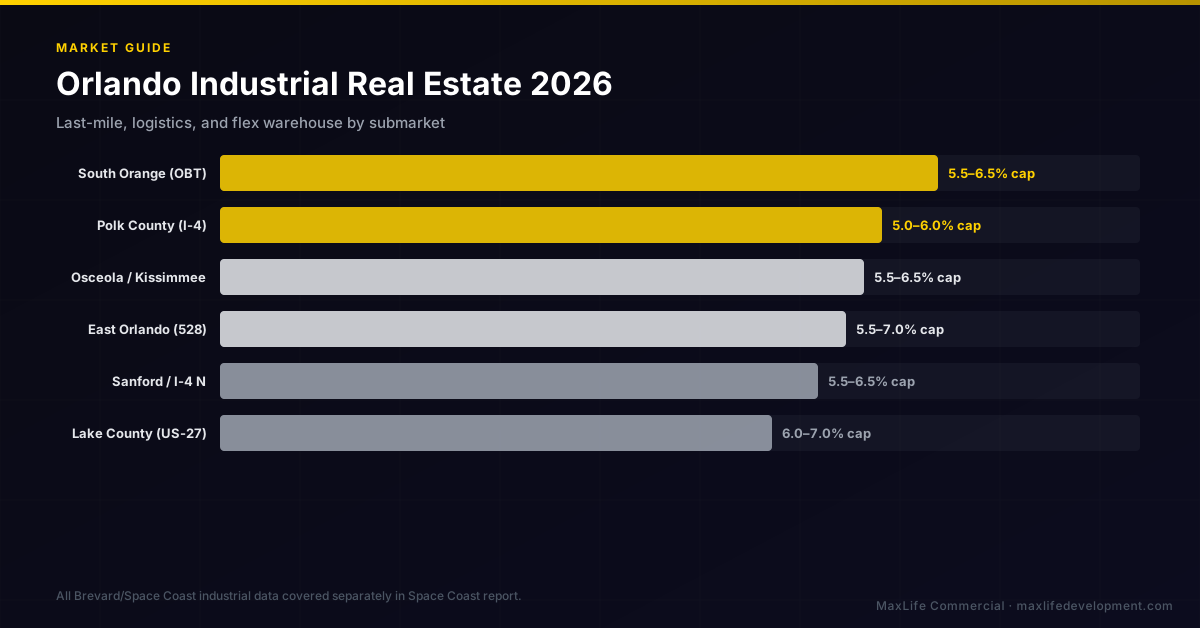
Cap rates for Class A industrial product in Orlando have generally settled in the 5.25% to 6.50% range depending on lease term, tenant credit, and submarket. Value-add and multi-tenant properties trade at wider spreads, often in the 6.50% to 8.00% range, reflecting the additional management intensity and lease-up risk. These spreads present an opportunity for investors with operational expertise to capture yield premiums that passive investors in single-tenant, credit-leased deals cannot access.
For investors evaluating Orlando industrial opportunities, the fundamentals point to a market with durable demand drivers and limited downside risk relative to other property types. The key is identifying properties in well-located submarkets with strong tenant profiles and appropriate building specifications. Our commercial real estate services team can help you source and evaluate industrial investment opportunities across the Orlando metro. If you are new to commercial property acquisition, start with our guide to buying commercial property in Orlando to understand the full transaction lifecycle from letter of intent through closing.
Related Reading
Industrial Property for Sale in Central Florida
Warehouse, flex, distribution, and manufacturing brokerage across the I-4 corridor and Space Coast.
Build-to-Suit Development in Orlando
Custom industrial development and site selection for distribution, manufacturing, and flex users.
Land for Development in Central Florida
Raw and entitled industrial land across Central Florida and the I-4 corridor.
Off-Market Commercial Deals in Orlando
Industrial and commercial opportunities sourced before they hit the public market.
Browse Industrial Properties for Sale
Current Florida industrial property categories and related submarkets.
All Industrial Property Types
Warehouse, flex, manufacturing, distribution — every industrial category.
Warehouse Properties
Bulk warehouse and mid-bay distribution facilities across the I-4 corridor.
Distribution Centers
Last-mile and regional distribution facilities serving Florida's 22M+ population.
Central Florida Industrial Hub
Submarket data, cap rates, and active industrial deal inventory.
Explore Orlando Industrial Investments
MaxLife Commercial helps investors identify, underwrite, and acquire industrial properties across Central Florida. Whether you are targeting warehouse, flex, or distribution assets, we can help you find the right opportunity.
Contact UsGet Off-Market CRE Deals in Your Inbox
Join our investor list for exclusive Central Florida opportunities, market reports, and deal analysis — delivered weekly. No spam, unsubscribe anytime.