Medical Office Investing in Central Florida: A Comprehensive Guide for CRE Investors
Medical office buildings are one of the most resilient and recession-resistant property types in commercial real estate. In Central Florida, the convergence of aging demographics, healthcare system expansion, and population growth creates an exceptionally compelling opportunity for medical real estate investors.
Why Medical Office Is the Quiet Powerhouse of CRE
Medical office buildings (MOBs) occupy a unique position in the commercial real estate landscape. They combine the stability of long-term, credit-quality tenants with the recession resistance of the healthcare sector and the inflation protection of contractual rent escalations. While other property types experience boom-bust cycles tied to economic conditions, healthcare demand is driven by demographics — and demographics do not fluctuate with the business cycle.
The investment thesis for medical office is compelling across the United States, but Central Florida amplifies every favorable trend. The region is one of the fastest-growing metropolitan areas in the country, it has a disproportionately large and growing senior population, and it is home to some of the most aggressive healthcare system expansion programs anywhere. The result is a market where demand for medical office space consistently outpaces supply, driving occupancy rates above 95% in most submarkets and supporting cap rates that offer meaningful yield premiums over other low-risk property types.
This guide examines the Central Florida medical office market in detail, covering the demand drivers, lease structures, investment metrics, top submarkets, and strategies that investors should understand before deploying capital in this sector.
6.0-7.5%
MOB Cap Rate Range
95%+
Average Occupancy
10-15 yr
Typical Lease Term
$28-$42/SF
Avg NNN Lease Rate
Aging Demographics: The Demand Engine
Healthcare utilization increases dramatically with age. Americans over 65 consume roughly three times more healthcare services per capita than those under 65, and the 75-plus cohort consumes even more. This is not a trend — it is a biological reality that creates predictable, long-duration demand for medical office space in any market with a growing senior population.
Central Florida's demographic profile is exceptionally favorable for medical office investment. The Orlando-Kissimmee-Sanford MSA has one of the fastest-growing 65-plus populations in the United States, driven by both domestic migration (retirees relocating from the Northeast and Midwest) and the aging of the region's existing population. Florida's 65-plus population is projected to grow by more than 30% between 2020 and 2035, and Central Florida is growing even faster than the state average.
But medical office demand is not driven solely by seniors. Central Florida's overall population growth — expected to add 1 million new residents to the metro area by 2035 — generates demand for primary care, pediatrics, OB/GYN, dental, urgent care, and other medical services that serve all age groups. The combination of overall population growth and a disproportionate increase in the highest-utilization age cohorts creates a double-barreled demand driver that is difficult to replicate in slower-growing markets.
| Age Cohort | 2020 Population | 2035 Projected | Growth | Healthcare Spend/Capita |
|---|---|---|---|---|
| Under 18 | 580,000 | 670,000 | +15.5% | $3,700 |
| 18 - 44 | 920,000 | 1,050,000 | +14.1% | $4,500 |
| 45 - 64 | 610,000 | 720,000 | +18.0% | $8,200 |
| 65 - 74 | 230,000 | 340,000 | +47.8% | $12,800 |
| 75+ | 140,000 | 225,000 | +60.7% | $18,500 |
The Math Behind Medical Office Demand
The 65-plus population in the Orlando metro is projected to grow by approximately 195,000 people between 2020 and 2035. At an average of 7-8 physician visits per year (versus 3-4 for younger cohorts), this translates to roughly 1.4 million additional annual patient visits — requiring an estimated 800,000 to 1.2 million square feet of new medical office space just to serve this single demographic segment.
Healthcare System Expansion: The Institutional Demand Story
Central Florida's healthcare landscape is dominated by several major health systems that are actively expanding their outpatient and ambulatory care footprints. This institutional expansion is a primary driver of medical office demand and creates specific investment opportunities for CRE investors who understand the dynamics.
Lake Nona Medical City
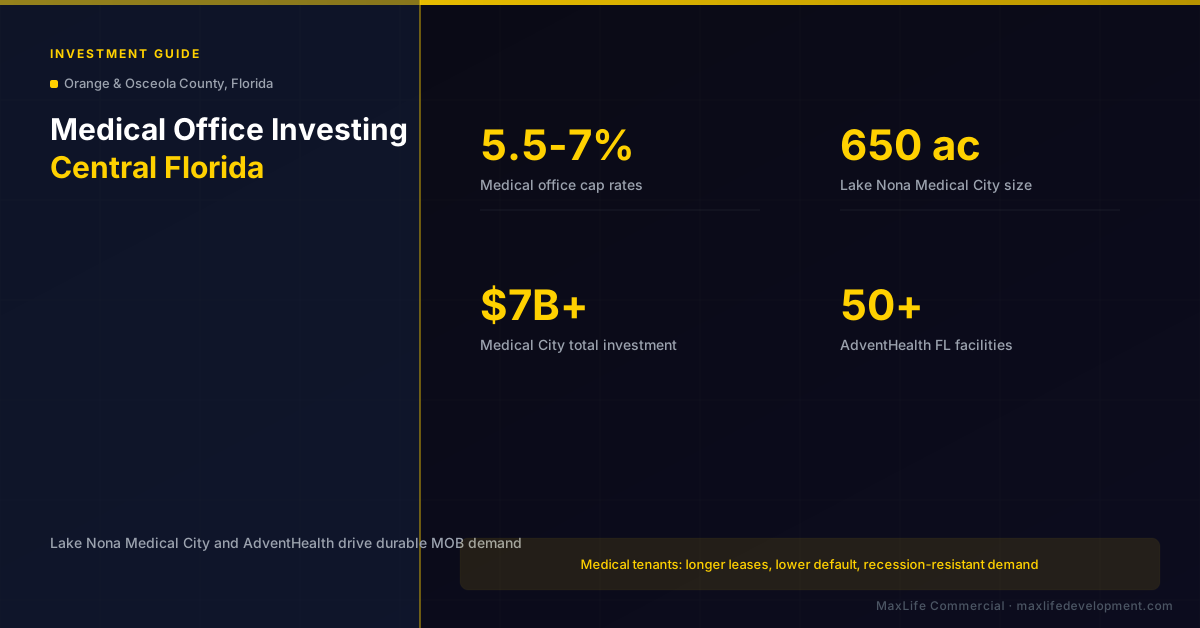
Lake Nona Medical City is the crown jewel of Central Florida's healthcare real estate market. This 650-acre medical campus in southeast Orlando houses the University of Central Florida College of Medicine, the Nemours Children's Hospital, the VA Medical Center, and the UCF Lake Nona Medical Center. The campus has attracted billions of dollars in healthcare investment and continues to expand with new research facilities, specialty clinics, and medical office buildings.
For medical office investors, the Lake Nona corridor offers premium opportunities but at premium pricing. MOB cap rates near Lake Nona Medical City typically range from 5.5% to 6.5%, reflecting the institutional quality of the tenants and the prestige of the location. Lease rates range from $32 to $45 per square foot NNN for Class A medical office space, among the highest in the Central Florida market.
AdventHealth System Expansion
AdventHealth (formerly Florida Hospital) is the largest healthcare provider in Central Florida and one of the largest in the country. The system operates over a dozen hospitals in the region and is aggressively expanding its outpatient presence through new medical office buildings, urgent care centers, and freestanding emergency departments. AdventHealth's expansion strategy focuses on placing outpatient services closer to where patients live, which means new medical office development in growth corridors like Lake County, Horizon West, and the US 192 corridor.
AdventHealth is a highly desirable tenant for medical office investors. The system carries investment-grade credit ratings, signs long-term leases (typically 10-15 years), and invests heavily in tenant improvements that increase property value. Properties leased to AdventHealth or its affiliated physician groups command cap rate premiums (lower cap rates) reflecting the credit quality and lease duration.
Orlando Health System
Orlando Health operates Orlando Regional Medical Center (the area's only Level One trauma center), Arnold Palmer Hospital for Children, and a growing network of outpatient facilities. The system has been particularly active in developing medical office space in the downtown Orlando corridor and along the I-4 corridor through Seminole County. Orlando Health's $3 billion campus expansion in downtown Orlando is creating new demand for affiliated medical office space within a 5-mile radius of the main campus.
| Health System | Hospitals | Expansion Focus | Typical MOB Lease |
|---|---|---|---|
| AdventHealth | 12+ in Central FL | Lake County, Horizon West, US 192 | 10-15 yr NNN, 2-3% annual escalations |
| Orlando Health | 8+ in Central FL | Downtown Orlando, I-4 corridor, Seminole | 10-12 yr Modified Gross, CPI escalations |
| HCA / UCF Health | 5+ in Central FL | Osceola County, Lake Nona, Melbourne | 7-10 yr NNN, fixed escalations |
| Nemours | 1 (Lake Nona) | Pediatric specialty, Lake Nona campus | 15+ yr NNN, investment-grade credit |
Medical Tenant Stability: Why Doctors Rarely Move
One of the most attractive characteristics of medical office investment is the exceptional tenant retention rate. Medical tenants are among the stickiest in all of commercial real estate, with renewal rates typically exceeding 85% — significantly higher than retail (65-70%) or traditional office (60-70%). Understanding why medical tenants stay is important for evaluating the durability of the income stream.
The primary reason is the high cost of relocation. Medical office buildouts are among the most expensive in commercial real estate, typically costing $80 to $150 per square foot for standard medical suites and $150 to $300 or more for specialty practices requiring imaging equipment, procedure rooms, or surgical suites. These buildout costs are usually amortized over the initial lease term, and a medical tenant who has invested $500,000 or more in their space has a powerful financial incentive to renew rather than relocate.
Beyond the buildout cost, medical practices build their patient bases around their physical location. Patients choose physicians partly based on convenience, and a practice that moves more than a few miles risks losing a meaningful portion of its patient base. This geographic stickiness means that even when a medical tenant has the financial ability to relocate, they often lack the business incentive to do so. The result is predictable lease renewals and long-term income stability that is difficult to achieve with other tenant types.
85%+
Tenant Renewal Rate
$80-$150/SF
Standard Buildout Cost
2-3%
Annual Rent Escalations
92-96%
Market Occupancy Rate
< 5%
Historical Default Rate
10-15 yr
Avg Initial Lease Term
Medical Office Lease Structures: NNN vs. Modified Gross
Medical office leases typically fall into one of two categories: triple net (NNN) and modified gross. Understanding the differences is critical for properly underwriting medical office investments, as the lease structure directly affects the property's NOI, risk profile, and management requirements. For a broader understanding of NNN leases, see our guide on Orlando NNN properties.
NNN Medical Office Leases
In a triple net medical office lease, the tenant pays base rent plus all operating expenses including property taxes, insurance, and common area maintenance (CAM). NNN leases are most common in single-tenant medical office buildings or medical condominiums where each tenant occupies a distinct, separately metered unit. The advantage for investors is predictable income with minimal management responsibility — the NOI closely approximates the base rent because the tenant is responsible for all variable expenses.
NNN medical office leases in Central Florida typically run 10 to 15 years for initial terms, with two to three renewal options of five years each. Rent escalations are typically structured as fixed annual increases (2-3% per year) or CPI-based adjustments. Base rental rates for NNN medical office space in the Orlando metro range from $24 to $38 per square foot in suburban markets and $32 to $45 in premium locations like Lake Nona and Dr. Phillips.
Modified Gross Medical Office Leases
Modified gross leases are more common in multi-tenant medical office buildings where shared common areas, mechanical systems, and building services make a true NNN structure impractical. In a modified gross lease, the tenant pays base rent plus a proportional share of certain operating expenses (typically property taxes and insurance), while the landlord retains responsibility for common area maintenance, building systems, and structural repairs.
Modified gross leases require more active management from the landlord but often generate higher effective rental rates when properly managed. The key underwriting consideration is the base year or expense stop provision, which determines when the tenant begins sharing in expense increases. Investors should pay close attention to how operating expenses are allocated among tenants and whether any expense caps limit the landlord's ability to pass through cost increases.
| Feature | NNN Lease | Modified Gross |
|---|---|---|
| Expense Responsibility | Tenant pays all (taxes, insurance, CAM) | Shared — tenant pays pro rata above base year |
| Typical Term | 10-15 years initial | 7-10 years initial |
| Management Intensity | Low — near passive | Moderate — active management needed |
| Base Rent Range | $24 - $45/SF | $28 - $48/SF (higher to offset landlord expenses) |
| Typical Tenant | Health system, large group practice | Multi-tenant building, smaller practices |
| Cap Rate Impact | Lower (6.0 - 6.5%) — reflects lower risk | Higher (6.5 - 7.5%) — reflects mgmt burden |
Build-to-Suit vs. Existing Medical Office Investment
Medical office investors face a fundamental strategic choice: acquire existing, income-producing properties or pursue build-to-suit development for specific medical tenants. Both approaches have distinct advantages and risk profiles, and the right choice depends on the investor's capital capacity, risk tolerance, development expertise, and return requirements.
Build-to-Suit Medical Office
Build-to-suit (BTS) development involves constructing a medical office building to the specific requirements of a preleased tenant. The tenant signs a long-term lease before construction begins, providing income certainty upon completion. BTS development in Central Florida typically generates day-one yields of 7.5% to 9.0% on total development cost, compared to 6.0% to 7.5% cap rates for existing stabilized properties. This 150 to 200 basis point spread represents the developer's profit for taking on construction risk.
The risks of BTS development include construction cost overruns, permitting delays, and the potential for the tenant to back out during the development period (though well-structured leases minimize this risk). Development timelines for medical office in Central Florida typically run 14 to 20 months from groundbreaking to certificate of occupancy, with an additional 2 to 4 months for tenant-specific improvements.
Existing Medical Office Acquisition
Acquiring existing, stabilized medical office properties is the lower-risk approach. You are buying a proven income stream with tenants already in place, and you can verify the property's actual operating performance during due diligence. The tradeoff is a lower initial yield — you are paying for the certainty of in-place income, which means your going-in cap rate will be lower than what a developer achieves on a BTS project.
Build-to-Suit
Pros: Higher returns (7.5-9.0% yield on cost), brand-new construction, purpose-built for tenant, long initial lease term, day-one equity creation
Cons: Construction risk, 18-24 month timeline, higher capital requirement, permitting uncertainty, requires development expertise
Existing Acquisition
Pros: Immediate cash flow, proven operating history, lower execution risk, faster deployment, easier to finance
Cons: Lower initial yield (6.0-7.5%), potential deferred maintenance, shorter remaining lease term, may need capital improvements
Medical Office Cap Rates in Central Florida: 6.0% to 7.5%
Medical office cap rates in Central Florida currently range from approximately 6.0% to 7.5%, depending on the quality of the property, tenant credit, lease term, and submarket. This range positions medical office as a compelling middle ground between the lower cap rates of premium NNN retail (5.0-6.0%) and the higher cap rates of traditional office (7.0-9.0%). For a comprehensive look at cap rates across all property types, see our Orlando cap rates investor guide.
| MOB Type | Cap Rate Range | Typical Tenant | Key Value Driver |
|---|---|---|---|
| Single-Tenant, Health System | 5.5% - 6.5% | AdventHealth, Orlando Health | Corporate credit guarantee, long term |
| Single-Tenant, Large Practice | 6.0% - 7.0% | Multi-physician group, dental chain | Lease term, practice financial strength |
| Multi-Tenant MOB (Class A) | 6.5% - 7.0% | Mix of specialties | Occupancy, lease rollover schedule, location |
| Multi-Tenant MOB (Class B) | 7.0% - 7.5% | Smaller practices, local tenants | Value-add potential, management upside |
| BTS Development (yield on cost) | 7.5% - 9.0% | Preleased to health system or group | Development spread over stabilized value |
Top Central Florida Submarkets for Medical Office Investment
Not all Central Florida submarkets offer the same opportunity for medical office investment. The most attractive submarkets combine strong demographic fundamentals, healthcare system presence, limited competitive supply, and accessibility for the patient population. The following submarkets stand out based on our analysis of the Orlando metro and surrounding markets. For broader market context, explore our Orlando commercial real estate overview.
Lake Nona
Lake Nona is the undisputed center of medical real estate in Central Florida. The presence of the medical city campus, multiple hospital systems, and a growing population of medical professionals creates an ecosystem that supports premium medical office rents and the tightest vacancy rates in the market. New MOB development in Lake Nona is preleased before construction is complete, and existing properties trade at a premium to every other submarket. Cap rates in Lake Nona run 50-100 basis points lower than the metro average.
Dr. Phillips / Sand Lake
The Dr. Phillips area in southwest Orange County is one of the most affluent and densely populated submarkets in the metro. The combination of high household incomes, an older demographic skew relative to other Orlando submarkets, and proximity to the Sand Lake Hospital campus makes this area a prime medical office market. MOB availability is limited, and new development opportunities are constrained by the built-out nature of the area, which protects existing assets from competitive supply.
Altamonte Springs / Seminole County
Altamonte Springs benefits from the presence of AdventHealth Altamonte Springs, one of the busiest hospitals in the system. The surrounding medical corridor along SR 436 and I-4 is home to dozens of medical office buildings housing primary care, specialty practices, and outpatient surgery centers. This mature submarket offers higher cap rates (6.5-7.5%) than Lake Nona or Dr. Phillips, making it attractive for income-focused investors who do not require premium locations.
Melbourne / Brevard County
Melbourne and the broader Brevard County market is an increasingly attractive medical office submarket. The Space Coast's growing population, driven by aerospace employment and retiree migration, is generating demand for medical services that outpaces the existing medical office supply. Cap rates in Brevard County typically run 50-100 basis points above the Orlando metro, and the competitive landscape is less saturated, creating opportunities for both acquisition and development.
| Submarket | MOB Cap Rate | Avg Lease Rate | Vacancy | Key Anchor |
|---|---|---|---|---|
| Lake Nona | 5.5% - 6.5% | $32 - $45/SF NNN | 2.8% | Medical City, Nemours, VA |
| Dr. Phillips | 6.0% - 6.8% | $30 - $40/SF NNN | 3.5% | Sand Lake Hospital, Dr. P. Hospital |
| Altamonte Springs | 6.5% - 7.5% | $26 - $34/SF NNN | 5.1% | AdventHealth Altamonte |
| Melbourne | 6.5% - 7.5% | $24 - $32/SF NNN | 5.8% | Holmes Regional, Health First |
Key Considerations for Medical Office Investors
Medical office investing requires understanding several factors that are unique to the healthcare real estate sector. These considerations can significantly impact returns and should be evaluated carefully before committing capital.
Regulatory Compliance
Medical buildings must meet specific ADA, HIPAA, and building code requirements. Non-compliance can create significant liability. Budget for compliance audits during due diligence.
Specialized Buildout Costs
Medical tenant improvements are 2-3x more expensive than standard office. TI allowances of $50-$80/SF are common, plus tenant-funded improvements of $50-$100/SF for specialized equipment and infrastructure.
Parking Requirements
Medical uses require more parking than standard office — typically 5-7 spaces per 1,000 SF versus 3-4 for general office. Inadequate parking is a dealbreaker for medical tenants.
Insurance and Liability
Medical properties may face higher insurance costs due to mold sensitivity, biohazard considerations, and ADA compliance requirements. Build these costs into your underwriting.
For investors ready to evaluate specific medical office opportunities, our deal analyzer tool can help model returns across different lease structures and scenarios. We also maintain an active database of medical office listings across Central Florida and can provide market-specific guidance through our commercial real estate services.
The Bottom Line
Medical office real estate in Central Florida represents one of the most compelling risk-adjusted investment opportunities in the commercial real estate market today. The combination of demographically driven demand, institutional-quality tenants, long-term lease structures, and cap rates in the 6.0% to 7.5% range offers investors a durable income stream with built-in growth and meaningful downside protection.
The Central Florida market amplifies every positive trend in medical office investing. Rapid population growth, an expanding senior population, aggressive healthcare system expansion, and limited competitive supply create an environment where well-located medical office properties will continue to appreciate in value and generate reliable cash flow for years to come.
Whether you are a passive investor seeking long-term NNN income or an active developer pursuing build-to-suit opportunities, Central Florida's medical office market deserves a place in your portfolio. The key is understanding the nuances of healthcare real estate — the lease structures, the regulatory requirements, the buildout economics, and the submarket dynamics — and working with a team that has deep expertise in this specialized sector.
Asset Profile
Medical Office Investment Profile
Explore Medical Office Opportunities
Our team specializes in medical office investment across Central Florida. Whether you are evaluating an acquisition or exploring build-to-suit development, we can help.
Browse Medical Office & Healthcare Properties
Current healthcare and office investment categories across Florida.
Medical Office Properties
Healthcare-leased buildings — single-tenant MOBs, multi-tenant, hospital-adjacent.
Professional & Dental
Dental, urgent care, surgical, and other specialty healthcare office.
All Office Categories
Traditional, medical, creative, coworking, and specialty office.
Healthcare Industry Hub
Industry-vertical landing page with tenant rep, market data, and case studies.
Related Reading
Orlando Cap Rates: Investor Guide
Cap rate analysis across all commercial property types in the Orlando metro area.
Orlando NNN Properties for Sale
Guide to finding and evaluating triple net lease properties in Central Florida.
Orlando Commercial Real Estate Market
Comprehensive overview of the Orlando metro commercial real estate market.
Get Off-Market CRE Deals in Your Inbox
Join our investor list for exclusive Central Florida opportunities, market reports, and deal analysis — delivered weekly. No spam, unsubscribe anytime.