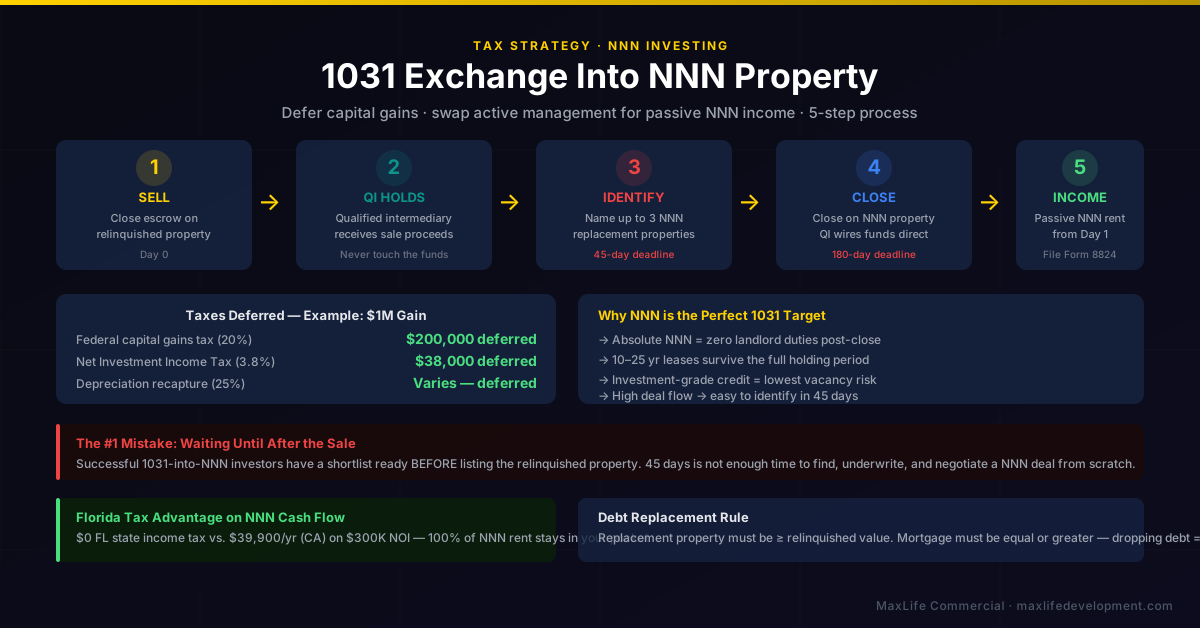
Why 1031 Into NNN Is One of the Best Moves in CRE
Swapping appreciated investment property into a passive, absolute NNN property via a 1031 exchange is one of the most powerful wealth-building plays available to real estate investors. You defer the tax bill — potentially hundreds of thousands of dollars in capital gains and depreciation recapture — and simultaneously step out of active management into a long-term passive income stream. No tenants to manage, no maintenance calls, no re-leasing risk for 10–25 years.
The combination is particularly powerful in Florida. The state has no income tax, which means every dollar of NNN rent flows directly to the investor. A California apartment investor who 1031s into a Florida NNN property eliminates both their California tax exposure and their management burden in a single transaction.
This guide walks through every step of the process — from understanding the IRC §1031 rules to selecting the right NNN tenant for your holding period and financial profile. For context on the broader NNN landscape, start with our ultimate guide to NNN investing.
1031 Exchange Basics
A 1031 exchange (technically a like-kind exchange under IRC §1031) allows you to defer capital gains tax and depreciation recapture when you sell an investment or business property — provided you reinvest the proceeds into a qualifying replacement property. There is no limit on how many times you can do a 1031 exchange, and the deferrals compound across exchanges. The tax bill only comes due when you eventually sell without doing another exchange.
Taxes You Are Deferring
- →Federal long-term capital gains: up to 20%
- →Net Investment Income Tax (NIIT): 3.8% (for income above $200K/$250K)
- →Depreciation recapture: 25% on accumulated depreciation
- →State income tax: varies — Florida investors owe 0%
On a $3M sale with $1M of gain and $300K of depreciation recapture, the combined federal tax exposure is approximately $280,000–320,000 before state tax. A 1031 exchange defers that entire amount, leaving more capital working in the replacement property from day one.
Key rules: the property must be held for investment or business use (not personal use). You must use a qualified intermediary (QI) — you cannot receive the sale proceeds yourself. And you must follow strict timelines: 45-day identification window and 180-day closing deadline. Any proceeds not reinvested become "boot" — taxable in the year of the exchange.
Why NNN Is the Perfect 1031 Target
NNN properties are not just a good 1031 option — they are purpose-built for 1031 investors who want to exit active management. Here is why the combination works so well.
- →Absolute NNN = Zero Landlord Duties: The tenant pays all property taxes, insurance, and maintenance including roof and structure. You collect rent and do nothing else. Ideal for investors stepping out of apartments, retail centers, or active management.
- →Long Lease Terms Eliminate Re-Leasing Risk: NNN leases run 10–25 years from execution. A 20-year lease signed today carries you to 2046 without a re-leasing event. That eliminates the most significant risk in the holding period for most investors.
- →Investment-Grade Credit Reduces Vacancy Risk: Dollar General, AutoZone, Walgreens, and similar tenants carry institutional credit ratings. The probability of lease default is measurably lower than with a private or unrated tenant.
- →Predictable Cash Flow Matches Passive Income Needs: Defined rent bumps (7.5–10% every 5 years, or 1.5–2% annually) create a predictable cash flow schedule that works for IRA distributions, trust structures, retirement income planning, and estate transfers.
- →Closes Within 180 Days: NNN properties are well-suited for the 1031 timeline. Due diligence is standardized, lender underwriting is straightforward for credit-tenant leases, and deal flow is high. Unlike development or value-add assets, you can reliably close a NNN deal within the 180-day window.
The 5-Step Process
Sell the Relinquished Property
Close escrow on your investment property. The 45-day clock starts the moment title transfers. Do not receive the proceeds — they must go directly to the QI.
Engage a Qualified Intermediary Before Closing
The QI must be in place before you close on the sale. The QI holds the exchange funds in a segregated escrow account. The QI cannot be your attorney, accountant, real estate broker, or anyone who has acted as your agent within the past 2 years.
45-Day Identification Window
Within 45 calendar days, submit a written identification of up to 3 replacement properties (3-property rule) to the QI. You can identify more under the 200% rule (total FMV ≤ 200% of relinquished property) or 95% rule (you must close on 95% of identified value). Be precise: address and legal description.
Close on the Replacement Property Within 180 Days
Close on one of your identified NNN properties within 180 calendar days of the relinquished property sale (or by the due date of your tax return for that year, whichever is earlier). The QI wires funds directly to the closing.
File IRS Form 8824
Report the exchange on IRS Form 8824 with your federal tax return for the year of the exchange. Your CPA handles this — but make sure your QI provides a complete exchange statement documenting all proceeds, costs, and replacement property details.
Identifying NNN Properties in 45 Days
The 45-day window is tight — especially if you start looking after you sell. The investors who execute 1031-into-NNN transactions without stress are the ones who have built their replacement property pipeline before they list the relinquished property. Your NNN broker should have a shortlist of viable candidates ready before you close the sale.
NNN is ideal for the 1031 identification window precisely because the deal flow is high and the due diligence checklist is standardized. A well-sourced NNN deal can be identified, underwritten, and placed under LOI within 2–3 weeks of starting a focused search. That leaves ample time to refine your identification and manage the closing timeline.
Common sources of 1031 exchange capital:
- →Apartments → absolute NNN (step from active to passive)
- →Retail strip centers → single-tenant NNN (simplify to credit tenant)
- →Industrial → NNN ground lease (simplify management)
- →Active rental portfolio → NNN portfolio (estate planning / retirement)
Watch for boot: do not pay down the mortgage on the relinquished property without replacing that debt at the replacement property. Dropping leverage is the most common source of unintentional boot in 1031-into-NNN transactions.
The most common 1031 mistake: waiting until after the sale to find the NNN property. Successful 1031-into-NNN investors have a shortlist of replacement properties ready before they list the relinquished property — not after.
Get Off-Market CRE Deals in Your Inbox
Join our investor list for exclusive Central Florida opportunities, market reports, and deal analysis — delivered weekly. No spam, unsubscribe anytime.
Debt Replacement Rules
The replacement property must be of equal or greater value, and the debt on the replacement property must be equal to or greater than the debt on the relinquished property. Dropping debt without adding equivalent cash creates boot — the difference becomes taxable in the year of the exchange.
Debt Replacement Example
NNN properties are typically financed at 60–70% LTV (or lower), so if your relinquished property carried higher leverage, you may need to bring additional cash at closing or accept some taxable boot. Work with your CPA and QI to model the boot exposure before you commit to a replacement property.
NNN Tenant Selection for a 1031 Exchange
Not all NNN tenants are appropriate for a 1031 exchange. The selection criteria should match your investment objectives — especially if the exchange is part of a retirement income or estate planning strategy.
- →10+ Years Remaining Lease: Prefer NNN deals with at least 10 years of lease term remaining at closing. Short remaining terms create re-leasing risk within your holding period — the opposite of what a 1031 investor wants.
- →Investment-Grade Credit (BBB- or Better): For conservative 1031 strategies — retirement income, trust distributions, estate planning — stick with investment-grade tenants. The default probability is dramatically lower, and the resale market is deeper.
- →Absolute NNN Structure: Confirm the lease is absolute NNN with no landlord obligations for roof, structure, or HVAC. Modified NNN leases that carve out certain expenses to the landlord are not the same investment and should be priced accordingly.
- →Defined Rent Escalations: Flat rents over a 15-year lease term erode purchasing power. Look for 7.5–10% bumps every 5 years, or 1.5–2% annual increases. This is non-negotiable for a long-term hold.
- →Avoid Deep-Discount NNN for 1031: High cap rate NNN deals (non-investment-grade credit, short lease, flat rent) can be good opportunistic investments — but they are poor 1031 replacement assets because the risk profile defeats the passive income objective.
The Florida Advantage
Florida's no-state-income-tax structure is the single most powerful financial advantage available to a 1031 exchange investor selecting a replacement property. Every dollar of NNN rent from a Florida-domiciled investment flows directly to the investor — there is no state tax bite. Compare that to investing in California (13.3% state income tax), New York (10.9%), or New Jersey (10.75%). On $150,000 of annual NNN rent, Florida domicile saves $15,000–20,000 per year in state taxes relative to high-tax states.
Florida domicile also eliminates state estate tax (Florida has none) and provides asset protection advantages under Florida homestead law for primary residents. For investors relocating from high-tax states who are executing a 1031 exchange, the combination of capital gains deferral and Florida domicile can be transformative for their long-term wealth picture.
To maximize tax efficiency on the replacement property, pair your 1031 exchange with a cost segregation study on the new NNN asset — even a passive NNN property has accelerated depreciation available on certain components. See our guide on cost segregation studies for Florida CRE.
Planning a 1031 Exchange Into NNN?
MaxLife Commercial helps Central Florida investors identify, underwrite, and close NNN properties within 1031 exchange timelines. Ryan Solberg works directly with investors and their CPAs to build the replacement property pipeline before the sale closes — so you're not scrambling on day one of the 45-day window.
Frequently Asked Questions
How does a 1031 exchange into a NNN property work?
You sell an investment property, transfer proceeds to a qualified intermediary (QI), then use those funds to purchase a NNN replacement property within 180 days. You must identify the replacement within 45 days of closing the sale. The replacement must be equal or greater value, and any mortgage must be replaced with equal or greater debt (or offset with cash) to avoid taxable boot.
What is the 45-day rule in a 1031 exchange?
The 45-day identification window requires you to formally identify your replacement property within 45 calendar days of closing on the relinquished property. The identification must be in writing and delivered to the QI. You can identify up to 3 properties (3-property rule) regardless of value, or more properties under the 200% or 95% rules.
Can you 1031 exchange into any NNN property?
Yes — any NNN property held for investment or business use qualifies as a like-kind replacement under IRC §1031. You can exchange an apartment for NNN retail, or industrial for a NNN ground lease. The IRS defines like-kind broadly for real property. The critical rules are equal or greater value, equal or greater debt, and closing within 180 days.
Do you need a Florida qualified intermediary for a 1031 exchange?
No — the QI does not need to be based in Florida. The QI must be in place before you close the sale, cannot be your attorney, accountant, or broker, and must hold exchange funds in a segregated escrow account. Using a reputable national QI bonded and insured with segregated exchange accounts is standard practice.
Related Articles
How to Analyze a NNN Deal
The complete NNN underwriting checklist — cap rate, lease review, credit, and site analysis.
1031 Exchange vs Opportunity Zone
Two powerful tax-deferral strategies compared — which is right for your situation.
Cost Segregation Studies Florida CRE
How to accelerate depreciation on commercial real estate — including NNN replacement properties.
Childcare NNN Properties Florida 2026
One of the stickiest alternative NNN categories — ideal for 1031 passive income buyers.
Net Lease Investing Florida
The complete guide to NNN, NN, and absolute net lease investing across Florida.
Passive Income CRE Florida
The best passive income strategies in Florida commercial real estate — NNN, industrial, and more.