What Is a Cost Segregation Study?
A cost segregation study is an engineering-based tax analysis that identifies and reclassifies components of a commercial property from longer depreciation lives to shorter ones. When you purchase a commercial building, the IRS generally requires you to depreciate it over 39 years (27.5 years for residential rental property). This produces a modest annual depreciation deduction that, while valuable, does not come close to reflecting the true economic reality of how different parts of a building wear out.
A cost segregation study fixes this by dissecting the property into its component parts. A qualified engineering firm — not just a CPA estimating from the purchase price — physically inspects the property, reviews construction documents, and reclassifies individual components according to IRS asset class lives. Personal property (carpeting, specialty lighting, cabinets, plumbing fixtures) qualifies for 5-year depreciation. Land improvements (parking lots, landscaping, sidewalks, site fencing) qualify for 15-year depreciation. Only the structural shell of the building must stay on the 39-year schedule.
The result: rather than waiting 39 years to fully depreciate a $3 million commercial building, you accelerate a meaningful portion of those deductions into the first 5 to 15 years of ownership — dramatically reducing taxable income in the early years when the deductions have the highest present value.
Cost segregation is not a loophole or a gray area — it is an established IRS-sanctioned methodology codified in Treasury regulations and supported by more than two decades of Tax Court rulings. The IRS has published its own audit technique guide for cost segregation, which itself is an endorsement of the strategy when properly executed.
The Three Depreciation Buckets
Understanding how the IRS classifies property is the foundation of cost segregation. Every component of a commercial building falls into one of three primary depreciation categories.
5-Year Property — Personal Property
The IRS allows 5-year depreciation for tangible personal property that is not inherently permanent. In a commercial real estate context, this includes items like carpeting, vinyl and laminate flooring, specialty lighting systems, decorative fixtures, restaurant equipment, appliances, computers and wiring installed during construction, and tenant-specific improvements that serve the occupant rather than the building itself.
On a typical commercial property, personal property might represent 5% to 15% of total cost, depending on the property type. Restaurants, retail stores, and medical offices tend to have higher personal property percentages because they contain more specialized, removable equipment and finishes than, say, a warehouse or a simple office building.
15-Year Property — Land Improvements
Land improvements that are not inherently permanent and do not relate to the structural integrity of the building qualify for 15-year depreciation. This category includes parking lots and parking structures, landscaping and irrigation systems, sidewalks and curbing, outdoor lighting (pole lights, parking lot fixtures), site signage, fencing, and some utility connections running from the street to the building.
For many commercial properties — especially retail centers, NNN pad sites with significant parking, and industrial facilities with large lot coverage — land improvements can represent 10% to 20% of total cost. These assets are important cost segregation targets because they often have significant dollar value and the 15-year life represents meaningful acceleration over the 39-year default.
39-Year Property — Structural Components
The building shell and its inherently permanent structural components must remain on the 39-year depreciation schedule. This includes the foundation, exterior walls, structural framing, roofing, HVAC systems serving the entire building, elevators, plumbing systems, and electrical systems that are building-wide rather than tenant-specific.
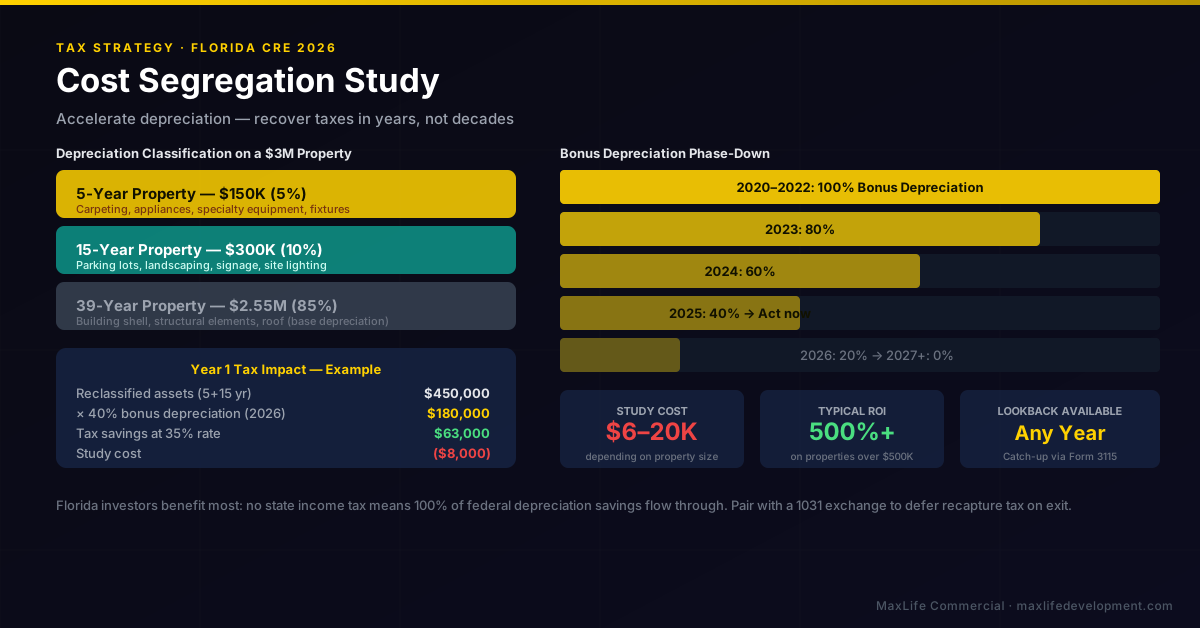
After a well-executed cost segregation study, the 39-year bucket should represent 65% to 85% of the depreciable basis, with the remainder accelerated into 5- and 15-year categories. The exact split depends on property type, construction quality, tenant mix, and the extent of personal property and site improvements.
Bonus Depreciation Rules in 2026
Bonus depreciation is what transforms cost segregation from a useful tax tool into a potentially transformative one. Under current tax law, investors can deduct a percentage of the cost of 5-year and 15-year property in the first year of ownership rather than spreading the deduction over the asset's depreciation life.
The bonus depreciation percentage has been phasing down since 2023. It was 100% from 2020 through 2022 (meaning you could deduct the entire cost of qualifying assets in year one). The phase-down schedule is:
- →2022: 100% bonus depreciation
- →2023: 80%
- →2024: 60%
- →2025: 40% (note: Congress may act)
- →2026: 40% (current law — confirm with your CPA)
- →2027+: 20%, then 0% under current law absent legislative action
2026 Bonus Depreciation Example
You purchase a $5 million commercial building. A cost segregation study identifies $750,000 of 5-year and 15-year qualifying assets. With 40% bonus depreciation in 2026, you can deduct $300,000 in year one (40% × $750,000), in addition to the regular first-year depreciation on the remaining $450,000 of qualifying assets (roughly $90,000) and the 39-year structural depreciation (roughly $110,000). Total year-one depreciation: approximately $500,000 — on a $5M property where straight-line depreciation would have given you roughly $128,000.
Real Numbers: Cost Segregation on a $3M NNN Property
Let's walk through a realistic example using a $3 million NNN retail property — a common acquisition for Florida CRE investors doing 1031 exchanges or buying single-tenant assets for passive income.
$3M NNN Property — Cost Segregation Analysis
This example uses conservative assumptions — a 5% personal property allocation and 10% land improvements. Properties with significant tenant improvements, specialized finishes, or large parking areas will have higher reclassification percentages and correspondingly larger tax benefits. A restaurant NNN property or a medical office building might see 20–30% of basis reclassified, nearly doubling the benefit shown above.
Get Off-Market CRE Deals in Your Inbox
Join our investor list for exclusive Central Florida opportunities, market reports, and deal analysis — delivered weekly. No spam, unsubscribe anytime.
Who Benefits Most from Cost Segregation?
Cost segregation is valuable for virtually every commercial real estate owner, but the benefit is most dramatic for specific investor profiles.
Real Estate Professionals (Active Investors)
Investors who qualify as real estate professionals under IRS rules — spending more than 750 hours per year in real estate activities and more time in real estate than any other profession — can use depreciation losses to offset not just rental income but any income, including W-2 wages and investment income. This dramatically multiplies the value of accelerated depreciation. A real estate professional investor in the 37% bracket can save $370 for every $1,000 of additional depreciation generated by cost segregation.
High-Income W-2 Earners with Passive Losses
Passive investors (those who do not qualify as real estate professionals) can still benefit substantially, but the depreciation losses are passive losses that can only offset passive income — rents from other properties, partnership distributions, etc. If you have multiple rental properties, passive losses from cost segregation on one property can offset income from others. Any unused passive losses carry forward indefinitely and become fully deductible when you sell the property.
Investors in Properties Worth $1M+
The ROI of a cost segregation study scales with property value. On a $500K property, the study cost might represent 1.5–2% of the tax savings, which is still a good trade but less dramatic. On a $5M property, the study cost is a rounding error compared to the six-figure tax savings it generates. Most cost segregation firms agree the strategy becomes compelling at property values above $500K and becomes a near-automatic decision above $1M.
Recent Purchasers and 1031 Exchange Buyers
The best time to order a cost segregation study is at acquisition, so you can capture the maximum benefit from the first tax year of ownership. Investors completing a 1031 exchange into a new property should order a cost segregation study on the replacement property immediately after closing. The depreciation deductions begin from your acquisition date, not from the study date.
Value-Add Repositioning Investors
When you renovate or expand a commercial property, the improvements you make are subject to cost segregation just like the original acquisition. Investors doing significant capital improvements — tenant buildouts, parking lot reconstruction, HVAC replacement — should include those improvements in a cost segregation analysis to maximize the depreciation benefit on the newly invested capital.
Lookback Studies: It's Not Too Late to Go Back
One of the most valuable and least-known aspects of cost segregation is the lookback study — the ability to capture missed depreciation on properties you have owned for years, without filing amended tax returns.
Under IRS Revenue Procedure 2015-13, a property owner can change their depreciation method by filing Form 3115 (Application for Change in Accounting Method) with their current-year tax return. The cumulative catch-up deduction — representing all the accelerated depreciation you would have taken if you had done the study at acquisition — is taken as a single lump-sum deduction in the year you file the Form 3115.
Lookback Study Example
You purchased a $2 million commercial property seven years ago and have been depreciating it straight-line at 39 years ($51,300/yr). A lookback study determines that $300,000 of that property was 5-year or 15-year property. Over seven years, you should have taken roughly $180,000 more in depreciation than you did. You file Form 3115 this year and take a $180,000 catch-up deduction — all in the current tax year — with no amended returns for prior years. At a 32% tax rate, that is $57,600 of tax savings, available now.
Lookback studies are typically worth pursuing for properties owned for 1 to 15 years. Beyond 15 years, much of the 15-year property would have been fully depreciated anyway, reducing the catchup opportunity. Work with your CPA and cost segregation firm to determine whether a lookback study makes economic sense for properties you already own.
How Much Does a Cost Segregation Study Cost?
Cost segregation study fees vary based on property type, complexity, size, and the methodology used. Here are realistic ranges for Florida commercial properties in 2026:
- →$500K–$1M property: $4,000–$8,000 (template-assisted or smaller engineering study)
- →$1M–$3M property: $6,000–$12,000 (full engineering study)
- →$3M–$10M property: $10,000–$20,000 (comprehensive engineering study)
- →$10M+ or complex properties: $18,000–$30,000+ (large-scale engineering analysis)
- →Lookback studies: Typically 10–20% less than new-acquisition studies of equivalent size
Be cautious of low-fee “software-only” studies that rely on national average percentages rather than a property-specific engineering analysis. While these cost less upfront, they often miss reclassification opportunities and produce results that may not withstand IRS scrutiny. The IRS has specifically noted in audit guidance that engineering-based studies are the appropriate methodology.
A properly executed cost segregation study on any commercial property worth $500K or more almost always generates a positive ROI — typically returning $5 to $15 in tax savings for every $1 spent on the study. On larger properties, the ratio is often $20-to-$1 or higher in the first year alone.
Florida-Specific Advantages for Cost Segregation
Florida's status as a no-income-tax state has an important implication for cost segregation: every dollar of depreciation savings compounds entirely at the federal level.
In high-tax states like California or New York, the depreciation deduction reduces both federal and state taxable income. But because state income taxes are themselves deductible (subject to the $10,000 SALT cap), the true benefit of the state-level deduction is reduced. The calculation is messier, and in some cases investors in high-tax states are effectively generating a smaller net benefit per dollar of depreciation than their Florida counterparts.
Florida investors also benefit from the ability to pair cost segregation with a 1031 exchange strategy. Here is how the combination works:
- →Step 1: Acquire replacement property via 1031 exchange — defer capital gains tax from the relinquished property
- →Step 2: Order a cost segregation study on the replacement property — accelerate depreciation and reduce current-year tax liability
- →Step 3: Hold and generate cash flow with reduced tax drag from accelerated depreciation
- →Step 4: When ready to exit, execute another 1031 to defer depreciation recapture tax — or hold until death, when heirs receive a stepped-up basis
This strategy — sometimes called the “1031 and cost seg ladder” — is one of the most effective long-term tax deferral strategies in commercial real estate. Florida's no-state-tax environment makes the arithmetic cleaner and the benefit more predictable than in states with complex state tax overlays.
How to Order a Cost Segregation Study
The process is straightforward, but the quality of the firm you hire makes a meaningful difference in the size of the benefit and the defensibility of the result.
Step 1: Engage a Qualified Engineering Firm
Look for a firm that employs licensed engineers or architects and performs property-specific analysis rather than applying generic percentage tables. Ask whether they have experience with your specific property type (NNN retail, industrial, medical office, etc.) and request references from prior clients in similar situations. Your CPA can often recommend firms they have worked with successfully.
Step 2: Provide Property Documentation
The firm will request your closing documents (purchase price allocation, settlement statement), any construction documents (blueprints, contractor invoices), the property address, and your tax basis in the property. If you are doing a lookback study, your prior depreciation schedules from your CPA are also needed to calculate the catch-up amount.
Step 3: Property Inspection
A qualified engineer inspects and measures the property, photographs components, and identifies personal property and land improvements in the field. This typically takes a few hours for smaller properties and half a day or more for larger assets. Some firms combine the site visit with a review of construction documents to maximize the reclassification opportunity.
Step 4: Report Delivery (2–4 Weeks)
The firm delivers a detailed report that itemizes each reclassified asset, the depreciation method, the recovery period, and the first-year deduction. This report becomes the supporting documentation attached to your tax return. It should be detailed enough to withstand an IRS inquiry without requiring additional explanation.
Step 5: Coordinate with Your CPA
Once you have the cost segregation report, share it with your CPA or tax advisor. They will update your depreciation schedule and incorporate the new deductions into your tax return. For lookback studies, your CPA will prepare and file Form 3115 with your return. Make sure your CPA reviews any passive loss limitations that may affect when you can actually use the deductions.
Estimate Your Savings Before You Order
Before engaging a cost segregation firm, it helps to get a ballpark sense of the benefit for your specific property. Our cost segregation calculator lets you input your purchase price, property type, and estimated land value to generate a projection of your potential year-one depreciation deduction and tax savings under 2026 bonus depreciation rules.
Cost Segregation Calculator
Enter your property details to estimate first-year depreciation, bonus depreciation, and tax savings for Florida commercial real estate.
Use the CalculatorReady to talk through how cost segregation fits into your overall CRE investment strategy? Contact MaxLife Commercial — we work with Florida CRE investors on deal structuring, acquisition strategy, and tax planning coordination across markets including Orlando, Tampa, and the broader I-4 corridor. You can also explore our Deal Analyzer to model after-tax returns that incorporate accelerated depreciation into your investment analysis.
Related Articles
1031 Exchange Guide for Florida Investors
How to execute a 1031 exchange in Florida — timelines, identification rules, and deal sourcing.
1031 Exchange vs Opportunity Zone
When to use a 1031 exchange vs an Opportunity Zone fund for capital gains deferral.
NNN vs Multifamily Investing
Comparing the risk, return, and tax profile of net lease vs multifamily CRE investment.
Why Invest in Commercial Real Estate in Florida?
The structural case for Florida CRE — no income tax, population growth, and business climate.
The Ultimate Guide to NNN Investing
Everything you need to know about single-tenant net lease investing, cap rates, and tenant credit.
Florida CRE Investor Guide
Statewide market overview, tax advantages, and asset class fundamentals for Florida investors.