Tampa Bay CRE: Why It's Florida's #2 Market
The Tampa-St. Petersburg-Clearwater MSA is home to more than 3.2 million people and has been one of the fastest-growing large metros in the United States for the past decade. While Miami dominates Florida's international real estate headlines, Tampa has quietly built a stronger economic foundation than its southeast Florida counterpart — at a fraction of the entry cost.
Tampa's economy is genuinely diversified. Financial services giants including Raymond James, Citigroup's operations center, and Franklin Templeton have major Tampa footprints. USF Health, Tampa General Hospital, and AdventHealth anchor a massive healthcare sector. MacDill Air Force Base — home to CENTCOM and SOCOM — adds defense employment that is insulated from economic cycles. And a growing tech sector is filling in around the University of South Florida.
Port Tampa Bay is the largest seaport in Florida, handling bulk cargo, containers, petroleum, and cruise passengers. The port is not just an economic engine — it is a direct driver of industrial real estate demand in a market where developable land near the core is nearly exhausted.
For CRE investors, the key advantages Tampa offers over Miami are lower cost of entry (cap rates 50–100 bps wider), less regulatory friction, stronger industrial fundamentals, and faster population growth. Tampa's population is growing faster in percentage terms than Miami's, with in-migration driven by both retirees and working-age households priced out of South Florida.
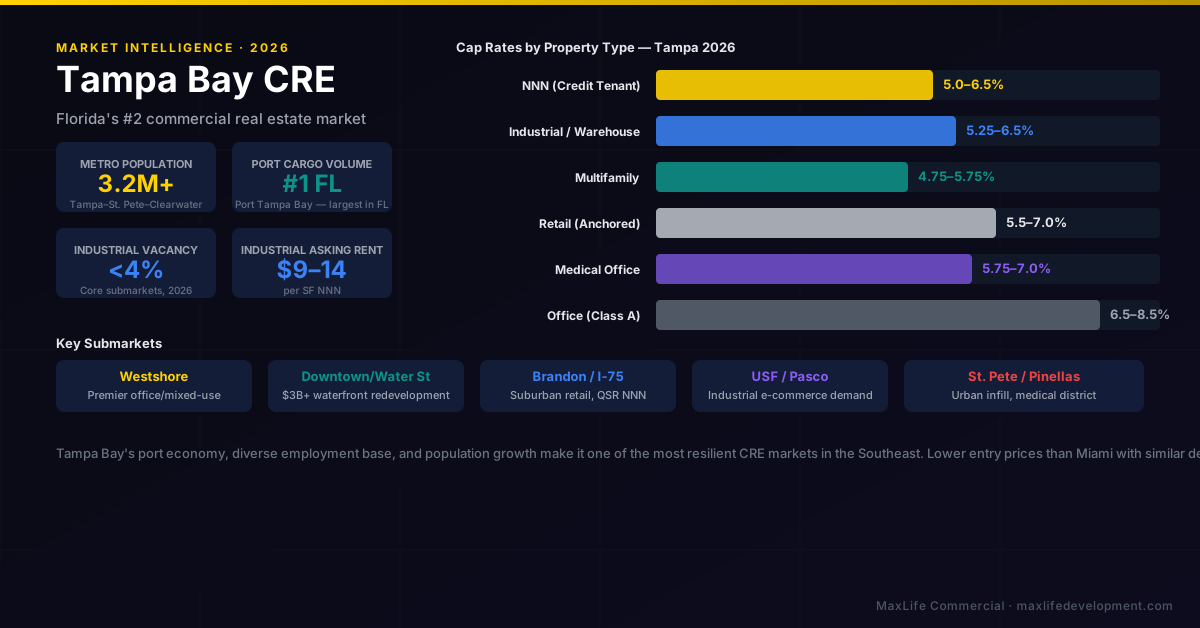
Cap Rates by Property Type — Tampa 2026
Tampa cap rates reflect a market that is institutionally recognized but still offers more yield than the tightest Sun Belt metros. The ranges below apply to stabilized, market-rate assets in core Tampa Bay locations. Secondary submarkets or properties with lease-up risk will trade wider.
| Property Type | Cap Rate Range | Notes |
|---|---|---|
| NNN (credit tenant) | 5.0–6.5% | Investment-grade, 10+ yr lease |
| Industrial / Warehouse | 5.25–6.5% | Port proximity commands premium |
| Multifamily | 4.75–5.75% | Class A urban; Class B wider |
| Retail (anchored center) | 5.5–7.0% | Grocery-anchored tightest |
| Medical Office | 5.75–7.0% | Strong healthcare employment base |
| Office (Class A) | 6.5–8.5% | Westshore tighter; suburban wider |
How Tampa compares to Orlando
Tampa industrial cap rates are typically 25–50 basis points tighter than comparable Orlando product due to Port Tampa Bay's logistics demand. NNN retail is broadly equivalent. Multifamily has compressed harder in Tampa's urban core (Downtown, Channelside, St. Pete) than in most Orlando submarkets, reflecting the Water Street redevelopment premium.
Top Tampa Submarkets for CRE Investment
Tampa Bay is not one market — it is a collection of distinct submarkets with different demand drivers, tenant bases, and risk profiles. Submarket selection matters as much as asset class selection.
Westshore
Westshore is Tampa's premier office and mixed-use corridor, situated between Tampa International Airport and downtown. It contains more than 20 million square feet of office inventory — the largest office concentration in Florida outside Miami's Brickell. Airport adjacency and direct I-275 access make Westshore the preferred address for financial services, consulting, and corporate headquarters tenants.
Office vacancy in Westshore is tighter than in most Sun Belt CBDs because the submarket's tenant mix skews toward industries that have maintained higher in-office expectations — finance, defense contracting, and healthcare administration. Retail along Westshore Boulevard benefits from the daytime employee population, and several mixed-use development projects are adding residential density that will further strengthen the retail and service economy.
Downtown Tampa / Channelside
The Water Street Tampa development — a $3 billion mixed-use project by Strategic Property Partners — has fundamentally transformed the downtown and Channelside districts. The development has added Class A office, luxury multifamily, hotels, and ground-floor retail to a previously underutilized waterfront area. Tampa's downtown skyline and walkability are now legitimate competitors to Orlando and Charlotte for corporate relocations seeking urban amenities.
For investors, Downtown/Channelside offers multifamily, hospitality, and mixed-use opportunities at cap rates reflecting the renewed confidence in the urban core. Condo-to-rental conversions and adaptive reuse of older office inventory are active strategies in the area. Ground lease opportunities have emerged along the waterfront as institutional developers structure longer-term value creation.
Brandon / Valrico
Brandon is Hillsborough County's largest suburban community, sitting at the junction of I-75 and the Brandon interchange with direct access to the I-4 corridor. Median household income in Brandon exceeds $72,000, making it one of the stronger retail trade areas in the Tampa metro. The submarket has one of the highest concentrations of quick-service restaurants, auto parts retailers, and dollar stores in Hillsborough County — classic NNN tenant categories.
NNN investors targeting the Tampa market frequently focus on Brandon because the high household income and traffic counts support credit-tenant locations. US-60 (Brandon Boulevard) and Lithia Pinecrest Road are the primary retail corridors. Valrico, immediately east of Brandon, is growing rapidly and offers slightly wider cap rates than Brandon proper for comparable assets.
I-75 / USF Corridor
The I-75 corridor north of downtown — stretching from the University of South Florida south campus through New Tampa and into Pasco County — is Tampa's primary industrial growth axis. E-commerce fulfillment, food distribution, and port-related logistics operations have absorbed nearly all available industrial inventory in this corridor. Pasco County industrial activity is spilling over from core Hillsborough County as land becomes scarce.
Proximity to Port Tampa Bay gives this corridor a built-in demand advantage that is difficult for competing submarkets to replicate. Investors looking at industrial product here should underwrite tight vacancy assumptions — sub-4% vacancy has persisted through multiple economic cycles due to the port's anchor effect on logistics demand.
St. Pete / Pinellas County
St. Petersburg has emerged as one of Florida's most dynamic urban markets. The downtown creative district, arts scene, and waterfront access have attracted significant multifamily development and transformed the city's office market. Creative office — flexible, open-plan space in retrofitted industrial and retail buildings — is particularly active here, serving advertising agencies, tech startups, and healthcare-adjacent firms.
The Pinellas Medical District near Bayfront Health and St. Anthony's Hospital is a strong medical office submarket. Urban infill retail along Central Avenue and Beach Drive trades at tight cap rates reflecting the neighborhood's high foot traffic and affluent demographic base. Investors looking for value should examine secondary Pinellas corridors where cap rates run 75–100 basis points wider than St. Pete proper.
Get Off-Market CRE Deals in Your Inbox
Join our investor list for exclusive Central Florida opportunities, market reports, and deal analysis — delivered weekly. No spam, unsubscribe anytime.
Tampa Industrial Market: Port-Driven and Land-Constrained
Tampa's industrial market is the strongest in Florida outside Miami-Dade. Port Tampa Bay — which handles over 37 million tons of cargo annually — creates demand for warehousing, cold storage, distribution, and transloading facilities that no other Florida port city outside Miami can match in terms of volume.
Core industrial vacancy in Tampa has remained below 4% for several years, and the supply constraint is structural rather than cyclical. The urban core of Hillsborough County has almost no developable industrial land remaining. New industrial development has shifted to Pasco County to the north and parts of Polk County to the east, but these locations lack the Port Tampa Bay adjacency premium that drives the tightest pricing.
- →Asking rents for bulk distribution: $11–14/SF NNN
- →Asking rents for small-bay / flex industrial: $9–12/SF NNN
- →Core vacancy: sub-4% persistently
- →Primary demand drivers: e-commerce, port logistics, food distribution, building materials
- →Growth edge: Pasco County, East Hillsborough, Polk County fringe
Investors acquiring stabilized industrial in core Tampa are paying cap rates that reflect the scarcity premium. For investors seeking higher entry yields, value-add plays on older flex industrial in secondary locations — upgrading dock doors, clear heights, and office finishes — remain one of the more compelling strategies in the metro.
Tampa NNN Investment: Tenant Density and Traffic Corridors
Tampa Bay is one of the strongest NNN investment markets in the Southeast. The combination of high population density, above-average household incomes in suburban corridors, and persistent in-migration makes it an attractive environment for the national retail tenants that underpin NNN investment — quick-service restaurants, auto parts, dollar stores, pharmacies, and convenience stores.
The primary NNN investment corridors are US-301 (running through Brandon and Riverview), US-41 (Tamiami Trail, connecting South Tampa to Bradenton), and the I-75 interchange communities of Brandon, Wesley Chapel, Riverview, and Apollo Beach. These corridors have absorbed significant national tenant expansion over the past decade and continue to attract new-construction NNN development.
Top NNN tenant categories in Tampa Bay
Quick-service restaurants (Chick-fil-A, McDonald's, Raising Cane's), auto service (AutoZone, O'Reilly, Valvoline), dollar stores (Dollar General, Dollar Tree/Family Dollar combined), pharmacies (Walgreens, CVS), convenience (Wawa, Buc-ee's), and medical/urgent care. The QSR and auto service categories are particularly active in Tampa's I-75 interchange communities where new residential development is driving first-time tenant location decisions.
Tampa vs. Orlando: Key Investment Differences
Investors frequently ask whether to focus on Tampa or Orlando. The honest answer is that they are different markets serving different investment profiles — and the best Florida CRE investors often hold assets in both.
| Factor | Tampa | Orlando |
|---|---|---|
| Economy anchor | Finance, healthcare, port, defense | Tourism, healthcare, tech, logistics |
| Population growth | 1.8% annually | 2.1% annually |
| Industrial | Strongest in FL (Port driver) | Growing, strong I-4 corridor |
| NNN retail | Strong, I-75/US-301 corridors | Strong, tourism corridors too |
| Multifamily urban core | Compressed (Water Street) | Compressed (Lake Nona, Thornton Park) |
| Office fundamentals | Better (finance tenant base) | Mixed (tourism HQ limited) |
| Development pipeline | More constrained, less land | More active, suburban growth |
| Entry cost | Slightly lower than Orlando | Slightly higher due to tourism premium |
Read the full head-to-head breakdown in our Orlando vs. Tampa CRE market comparison.
How MaxLife Commercial Serves Tampa Bay Investors
MaxLife Commercial, led by Ryan Solberg, covers the Tampa Bay market actively alongside our primary Central Florida markets. We work with buyers and sellers across NNN retail, industrial, multifamily, and mixed-use properties throughout Hillsborough, Pinellas, Pasco, and Polk counties.
Our approach in Tampa mirrors what we do in Orlando — deep submarket knowledge, off-market deal sourcing, and a focus on the numbers. We do not speculate on hope; we underwrite to defensible assumptions and present the risk clearly so investors can make informed decisions.
- →Buyer representation for Tampa CRE acquisitions
- →Seller representation and disposition strategy
- →1031 exchange identification in Tampa Bay market
- →Deal underwriting and cap rate analysis
- →Market intelligence and submarket advisory
Visit our Tampa market page or contact us to discuss your Tampa Bay CRE investment goals.
Getting Started with Tampa CRE Investment
Whether you are a first-time commercial investor evaluating Tampa or an experienced buyer looking to expand your Florida portfolio, the process starts with understanding what your capital can achieve in the current market.
- →Use our Deal Analyzer to model cap rates, cash-on-cash returns, and debt service coverage on any Tampa property
- →Review Tampa cap rate benchmarks against the property you are evaluating — is it priced correctly for the submarket?
- →Understand the tenant credit profile — a 10-year lease with an investment-grade tenant is a fundamentally different asset than a 3-year lease with a regional operator
- →Consider a 1031 exchange if you are selling appreciated real estate and need to defer capital gains
- →Contact MaxLife Commercial for deal-specific guidance on Tampa acquisitions
Market Data
Tampa Bay Cap Rates by Asset Class
Ready to Explore Tampa CRE?
MaxLife Commercial provides market analysis, deal underwriting, and acquisition support for investors across the Tampa Bay area.
Talk to Ryan SolbergRelated Articles
Orlando vs Tampa CRE Market
Head-to-head comparison of Florida's two largest inland commercial real estate markets.
Florida CRE Investor Guide
Statewide market overview, tax advantages, and asset class fundamentals for Florida investors.
The Ultimate Guide to NNN Investing
Everything you need to know about single-tenant net lease investing — from cap rates to tenant credit.
Orlando Industrial Real Estate Guide
Industrial market analysis for the I-4 corridor — vacancy, rents, and where to find deals.
1031 Exchange Guide for Florida Investors
How to execute a 1031 exchange in Florida, identification rules, and deal sourcing strategies.
Why Invest in Commercial Real Estate in Florida?
The structural case for Florida CRE — population growth, no income tax, and business climate.