Why Out-of-State Investors Choose Florida Commercial Real Estate
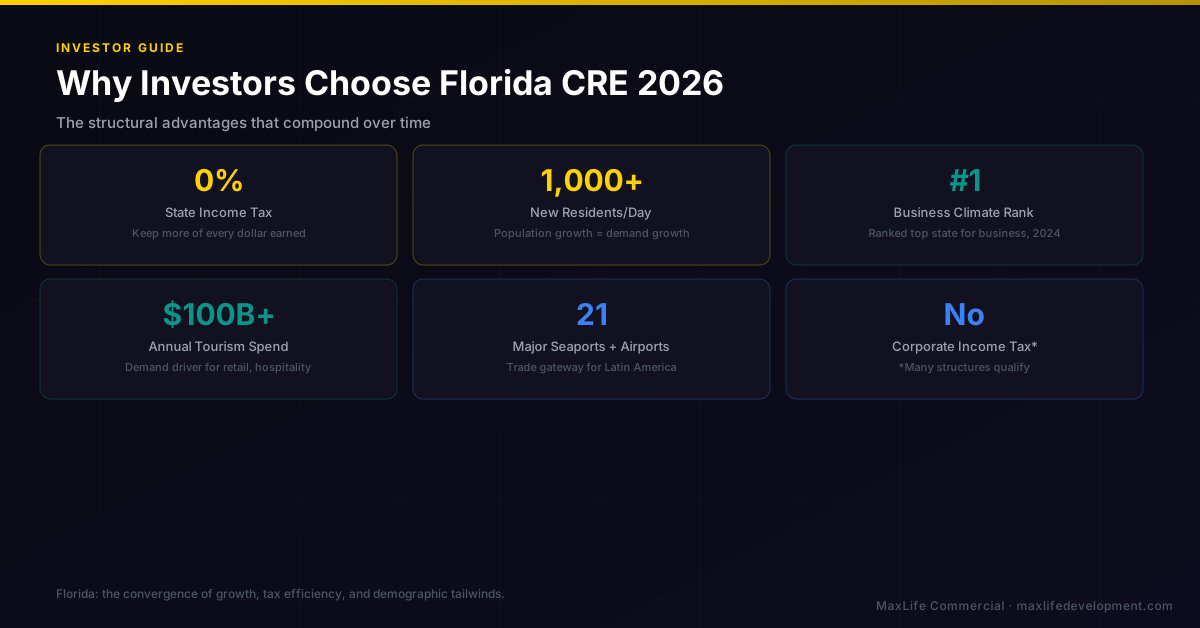
From no state income tax to the nation's strongest migration trends, Florida has become the top destination for out-of-state commercial real estate capital. Here is why investors from California, New York, New Jersey, and Illinois are moving their portfolios south — and why Central Florida leads the pack.
The Great Capital Migration to Florida
Something unprecedented is happening in American commercial real estate. Capital that was historically concentrated in the gateway markets of New York, Los Angeles, San Francisco, and Chicago is flowing south at a pace that has reshaped the investment landscape. Florida is the primary beneficiary of this capital migration, and the trend is accelerating. In 2025, Florida attracted more out-of-state commercial real estate investment than any other state in the country, surpassing Texas for the first time in a decade.
The reasons are both obvious and nuanced. The obvious ones — no state income tax, population growth, business-friendly regulation — get the most attention. But the full picture is more compelling than any single factor suggests. Florida offers a unique combination of tax advantages, demographic tailwinds, economic diversification, and market fundamentals that create a structurally superior environment for commercial real estate investment. And within Florida, Central Florida — particularly the Orlando metro — offers the best risk-adjusted return profile for investors deploying capital from out of state.
This guide examines every major factor driving out-of-state capital into Florida CRE, with specific data and examples that quantify the advantages. Whether you are a California investor exploring tax-free jurisdictions, a New York investor pursuing a 1031 exchange, or an Illinois investor seeking growth markets to replace stagnant Midwest returns, this analysis will help you understand why Florida deserves a central place in your investment strategy.
0%
State Income Tax
#1
Net Domestic Migration
1,200/day
New FL Residents (avg)
23M+
State Population (2025)
Migration Trends: Where the People Go, the Capital Follows
Population growth is the single most reliable predictor of long-term commercial real estate demand. People need places to shop, eat, work, receive healthcare, and store goods. When a state or metro area is gaining population at a rapid pace, commercial real estate demand follows — and Florida has been the nation's top population growth state for years running.
Between 2020 and 2025, Florida gained approximately 2.2 million net new residents, more than any other state by a wide margin. The migration is concentrated from a small number of feeder states, and understanding the source markets helps explain both the volume and the economic profile of new Florida residents. These are not just retirees — they are high-income professionals, business owners, and investors who bring both spending power and capital with them.
| Feeder State | Net Migration to FL (2020-2025) | Avg HH Income of Movers | Primary FL Destination |
|---|---|---|---|
| New York | ~380,000 | $112,000 | South FL, Orlando, Tampa |
| California | ~195,000 | $128,000 | Tampa, Orlando, Jacksonville |
| New Jersey | ~165,000 | $105,000 | South FL, Orlando |
| Illinois | ~145,000 | $98,000 | Tampa, Orlando, SW FL |
| Pennsylvania | ~110,000 | $92,000 | Central FL, Space Coast |
| Connecticut | ~65,000 | $135,000 | South FL, Orlando |
The economic profile of these migrants is critical for commercial real estate investors. These are predominantly high-income households — the average household income of interstate movers to Florida significantly exceeds the state average. They bring established spending patterns, business relationships, and investment capital that directly supports demand for commercial real estate. A successful business owner relocating from New York to Orlando does not just buy a house — they lease office space, patronize local retail and restaurants, and often deploy investment capital into local commercial real estate.
No State Income Tax: The Numbers Are Staggering
Florida's lack of a state income tax is the single most cited reason for investor migration, and for good reason — the savings are substantial. Florida is one of only seven states with no personal income tax and no corporate income tax on pass-through entities (S-corps, LLCs, partnerships). For high-income investors and business owners, the tax savings from relocating to Florida can easily exceed $50,000 per year and often reach well into six figures.
The impact is not just about the personal tax savings — it extends to the returns on commercial real estate investments themselves. When you generate rental income, capital gains, or 1031 exchange proceeds in Florida, that income is not subject to state income tax. An investor earning $200,000 per year in net rental income from Florida commercial properties pays zero state tax on that income. The same income generated in California would be subject to a 13.3% state income tax rate at the top bracket, resulting in a $26,600 annual tax bill that simply does not exist in Florida.
| Annual Income | California Tax | New York Tax | New Jersey Tax | Illinois Tax | Florida Tax |
|---|---|---|---|---|---|
| $200,000 | $17,400 | $13,200 | $13,700 | $9,900 | $0 |
| $500,000 | $52,500 | $38,800 | $41,500 | $24,750 | $0 |
| $1,000,000 | $118,800 | $82,500 | $89,300 | $49,500 | $0 |
| $2,000,000 | $251,600 | $173,000 | $185,800 | $99,000 | $0 |
Real-World Example: The $500K Income Investor
Consider an investor with $500,000 in annual income (salary plus rental income) who relocates from California to Florida. The state income tax savings alone exceed $52,000 per year. Over a 10-year period, that represents $520,000 in cumulative tax savings — before accounting for the investment returns on those saved dollars. If reinvested at a 7% annual return, those tax savings compound to over $750,000 in additional wealth over a decade. That is the equivalent of acquiring another income-producing property entirely from tax savings.
Business-Friendly Environment: Beyond Taxes
While the tax advantages get the most attention, Florida's regulatory and business environment provides additional advantages that are meaningful for commercial real estate investors. Florida consistently ranks among the top five states for business climate, and the practical implications for CRE investors are significant.
Florida's landlord-tenant laws are notably more favorable to property owners than those in states like California, New York, or Illinois. Commercial lease enforcement is straightforward, eviction processes for defaulting tenants are more efficient, and there are no rent control provisions that affect commercial properties. For investors accustomed to the regulatory burdens of high-tax states, Florida's business environment feels refreshingly streamlined.
The permitting and development process in Florida, while varying by jurisdiction, is generally faster and more predictable than in coastal California or the New York metro area. A commercial development that might take 2-3 years to permit in Los Angeles can often be permitted in 6-12 months in Central Florida. This faster timeline reduces carrying costs, accelerates returns, and reduces the regulatory risk that can derail projects in more restrictive jurisdictions.
Efficient Legal Framework
Commercial lease enforcement and eviction processes are straightforward. No commercial rent control. Strong property rights protections under Florida law.
Faster Permitting
Commercial development permitting in 6-12 months in most Central FL jurisdictions. Significantly faster than CA (24-36 months) or NY metro (12-24 months).
Homestead Protection
Florida's unlimited homestead exemption protects personal residences from creditors — a significant asset protection benefit for investors who relocate.
No Estate Tax
Florida has no state estate tax, compared to rates up to 16% in New York, 12% in Illinois, and 16% in New Jersey. Major benefit for generational wealth planning.
Insurance Considerations: The One Caveat Investors Must Understand
No honest discussion of Florida commercial real estate investment is complete without addressing insurance. Property insurance costs in Florida are among the highest in the nation, driven by hurricane exposure, litigation environment, and a challenging reinsurance market. For out-of-state investors accustomed to property insurance costs that represent a minor operating expense, Florida's insurance landscape can be a rude awakening if not properly anticipated.
Commercial property insurance in Central Florida typically runs $1.50 to $3.50 per square foot annually, depending on building construction type, age, location, and claims history. A 10,000 square foot commercial property might carry annual insurance costs of $15,000 to $35,000 — significantly higher than comparable properties in the Midwest or Pacific Northwest. However, these costs are already reflected in the market — cap rates, lease structures, and property pricing in Florida account for the insurance environment.
The key for out-of-state investors is to underwrite insurance costs accurately and to understand the strategies for managing them. NNN lease structures pass insurance costs through to tenants, eliminating the landlord's exposure to insurance cost increases. Newer construction with hurricane-resistant features (impact windows, reinforced roofing, concrete block construction) commands lower premiums. And portfolio insurance programs for investors with multiple Florida properties can generate meaningful savings over individual property policies.
Insurance Cost Comparison by Region
Central FL
$1.50-$3.50/SF
South FL
$2.50-$5.00/SF
Midwest
$0.50-$1.50/SF
California
$0.75-$2.00/SF
Property Management from Out of State: How to Do It Right
One of the most common concerns for out-of-state investors is how to effectively manage commercial properties from a distance. The good news is that the commercial real estate industry has evolved significantly, and managing Florida CRE from California, New York, or anywhere else is entirely feasible with the right approach and team in place.
The most straightforward approach is to invest in NNN leased properties, which require minimal active management. In a well-structured NNN lease, the tenant is responsible for property taxes, insurance, maintenance, and repairs. The landlord's responsibilities are essentially limited to collecting rent and managing lease renewals. This structure is ideal for out-of-state investors who want Florida CRE exposure without the burden of day-to-day property management.
For properties that require active management — multi-tenant retail, office, or value-add investments — hiring a qualified local property management company is essential. Professional commercial property management in Central Florida typically costs 4-6% of effective gross revenue for retail and office properties, with additional fees for leasing commissions, construction management, and capital project oversight. The key is selecting a management firm with specific experience in your property type and submarket.
Technology for Remote Ownership
Modern property management technology has made remote ownership more practical than ever. Cloud-based platforms provide real-time access to financial reporting, maintenance requests, lease management, and tenant communications. Security cameras with remote access allow visual monitoring. Automated rent collection and bill-pay systems reduce the administrative burden. And video conferencing makes it possible to conduct property tours, tenant meetings, and contractor walk-throughs without being physically present.
1031 Exchange into Florida: A Strategic Move
One of the most powerful strategies for out-of-state investors is using a 1031 exchange to defer capital gains taxes while simultaneously moving investment capital from a high-tax state into Florida's tax-free environment. This strategy allows investors to sell appreciated properties in states like California or New York, defer both federal and state capital gains taxes, and reinvest the full proceeds into Florida commercial real estate. For a complete guide to this process, see our 1031 exchange guide for Orlando.
The tax benefit is compounded by the state-level advantage. When you sell a property in California and complete a 1031 exchange into Florida, you defer the federal capital gains tax (which you would defer in any state) plus the California state capital gains tax of up to 13.3%. When you eventually sell the Florida property — or pass it to heirs with a stepped-up basis — that California tax is never paid. The same principle applies to New York (up to 8.82%), New Jersey (up to 10.75%), and Illinois (4.95%).
Additionally, Florida is a particularly attractive 1031 exchange destination because of the depth and diversity of the commercial real estate market. Whether you are exchanging out of a small NNN property or a large multifamily complex, Florida's market offers suitable replacement properties across every property type and price range. The breadth of the market also helps meet the strict 45-day identification and 180-day closing timelines that 1031 exchanges require. For more on exchange strategies, visit our Florida 1031 exchange resource center.
1031 Exchange Tax Savings Example
An investor sells a $3M commercial property in California with $1.5M in capital gains. Without a 1031 exchange, the combined federal and state tax would be approximately:
Without 1031
- Federal: ~$300,000 (20%)
- NIIT: ~$57,000 (3.8%)
- CA State: ~$199,500 (13.3%)
- Total: ~$556,500
With 1031 into FL
- Federal: Deferred
- NIIT: Deferred
- CA State: Deferred / Eliminated
- Total Tax: $0 (at exchange)
Market Comparison: Orlando vs. South Florida vs. Tampa
Florida is not a monolithic market. The three major metro areas — Orlando, South Florida (Miami-Fort Lauderdale-Palm Beach), and Tampa Bay — each offer distinct investment profiles. Understanding the differences is important for out-of-state investors deciding where to deploy capital. For more on the Orlando market specifically, see our Orlando commercial real estate overview.
| Factor | Orlando Metro | South Florida | Tampa Bay |
|---|---|---|---|
| Population Growth (5yr) | +12.5% | +6.8% | +10.2% |
| Avg Retail Cap Rate | 6.0% - 7.5% | 5.0% - 6.5% | 5.5% - 7.0% |
| Avg Industrial Cap Rate | 5.5% - 7.0% | 4.5% - 6.0% | 5.0% - 6.5% |
| Insurance Cost/SF | $1.50 - $3.50 | $2.50 - $5.00 | $1.75 - $3.75 |
| Hurricane Risk | Moderate (inland) | High (coastal) | Moderate-High (coastal) |
| Economic Diversification | High (tourism, tech, defense, healthcare) | High (finance, trade, tourism) | Moderate-High (finance, healthcare, defense) |
| Entry Price Point | Lower — more accessible | Highest in state | Moderate |
| Development Land Availability | High (Lake, Osceola counties) | Very Limited | Moderate (Pasco, Hillsborough) |
Why Central Florida Is the Sweet Spot for Out-of-State Capital
While South Florida and Tampa Bay are both strong markets, Central Florida offers the best combination of growth, yield, and accessibility for out-of-state investors. Here is why Orlando and its surrounding counties consistently outperform on a risk-adjusted basis.
Higher Cap Rates with Comparable Growth
Central Florida cap rates run 50 to 150 basis points higher than South Florida across virtually every property type. This yield premium does not reflect inferior market fundamentals — it reflects the intense competition for South Florida assets from international capital and local investors with deep market knowledge. For out-of-state investors, Central Florida's higher yields mean more income from day one, with population growth rates that actually exceed South Florida's. Use our deal analyzer to compare returns across Florida markets.
Lower Insurance Costs
Central Florida's inland location provides a meaningful insurance advantage over coastal markets. Property insurance costs in Orlando are 30-50% lower than comparable properties in Miami-Dade or Broward County. This cost advantage flows directly to the bottom line for investors, improving NOI and cash-on-cash returns. It also reduces the risk of catastrophic loss — Central Florida has not experienced a direct hit from a major hurricane in decades, while coastal markets face this risk annually.
Development and Value-Add Opportunities
Unlike South Florida, where developable land is extremely scarce and expensive, Central Florida has significant land available for commercial development — particularly in Lake County, Osceola County, and the Wellness Way corridor. This availability creates opportunities for development, build-to-suit, and land-based investment strategies that simply do not exist in built-out coastal markets. Out-of-state investors with development experience can deploy those skills in Central Florida at a fraction of the land cost while accessing the same population growth dynamics.
Economic Diversification
Orlando's economy has diversified significantly beyond tourism over the past two decades. The metro is now a major center for defense and simulation technology (Lockheed Martin, L3Harris, Raytheon), health sciences (Lake Nona Medical City), fintech, and higher education (UCF, one of the largest universities in the country). This diversification reduces the risk that any single economic shock could significantly impair commercial real estate values, providing a more stable foundation for long-term investment. Read more about these trends in our Orlando cap rates investor guide.
3.5M+
Metro Population
75M+
Annual Tourism Visitors
165K+
Tech Sector Jobs
$200B+
Metro GDP
Getting Started: A Roadmap for Out-of-State Investors
Moving capital into a new market requires a structured approach. The following roadmap outlines the key steps for out-of-state investors looking to establish a commercial real estate presence in Florida.
Step 1: Define Your Investment Criteria
Determine your target property type, price range, return requirements, and management preferences before exploring the market. This focus prevents analysis paralysis.
Step 2: Establish Florida Entities
Work with a CPA and attorney to set up Florida LLCs for property ownership. Consider establishing Florida domicile if the tax savings justify the move.
Step 3: Build Your Local Team
Engage a Florida commercial real estate broker, commercial lender, property manager, and real estate attorney. Your local team is essential for off-market deal flow and market intelligence.
Step 4: Underwrite Market Fundamentals
Study submarket demographics, traffic patterns, competitive supply, and infrastructure projects. Use our deal analyzer and market reports to build conviction before making offers.
Step 5: Start with Lower-Risk Properties
NNN leased properties with credit tenants are ideal first investments for out-of-state buyers. They require minimal management and provide reliable income while you learn the market.
Step 6: Scale Strategically
Once you have experience in the market, consider value-add, development, or multi-tenant properties that offer higher returns but require more local engagement and expertise.
The Bottom Line
The flow of capital from high-tax, slow-growth states into Florida is not a trend — it is a structural shift that has fundamentally altered the competitive landscape of American commercial real estate. Florida offers a combination of tax advantages, population growth, economic diversification, and business-friendly governance that no other state can match. And within Florida, Central Florida provides the optimal balance of yield, growth, and risk management for out-of-state investors.
The investors who have already made the move are benefiting from rising property values, strong cash flows, and tax savings that compound their returns year after year. Those who delay face increasing competition for the best assets as more capital discovers what early movers already know: Florida is not just a good place to invest — for many investors, it is the best place to invest.
The key is working with a team that understands both the Florida market and the specific needs of out-of-state investors — from entity structuring to 1031 exchange timelines to property management logistics. That local expertise is what transforms a good Florida investment thesis into a successfully executed portfolio strategy.
Ready to Invest in Florida CRE?
Whether you are exploring your first Florida investment or expanding an existing portfolio, our team provides the local expertise and market access that out-of-state investors need to succeed.
Related Articles
1031 Exchange Orlando Guide
Defer capital gains by rolling proceeds into like-kind Florida commercial real estate.
Orlando Cap Rates: Investor Guide
Cap rate benchmarks by asset class across the Orlando metro area.
Florida CRE Investor Guide
The structural case for Florida — markets, asset types, and investor strategy.
How to Buy Commercial Property in Orlando
Step-by-step acquisition framework — sourcing through closing.
What Is a Triple Net (NNN) Lease?
NNN properties are the most popular entry point for out-of-state Florida investors.
Orlando CRE Trends 2026
Market data, cap rates, and submarket performance for the year ahead.
Get Off-Market CRE Deals in Your Inbox
Join our investor list for exclusive Central Florida opportunities, market reports, and deal analysis — delivered weekly. No spam, unsubscribe anytime.