Guide
How to Choose the Right Commercial Real Estate Broker
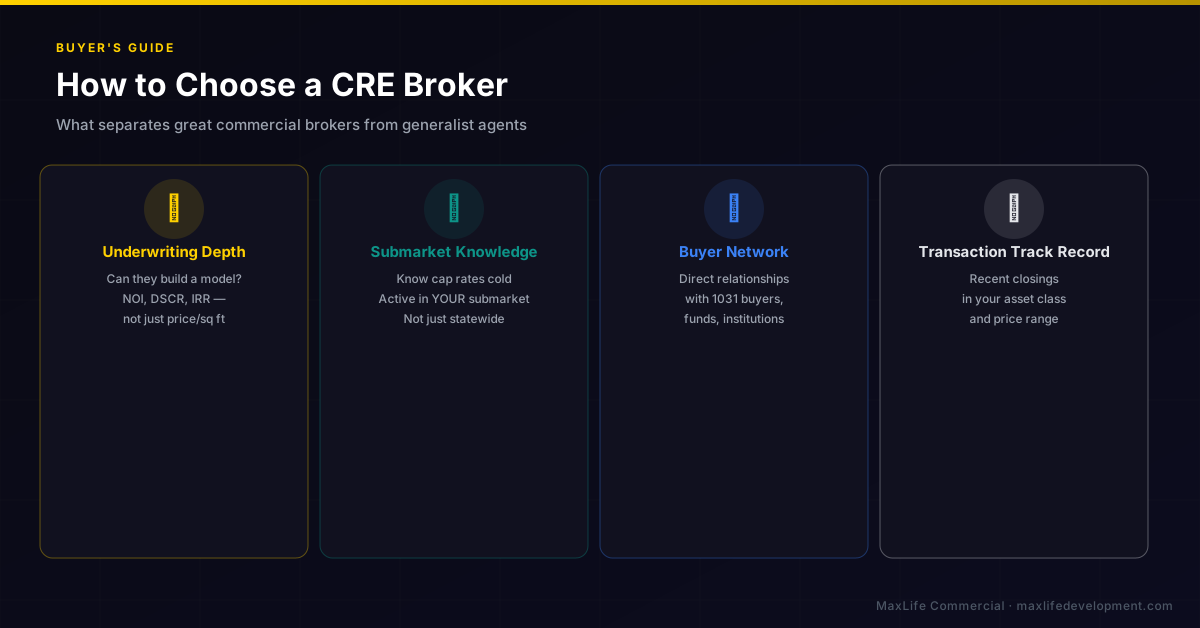
You wouldn't hire a surgeon based on a Zillow listing. So why hire a broker to represent your commercial property without understanding their credentials, experience, and network? This guide walks you through the essentials.
In This Guide:
1. Broker vs. Real Estate Agent — What's the Difference?
This is foundational. A lot of people use these terms interchangeably — they're not.
Real Estate Agent
- • Works under a broker's license
- • Usually handles residential OR commercial
- • Focuses on listings and sales activity
- • May have limited deal analysis expertise
Commercial Real Estate Broker
- • Holds their own broker license (requires more experience)
- • Specializes in commercial property types
- • Provides advisory services (deal analysis, valuations)
- • Usually brings institutional buyer/investor network
- • Understands cap rates, lease structures, financing
For commercial property, you want a broker. Period.
2. Essential Credentials & Licenses
Before you even have a conversation, verify these:
Active Florida Broker License
Verify at: myfloridalicense.com
Look for: Active broker license (not agent). No disciplinary history.
CPD (Continuing Professional Development)
Brokers must complete CPD courses annually. A broker who stays current on law, tax, and market trends is serious.
Industry Designations
Look for these (not required, but valuable):
- • CCIM (Certified Commercial Investment Member)
- • SIOR (Society of Industrial Office Realtors)
- • CBRE, JLL affiliation
Mortgage Loan Officer License (Bonus)
If they hold an NMLS Mortgage Loan Officer license, they understand financing in depth. This is helpful for complex deals.
3. What to Look for in Experience
A license doesn't equal expertise. Dig into their track record:
✓ Years in Commercial Real Estate
Less than 3 years? They're learning. Less than 10? They haven't weathered a market cycle. 15+ years is ideal — they've seen booms, downturns, and know how to navigate both.
✓ Property Types & Markets They Know
Have they transacted in your market? Your property type? Ask for specifics:
- • "How many NNN deals have you closed in the past 3 years?"
- • "What's your experience with [Orlando/Space Coast/Tampa]?"
- • "Can you show me recent land development deals?"
✓ Transaction Volume & Dollar Amount
Don't be shy about asking for numbers. A broker who has facilitated $500M+ in transactions across property types is battle-tested.
✓ Recent Deals (Last 12 Months)
Market changes quickly. Ask for recent comparable sales. If they can't name recent deals in your space, that's a red flag.
4. The Importance of a Strong Buyer/Lender Network
Experience matters. Network matters more.
A broker with a deep institutional network can:
- →Reach qualified buyers directly — not just listing on CoStar and hoping. Direct relationships = faster closings and better prices.
- →Identify off-market opportunities— Brokers know what's about to hit the market. They can tell you before public listing.
- →Connect you with lenders — If you need financing, a well-connected broker can intro you to 10 different lenders with different terms. That competition matters.
- →Navigate 1031 exchanges — They know which properties fit your timeline and goals.
How to assess their network:Ask them to name 5 active institutional buyers in your market. If they hesitate, that's a warning.
5. Specialization Matters
A commercial broker who specializes in your property type is worth more than a generalist.
For example, if you own an NNN retail property:
- •An NNN specialist knows tenant credit standards, SNDA processes, and where NNN capital is active today
- •A generalist might default to listing on CoStar and hoping for offers
What to ask:"What percentage of your deals are in [property type]?" If it's less than 40%, keep looking.
6. Questions to Ask Before You Hire
Use this checklist during your broker interview:
How many [NNN/multifamily/industrial] properties have you sold in the past 12 months?
Can you walk me through your last 3 sales in this market?
Who are the active institutional buyers for this property type in this market? Name 5.
What's the typical timeline for selling a property like mine?
How do you determine value? Show me your methodology.
What's your fee structure and why?
How often will I hear from you during the sale process?
What markets do you have strong relationships in?
How do you handle off-market sales?
Can you introduce me to 3 recent clients as references?
7. Red Flags to Avoid
Walk away if you hear:
"Your property is worth around $X. Trust me."
Real brokers show their math. If they can't articulate how they arrived at a valuation, they haven't done the work.
"I'll list it on CoStar and we'll see what offers come in."
That's not brokering, that's listing. Brokers actively work their network to place property.
"First time they mention commission during the first call."
A broker worth hiring focuses on fit, timeline, and outcome. Commission comes later.
"I don't have direct experience with [your property type], but I can learn."
Your deal is too important to be a learning project. Find a specialist.
"You're my 47th current listing."
Brokers who take every listing don't have time to work yours. Selective brokers get better results.
"I've never needed to talk to recent clients for references."
Reputable brokers offer references willingly. If they seem defensive, keep moving.
The Bottom Line
A commercial real estate broker should be part advisor, part strategist, part closer. They bring expertise you don't have, relationships you need, and accountability for results.
Take your time hiring. Ask hard questions. Verify credentials. And once you hire, trust them to do the work. The right broker will earn it.
Written by Ryan Solberg, commercial real estate broker at MaxLife Commercial with 20+ years experience in Florida CRE.
Related Articles
How to Buy Commercial Property in Orlando
End-to-end acquisition process for Orlando CRE buyers.
How to Evaluate a CRE Deal
Cap rate, NOI, DSCR — the metrics every CRE deal must pass.
Florida CRE Investor Guide
Why investors come to Florida and how to navigate the market.
Orlando Cap Rates Investor Guide
Cap rate ranges across Orlando submarkets and asset classes.
1031 Exchange Orlando Guide
Use a broker who specializes in 1031 timeline-driven deals.
Ultimate Guide to NNN Investing
What an NNN-specialist broker should know cold.