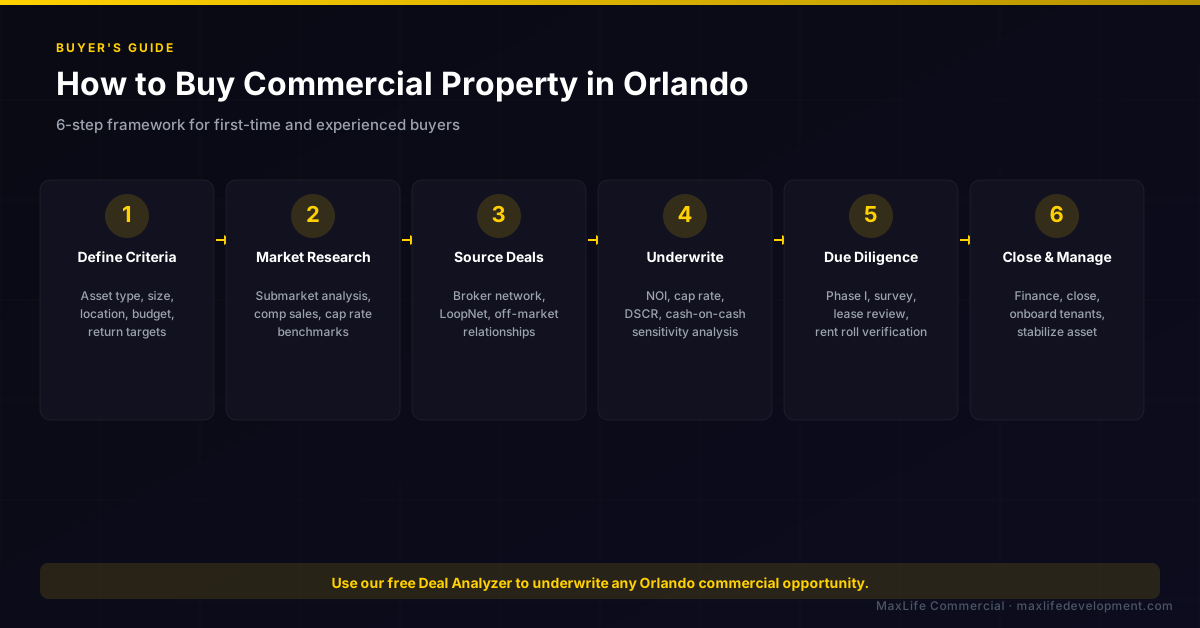
Watch the Guide
This is the step-by-step buyer's guide. For the full market overview — cap rates, submarkets, property types, and current listings — see our Orlando commercial real estate hub.
Orlando CRE Market Overview for Buyers
Orlando is one of the fastest-growing metropolitan areas in the United States, and that population growth translates directly into demand for commercial real estate. The metro area adds roughly 1,500 new residents per week, fueling job creation across healthcare, technology, aerospace, and hospitality. For investors looking to buy commercial property, this sustained growth creates a durable foundation of tenant demand that many secondary markets simply cannot match. Whether you are acquiring a retail strip center, an industrial warehouse, or a medical office building, Orlando's demographic tailwinds work in your favor.
The Orlando commercial real estate market is divided into distinct submarkets, each with its own supply-and-demand dynamics. Downtown Orlando and the Central Business District command the highest office rents but also carry the most lease-up risk for older Class B product. The International Drive corridor and the tourist districts along I-4 generate strong retail and hospitality revenues, though cap rates tend to be compressed due to institutional buyer competition. Lake Nona, anchored by the Medical City campus, has emerged as a premier submarket for healthcare and life-science properties, with land values that have appreciated significantly over the past five years. Meanwhile, submarkets along the 429 corridor in southwest Orange County and the East Orlando area near the University of Central Florida offer more favorable entry pricing for investors who want exposure to Orlando's growth without paying core-market premiums. Visit our Orlando commercial real estate market page for current submarket data and trend analysis.
Typical pricing in Orlando varies widely by asset class. Small single-tenant NNN retail properties in secondary corridors can trade in the $500,000 to $2 million range, while well-located multi-tenant retail centers often start at $3 million and climb past $15 million. Industrial and flex properties in the airport submarket or along the 408 corridor generally trade between $125 and $175 per square foot depending on age, clear height, and dock configuration. Office properties range from $150 per square foot for suburban Class B product to $300-plus per square foot for newer Class A buildings in downtown or Lake Nona. Understanding these price benchmarks before you begin your search prevents wasted time on properties that fall outside your capitalization range.
Key Orlando Submarkets for CRE Buyers
- Downtown / CBD: Class A office, mixed-use; highest rents, institutional competition
- I-Drive / Tourist Corridor: Retail, hospitality; compressed cap rates, strong revenue
- Lake Nona / Medical City: Healthcare, life-science; premium land values, long-term growth
- Airport / 408 Corridor: Industrial, logistics, flex; steady demand from distribution tenants
- 429 / West Orange County: Suburban retail, industrial; lower entry pricing, rapid residential growth
- East Orlando / UCF Area: Multifamily, retail; strong demographics, student and young professional demand
- Kissimmee / Osceola County: Retail, industrial; affordable land, significant population influx
Define Your Investment Criteria
Before you start browsing listings, you need a clear picture of what you are buying and why. Orlando's commercial market spans everything from single-tenant NNN retail pads to large multifamily complexes and Class A office buildings. Each property type carries its own risk profile, capital requirements, and return expectations. Writing down your target asset class, price range, desired cap rate, and preferred submarket will save you months of unfocused searching.
Think about your investment timeline. Are you looking for long-term passive income from a credit-tenant NNN property, or are you pursuing a value-add multifamily deal that requires repositioning over 18 to 24 months? Your answer determines the financing structure, the management intensity, and the exit strategy. Investors who skip this step often end up chasing deals that look attractive on paper but conflict with their actual goals.
Orlando's growth corridors each offer different advantages. The I-4 corridor between downtown and Walt Disney World anchors the tourism and hospitality sector. Lake Nona and the Medical City area attract healthcare and life-science tenants. The airport submarket draws logistics and flex-industrial users. Matching your criteria to the right submarket is the foundation of a successful acquisition. Explore Orlando commercial real estate market data to compare submarkets side by side.
Capital structure is another critical variable to define upfront. Determine how much equity you can deploy and whether you will use conventional bank financing, SBA loans, private capital, or a combination. Many first-time commercial buyers underestimate the total capital required beyond the down payment -- lender reserves, closing costs, immediate capital improvements, and working capital for lease-up periods all need to be accounted for. A $2 million acquisition with 25% down requires $500,000 in equity, but your true day-one capital need may be $600,000 to $650,000 once you factor in these additional costs.
Finally, define your return thresholds before you begin evaluating deals. Orlando cap rates for stabilized commercial properties generally range from 5.5% to 8.5% depending on asset class, tenant credit, and location. NNN properties leased to investment-grade tenants in prime corridors trade at the tightest cap rates, while value-add retail or office properties with vacancy or near-term lease rollover offer higher going-in yields to compensate for the additional risk. Setting a minimum cash-on-cash return target -- typically 7% to 10% for leveraged acquisitions -- gives you a concrete filter for evaluating every opportunity. Use our Deal Analyzer to model these scenarios before making an offer.
Finding Commercial Properties in Orlando
Unlike residential real estate, most commercial deals never appear on consumer-facing portals. The best opportunities surface through broker networks, direct mail campaigns, and off-market relationships. Working with a firm that specializes in commercial real estate services gives you access to pocket listings and pre-market deal flow that the general public never sees.
Online platforms such as Crexi, LoopNet, and CoStar are useful starting points, but they represent only a fraction of the market. Many sellers prefer a quiet disposition to avoid disrupting tenant relationships or signaling distress. Building direct relationships with property owners, attending local ICSC and CCIM events, and partnering with a buyer's broker who knows the Orlando market will dramatically expand the universe of deals available to you.
When evaluating listings, focus first on location fundamentals, tenant credit quality, and lease term remaining. A well-located property with a strong tenant on a long-term lease commands a premium for good reason -- it delivers predictable cash flow with minimal management overhead. Use our Deal Analyzer to quickly model cap rates, cash-on-cash returns, and debt service coverage on any property you are considering.
For off-market sourcing, consider driving target submarkets and identifying properties that show signs of deferred maintenance, vacancy, or ownership fatigue. Orange County Property Appraiser records are publicly available and allow you to research ownership history, assessed values, and mailing addresses for direct outreach. Many of Orlando's best acquisitions come from owners who were not actively marketing their property but were receptive to a well-structured offer at the right time. This approach requires patience, but it eliminates broker competition and often results in more favorable pricing.
Pay close attention to deal volume and days on market in your target submarket. Properties that have been listed for 120 days or more without a contract may present negotiation leverage, particularly if the seller has already reduced the asking price. Conversely, new listings in high-demand corridors like Lake Nona or the I-4 industrial belt may attract multiple offers within the first two weeks, requiring you to move quickly with a strong letter of intent and proof of funds to stay competitive.
Due Diligence for Orlando CRE
Due diligence is where deals are won or lost. Once you have an executed letter of intent or purchase and sale agreement, the clock starts on your inspection period -- typically 30 to 60 days for commercial transactions in Florida. During this window you need to verify every assumption in your underwriting.
Start with a Phase I Environmental Site Assessment. This is standard for any commercial acquisition and identifies potential contamination from current or historical use. If the Phase I flags recognized environmental conditions, a Phase II investigation with soil and groundwater sampling may be required. Orlando's history of citrus farming, dry cleaning operations, and gas stations means environmental surprises are not uncommon.
Review the lease documents line by line. Confirm the rent roll, verify tenant estoppels, and understand every landlord obligation including roof and structural responsibilities, capital expenditure reserves, and co-tenancy clauses. For NNN properties, confirm that the tenant truly covers taxes, insurance, and maintenance with no carve-outs that shift costs back to the owner. Our Orlando cap rates guide can help you benchmark pricing against comparable properties.
Order a property condition assessment, a survey, and a title search. Verify zoning compliance with Orange County or the relevant municipality. Review historical tax assessments and confirm that the property's assessed value aligns with your purchase price to avoid a surprise reassessment. Florida's Save Our Homes cap does not apply to commercial property, so taxes can and do increase substantially after a sale.
Beyond the physical and legal inspections, conduct thorough financial due diligence. Request at least three years of operating statements, including detailed breakdowns of revenue by tenant and expense line items. Compare the seller's reported net operating income against your own projections. Common areas where underwriting assumptions diverge include property management fees, capital expenditure reserves, vacancy and credit loss assumptions, and real estate tax projections post-sale. If the property is in Orange County, remember that the property appraiser will likely reassess to the purchase price at the next assessment cycle, which can result in a significant tax increase from the current owner's grandfathered assessed value.
For properties with multiple tenants, request a copy of every lease amendment, guaranty, and subordination agreement. Confirm that no tenants are in default or have pending disputes with the landlord. Check whether any tenants have exclusive use clauses that could restrict your ability to lease vacant space to competing businesses. In Orlando's retail market, exclusive use conflicts are a frequent source of post-acquisition headaches -- a restaurant exclusivity clause buried in one tenant's lease can block you from leasing adjacent space to another food-service operator, directly impacting your lease-up strategy.
Due Diligence Checklist for Orlando CRE
- Phase I Environmental Site Assessment (Phase II if RECs are identified)
- Property Condition Assessment (PCA) with roof, HVAC, and structural evaluation
- ALTA survey and legal description verification
- Title search and commitment review; resolve any exceptions
- Zoning verification with Orange County or applicable municipality
- Lease abstraction -- review every lease, amendment, and guaranty
- Tenant estoppel certificates confirming rent, term, and deposit amounts
- Three years of operating statements and rent roll audit
- Real estate tax projection post-reassessment
- Insurance quote for replacement cost coverage
- Utility review and any pending utility assessments or special assessments
- ADA compliance review for public-facing properties
Financing Your Purchase
Commercial real estate financing differs significantly from residential mortgages. Lenders underwrite the property's income stream, not just the borrower's personal credit. Typical loan-to-value ratios range from 65% to 75%, with debt service coverage ratios of 1.25x or higher required. Interest rates, amortization schedules, and prepayment penalties vary widely between lenders and loan products.
Local and regional banks are often the most competitive lenders for Orlando commercial acquisitions under $5 million. They understand the local market and can offer more flexible terms than national conduit lenders. For larger deals, CMBS loans and life company financing provide lower rates but come with more restrictive covenants and longer closing timelines.
If you are executing a 1031 exchange, coordinate early with your qualified intermediary and lender to ensure the financing timeline aligns with your exchange deadlines. A 45-day identification period and 180-day closing window leave little room for delays. Having pre-approval in place before you identify replacement properties is critical to executing a successful exchange.
SBA 504 loans deserve special attention for owner-occupied commercial properties in Orlando. This program allows qualifying buyers to acquire commercial real estate with as little as 10% down, with the SBA providing a second-position loan at a fixed rate for up to 25 years. The remaining 50% comes from a conventional first-position lender. For a business owner purchasing a $2 million property, this structure reduces the equity requirement from $500,000 to $200,000 -- a meaningful difference that frees capital for tenant improvements or operating reserves. The SBA 504 program is particularly well-suited for medical offices, owner-operated retail locations, and professional service firms purchasing their own space in Orlando's suburban submarkets.
Expect the commercial loan process to take 45 to 90 days from application to closing, depending on the lender and deal complexity. Lenders will require a full appraisal, environmental report, rent roll verification, and borrower financial statements including tax returns, a personal financial statement, and a schedule of real estate owned. Having these documents organized and ready before you submit your loan application can shave two to three weeks off the timeline. For deals above $5 million, consider engaging a commercial mortgage broker who can solicit term sheets from multiple capital sources simultaneously -- including banks, credit unions, debt funds, and life insurance companies -- to ensure you are getting the most competitive execution available for your specific deal profile.
Working with a Commercial Real Estate Broker
Engaging an experienced commercial real estate broker is one of the highest-leverage decisions you can make as a buyer. Unlike residential transactions where buyers routinely search for homes on their own, commercial acquisitions involve complex lease structures, specialized underwriting, and negotiation dynamics that benefit significantly from professional representation. A knowledgeable broker brings market intelligence that no online platform can replicate -- including knowledge of which properties are likely to trade before they are formally listed, which sellers are motivated, and what comparable properties have actually closed for versus their listed prices.
In most commercial transactions, the seller pays the brokerage commission, which means buyer representation often comes at no direct cost to you. Your broker will prepare or review your letter of intent, coordinate due diligence activities, interface with the seller's broker, and help negotiate price adjustments based on findings during inspection. They also serve as a buffer during tense negotiations, keeping the deal on track when emotions run high over repair credits or lease assumption disputes.
When selecting a broker in Orlando, prioritize experience in your target asset class and submarket. A broker who specializes in industrial properties along the 408 corridor will have different relationships and market knowledge than one focused on retail along International Drive. Ask prospective brokers about their recent transaction volume, their access to off-market deal flow, and their familiarity with the specific ownership groups and landlords in your target area. MaxLife's commercial real estate team provides buyer advisory services across all major Orlando submarkets and asset classes.
Beyond the transaction itself, a strong broker relationship pays dividends over time. As you build a portfolio of commercial properties in Orlando, your broker becomes a strategic partner who understands your return criteria, risk tolerance, and portfolio composition. They can proactively bring you opportunities that match your evolving investment thesis and provide market intelligence on when to acquire, hold, or dispose of assets based on cycle timing. For investors planning multiple acquisitions, this ongoing relationship is far more valuable than any single transaction fee. Reach out to our team to discuss your acquisition strategy.
Closing and Post-Acquisition Strategy
Closing a commercial transaction in Florida involves title insurance, documentary stamp taxes, and recording fees. The buyer typically pays for the owner's title policy, while the lender requires a separate loan policy. Florida documentary stamps run $0.70 per $100 of consideration, and intangible tax on the mortgage adds $0.002 per dollar of debt. Budget these closing costs into your acquisition model -- they can add 1.5% to 2.5% to your total cost basis.
The closing timeline for a typical Orlando commercial transaction runs 60 to 90 days from executed purchase and sale agreement to funding. This includes the due diligence period, loan underwriting, title clearance, and final document preparation. Expect to coordinate with your attorney, lender, title company, and the seller's team throughout this process. Common causes of closing delays include slow tenant estoppel delivery, lender appraisal issues, title exceptions requiring resolution, and environmental report turnaround times. Building buffer into your timeline -- particularly if you are on a 1031 exchange clock -- is essential. Most experienced buyers negotiate a minimum 30-day extension option in their purchase agreement to protect against unforeseen delays.
After closing, your focus shifts to asset management. Even passive NNN investments require periodic attention -- monitoring tenant financial health, tracking lease renewal dates, and ensuring the tenant is meeting its maintenance obligations. Value-add properties demand a more hands-on approach with tenant improvements, lease-up campaigns, and capital expenditure programs. MaxLife's property services team can support your post-acquisition strategy regardless of the asset type.
For value-add acquisitions, develop a detailed business plan with a month-by-month execution timeline before closing. Identify which capital improvements will generate the highest return on investment, prioritize lease-up of vacant spaces, and establish relationships with local contractors and property management firms in advance. In Orlando's competitive leasing market, properties that sit vacant during a prolonged renovation period lose valuable leasing momentum. The most successful value-add operators begin marketing available space during the due diligence period so they can execute leases shortly after closing.
Plan your exit from day one. Whether you intend to hold for five years, ten years, or indefinitely, understanding your disposition options keeps you ahead of market cycles. Refinancing to pull out equity, executing a cash-out 1031 exchange into a larger asset, or selling into a strong seller's market are all viable paths. The key is aligning your hold period with your broader investment goals and tax strategy. Review our Orlando cap rates investor guide to understand how market pricing trends affect your exit timing.
Orlando CRE Acquisition Timeline Summary
- Weeks 1-4: Define criteria, secure financing pre-approval, engage broker
- Weeks 4-12: Property sourcing, tours, underwriting, and LOI submission
- Weeks 12-14: LOI negotiation and execution of purchase and sale agreement
- Weeks 14-22: Due diligence period -- inspections, environmental, lease review, survey
- Weeks 18-24: Loan underwriting, appraisal, and commitment letter
- Weeks 22-26: Title clearance, closing document preparation, and funding
- Post-Closing: Tenant introductions, property management transition, business plan execution
Related Reading
Off-Market Commercial Deals in Orlando
Get access to investment-grade commercial property for sale in Orlando before it hits the public market.
NNN Properties in Florida
Single-tenant triple-net investment properties across Orlando and Central Florida.
Industrial Property for Sale in Central Florida
Warehouse, flex, distribution, and manufacturing buildings across the I-4 corridor and Space Coast.
1031 Exchange Replacement Properties
Qualified 1031 exchange replacement properties across Orlando and Central Florida.
Florida CRE Market Data & Cap Rates
Current cap rates, vacancy trends, and investment outlook across all major Florida commercial real estate markets.
Deal Case Studies
Real Florida CRE transactions — underwriting assumptions, deal structure, and outcomes on closed deals.
Ready to Buy Commercial Property in Orlando?
MaxLife Commercial helps investors find, analyze, and close commercial real estate deals across Central Florida. Whether you are acquiring your first commercial property or expanding an existing portfolio, our team provides end-to-end advisory from market selection through closing and asset management.
Get Off-Market CRE Deals in Your Inbox
Join our investor list for exclusive Central Florida opportunities, market reports, and deal analysis — delivered weekly. No spam, unsubscribe anytime.