What Is the SBA 504 Loan Program?
The SBA 504 program is a US Small Business Administration loan designed specifically for owner-user commercial real estate and major equipment purchases. It is structured as a two-lender arrangement that lets a Florida business owner purchase a commercial property with as little as 10% down — compared to the 25–35% required for a conventional commercial real estate loan.
The program has been used by thousands of Florida businesses to purchase warehouses, office buildings, industrial flex space, retail storefronts, and mixed-use properties. The SBA does not lend directly — it guarantees a second mortgage originated by a Certified Development Company (CDC) on your behalf.
How the SBA 504 Structure Works
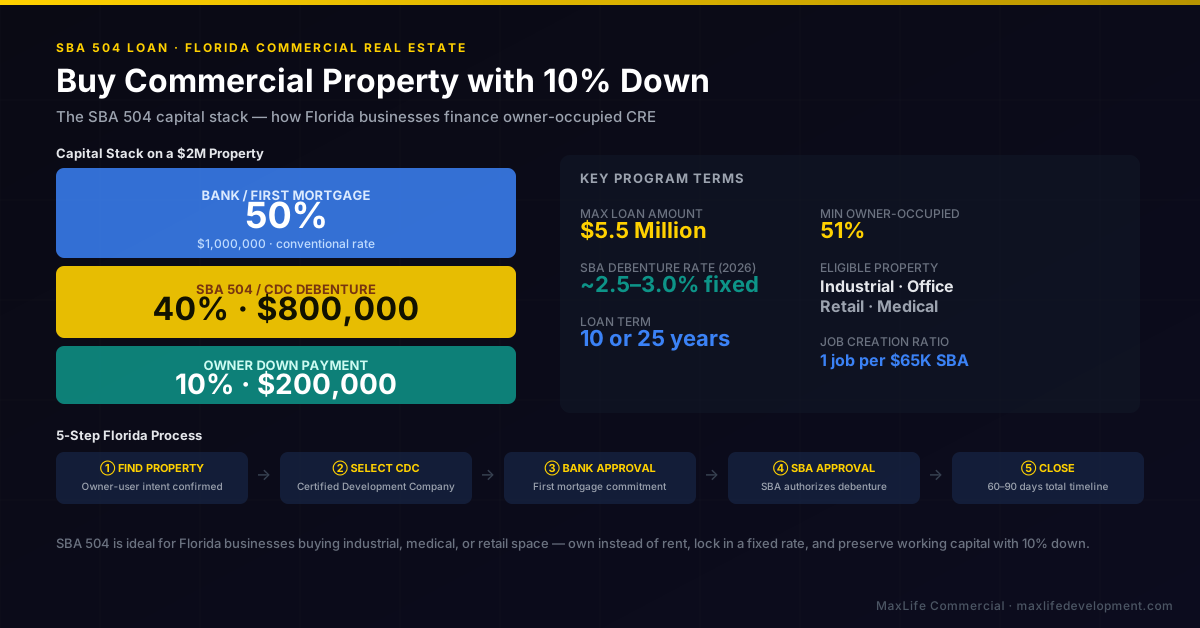
An SBA 504 loan is a three-party structure — borrower, primary lender, and CDC. Here is how the capital stack works on a typical Florida commercial property purchase:
| Tranche | Source | Share | Term / Rate |
|---|---|---|---|
| First Mortgage | Bank / Credit Union | 50% | Negotiated (fixed or variable) |
| Second Mortgage | CDC (SBA-guaranteed) | 40% | 25-year fixed (SBA rate) |
| Down Payment | Borrower | 10% | — |
Newer or special-purpose properties may require 15% down. Startups (less than 2 years in business) typically require 15–20%.
On a $3M Florida industrial building, this means: $1.5M first mortgage from a bank, $1.2M CDC second mortgage at a fixed SBA rate, and $300K down from the borrower. Without SBA 504, the same purchase would require $750K–$1.05M in equity.
SBA 504 Eligibility Requirements
To qualify for an SBA 504 loan in Florida, the borrower and property must meet these requirements:
- Owner-user occupancy: The business must occupy at least 51% of the property being purchased (or 60% for new construction, allowing 40% for sublease). The SBA 504 is not available for pure investment properties.
- For-profit business: The operating company must be a US-based for-profit business. Nonprofits, passive real estate holding companies, and speculation ventures do not qualify.
- Net worth and income cap: The business must have a tangible net worth under $20M and average net income after taxes under $6.5M for the preceding two years. Most small and mid-size Florida businesses qualify comfortably.
- Use of proceeds: Funds must be used for fixed assets — commercial real estate purchase, construction, renovation, or major equipment. Working capital is not an eligible use under SBA 504 (use SBA 7(a) instead).
- Job creation or community goal: Most 504 deals qualify under the job creation standard — one job per $90K of SBA debenture. Florida's growing market makes this easy to meet in nearly all cases.
Eligible Property Types in Florida
SBA 504 can be used to purchase the following commercial property types in Florida, provided the borrower occupies at least 51%:
Industrial / Warehouse
Most common SBA 504 use in Florida. Flex warehouses, light manufacturing, distribution buildings, and service-trade facilities. Popular in Lakeland, East Orlando, Sanford, and Jacksonville.
Office Buildings
Professional services, medical offices, and suburban office buildings. Owner-users commonly buy single-story office condos or full buildings in suburban submarkets.
Retail / Mixed-Use
Owner-occupied retail storefronts, showroom/warehouse combos, and mixed-use buildings where the borrower occupies the majority. Auto dealerships are a common use.
Self-Storage (Owner-Operated)
Self-storage facilities qualify if the borrower actively manages and operates the facility. Passive storage investment REITs do not qualify.
Car Washes / Service Businesses
Drive-through businesses with a significant real estate component qualify when the operating business owns the facility.
Medical & Dental Offices
Physician-owned practices buying their own medical office building are among the most active SBA 504 borrowers in Florida.
SBA 504 Rates and Fees in 2026
The SBA 504 debenture rate (second mortgage) is set monthly by the SBA and tied to the 10-year US Treasury rate plus a spread. In 2026, rates on the SBA portion run approximately in line with 10-year Treasury yields plus 2.5%–3.0%. The first mortgage rate is negotiated directly with the primary lender and can be fixed or floating.
SBA 504 fees include: a 3.5% CDC processing fee (on the SBA debenture portion), a 0.5% SBA guarantee fee, and ongoing annual service fees of approximately 0.94% on the outstanding SBA debenture. These fees are typically financed into the loan, not paid out of pocket at closing.
Despite the fees, SBA 504 almost always results in a lower all-in effective rate than a conventional commercial loan when accounting for the low down payment, long amortization, and fixed-rate certainty on the SBA portion.
SBA 504 vs Conventional CRE Loan vs SBA 7(a): Quick Comparison
| Factor | SBA 504 | SBA 7(a) | Conventional |
|---|---|---|---|
| Min. Down Payment | 10% | 10–15% | 25–35% |
| Max Loan Size | $5.5M (SBA portion) | $5M total | Unlimited |
| Rate Type | Fixed (SBA portion) | Variable (Prime-based) | Fixed or Variable |
| Amortization | 25 years | 25 years (RE) | 20–30 years |
| Owner Occupancy Required | Yes (51%+) | Yes (51%+) | No |
| Working Capital | No | Yes | No (separate HELOC/LOC) |
The SBA 504 Process in Florida: Step by Step
- 1Find the Property: Identify an owner-user commercial property in Florida that meets your business needs. Your broker sources on- and off-market options and helps you evaluate the property against your SBA 504 qualifications.
- 2Select a Primary Lender and CDC: The primary lender (bank) handles the 50% first mortgage. The CDC — a nonprofit intermediary certified by the SBA — handles the 40% second mortgage and files the SBA guarantee application. Your lender typically has CDC relationships; alternatively, search the SBA.gov CDC locator for Florida CDCs including Florida First Capital, Stonehill CDC, and others.
- 3Submit Applications Simultaneously: You apply to both the primary lender and the CDC simultaneously. The primary lender underwrites the first mortgage while the CDC prepares the SBA debenture application. Having your last 3 years of business tax returns, personal financial statement, and business plan ready accelerates this stage.
- 4SBA Authorization: The SBA reviews and authorizes the debenture guarantee, typically within 5–15 business days after a complete CDC application is submitted. SBA Express can shorten this in some cases.
- 5Closing: Both loans close simultaneously. The SBA debenture funds through a pooling process, so there may be a 2–3 week lag between closing and SBA debenture funding — your primary lender typically bridges this with a short-term note.
Is Buying Better Than Leasing for Florida Businesses?
In Florida's current industrial and office market, buying with SBA 504 is often cheaper than leasing within 3–5 years — and you build equity, eliminate rent escalation risk, and gain the ability to sublease unused space.
A Florida business paying $18/SF NNN for a 5,000 SF warehouse pays $7,500/month with zero equity. The same building purchased with SBA 504 at $150/SF ($750K) requires a $75K down payment and a monthly debt service of approximately $4,200–$4,500 — building equity from day one while paying less than the market lease rate.
The math shifts even further in favor of buying as Florida industrial vacancy continues to tighten. Locking in a purchase price today protects against the rent inflation that has pushed industrial rents up 35–50% across the I-4 corridor since 2020.
Ready to Use SBA 504 to Buy Your Florida Facility?
MaxLife Commercial works with Florida businesses looking to buy their own facility. We source warehouse, industrial, office, and flex space throughout Central Florida — and we know which lenders and CDCs move quickly on SBA 504 transactions.
Talk to a BrokerRelated Articles
How to Buy Commercial Property in Orlando 2026
Step-by-step guide to the Orlando commercial real estate purchase process.
Florida CRE Investor Guide 2026
Complete guide to investing in Florida commercial real estate.
Cap Rate vs Cash-on-Cash Return
How to evaluate CRE investment performance correctly.
1031 Exchange Orlando Guide
Defer capital gains by exchanging into Florida CRE.
Why Out-of-State Investors Choose Florida CRE
Tax advantages, migration trends, and market comparison data.
Build-to-Suit vs Buying Existing Commercial Space
Which makes more sense for Florida owner-user acquisitions?