Why Florida Multifamily Remains a Core Allocation
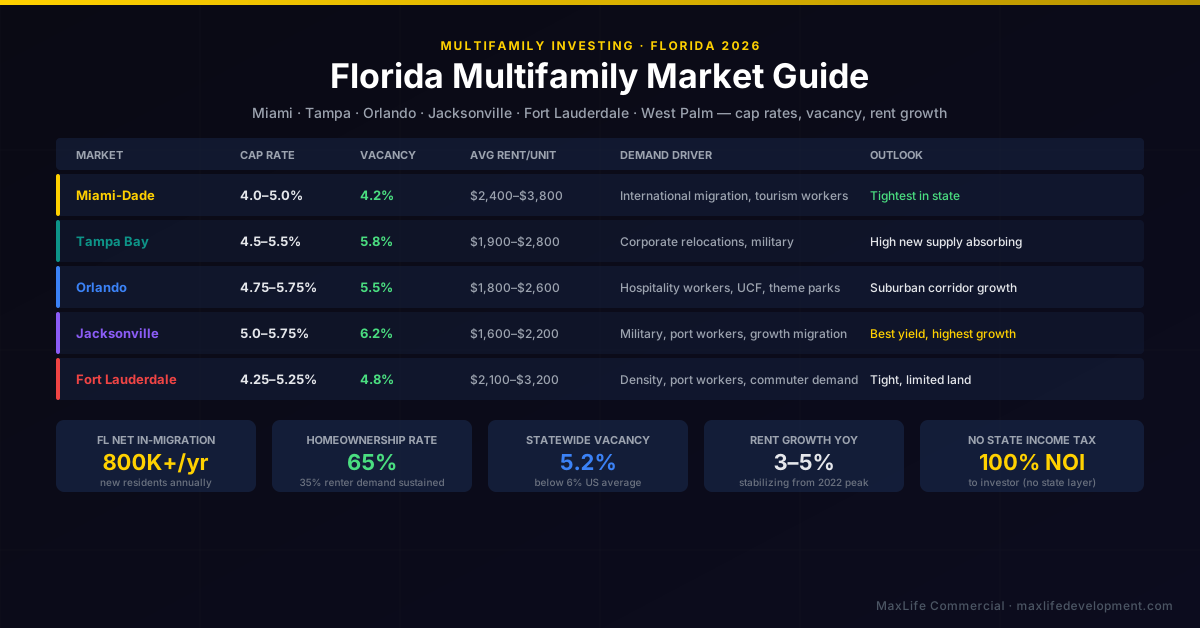
The structural case for Florida multifamily hasn't changed: the state is the fastest-growing in the country by net in-migration, with a homeownership rate of 65% that permanently sustains 35% renter demand. Statewide vacancy of 5.2% sits below the 6% US average despite several years of elevated new supply.
No state income tax means 100% of NOI stays with the investor — a structural advantage versus California, New York, or New Jersey multifamily at equivalent cap rates. For out-of-state buyers, this is often the deciding factor.
Florida Multifamily Market Comparison
Miami-Dade
Tampa Bay
Orlando
Jacksonville
Fort Lauderdale
Market Deep Dives
Miami-Dade — Tightest Market in the State
Miami-Dade runs at 4.2% vacancy — the lowest in Florida and competitive with the tightest gateway markets nationally. International migration from Latin America, Caribbean, and Europe sustains a renter pool that is largely income-inelastic; $3,000+/month rents are absorbed by UHNW renters-by-choice and relocating executives.
Cap rates of 4.0–5.0% reflect scarcity of land and permitting friction in Miami proper. Opportunity lies in Hialeah, Doral, and southwest Miami-Dade suburban corridors where land costs are lower and rents are catching up to urban pricing.
Tampa Bay — Supply Absorption Phase
Tampa added significant new supply in 2023–2025, pushing vacancy to 5.8% — above its historical average. The market is now absorbing that supply as pipeline deliveries slow. Corporate relocations (Publix, Mosaic, Raymond James HQ, USSOCOM) sustain Class A demand, while Pinellas County and south Hillsborough offer value-add B/C product.
The Westshore business district, Midtown Tampa, and Wesley Chapel are the highest-demand submarkets. Investors who bought during the supply peak (2024–2025) are positioned for rent growth as new deliveries dry up through 2027.
Orlando — Suburban Corridor Growth
Orlando's employment base — hospitality, healthcare, and UCF (the largest university in the US) — drives persistent renter demand across price points. The theme park corridor, Lake Nona Medical City, and Apopka-Winter Garden are absorbing suburban Class A supply, while older properties near UCF and International Drive offer value-add opportunity.
Jacksonville — Best Yield in the State
Jacksonville offers 5.0–5.75% cap rates — the widest in the major Florida markets — while posting strong population growth and a diversified employment base (NAS Jacksonville, JAXPORT, finance, healthcare). The market is often overlooked by institutional capital, creating an opportunity for private investors.
Emerging submarkets: Riverside/Avondale (urban core), Nocatee/St. Johns County (suburb), and the Baymeadows corridor. Long-term rent growth is supported by limited new construction relative to absorption.
Fort Lauderdale — Dense, Land-Constrained
Broward County benefits from Miami-Dade spillover demand at 20–30% lower rent. Port Everglades logistics employment, Fort Lauderdale-Hollywood International Airport, and Boca Raton tech jobs underpin renter demand. Land scarcity is the primary supply constraint — new deliveries are limited, vacancy holds at 4.8%, and rent growth continues.
Free Consultation
Looking for a Florida CRE Property?
MaxLife Commercial brokers NNN, industrial, retail, and multifamily deals across Central Florida. Tell us your criteria and we'll match you with qualified properties.
Contact Us →Multifamily Underwriting Checklist for Florida
Frequently Asked Questions
Is Florida multifamily a good investment in 2026?
Yes — structurally. Florida's 800K+/year in-migration, 35% renter demand, no state income tax, and sub-6% statewide vacancy create durable fundamentals. Near-term headwinds from elevated supply (especially Tampa and Orlando) are working through the market. Investors with a 5+ year hold horizon are well-positioned to benefit from supply normalization and continued rent growth.
How does Florida's insurance market affect multifamily returns?
Significantly — and it's the most common underwriting miss. Florida insurance premiums rose 40–80% in many markets between 2022 and 2025. Coastal and flood-zone properties are most affected. Always obtain actual current insurance bids before closing, and stress-test returns against a 20% further increase.
What size multifamily deal makes sense for private investors in Florida?
The 20–100 unit range is the sweet spot for private capital — above single-family risk concentration, below institutional competition for the largest assets. At this size, agency financing (Fannie/Freddie) is available, professional management is justified, and buyer pools are broad at exit.
Related Articles
- IndustrialFlorida Industrial Real Estate Investing
- Retail NNNRetail Pad Site Investing in Florida
- FinanceCommercial Real Estate Financing Florida
- Market GuideJacksonville CRE Market Guide