Florida CRE Financing Landscape in 2026
Florida's commercial real estate lending market in 2026 reflects the broader post-rate-hike environment: rates have settled from their 2023–2024 peaks but remain elevated relative to the 2020–2022 period. Life insurance companies have re-entered the market with competitive terms for high-quality stabilized assets. CMBS issuance has recovered. Regional banks remain relationship-driven. Bridge lending costs are high but available for value-add deals with clear exit strategies.
Florida's no-state-income-tax advantage means NOI flows 100% to investors, improving debt coverage ratios and net returns relative to comparable deals in states with income taxes — a meaningful structural advantage when lenders are underwriting DSCR.
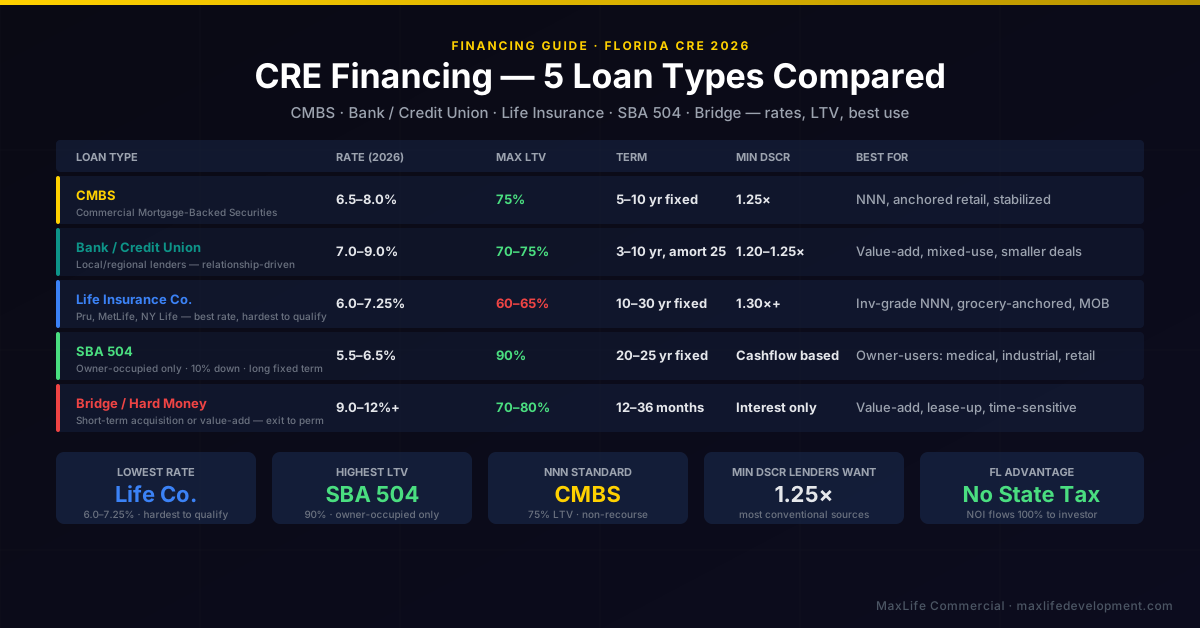
CRE Loan Type Comparison — 2026 Rates
CMBS (Commercial Mortgage-Backed Securities)
Non-RecourseSecuritized mortgages pooled and sold to bond investors. Excellent for stabilized NNN and anchored retail. Non-recourse structure limits personal liability, but defeasance penalties make early payoff expensive. Loan is serviced by a special servicer — expect limited flexibility for modifications or covenant relief.
Best for: NNN credit tenant, anchored retail, stabilized multifamily. Not for value-add, short-term holds, or deals needing flexibility.
Bank / Credit Union
RecourseLocal and regional banks remain the most flexible CRE lender for Florida deals below $10M. Relationship-driven underwriting means faster decisions, ability to work through lease-up situations, and loan modifications when needed. Rates are higher than life insurance companies but deal types are broader. Credit unions often offer competitive rates for owner-occupied and community-impact properties.
Best for: Value-add, mixed-use, smaller deals ($1M–$10M), relationships with local deposit account.
Life Insurance Company
Best RatePrudential, MetLife, and NY Life are the most active life insurance CRE lenders in Florida. They offer the lowest rates in the market but have the most restrictive underwriting: 60–65% LTV, 1.30× DSCR minimum, and strict property quality requirements. They favor grocery-anchored retail, investment-grade NNN, and Class A industrial. These lenders effectively have unlimited capital but high selectivity.
Best for: Investment-grade NNN, grocery-anchored retail, medical office buildings. Hardest to qualify — bring a pristine deal.
SBA 504 Loan
Highest LTVThe SBA 504 is the most capital-efficient loan for Florida business owners purchasing commercial real estate they will occupy. The structure — 50% bank, 40% CDC, 10% borrower — allows acquisition with just 10% down and a 20–25 year fixed rate through the CDC portion. Medical practices, industrial users, auto-service businesses, and retail owner-occupants are ideal candidates. The primary restriction: you must occupy at least 51% of the building.
Best for: Owner-users — medical offices, dental, industrial, auto service, retail. Not for investors/landlords.
Bridge / Hard Money
Short-TermBridge loans finance acquisitions that can't qualify for permanent financing due to occupancy, lease-up status, or time sensitivity. Terms are 12–36 months, interest-only, with an exit to permanent financing upon stabilization. Rates are high (9.0–12%+) — the premium is for speed, flexibility, and the ability to acquire assets that conventional lenders won't touch yet. Best used with a clear stabilization plan and a defined refinance timeline.
Best for: Value-add acquisitions, lease-up situations, time-sensitive closings, distressed assets.
Get Off-Market CRE Deals in Your Inbox
Join our investor list for exclusive Central Florida opportunities, market reports, and deal analysis — delivered weekly. No spam, unsubscribe anytime.
Understanding DSCR: What Lenders Actually Underwrite
DSCR (Debt Service Coverage Ratio) is the most important metric in CRE lending. It measures how much cushion your NOI provides above your debt payments:
DSCR = NOI ÷ Annual Debt Service
Example: $400,000 NOI ÷ $300,000 annual loan payments = 1.33× DSCR
Most Florida conventional lenders require 1.25× minimum. At 1.25×, every $1.00 of debt service is covered by $1.25 of NOI. Life insurance companies push to 1.30×. Below 1.25× and you're looking at bridge debt or a higher equity requirement.
The Florida no-state-income-tax advantage directly improves DSCR: if a comparable deal in New York generates a 1.18× DSCR after state taxes, the same asset in Florida might clear 1.28×, qualifying for conventional financing that the New York deal could not access.
Matching Loan Type to Deal Type
- →Stabilized NNN with credit tenant, hold 5–10 years: CMBS or life insurance company. CMBS for higher LTV; life insurance for lower rate.
- →Value-add retail or office, lease-up needed: Bank or bridge to stabilize, then refinance into CMBS or permanent debt.
- →Medical practice buying their own building: SBA 504 — 10% down, 20-year fixed, lowest rate available to owner-users.
- →Industrial warehouse, stabilized, under $5M: Regional bank or credit union — relationship-driven, faster close than CMBS.
- →Time-sensitive acquisition (7–14 day close): Bridge lender — the premium is for speed. Plan your exit to permanent financing at 12–18 months.
- →Grocery-anchored center, hold 10+ years: Life insurance company — longest fixed-rate period, lowest rate, matched to hold horizon.
Florida Financing Advantages
Beyond the no-state-income-tax NOI advantage, Florida offers several structural financing benefits:
- →Population growth: Lenders view Florida as a stable demand market — easier to justify aggressive LTV in growing submarkets
- →No tenant local income tax: Retailers in Florida keep more revenue, improving rent coverage ratios
- →Broad lender competition: Florida's large CRE market attracts national CMBS lenders, life companies, and regional banks — competitive pricing
- →Documentary stamp tax: Florida charges doc stamps on mortgages (0.35 per $100) — factor this into closing cost estimates
Get Florida CRE Financing Guidance
Structuring the right financing for a Florida CRE acquisition requires matching the deal type, hold horizon, and capital stack to the lender most likely to say yes at the best rate. MaxLife Commercial works with investors across all loan types — from SBA 504 owner-user acquisitions to CMBS-financed NNN portfolios.
Structure Your CRE Financing
Ryan Solberg works with buyers across NNN, industrial, and retail acquisitions in Florida — including financing structure guidance for CMBS, SBA 504, and bank debt.