Why Jacksonville Is Florida's Hidden CRE Opportunity
Jacksonville's story in 2026 is one of persistent undervaluation. The metro has all the economic underpinnings that drive strong CRE demand — population growth, port infrastructure, military employment, and a diversified economy across finance, healthcare, logistics, and defense — but pricing has lagged behind Florida's more-hyped markets. That gap is closing.
The metro population has surpassed 1.6 million and is growing at roughly 30,000 residents per year, driven primarily by migration from the Northeast and Midwest. Jacksonville is one of the few Florida markets where you can still buy a well-located NNN retail asset at a 6.0%+ cap rate with a 15-year lease remaining.
Key Thesis: Jacksonville offers Miami-quality tenant demand at cap rates 75–100 bps wider — driven by lower name recognition among coastal institutional buyers, not weaker fundamentals.
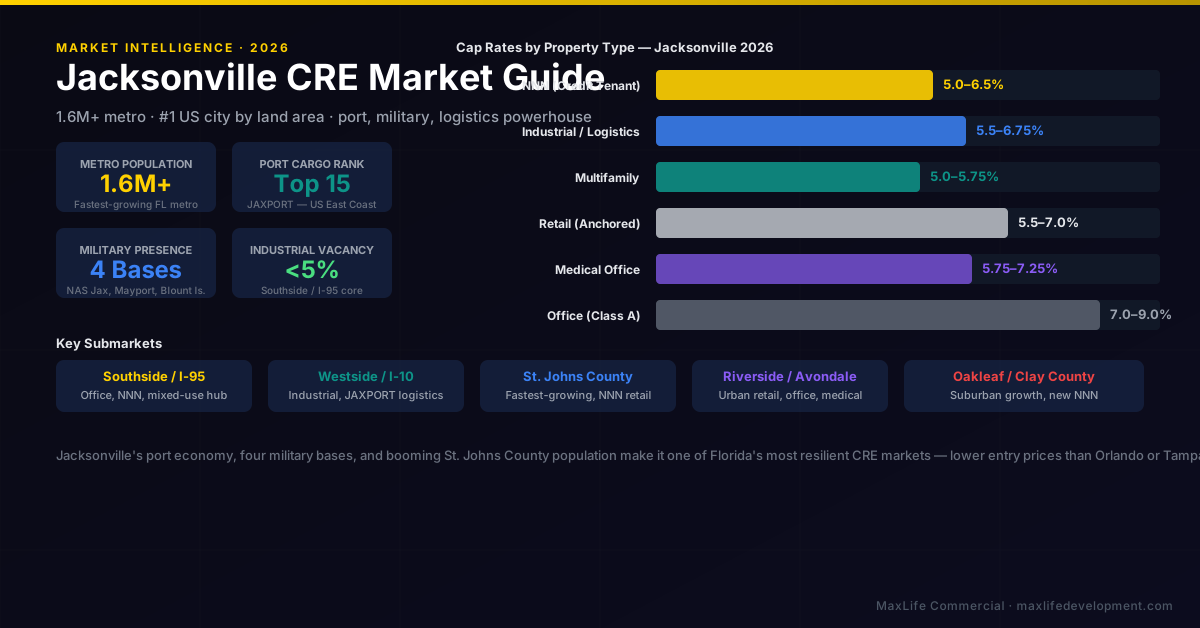
Jacksonville Cap Rates by Property Type — 2026
Cap rates across all asset classes in Jacksonville compress as you move toward St. Johns County, the Southside, and suburban corridors. The widest spreads are in Class A office — still recovering from remote work — and mid-tier retail.
| Property Type | Cap Rate Range | Notes |
|---|---|---|
| NNN (Credit Tenant) | 5.0–6.5% | Investment-grade, 10–15 yr leases |
| Industrial / Logistics | 5.5–6.75% | I-95/I-10 corridor, JAXPORT adjacency |
| Multifamily | 5.0–5.75% | St. Johns Co., Southside demand |
| Retail (Anchored) | 5.5–7.0% | Publix-anchored tightest |
| Medical Office | 5.75–7.25% | Baptist Health, Mayo Clinic adjacency |
| Office (Class A) | 7.0–9.0% | Value-add; Southside/San Marco |
JAXPORT: The Engine Behind Jacksonville Industrial
JAXPORT ranks among the top 15 container ports on the US East Coast and is the leading vehicle-import port in the nation, processing hundreds of thousands of automobiles annually for Ford, BMW, Volkswagen, and others. The port is midway through a $900M+ deepening project, positioning it to handle neo-Panamax vessels and compete directly with Savannah and Charleston for Southeast cargo.
The result is relentless industrial absorption along the Westside I-10 corridor. Vacancy in core logistics submarkets sits below 5%, and new spec industrial construction is pre-leased before delivery. Cold storage, last-mile, and flex tenants are competing for the same constrained supply.
- →Top-15 US East Coast container port by volume
- →#1 vehicle-import port in the United States
- →$900M+ port deepening project underway
- →Industrial vacancy below 5% in Westside logistics corridor
- →Growing cold storage, e-commerce fulfillment, and auto-logistics tenants
Get Off-Market CRE Deals in Your Inbox
Join our investor list for exclusive Central Florida opportunities, market reports, and deal analysis — delivered weekly. No spam, unsubscribe anytime.
Key Submarkets for CRE Investors
Southside / I-95 Corridor
Jacksonville's primary office and NNN retail hub. Home to the bulk of Class A office, major financial institutions (Bank of America, Fidelity, Deutsche Bank), and the densest cluster of NNN retail on US-1 and Beach Boulevard. Strong medical office demand near the Southside Baptist campus. Best submarket for diversified retail and office-adjacent NNN plays.
Westside / I-10 — JAXPORT Logistics
Industrial Jacksonville. The I-10 corridor from downtown to the interchange carries the bulk of JAXPORT freight movement. Blount Island and adjacent industrial parks are home to auto-logistics, cold storage, container yards, and intermodal facilities. Cap rates here are tighter than most Florida industrial markets due to port-driven demand with no viable substitute location.
St. Johns County
Florida's fastest-growing county by percentage. The SR-9B extension has opened new retail and commercial corridors in Nocatee, Ponte Vedra, and St. Augustine. Publix-anchored strip centers, medical offices, and new NNN fast-casual restaurants are being absorbed as quickly as they are built. Investors chasing residential-growth tailwinds should focus here first.
Riverside / Avondale — Urban Core
Jacksonville's urban neighborhood retail and creative office market. Strong demand from healthcare, boutique retail, and food-and-beverage tenants. Medical office demand is expanding from the Downtown Baptist campus westward. Smaller deal sizes ($1M–$5M) make this accessible for private capital.
Oakleaf / Clay County
One of the fastest-growing residential corridors in Northeast Florida. New NNN retail, QSR, and medical office is following the residential growth southwest from Orange Park along Blanding Boulevard and US-17. Entry prices remain low; investors positioning ahead of retail saturation can acquire at 6.5–7.5% caps.
Military Economy: A Stabilizing Force
Jacksonville's four military installations — Naval Air Station Jacksonville, Naval Station Mayport, Blount Island Command, and Kings Bay (just north in Georgia) — collectively employ over 25,000 active military personnel and an equal number of civilian contractors and dependents. This creates permanent demand for housing, retail, healthcare, and services that is largely recession-proof.
NAS Jacksonville alone has an annual economic impact exceeding $3 billion. For CRE investors, proximity to military employment is a built-in occupancy hedge — NNN retail and medical near the bases maintains occupancy through economic cycles that shake other Florida markets.
Jacksonville Underwriting Considerations
Jacksonville's market has some unique underwriting factors that differ from Central and South Florida:
- →Tenant credit over location premium: Jacksonville lacks the tourism-driven "irreplaceable location" premium of Miami or Orlando. Underwrite the tenant, not the corner.
- →Flood zone awareness: Portions of the St. Johns River corridor have significant flood exposure. Verify FEMA zone and insurance costs before closing.
- →St. Johns growth trajectory: County-level population projections matter. The CR-210 corridor in St. Johns County has a decade of NNN retail runway ahead.
- →Industrial: dock-door count matters: JAXPORT logistics tenants need cross-dock capability. Generic warehouse without dock doors leases at a significant discount.
- →Exit liquidity: Jacksonville's buyer pool is growing but still thinner than Orlando or Tampa. Stabilized NNN assets with credit tenants exit cleanly; value-add takes longer.
Jacksonville vs. Other Florida CRE Markets
Jacksonville is often overlooked by investors who lead with Miami or Orlando. That oversight is the opportunity:
| Market | NNN Cap Rate | Industrial Cap | Entry Price Avg |
|---|---|---|---|
| Miami / Ft. Lauderdale | 4.5–5.75% | 4.75–5.75% | $6M–$15M+ |
| Orlando / Central FL | 5.0–6.25% | 5.0–6.25% | $4M–$10M |
| Tampa / St. Pete | 4.75–6.0% | 5.0–6.0% | $4M–$12M |
| Jacksonville | 5.0–6.5% | 5.5–6.75% | $2M–$7M |
2026 Outlook: Catalyst Events to Watch
- →JAXPORT expansion completion: Full neo-Panamax capacity will bring new shipping lines and additional industrial demand to the Westside.
- →Amazon expansion: Multiple fulfillment and delivery nodes are under contract or in planning in Clay and Duval Counties.
- →Baptist Health campus growth: Ongoing hospital and medical office expansion is generating adjacent MOB demand.
- →St. Johns County CR-210 extension: New road infrastructure is unlocking commercial land for NNN and retail development in the fastest-growing county.
- →Jacksonville Urban Core revival: The Downtown Investment Authority is driving residential and mixed-use projects that will eventually lift surrounding retail and office values.
Market Data
Jacksonville Cap Rates by Asset Class
Acquiring Jacksonville CRE
Jacksonville's CRE market rewards investors who understand the port economy, the suburban growth vectors, and the military employment base. The best opportunities in 2026 are NNN retail along the St. Johns growth corridor, industrial near JAXPORT, and medical office adjacent to the Baptist Health system. Pricing remains attractive relative to South Florida with comparable tenant demand.
Explore Jacksonville Opportunities
MaxLife Commercial sources NNN, industrial, and retail acquisitions across Northeast Florida — including Jacksonville's growth corridors and JAXPORT logistics market.