Why Florida Industrial Outperforms the National Market
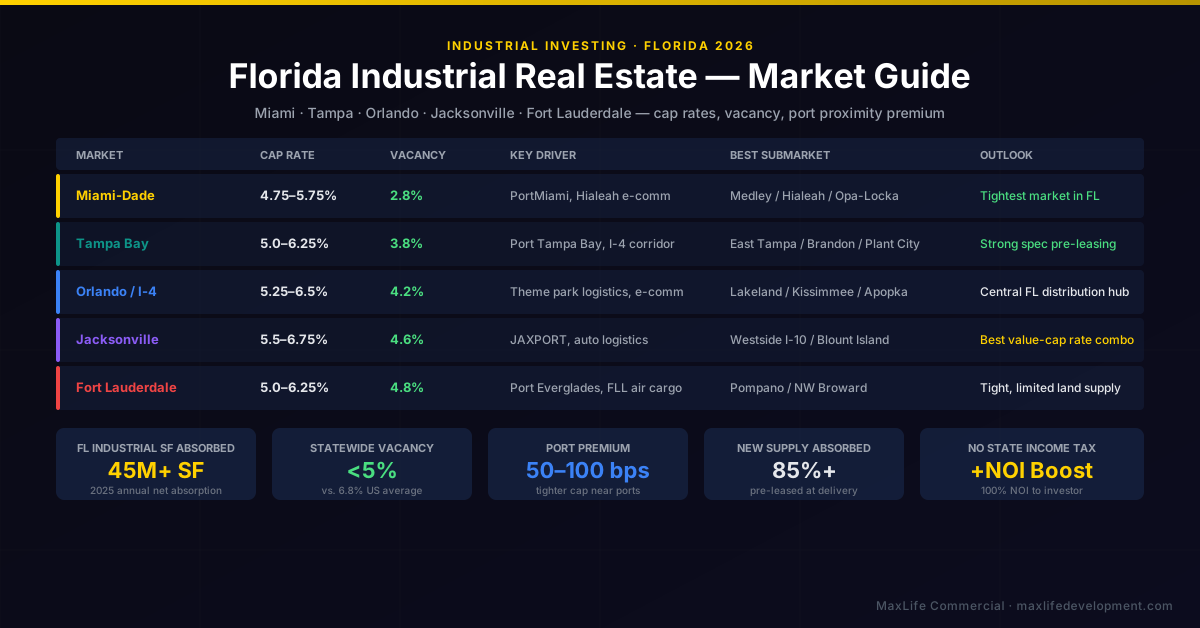
Florida industrial vacancy sits below 5% statewide — significantly below the 6.8% US average. That outperformance is not cyclical luck; it is structural, driven by five reinforcing demand drivers that other industrial markets cannot replicate:
- →Five major seaports: PortMiami, Port Tampa Bay, JAXPORT, Port Everglades, and Port Canaveral collectively handle hundreds of millions of tons of cargo, creating persistent port-adjacent industrial demand in every major Florida metro.
- →22M+ population: Florida is the third-most-populous state and still growing at 800–1,000 new residents per day. Every new resident needs food, goods, and services — all flowing through industrial space.
- →E-commerce penetration: Florida's large retiree population has high e-commerce adoption rates. Amazon alone has 20+ fulfillment and delivery nodes in Florida.
- →Land constraints in coastal markets: Miami-Dade and Broward have virtually no developable industrial land remaining. New supply is constrained by the urban growth boundary and Everglades preservation — a structural vacancy floor.
- →No state income tax: Tenant operating costs in Florida are structurally lower than competing Sun Belt states, improving rent affordability and occupancy sustainability.
Florida Industrial Market Comparison — 2026
| Market | Cap Rate | Vacancy | Key Driver | Outlook |
|---|---|---|---|---|
| Miami-Dade | 4.75–5.75% | 2.8% | PortMiami, e-commerce | Tightest in FL |
| Tampa Bay | 5.0–6.25% | 3.8% | Port Tampa, Amazon | Spec pre-leasing strong |
| Orlando / I-4 | 5.25–6.5% | 4.2% | Theme parks, e-comm | Central FL hub |
| Jacksonville | 5.5–6.75% | 4.6% | JAXPORT, auto logistics | Best value-yield combo |
| Fort Lauderdale | 5.0–6.25% | 4.8% | Port Everglades, FLL | Tight, limited land |
The Port Proximity Premium
Florida's ports create a measurable cap rate premium for adjacent industrial assets. Industrial within a 5-mile radius of a major Florida port trades 50–100 bps tighter than comparable non-port industrial — and carries vacancy that is structurally lower because port tenants have no viable alternative location for their operations.
A phosphate terminal operator near Port Tampa Bay cannot move their operations 20 miles inland and still access the port. A vehicle-logistics operator at JAXPORT's Blount Island is tied to the auto-import infrastructure. An HVAC cold storage operator at PortMiami's cold chain is dependent on the port's refrigerated container handling. In each case, the tenant is sticky in a way that general warehouse tenants are not.
Port-adjacent industrial in Florida carries a 50–100 bps cap rate premium (meaning tighter pricing, not higher yield) relative to non-port industrial — reflecting the lower vacancy risk and higher tenant stickiness of port-dependent operations.
Get Off-Market CRE Deals in Your Inbox
Join our investor list for exclusive Central Florida opportunities, market reports, and deal analysis — delivered weekly. No spam, unsubscribe anytime.
Active Tenant Categories Driving Florida Industrial
E-Commerce Fulfillment
Amazon has 20+ nodes in Florida. Third-party logistics (3PL) companies supporting DTC brands need 100,000–500,000 SF fulfillment centers near population centers in every major metro.
Last-Mile Delivery
UPS, FedEx, USPS, Amazon DSPs, and OnTrac compete for sub-100,000 SF delivery stations near dense residential areas. Florida's sprawling metros create multiple last-mile demand zones per market.
Cold Storage & Food Distribution
Florida's food service industry — restaurants, grocery, healthcare meal delivery — is undersupplied in temperature-controlled logistics space. Cold storage commands a 25–50% rent premium over dry warehouse.
Auto Logistics
JAXPORT is the #1 vehicle-import port in the US, handling BMW, Ford, and Volkswagen vehicles. Auto-logistics tenants (vehicle processing, pre-delivery inspection, storage) drive industrial demand in Jacksonville's Westside.
Healthcare Distribution
Florida's aging population drives outsized healthcare supply chain demand. Medical device distributors, pharmaceutical wholesalers, and hospital supply companies need specialized flex and warehouse space near major hospital clusters.
Construction Materials
Florida's ongoing residential and commercial building boom creates sustained demand for lumber yards, concrete block plants, roofing materials, and HVAC equipment distribution — all occupying light industrial and outdoor storage.
Industrial Underwriting: Florida-Specific Factors
- →Clear height: Modern logistics tenants require 28–36 ft clear height. Florida's older industrial stock (pre-2010) often has 18–24 ft clear, limiting tenant options. Verify and underwrite height as a permanent constraint.
- →Dock doors vs. grade level: E-commerce and fulfillment require cross-dock capability. Grade-level-only buildings are limited to construction, landscaping, and light manufacturing tenants.
- →Trailer parking: Logistics tenants need trailer storage ratios of 1 trailer space per 5,000–10,000 SF. Florida zoning often restricts outdoor storage — verify before underwriting logistics demand.
- →Flood zone: Florida's flat topography means flood risk varies dramatically within a single industrial park. Verify FEMA zone and whether the building pad is elevated above base flood elevation.
- →Hurricane exposure: Florida building codes post-1992 (post-Andrew) require significantly higher wind resistance. Older industrial built before 1993 may face higher insurance costs and material structural risk.
- →Power supply: Data centers and cold storage tenants require 480V three-phase power with high amperage. Verify utility capacity before underwriting specialized industrial demand — see our guide to three-phase power in industrial property for service configurations, amperage by tenant type, and upgrade costs.
Where the Best Opportunities Are in 2026
The highest-conviction Florida industrial plays for 2026:
- →Jacksonville JAXPORT corridor (Westside I-10): Best value-cap rate combination in the state. 5.5–6.75% cap rates with port-driven demand that keeps vacancy structural, not cyclical.
- →Tampa Plant City / Lakeland I-4: Last available industrial land near the Tampa metro with full logistics infrastructure. Development underwritten to 6.0–6.5% stabilized cap rate pencils against construction costs.
- →Orlando south (Kissimmee / Osceola): Growing e-commerce demand from the Orlando metro's south suburban growth is under-served relative to the I-4 East corridor. Land is available and zoning is supportive.
- →Cold storage statewide: Any market, any city — temperature-controlled industrial is undersupplied across Florida. Cold storage commands 25–50% rent premium and has virtually zero competing supply in most submarkets.
Acquire Florida Industrial Real Estate
MaxLife Commercial sources industrial acquisitions across Florida's major logistics corridors — from JAXPORT in Jacksonville to the I-4 corridor in Tampa and Orlando. Our focus on port-adjacent and logistics-driven industrial gives clients access to the strongest demand fundamentals in the state.
Industrial Acquisition Advisory
Ryan Solberg advises buyers on Florida industrial acquisitions — NNN single-tenant, multi-tenant flex, and value-add repositioning opportunities across the state's five major industrial markets.