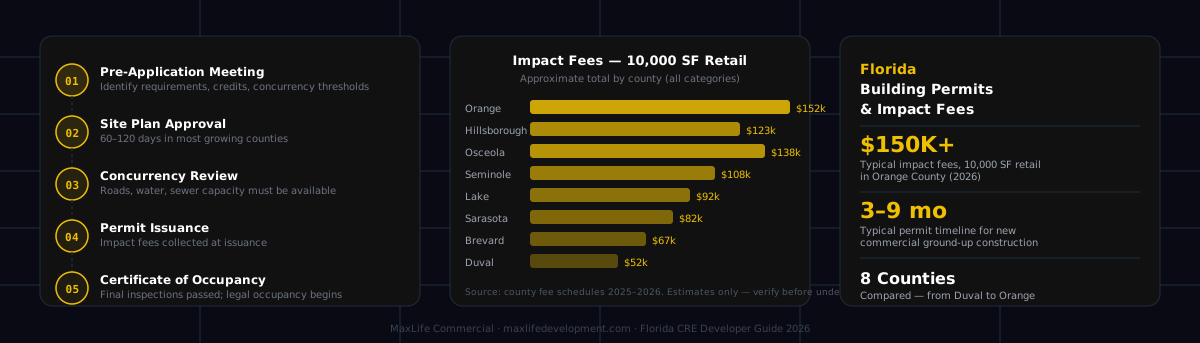
Florida's growth has a price tag — and a significant portion of it lands on developers at permit issuance. Between transportation impact fees, utility connection charges, fire and EMS assessments, and school concurrency requirements, the line items can add $50,000 to $200,000+ to the cost of a commercial project before a shovel touches the ground.
Understanding how building permits work, how impact fees are calculated, and where the variation between counties lies is essential for accurate pro forma underwriting — and for avoiding costly surprises during due diligence.
What Are Impact Fees?
Impact fees are one-time charges levied by Florida counties and municipalities when a new development project creates demand on public infrastructure. The legal basis is Florida Statute §163.31801, which requires that impact fees be calculated using a rational nexus methodology — the fee must have a direct connection to the infrastructure burden the new development creates.
Common impact fee categories in Florida commercial development include:
Transportation
Largest fee in most jurisdictions. Based on peak-hour vehicle trip generation — retail generates more trips per SF than industrial.
Fire / EMS
Varies by building size and use. Assessed to fund fire stations and equipment serving new development.
Parks & Recreation
Less common for purely commercial projects, but applies in some counties to mixed-use and certain retail categories.
Water & Sewer
Connection fees and capacity charges, often billed by the utility authority separately from county impact fees.
Schools
Applied to residential uses only in Florida — commercial projects are not assessed school impact fees.
Libraries / Government
Small fees charged by some counties for library facilities and general government buildings.
How Impact Fees Are Calculated
Impact fees in Florida are calculated per unit of development — typically per 1,000 square feet of gross floor area or per dwelling unit. The rate schedule is adopted by ordinance, updated periodically, and available from the county or city building department.
Example: 10,000 SF Retail Strip — Orange County
Illustrative estimates based on 2025–2026 Orange County fee schedules. Actual charges depend on specific use, connection size, and applicable credits.
The key driver is the Institute of Transportation Engineers (ITE) trip generation rate for your land use code. A fast-food restaurant generates roughly 5× more peak-hour trips per square foot than a general office building — and pays proportionally higher transportation impact fees.
Impact Fee Ranges by County — Commercial Uses
The table below shows approximate total impact fee ranges (all categories combined, excluding utility connection charges) for a 10,000 SF retail project and a 10,000 SF industrial/warehouse project across major Florida counties. Ranges reflect variation in exact use type, location within the county, and applicable utility district.
| County | Retail 10,000 SF | Industrial 10,000 SF |
|---|---|---|
| Orange County | $142,000–$165,000 | $58,000–$72,000 |
| Hillsborough County | $110,000–$135,000 | $45,000–$60,000 |
| Osceola County | $125,000–$150,000 | $50,000–$65,000 |
| Brevard County | $55,000–$80,000 | $22,000–$38,000 |
| Seminole County | $95,000–$120,000 | $38,000–$52,000 |
| Lake County | $80,000–$105,000 | $32,000–$48,000 |
| Duval County (Jacksonville) | $40,000–$65,000 | $18,000–$30,000 |
| Sarasota County | $70,000–$95,000 | $28,000–$42,000 |
Ranges are estimates for planning purposes only. Verify current schedules with the applicable county building department before underwriting.
The Commercial Building Permit Process in Florida
Building permits for commercial construction in Florida follow a multi-step review process that varies by jurisdiction but generally flows through these stages:
Pre-Application / Pre-Development Meeting
Most Florida counties encourage or require a pre-application meeting with the building and planning department before submitting plans. This is the best opportunity to identify jurisdiction-specific requirements, concurrency thresholds, and impact fee credits that may apply to your project.
Site Plan Approval
Ground-up commercial projects require site plan review before a building permit can be issued. This covers site design, parking, landscaping, stormwater management, and utilities. In growing counties, site plan review alone can take 60–120 days, with multiple rounds of comment.
Concurrency Review
Florida's Growth Management Act requires that public infrastructure be available concurrent with new development. This means roads, water, sewer, and schools (for residential) must have adequate capacity. If your project triggers a concurrency deficiency, you may need to contribute to or fund infrastructure improvements before proceeding.
Building Permit Application
Once site plan approval is in hand, construction documents are submitted for building plan review. Plans are reviewed by building, mechanical, electrical, plumbing, and fire departments. Impact fees are assessed and collected at permit issuance.
Permit Issuance & Inspections
After fees are paid and plans are approved, the permit is issued and construction can begin. Inspections are required at defined milestones — foundation, framing, rough-in MEP, insulation, and final occupancy. Each inspection must be requested and pass before the next phase can proceed.
Certificate of Occupancy
The CO is issued after all final inspections pass and required documentation (fire system certifications, health department approvals for food service, etc.) is submitted. This is the final milestone — the building cannot be legally occupied or used until the CO is issued.
Realistic Permit Timelines by Project Type
No site plan required. Plan review cycle is typically 2–3 weeks; permit issuance follows approval.
Site plan required if not previously approved. Plan review + permit issuance in most major cities.
Site plan, concurrency, stormwater, and utility reviews. Streamlined somewhat by lower trip generation.
Similar to retail. High-traffic uses trigger concurrency review; may require traffic study.
DRI thresholds may apply. EIS and traffic studies are common. Full concurrency review required.
Master plan approval, phased site plan, utility extensions. Jurisdictions vary widely.
Underwriting Impact Fees in Your Pro Forma
Many developers — especially those underwriting Florida for the first time — make the mistake of looking only at land cost and hard construction costs. Impact fees and permit-related soft costs are a meaningful line item that can move the needle on project feasibility.
Pro Forma Line Items to Include
On a typical Central Florida retail development, total permit-related costs (impact fees, utility connections, traffic study, and permit application fees) often run $150,000–$250,000 for a 10,000–15,000 SF project — before any construction costs. Budget this line explicitly; don't absorb it into contingency.
Impact Fee Credits and Reductions
Florida law allows — and in some cases requires — counties to provide impact fee credits when a developer funds infrastructure that offsets the impact their project creates. Common credit scenarios include:
- Road Improvements: If your project requires and funds a turn lane, deceleration lane, or signal upgrade, you may receive a transportation impact fee credit equal to the improvement's cost up to the fee owed.
- Proportionate Fair-Share Agreements: For projects that trigger concurrency deficiencies, Florida law provides a mechanism to contribute a proportionate share toward planned improvements rather than being denied development approval.
- Redevelopment Credits: If you demolish an existing structure and rebuild, the prior structure's impact fees already paid (or implied by existing use) can offset new fees — though credits must be documented and claimed correctly.
- Economic Development Programs: Some counties offer impact fee deferrals or reductions for qualifying job-creating industries. Orange County's economic incentive program and Brevard County's qualified target industry program are examples.
2025–2026 Trends: Rising Fees, Faster Processing
Several dynamics are reshaping the Florida permitting and impact fee landscape heading into 2026:
Fee Escalation Across High-Growth Counties
Orange, Osceola, and Lake counties have all updated their impact fee schedules in 2024–2025, with transportation fees in particular rising 15–30% in some jurisdictions to keep pace with infrastructure costs. Developers underwriting to older fee assumptions are getting burned.
State Preemption Debates
There have been legislative proposals at the Florida statehouse to cap or freeze local impact fees. As of 2026, no broad preemption has passed, but the political environment is worth monitoring — particularly for longer development timelines.
Electronic Permitting and Concurrent Review
Orange County, Hillsborough, and several other major jurisdictions have made substantial investments in electronic plan review systems that allow concurrent review across departments. This is meaningfully accelerating timelines in jurisdictions that have fully implemented the systems.
Expedited Review Programs
Most major Florida counties now offer fee-based expedited review tracks for commercial projects. A typical expedited review premium runs $2,000–$8,000 but can cut review time in half — a worthwhile trade on time-sensitive deals.
The Bottom Line
Florida's impact fee environment is one of the most complex in the country — fees vary dramatically by county, asset type, and use, and they change frequently as infrastructure costs escalate. For developers, the imperative is simple: pull the current fee schedule early, model it explicitly, and get a pre-application meeting on the calendar before you tie up a site.
For investors evaluating development deals, impact fees and entitlement timelines are material assumptions — not footnotes. A deal that pencils at $120/SF all-in may not pencil at $145/SF once actual permits are pulled. Diligence on these line items is as important as diligence on rent comps.
Evaluating a Development Site in Florida?
MaxLife Commercial helps developers and investors underwrite Florida commercial land and ground-up development — including impact fee estimates and entitlement timeline assessments before you commit to a site.
Talk to Ryan SolbergRelated Articles
Central Florida Land Development Guide
Population growth, infrastructure investment, and rising demand for land across the Orlando metro.
Build-to-Suit vs. Existing Commercial in Orlando
When ground-up development beats acquiring existing CRE — and when it doesn't.
Florida CRE Due Diligence Checklist
What to verify before closing on commercial property in Florida.
SBA 504 Loans in Florida — Complete Guide
How owner-users buy commercial property with 10% down using SBA 504 financing.
Commercial Real Estate Financing Florida
Loan types, lenders, LTV ratios, and rates for Florida CRE investment.
Lake County FL Commercial Real Estate Guide
Wellness Way, Clermont, and the next Central FL growth corridor.
Get Off-Market CRE Deals in Your Inbox
Join our investor list for exclusive Central Florida opportunities, market reports, and deal analysis — delivered weekly. No spam, unsubscribe anytime.