Lake County FL Commercial Real Estate: The Growth Corridor Investors Are Missing
While Orlando grabs the headlines, Lake County is quietly becoming Central Florida's most compelling commercial real estate growth story. From the Wellness Way corridor to the Florida Turnpike expansion, here's everything investors need to know about this emerging market.
Why Lake County Deserves Your Attention Right Now
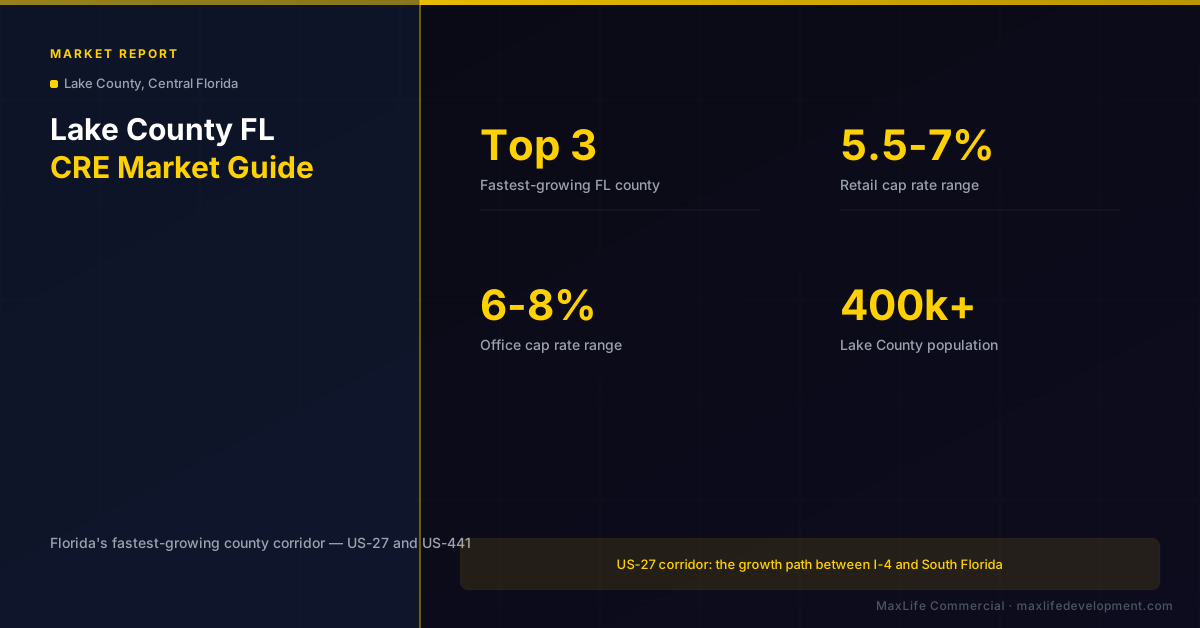
If you are an investor focused exclusively on Orange, Seminole, or Osceola County, you are overlooking one of the most dynamic growth corridors in Central Florida. Lake County, located directly west and northwest of Orlando, has transformed from a sleepy, rural county into one of the fastest-growing regions in the entire state. The numbers tell the story: Lake County's population surged past 420,000 residents in 2025 and is projected to exceed 500,000 by 2035. That trajectory represents a growth rate that outpaces Orange County on a percentage basis, and it is creating massive demand for commercial real estate that has not yet been fully priced into the market.
The investment thesis for Lake County commercial real estate is straightforward: this is a market where population growth is running ahead of commercial development. Tens of thousands of new rooftops are being delivered across master-planned communities in Clermont, Minneola, Groveland, and the Wellness Way corridor, but the commercial infrastructure to serve those residents is still catching up. For investors who understand the "retail follows rooftops" playbook, Lake County presents an opportunity to acquire land and develop or invest in commercial properties at a fraction of what comparable assets cost in established Orlando submarkets.
This guide provides a comprehensive look at Lake County's commercial real estate landscape, covering the key growth drivers, submarket analysis, property type opportunities, and specific development corridors that are attracting institutional and private capital. Whether you are evaluating raw land for development, seeking NNN retail investments, or exploring industrial opportunities driven by logistics demand, Lake County offers a compelling risk-adjusted return profile that is increasingly difficult to find in more mature Central Florida markets.
420K+
2025 Population
500K+
Projected by 2035
18.5%
10-Year Pop Growth
$45B
County GDP (est.)
The Wellness Way Development Corridor: Ground Zero for Growth
If there is a single development corridor that encapsulates the Lake County growth story, it is Wellness Way. Located in the southeastern portion of the county, straddling the boundary between Lake and Orange counties, the Wellness Way Sector Plan encompasses approximately 16,000 acres of land designated for mixed-use development. It is one of the largest planned development areas in Florida history, and it is actively being built out today.
The Wellness Way plan was adopted in 2015 to provide a framework for the orderly development of this rapidly growing area. The plan envisions up to 25,000 residential units and millions of square feet of commercial, retail, office, and industrial space. Major developers including Hanover Family Builders, Pulte Homes, and Meritage Homes have already delivered thousands of homes in the corridor, with thousands more under construction or in the permitting pipeline.
For commercial real estate investors, Wellness Way represents something rare: a greenfield development corridor with existing infrastructure commitments, approved entitlements, and a clear population trajectory. The county has invested heavily in road infrastructure including the extension of Wellness Way itself, new interchanges, and improvements to connecting arterials. This infrastructure spending de-risks development by ensuring that commercial sites will have the traffic counts and accessibility needed to support retail, medical, and service-oriented tenants.
Commercial Opportunities in Wellness Way
The current commercial development pipeline in Wellness Way is heavily weighted toward neighborhood-serving retail, medical office, and convenience-oriented uses. National tenants including Publix, Wawa, McDonald's, and CVS have either opened or committed to locations in the corridor. However, the commercial buildout is still in its early stages relative to the residential delivery, creating a significant supply gap that will take years to fill.
Land prices in Wellness Way have appreciated significantly over the past five years but remain well below comparable parcels in established Orange County corridors. Commercially zoned parcels along primary arterials are trading in the $8 to $15 per square foot range for raw land, compared to $25 to $50 or more for similar parcels in developed Orlando submarkets. Pad-ready sites with entitlements command premium pricing but still represent compelling value relative to the projected demand.
Investor Insight: Wellness Way Land Play
The most strategic play in Wellness Way today is acquiring commercially entitled land along primary arterials before the next wave of residential deliveries drives demand even higher. Investors who acquired land in this corridor three to five years ago have seen 100-200% appreciation. The runway for further appreciation remains strong given the 10+ year buildout horizon.
The Florida Turnpike Expansion: A Catalyst for Commercial Demand
The Florida Turnpike is the primary north-south transportation artery connecting Lake County to greater Orlando, and the ongoing expansion project is a game-changer for commercial real estate in the region. The Turnpike widening from four to eight lanes through the Lake County section, combined with new interchange construction at key points, is dramatically improving connectivity and reducing travel times between Lake County communities and Orlando employment centers.
New interchange construction at the Hancock Road and Wellness Way intersections is creating entirely new commercial nodes. Historically, interchange areas are among the most valuable commercial real estate locations in any market, and the Lake County interchanges are no exception. Land prices within a one-mile radius of planned interchange locations have increased 50-100% since the projects were announced, and further appreciation is expected as construction nears completion and traffic patterns shift.
The Turnpike expansion also supports the growing logistics and industrial demand in Lake County. As e-commerce fulfillment requirements push distribution further from congested urban cores, Lake County's combination of available land, lower construction costs, and improved Turnpike access makes it an increasingly attractive location for last-mile distribution, flex industrial, and light manufacturing. Industrial lease rates in Lake County currently range from $8 to $12 per square foot NNN, compared to $12 to $18 in established Orange County industrial corridors.
| Infrastructure Project | Status | CRE Impact | Completion |
|---|---|---|---|
| Turnpike Widening (4 to 8 lanes) | Under Construction | Reduced commute times, higher traffic counts | 2027 |
| Hancock Rd Interchange | Design Phase | New commercial node, 500+ acres activated | 2028 |
| Wellness Way Extension | Partially Complete | Connects residential to commercial corridors | 2026-2028 |
| US 27 Widening (Clermont) | Planning | Enhanced retail corridor capacity | 2029 |
| Minneola Interchange Improvements | Complete | Unlocked 1,200+ acres for development | 2025 |
Population Projections & Demographic Trends
Understanding Lake County's population trajectory is essential for sizing the commercial real estate opportunity. The county has been on a consistent upward growth curve for over a decade, but the pace of growth has accelerated meaningfully since 2020 as remote work adoption and affordability pressures in Orange County pushed homebuyers further west along the US 192 and SR 50 corridors.
Lake County added approximately 55,000 new residents between 2020 and 2025, an average of 11,000 per year. Residential building permit data suggests this pace will continue or accelerate through at least 2030, supported by the massive pipeline of approved residential entitlements in the Wellness Way corridor, the Four Corners area, and along the US 27 corridor through Clermont and Minneola.
The demographic profile of new Lake County residents skews toward young families and early retirees, both of which are heavy consumers of commercial real estate services. Young families drive demand for grocery-anchored retail, medical and dental offices, daycare facilities, quick-service restaurants, and fitness concepts. Retirees drive demand for medical offices, pharmacy, dining, and personal-service retail. This dual-demand driver is a key factor supporting the commercial real estate investment thesis.
| Year | Population (est.) | Growth from 2020 | New Households |
|---|---|---|---|
| 2020 | 365,000 | Baseline | Baseline |
| 2025 | 420,000 | +15.1% | ~22,000 |
| 2030 | 470,000 | +28.8% | ~42,000 |
| 2035 | 510,000 | +39.7% | ~58,000 |
What This Means for CRE Investors
Every 10,000 new households typically supports approximately 150,000 to 200,000 square feet of new retail space, 30,000 to 50,000 square feet of medical office, and proportional demand for restaurants, service-oriented businesses, and industrial distribution. Lake County's projected 58,000 new households by 2035 translates to demand for roughly 1 million+ square feet of new commercial space across all property types.
Clermont & Minneola: The Twin Engines of Lake County Growth
Clermont is the largest and most economically significant city in Lake County, and it is the primary commercial hub for the southern portion of the county. With a population that has grown from roughly 35,000 in 2015 to over 55,000 today, Clermont has evolved from a small bedroom community into a city with a diversified economic base that includes healthcare, retail, hospitality, and a growing professional services sector.
The US 27 corridor through Clermont is the primary commercial arterial, and it has seen explosive development over the past decade. National retailers including Target, Costco, Home Depot, Lowe's, and multiple grocery chains have established locations along US 27, and the corridor continues to attract new commercial development as residential growth pushes further south and west. Retail lease rates along US 27 in Clermont range from $22 to $35 per square foot NNN for inline space and $35 to $50 for endcaps and pad sites with drive- through capability.
Minneola, located adjacent to Clermont along the Turnpike corridor, is experiencing even faster growth on a percentage basis. The city's population has more than doubled in the past decade, driven by master-planned communities including Hills of Minneola, Olympia, and the massive Minneola Hills development. Minneola's proximity to the Turnpike interchange makes it particularly attractive for commercial development targeting both local residents and commuters.
Submarket Comparison: Clermont vs. West Orange County
One of the most compelling aspects of the Clermont and Minneola market is the pricing differential relative to adjacent West Orange County. Properties in the Horizon West, Winter Garden, and Windermere areas of Orange County command significantly higher prices despite serving a similar demographic profile. This pricing gap creates an arbitrage opportunity for investors willing to look across the county line.
| Metric | Clermont / Minneola | West Orange County |
|---|---|---|
| Retail Cap Rate | 6.5% - 7.5% | 5.5% - 6.5% |
| Retail Lease Rate (NNN) | $22 - $35/SF | $30 - $50/SF |
| Commercial Land (per SF) | $8 - $18 | $25 - $55 |
| Median HH Income | $82,000 | $95,000 |
| Population Growth (5yr) | +28% | +22% |
| Vacancy Rate (Retail) | 4.2% | 3.1% |
Land Development Opportunities in Lake County
Lake County is one of the few remaining markets in the Central Florida metro where investors can acquire commercially zoned land at reasonable prices with a clear path to entitlement and development. In Orange and Seminole counties, available commercial land is increasingly scarce and expensive, pushing developers and investors to look at adjacent markets. Lake County is the primary beneficiary of this dynamic.
The county's land development process has improved significantly over the past several years. Lake County has invested in staff and technology to streamline the permitting and approval process, recognizing that developer-friendly policies are essential to attracting the commercial investment needed to serve its growing population. Average time from site plan submission to approval for commercial projects has been reduced to approximately 60 to 90 days for projects that conform to the comprehensive plan, compared to 120 to 180 days or more in some neighboring jurisdictions.
The most active land development corridors include Wellness Way, the US 27 corridor through Clermont and Minneola, the Four Corners area at the intersection of US 27 and US 192, and the emerging corridor along CR 455 connecting Minneola to Montverde. Each of these corridors has a distinct character and investment profile, but they share common fundamentals: strong population growth, infrastructure investment, and a gap between residential delivery and commercial development.
Types of Land Plays in Lake County
Raw Land Assemblage
Acquire agricultural or rural-zoned land in the path of growth, rezone to commercial, and sell to developers or build-to-suit. Requires longer hold periods (3-7 years) but offers the highest returns.
Entitled Pad Sites
Purchase pad-ready sites with approved entitlements and sell or develop for single-tenant NNN. Lower risk due to approved plans and shorter timelines, but higher entry cost per square foot.
Outparcel Carve-Outs
Identify larger commercial parcels where outparcels can be subdivided and sold individually to restaurant, bank, or convenience store operators at premium per-square-foot pricing.
Mixed-Use Development
Larger parcels in the Wellness Way corridor zoned for mixed-use development combining retail, office, and residential components. Requires more capital but captures multiple revenue streams.
For investors looking at Lake County land development opportunities, our land development services team provides end-to-end support from site identification through entitlement, development, and disposition. We maintain an active database of available commercial parcels across all Lake County corridors and can provide comparative market analysis to help size the opportunity.
Retail Follows Rooftops: The Lake County Opportunity
The axiom that "retail follows rooftops" is one of the most reliable principles in commercial real estate, and Lake County is a textbook case study in its application. The county has experienced massive residential development over the past decade, with tens of thousands of single-family homes and townhomes delivered in master- planned communities. However, the commercial development to serve these new communities has consistently lagged behind, creating a persistent supply-demand imbalance that savvy investors are exploiting.
Consider the numbers: Lake County has added approximately 22,000 new households since 2020. Using industry standards, each household generates demand for approximately 8 to 10 square feet of retail space. That translates to demand for roughly 175,000 to 220,000 square feet of new retail annually. Actual retail deliveries have fallen short of this demand, resulting in declining vacancy rates, rising lease rates, and an increasingly competitive environment for retailers seeking space in the market.
The national retail tenants already in Lake County validate the market. Publix operates over a dozen locations in the county, and new stores are planned or under construction in the Wellness Way and Minneola corridors. Aldi, Winn-Dixie, and Walmart Neighborhood Market are also present, competing for the grocery spend of new residents. Quick-service and fast-casual restaurant brands including Chick-fil-A, Chipotle, Starbucks, and Wawa have aggressively expanded into Lake County, and their site selection activity indicates continued confidence in the market's growth trajectory.
22K+
New Households (2020-2025)
175K SF
Annual Retail Demand
4.2%
Retail Vacancy Rate
$22-$35
Inline NNN Rate/SF
12+
Publix Locations
6.5-7.5%
Retail Cap Rates
Industrial & Logistics Demand: The Emerging Story
While retail and land development dominate the Lake County investment conversation, the industrial and logistics sector is quietly becoming a significant opportunity. The same factors that make Lake County attractive for residential and retail development — available land, lower costs, and improving infrastructure — also appeal to industrial users seeking space for distribution, light manufacturing, and last-mile fulfillment.
The Turnpike expansion is the key catalyst for industrial demand. As the widened Turnpike reduces travel times to Orlando, Tampa, and points beyond, Lake County becomes increasingly competitive as a logistics location. Companies that previously required locations in Orange County's established industrial parks to meet delivery time requirements can now achieve similar service levels from Lake County facilities at significantly lower rents.
The emerging industrial corridor along US 27 and the Turnpike in southern Lake County has attracted several speculative industrial developments, and absorption has been strong. Flex industrial space in the 10,000 to 50,000 square foot range is in particularly high demand, serving local contractors, service companies, and small distribution operations. This segment of the market offers cap rates in the 7.0% to 8.5% range, well above what comparable assets command in Orange County.
Industrial Investment Metrics: Lake County vs. Orange County
Lake County
- Lease Rate: $8 - $12/SF NNN
- Cap Rate: 7.0% - 8.5%
- Land Cost: $4 - $8/SF
- Vacancy: 5.8%
Orange County
- Lease Rate: $12 - $18/SF NNN
- Cap Rate: 5.5% - 7.0%
- Land Cost: $12 - $25/SF
- Vacancy: 3.9%
How to Evaluate Lake County Commercial Properties
Investing in a growth market like Lake County requires a different analytical framework than investing in stabilized urban markets. The value proposition is driven primarily by growth and appreciation rather than current income, which means traditional metrics like cap rate and NOI are necessary but not sufficient for evaluating opportunities.
The most important factors to evaluate in Lake County include the pace of residential development within the property's trade area, the status of infrastructure projects that will affect accessibility and traffic counts, the competitive supply pipeline for the specific property type, and the quality of entitlements for development sites. Our deal analyzer tool can help you model these growth-market scenarios and compare opportunities across the Lake County submarket.
Traffic count data is particularly important in Lake County because many commercial corridors are still maturing. A site that shows 12,000 vehicles per day today may be projected to reach 25,000 or more within five years as new residential developments are completed and road improvements increase capacity. Evaluating properties based on current traffic counts alone will cause you to undervalue the opportunity. Understanding the relationship between approved residential entitlements and future traffic projections is essential.
Key Due Diligence Items for Lake County
Comprehensive Plan Consistency
Verify the property's land use designation in the Lake County Comprehensive Plan and confirm proposed use is consistent.
Concurrency / Impact Fees
Lake County impact fees vary by development type and location. Budget $15K-$30K+ per 1,000 SF for commercial development.
Water & Sewer Availability
Some areas of Lake County still rely on well and septic. Confirm utility availability and connection costs before closing.
Wetland & Environmental
Lake County has significant wetland areas. Phase I ESA and wetland delineation are essential for undeveloped parcels.
FDOT Access Permits
Properties on state roads (US 27, SR 50) require FDOT access permits. Confirm driveway cut locations and turning movements.
School Zone & Concurrency
Residential components of mixed-use projects may be affected by school concurrency requirements in high-growth areas.
Investment Strategies for Lake County CRE
The best investment strategy for Lake County depends on your capital profile, risk tolerance, and time horizon. However, several strategies are particularly well-suited to the current market conditions and growth trajectory.
Strategy 1: Land Banking in Growth Corridors
Acquiring commercially zoned or commercially designatable land along primary arterials in the Wellness Way, Minneola, and Four Corners corridors remains the highest-upside play. Hold periods of three to seven years are typical, and investors should be prepared to carry land with minimal or no income during the hold period. However, historical returns in this strategy have been exceptional, with investors who acquired land in these corridors five years ago realizing 15-25% annualized returns. To explore current land opportunities, visit our Lake County commercial land listings.
Strategy 2: NNN Retail Acquisition
Lake County offers a meaningful cap rate premium over Orlando for single-tenant NNN retail properties. A Starbucks, Chick-fil-A, or medical office NNN deal in Clermont or Minneola might trade at a 6.5% to 7.0% cap rate, compared to 5.5% to 6.0% for comparable assets in established Orlando submarkets. For investors seeking stable income with growth potential, these properties offer an attractive combination of current yield and future appreciation as the market matures. For more on evaluating these deals, see our cap rate investor guide.
Strategy 3: Build-to-Suit Development
For investors with development capability, Lake County offers compelling build-to-suit opportunities. National tenants actively seeking sites in the market include quick-service restaurants, auto service providers, medical and dental groups, and convenience store operators. The spread between development cost and stabilized value in Lake County is currently 100 to 200 basis points wider than in mature Orlando submarkets, reflecting the lower land and construction costs. This development spread translates to day-one equity creation that enhances overall returns.
Strategy 4: Value-Add Repositioning
As Lake County evolves from a rural to a suburban market, older commercial properties along US 27 and in downtown Clermont present value-add opportunities. Properties with below-market rents, deferred maintenance, or outdated tenant mixes can be repositioned to capture the higher rents that the growing population base supports. This strategy requires local market knowledge and active management but can generate outsized returns when executed well. Learn more about our approach in our Central Florida land development guide.
The Bottom Line
Lake County is no longer an emerging market — it is arriving. The combination of rapid population growth, massive infrastructure investment, a developer-friendly regulatory environment, and pricing that remains well below comparable Orlando submarkets creates a compelling investment thesis across multiple property types and strategies.
The window of opportunity is narrowing as institutional capital begins to recognize the same fundamentals that local investors have been capitalizing on for years. Cap rates are compressing, land prices are rising, and the best sites in the most desirable corridors are being absorbed. Investors who move decisively will benefit from the continued gap between where Lake County is today and where the growth trajectory is taking it over the next decade.
The key is working with a team that knows this market inside and out — who the landowners are, which parcels are quietly available, where the infrastructure is going, and which tenants are actively seeking space. That local knowledge is what separates a good Lake County investment from a great one.
Ready to Explore Lake County Opportunities?
Our team specializes in Lake County commercial real estate and can help you identify, evaluate, and execute on the best opportunities in this high-growth market.
Related Articles
Why Central Florida Is Hot for Land Development
Population growth and corridor-by-corridor land demand analysis across the region.
Orlando Cap Rates: Investor Guide
Cap rate benchmarks by asset class — including the Lake County premium over Orlando.
Build-to-Suit vs. Existing Commercial
Lake County's available land makes it ideal BTS territory — when to build vs. buy.
Florida CRE Investor Guide
The statewide case for Florida CRE investment — tax advantages, markets, and asset classes.
How to Buy Commercial Property in Orlando
The full acquisition playbook — applicable to Lake County transactions as well.
Orlando CRE Trends 2026
Market data and submarket performance data for the broader Central Florida region.
Get Off-Market CRE Deals in Your Inbox
Join our investor list for exclusive Central Florida opportunities, market reports, and deal analysis — delivered weekly. No spam, unsubscribe anytime.