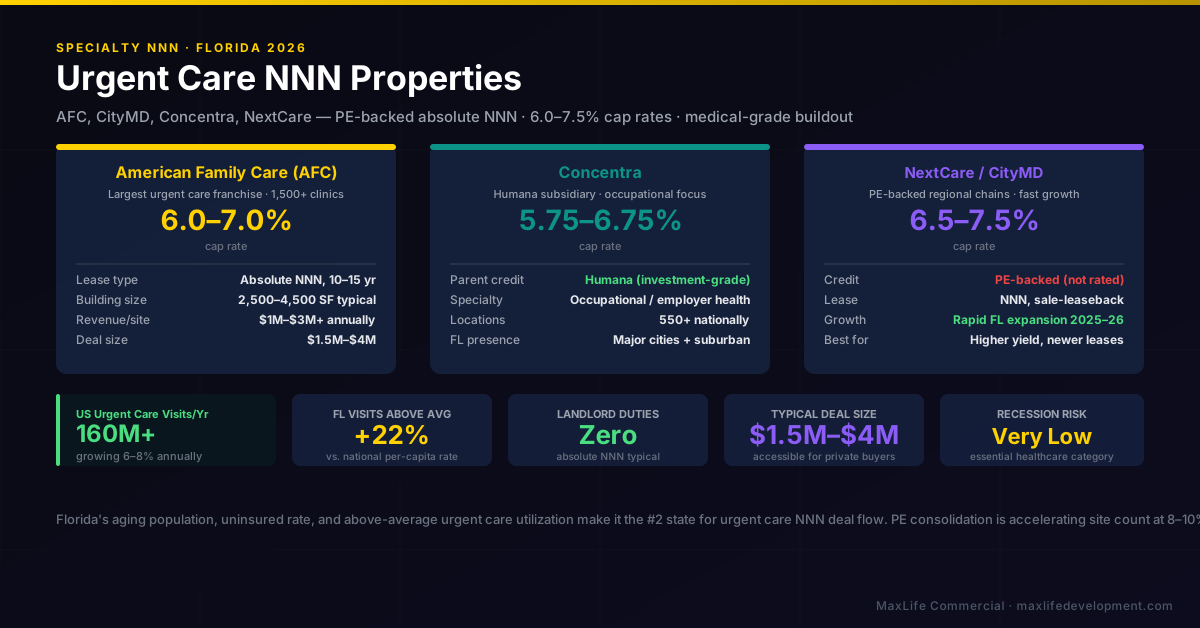
Why Urgent Care NNN Is a Strong Florida Investment
The urgent care sector has structural advantages that make it uniquely suited to the NNN investment thesis. Urgent care centers treat non-emergency medical conditions — sprains, minor lacerations, flu, infections, X-rays — at a fraction of the cost of an emergency room visit. With US ER visits averaging $1,500–$3,000 and urgent care visits averaging $150–$200, the economic incentive to use urgent care is overwhelming for the 28M+ uninsured Americans and the millions more with high-deductible plans.
Florida amplifies this dynamic: the state has one of the nation's highest uninsured rates and above-average urgent care utilization per capita — 22% higher than the national average. The state's large retiree population, active construction and agricultural workforce, and tourist population all drive above-average visit volume.
Urgent care is one of the few NNN categories that actually grew revenue during the 2020 pandemic — COVID testing and treatment drove above-normal visit volume at a time when other retail tenants were shuttered. Essential service demand does not follow the broader economic cycle.
Major Urgent Care NNN Operators in Florida
American Family Care (AFC)
FranchiseAFC is the largest urgent care franchise in the US with 1,500+ clinics. Florida has one of the highest AFC concentrations nationally. AFC franchisees operate under the AFC brand with franchise agreement backing — not a corporate guaranty, which means credit underwriting requires evaluating the individual franchisee's financial strength. Best AFC plays are multi-unit operators with established revenue history.
Concentra
Investment Grade ParentConcentra is a Humana subsidiary specializing in occupational health and urgent care, with 550+ locations nationally and strong Florida presence in industrial corridors and suburban markets. The Humana parent guaranty makes Concentra the highest-credit urgent care NNN option — comparable to a well-rated retail chain. Concentra's occupational focus (employer health programs, workers' comp) provides a revenue stream that is counter-cyclical to general urgent care.
NextCare / CityMD / Regional Chains
PE-BackedPE-backed regional urgent care chains are rapidly expanding into Florida, executing sale-leasebacks as their primary capital tool. NextCare (Blackstone-backed) and CityMD (now Summit Health, PE-backed) are both growing Florida site counts. Credit is PE-backed and unrated — underwrite the operating entity's financials directly. Higher cap rates compensate for lower credit quality.
Get Off-Market CRE Deals in Your Inbox
Join our investor list for exclusive Central Florida opportunities, market reports, and deal analysis — delivered weekly. No spam, unsubscribe anytime.
Underwriting Urgent Care NNN in Florida
- →Credit depth: Concentra (Humana) is investment-grade. AFC franchisees require individual financial review. PE-backed chains warrant lease guaranty review — does the parent entity guaranty the lease or just the operating subsidiary?
- →Visit volume: Request average daily patient visits if available. 40+ visits/day suggests viable economics; below 30 is a watch flag. Sites below 20 visits/day have material re-leasing risk.
- →Hospital competition: Map hospital-owned urgent care within a 1-mile radius. Hospital systems (AdventHealth, BayCare) aggressively open their own urgent care satellites, which can pull volume from independent operators.
- →Building configuration: Medical-grade buildout includes exam rooms, X-ray suite, lab, and waiting area. Replacement cost is $200–$350/SF, significantly reducing relocation probability.
- →Lease NNN structure: Confirm tenant responsibility for roof, structure, HVAC, taxes, and insurance. Modified gross leases are common in medical — push for absolute NNN on new acquisitions.
- →Parking ratio: Urgent care requires 4–6 spaces per 1,000 SF. Inadequate parking is a patient-facing barrier and a long-term occupancy risk.
- →Anchor proximity: Urgent care performs best in high-traffic retail corridors near grocery anchors (Publix, Walmart) or dense residential. Avoid freestanding sites with limited visibility.
Urgent Care vs. Traditional Medical Office: The Investor Choice
Investors often compare urgent care NNN to traditional medical office buildings (MOBs). The key differences:
| Factor | Urgent Care NNN | Medical Office Building |
|---|---|---|
| Cap Rate | 6.0–7.5% | 5.5–7.5% |
| Deal Size | $1.5M–$4M (accessible) | $3M–$15M+ |
| Tenant Count | Single (NNN) | Multi-tenant (more mgmt) |
| Landlord Duties | Zero (absolute NNN) | Varies — often NNN |
| Buildout Replacement Cost | $200–$350/SF | $100–$200/SF |
| Credit Risk | Operator dependent | Diversified (multi-tenant) |
1031 Exchange Fit for Urgent Care NNN
Urgent care NNN assets are excellent 1031 exchange replacement properties. The $1.5M–$4M deal size makes them accessible for a wide range of exchange scenarios, the absolute NNN structure eliminates active management concerns, and the 10–15 year initial lease term provides certainty for the exchange timeline. The combination of healthcare essential services with a long-term lease creates a low-management, stable-income profile that fits the passive income objective most 1031 exchangers seek.
The primary challenge is sourcing quality assets within the 45-day identification window. PE-backed operators execute sale-leasebacks frequently but often through private channels before broad marketing. Working with a broker who has active relationships with AFC, Concentra, and regional chain operators gives access to inventory before public listing.
Source Florida Urgent Care NNN Properties
MaxLife Commercial sources specialty NNN properties including urgent care for Florida investors and 1031 exchange buyers. Access to PE-backed sale-leaseback inventory from regional chains expanding in Florida's suburban and coastal markets.
Find Urgent Care NNN in Florida
Access AFC, Concentra, and regional urgent care sale-leaseback inventory across Florida's high-growth suburban and coastal markets.