What Is a 1031 Exchange?
A 1031 exchange — named after Section 1031 of the Internal Revenue Code — allows an investor to sell a commercial or investment property and reinvest the proceeds into a "like-kind" replacement property while deferring all capital gains taxes. The key word is "defer." You don't eliminate the tax — you postpone it until you eventually sell without exchanging.
This is one of the most powerful tools in commercial real estate investing. Instead of losing 20-30% of your gains to federal and state taxes, you redeploy the full amount into your next property, compounding your returns over time. Many investors use 1031 exchanges repeatedly throughout their careers, effectively deferring taxes indefinitely. Before you commit, it's worth modeling the replacement deal — our free deal analyzer scores any NNN or multifamily property on IRR, DSCR, and cash-on-cash in seconds.
The Critical Timelines
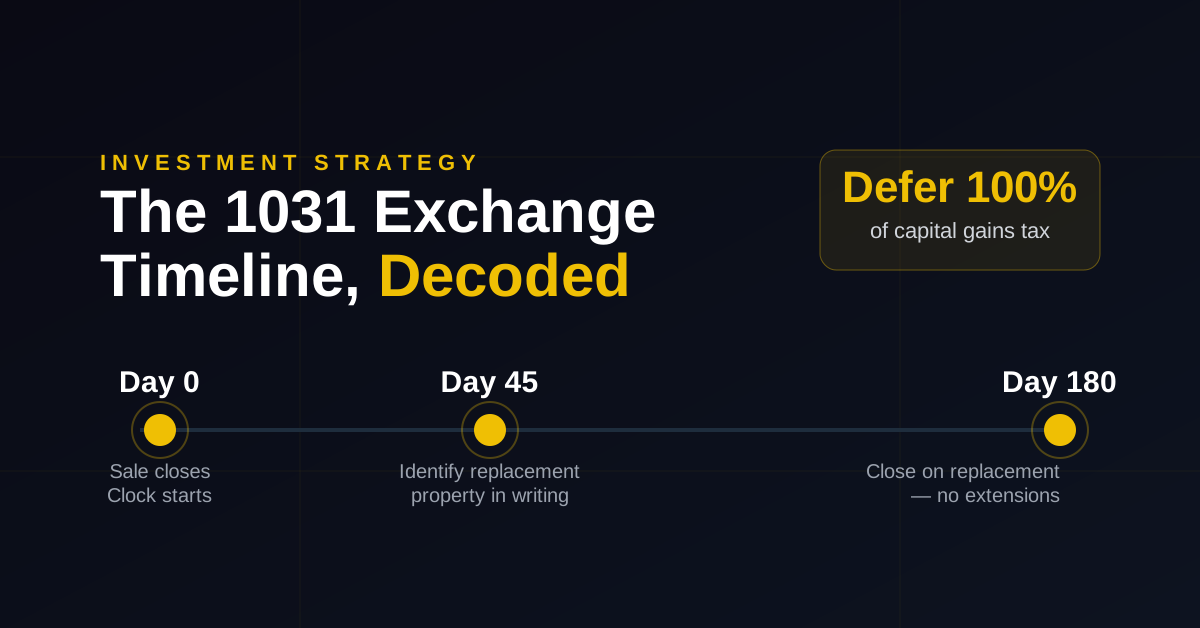
A 1031 exchange has two strict deadlines that begin the day you close on the sale of your relinquished (old) property. Missing either deadline disqualifies the entire exchange.
45-Day Identification Period
You have exactly 45 calendar days from the sale of your relinquished property to formally identify potential replacement properties in writing to your Qualified Intermediary. Most investors use the "3-Property Rule," which allows you to identify up to three properties regardless of value.
180-Day Closing Deadline
You must close on one or more of your identified replacement properties within 180 calendar days of selling your relinquished property. There are no extensions — not for holidays, weekends, or unforeseen circumstances.
These timelines run concurrently, meaning the 45-day identification window falls within the 180-day closing window. Planning ahead is essential — ideally, you should begin shopping for replacement properties before you even close on the sale.
Calculate your exact deadlines
Enter the date you sold (or plan to sell) your relinquished property and we'll map your 45-day and 180-day deadlines to real calendar dates.
Identification Period — Day 0 of 45
45 days
left to identify replacement properties in writing. Identification deadline: Tuesday, November 24, 2026
Identification Deadline
Tuesday, November 24, 2026
45 days
remaining
You must formally identify up to 3 potential replacement properties (or more under the 200% rule) in writing to your qualified intermediary by this date.
Closing Deadline
Thursday, April 8, 2027
180 days
remaining
You must close on one or more of your identified replacement properties by this date. Missing this deadline triggers full capital gains tax recognition.
Your Exchange Timeline
Today: Day 0 of 180Day 0
Oct 10
Day 45
Nov 24
Day 180
Apr 8
How your deadlines are calculated
Day 0 (sale closes): Oct 10, 2026
Day 0 + 45 calendar days → Nov 24, 2026 identification deadline
Day 0 + 180 calendar days → Apr 8, 2027 closing deadline
Both periods count every calendar day — weekends and holidays included — from the same Day 0, and run concurrently rather than back-to-back.
Milestone Checklist
0 of 5 completeChecklist state is for this session only — it isn't saved or sent anywhere.
3-Property Rule
You may identify up to 3 replacement properties regardless of value.
200% Rule
You may identify more than 3 if the combined FMV doesn't exceed 200% of the relinquished property's value.
95% Rule
You may identify any number of properties if you close on at least 95% of the combined value.
Critical Reminders
- • Both deadlines are calendar days, not business days. Weekends and holidays don't extend them.
- • You must engage a Qualified Intermediary (QI) before closing the relinquished property sale.
- • You cannot take constructive receipt of the sale proceeds at any point.
- • Your exchange must finish by the earlier of Day 180 or the due date of your tax return (with extensions) for the year of the sale — if Day 180 falls after your filing deadline, file an extension to use the full 180 days.
Deadline math only — this tool counts calendar days from the closing date you enter. It is not tax or legal advice; confirm your exact deadlines with your Qualified Intermediary and CPA before relying on them.
Key Rules and Requirements
- Like-Kind PropertyThe replacement property must be "like-kind," which in real estate is broadly defined. You can exchange an office building for a retail center, raw land for a warehouse, or an apartment complex for a NNN property.
- Qualified Intermediary (QI)You cannot touch the sale proceeds. A third-party QI must hold the funds between the sale and the purchase. If the money hits your account, the exchange is disqualified.
- Equal or Greater ValueTo defer 100% of taxes, the replacement property must be equal to or greater in value than the property sold, and you must reinvest all net proceeds.
- Investment Purpose OnlyBoth the relinquished and replacement properties must be held for investment or business use. You cannot 1031 exchange your primary residence or a property you intend to flip.
- Same TaxpayerThe same entity or individual that sells the relinquished property must acquire the replacement property. You can't sell from an LLC and buy in your personal name.
Why NNN Properties Are Ideal for 1031 Exchanges
NNN (triple net) properties are among the most popular replacement assets in 1031 exchanges, and for good reason. When you're under a 180-day clock, you need a property type that is straightforward to evaluate and close quickly. You can compare current cap rates by submarket to gauge whether an asking price leaves room for your target return.
Abundant Inventory
NNN properties from national tenants are consistently available across the market, giving you options within the 45-day window.
Simple Underwriting
Single-tenant NNN deals have straightforward financials — one tenant, one lease, predictable NOI. Less complexity means faster due diligence.
Passive Ownership
Many 1031 exchangers are looking to move from active management to passive income. NNN properties deliver exactly that.
Defined Pricing
NNN properties trade on cap rates with widely understood market comparables, making valuation and negotiation more efficient.
Common 1031 Exchange Mistakes
The benefits of a 1031 exchange are significant, but the process is unforgiving. Here are the most common pitfalls:
- •Starting the replacement property search too late — begin well before your sale closes
- •Failing to use a Qualified Intermediary from the start, or accidentally receiving sale proceeds
- •Missing the 45-day identification deadline, even by a single day
- •Trading down in value and triggering partial tax liability (known as "boot")
- •Confusing "like-kind" rules — personal residences and inventory properties do not qualify
- •Not consulting a CPA and real estate attorney before initiating the exchange
The Bottom Line
A 1031 exchange is one of the most tax-efficient strategies available to commercial real estate investors. When executed correctly, it allows you to grow your portfolio and compound returns without giving up a significant portion of your gains to taxes. The key is preparation: line up your Qualified Intermediary, start your replacement property search early, and work with a broker who understands the timeline pressure and can help you identify and close on the right property quickly.
Planning a 1031 Exchange?
MaxLife Commercial helps investors identify and close on NNN replacement properties within 1031 exchange timelines. Let us help you make the most of your tax-deferred dollars.
Contact Us