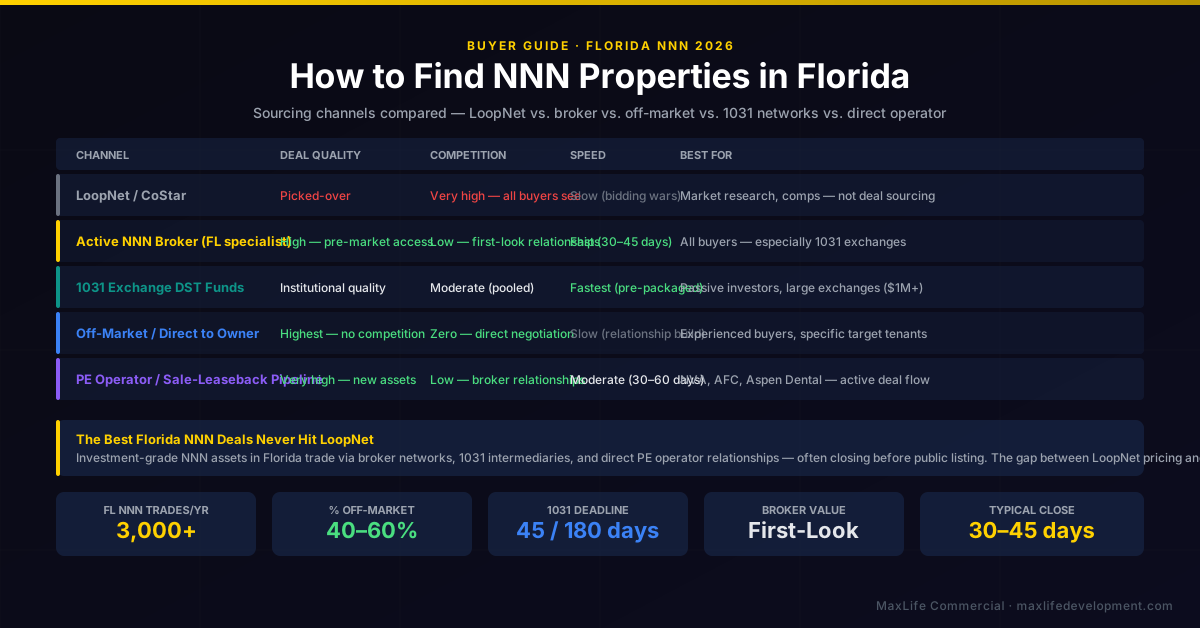
The Off-Market Gap
Florida processes 3,000+ NNN transactions per year. An estimated 40–60% of investment-grade assets trade before reaching LoopNet. The gap between off-market pricing and public-market pricing averages 25–75 basis points — which at a $5M purchase price represents $125,000–$375,000 in additional value captured by buyers with the right relationships.
Why do sellers avoid public listing? Sellers of premium assets — particularly PE-backed DSOs executing sale-leasebacks and institutional operators selling individual assets — prefer certainty and speed over maximum price exposure. A qualified 30-day close from a known buyer is worth more than a 90-day marketing process with uncertain outcome.
Sourcing Channel Comparison
LoopNet / CoStar
Active NNN Broker (FL specialist)
1031 Exchange DST Funds
Off-Market / Direct to Owner
PE Sale-Leaseback Pipeline
Channel Deep Dives
LoopNet / CoStar — Use for Research, Not Acquisition
LoopNet is the most-visited commercial real estate portal in the US — which is precisely the problem. Every 1031 buyer, institutional fund, and private equity shop sees the same inventory simultaneously, creating immediate bidding competition. Assets that reach LoopNet have already been passed on by first-look buyers, or they're priced aggressively to capture retail-buyer premiums.
LoopNet is invaluable for market research, cap rate comparables, and understanding what a finished deal should look like. It is not where you source acquisition targets if you want to buy at fair value.
Active NNN Broker — The Highest-ROI Channel
A Florida NNN specialist broker with active PE operator and DSO relationships sees deals before they hit any public market. These relationships are built over years — the broker who has closed 15 Aspen Dental deals gets the call when ADMI's real estate team has a new sale-leaseback. The broker who knows every Wawa site selector in South Florida gets first look at new Wawa groundbreaks before they're publicly marketed.
For buyers, the investment is relationship-building: work with one Florida NNN specialist, show up as a credible buyer (proof of funds, clear criteria, decision authority), and close your first deal quickly. Speed and certainty buy access to the next deal.
1031 Exchange DST Funds — For Large or Time-Pressed Exchanges
Delaware Statutory Trust (DST) structures pool multiple investors into pre-assembled NNN portfolios. They close almost immediately (the property is already acquired) and can be identified within days of a 1031 trigger. For buyers with $1M+ in exchange proceeds who cannot find a single-tenant NNN in 45 days, DSTs are the safety valve.
The tradeoff: DST investors have no control over asset management, exit timing, or refinancing. You are a fractional passive interest holder. Use DSTs for the proceeds that exceed your direct acquisition capacity — not as a primary strategy.
Off-Market Direct — Highest Yield, Longest Lead Time
Buying directly from owners who have not engaged a broker requires proactive outreach. Target owners of specific assets (specific tenant, specific market) and approach them directly — by letter, through title records, or via professional networks. Expect 6–18 months of relationship building before a transaction materializes. The yield premium (often 50–100 bps over marketed deals) rewards the patience.
PE Sale-Leaseback Pipeline — The Institutional Edge
PE-backed operators (NVA veterinary, AFC Urgent Care, Aspen Dental, Heartland Dental) execute sale-leasebacks continuously to recycle capital. These deals hit qualified buyers through broker relationships — typically 30–60 days from introduction to close. The assets are new, the leases are fresh, and the cap rates are competitive (not giveaway-priced, but fairly valued given the deal structure). This is the most consistent deal flow available for specialty NNN buyers in Florida.
Free Consultation
Looking for a Florida CRE Property?
MaxLife Commercial brokers NNN, industrial, retail, and multifamily deals across Central Florida. Tell us your criteria and we'll match you with qualified properties.
Contact Us →Building Your Florida NNN Acquisition Criteria
Before approaching any sourcing channel, define your criteria with precision. Brokers route deals to buyers who have demonstrated clear, consistent criteria — vague buyers get vague deal flow.
1031 Exchange Timing — The Florida NNN Solution
The 1031 exchange creates a ticking clock: 45 days to identify replacement properties, 180 days to close. Florida NNN is one of the most 1031-friendly categories in commercial real estate because:
- •Active broker networks can identify qualifying properties within days of a sale
- •PE sale-leaseback pipelines close in 30–45 days — well within the 180-day window
- •Florida's 3,000+/year transaction volume means qualifying properties are always available
- •DST funds are available as backup identification options for buyers who cannot close a direct NNN
1031 Buyer Priority Signal
Telling a Florida NNN broker you have an active 1031 exchange creates urgency that accelerates deal access. Brokers know 1031 buyers close — they have to. This urgency translates to priority routing of available inventory.
Frequently Asked Questions
How long does it take to find an NNN property in Florida?
With an active NNN broker relationship and clear acquisition criteria, most buyers identify a qualified deal within 30–90 days. 1031 exchange buyers with the clock running often close within 45–60 days of engaging a broker. First-time buyers without established broker relationships typically take 3–6 months for their first deal.
Do I need a buyer's broker for NNN investing in Florida?
An active NNN-specialist broker dramatically accelerates deal access and provides market intelligence that prevents overpaying. The cost is zero to the buyer in most transactions — NNN broker commissions are paid by the seller. The asymmetry (free access to pre-market deal flow) makes it one of the highest-ROI decisions in NNN investing.
What is the minimum equity needed to buy an NNN property in Florida?
Most Florida NNN lenders require 25–35% equity (65–75% LTV). At the lower end of the market ($1.5M–$2M dental or urgent care NNN), buyers need $375K–$700K in equity. The $2M–$8M pad site range requires $500K–$2.8M in equity. 1031 proceeds from a residential property sale can often fund the equity component.
Related Articles
- Specialty NNNDental Office NNN Properties Florida
- Retail NNNRetail Pad Site Investing in Florida
- Senior HousingAssisted Living NNN Properties Florida
- Strategy GuideSale-Leaseback Real Estate Florida