Data Centers: Community Impact & Permitting Guide
A hyperscale data center campus draws more electricity than 80,000 homes, transforms local tax rolls, and reshapes the industrial real estate market within a 10-mile radius. Here is what development actually does to a community — and the full permitting road map from site selection through certificate of occupancy.
Why Data Centers Are the Decade's Defining Industrial Asset
Global data center capacity is doubling roughly every four years. Generative AI, cloud computing, streaming infrastructure, and autonomous systems have created a demand floor that is structurally higher than anything the industry has seen before. Amazon Web Services, Microsoft Azure, Google Cloud, and Meta collectively announced over $200 billion in global data center investment in 2024 and 2025 combined — a number that dwarfs the entire US industrial REIT market by square footage.
Florida has emerged as a top-five data center destination. The reasons are specific: a deregulated energy market with competitive utility rates (FPL and Duke Energy), no state corporate income tax, a fiber backbone running along the I-4 corridor and into Miami as a global landing hub, relative land availability compared to Northern Virginia (the world's largest data center market, which is running out of power allocation), and geographic redundancy from the East Coast clusters.
For CRE investors and the communities where these campuses land, the story is two-sided. The economic benefits are real and substantial. So are the demands placed on local infrastructure. Understanding both is how you underwrite the opportunity — and the risk.
Where to Build: Florida's Data Center Geography
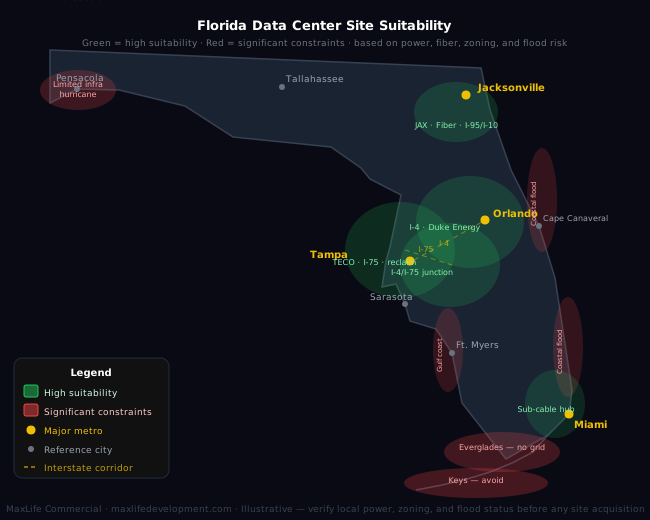
Not all of Florida is equal for data center development. The map below shows five high-suitability corridors (green) and the zones investors and developers should avoid (red) based on power grid capacity, fiber availability, zoning, flood risk, and hurricane exposure.
Jacksonville / Duval County
✓ High SuitabilityI-95 / I-10 corridor, strong FPL and JEA grid infrastructure, large industrial land inventory at lower cost than Central FL, growing fiber density, no state income tax and favorable impact fee environment for large capital projects.
Orange / Osceola — I-4 Corridor (Orlando)
✓ High SuitabilityThe I-4 fiber backbone is one of the densest in the Southeast. Duke Energy serves the corridor with multiple substations and has publicly committed to hyperscale data center interconnection capacity. Proximity to UCF talent pool and 3M+ metro labor market. Demand from theme park and hospitality tech operators adds local market depth.
Polk County — I-4 / I-75 Junction
✓ High SuitabilityLand costs 30–50% below Orange County. Sits at the convergence of I-4 (fiber) and I-75 (logistics). Duke Energy has available substation capacity in several Polk industrial parks. Reclaimed water available through Toho Water and county systems — an advantage for cooling-water permitting.
Hillsborough / Pasco — Tampa Metro
✓ High SuitabilityTECO (Tampa Electric) and Duke Energy both serve this corridor. Pasco County offers lower land cost than Hillsborough with I-75 access. The Wiregrass/Wesley Chapel industrial zone has attracted several tech users. Tampa International Airport proximity aids mission-critical site access for remote hands teams.
Miami-Dade / Broward
✓ Conditional SuitabilityThe NAP of the Americas in Miami is one of the largest carrier-neutral colocation hubs in the Western Hemisphere and the landing point for dozens of submarine cables connecting Latin America, Europe, and Africa. Data centers here benefit from unmatched international connectivity. Caveats: FPL power is more constrained than Central FL, land costs are significantly higher, and coastal flood risk in low-lying areas is real — sites must be selected carefully above FEMA base flood elevation.
Atlantic / Gulf Coastal Strips, Keys, Everglades
✗ AvoidFEMA Special Flood Hazard Areas (Zones AE, VE) make financing difficult and operating insurance extremely expensive. The Florida Keys have no mainland grid connection — FPL serves the Keys via a single transmission line that is the first casualty of any major hurricane. The Everglades protection zone has no power or fiber infrastructure and is subject to strict state and federal environmental regulation.
Economic Effects on Host Communities
A hyperscale campus — 500,000 to 1 million square feet on 50 to 100 acres — is one of the most significant economic events a mid-size Florida county can experience. The economic impact comes in three tranches: construction, operations, and tax base.
Construction Phase
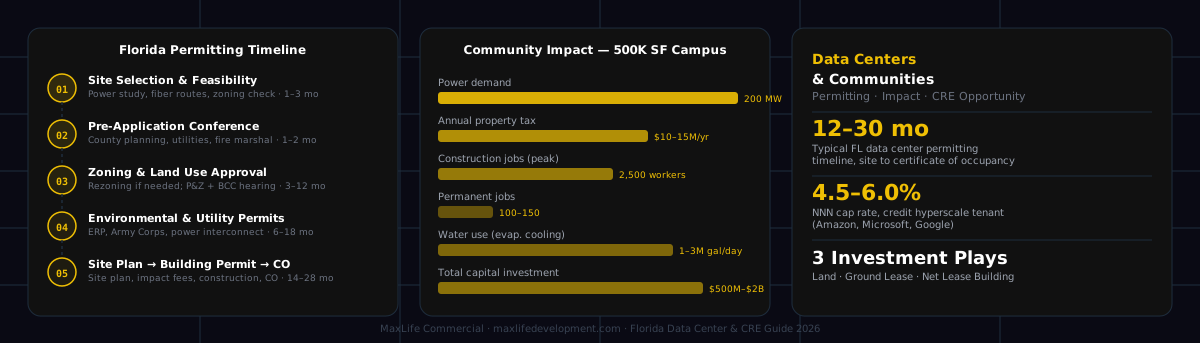
A 500,000 SF campus typically takes 18–36 months to build and employs 1,500–4,000 construction workers at peak. Subcontractors span electrical (the dominant trade), mechanical, structural, civil, fire suppression, and low-voltage. Total construction spend on a large hyperscale campus runs $500M–$2B. Most of that stays in the regional economy through labor, materials procurement, and local subcontractor contracts.
Permanent Employment
This is where communities are often surprised. Data centers are automated buildings. A fully operational 500,000 SF hyperscale facility may employ only 50–200 full-time workers — technicians, security, facility managers, and site reliability engineers. The jobs are high-quality ($70K–$120K+ annual pay) and typically offer strong benefits, but the job count looks small next to the acreage. The bigger employment story is indirect: fiber ISPs, security firms, equipment manufacturers, HVAC service contractors, and utility workforce expansions.
Property Tax and Local Revenue
This is the headline number that drives local government support. A $500M data center campus assessed at full construction value generates $5M–$15M in annual property tax depending on the county millage rate. Some Florida counties have negotiated economic development agreements (EDAs) that phase in assessment or provide partial ad valorem exemptions in exchange for capital investment commitments — but even at 50% of full assessment, the tax contribution per acre is orders of magnitude above typical industrial.
Infrastructure Demands: Power, Water, and Fiber
The community effects that generate the most friction are not the economic ones — they are the infrastructure demands. A large campus places extraordinary burdens on three systems:
A 100 MW data center draws as much electricity as 80,000 average Florida homes. Hyperscale campuses at 300–500 MW require new dedicated substations and, in some cases, new transmission lines from the regional grid. Florida Power & Light and Duke Energy have both committed to multi-gigawatt data center interconnection programs, but the permitting and construction of new transmission infrastructure adds 18–36 months to the effective development timeline in many markets. Data centers that can connect to existing industrial substations with available capacity move fastest.
Evaporative cooling towers — the dominant cooling technology for large data centers — consume millions of gallons of water per day. A 100 MW facility using evaporative cooling can use 1–3 million gallons per day at peak summer load. This is a genuine concern in water-constrained markets. Major hyperscalers (Google, Microsoft, Amazon) have adopted water stewardship commitments — including water-neutral or water-positive pledges — and are increasingly deploying closed-loop liquid cooling and air-side economizers that reduce water consumption by 60–90%. These technologies are a major negotiating point with water management districts and local utilities.
Data centers need diverse, redundant fiber routes — typically 2+ carriers entering from different physical directions. In Florida, proximity to the Miami submarine cable landing station (which connects to Latin America, Europe, and West Africa) is a meaningful differentiator. The I-4 corridor from Osceola County to Polk County has emerged as a secondary data center market partly because of the fiber infrastructure running parallel to the highway. Hyperscalers often negotiate with fiber providers to extend dark fiber to a site as part of the development deal.
Why AI Is Different: Power Density by Workload
The current data center construction wave is not just bigger than prior cycles — it is fundamentally different in the infrastructure it requires. The shift from traditional cloud to AI/GPU workloads has blown up the power density assumptions that most data center buildings were designed around. This is why older facilities can be stranded, and why new builds command a significant premium.
A rack drawing 100 kW generates roughly 340,000 BTU/hour — more heat than a medium-sized home produces in a day. Air cooling becomes physically impossible at these densities. Buildings designed before the AI wave (pre-2022) with air-cooled infrastructure often cannot be retrofit to support GPU clusters economically, which is why hyperscalers are building brand-new purpose-built AI campuses rather than repurposing existing capacity. For investors, this means the 15–20 year useful life assumption for a data center building must be underwritten against the specific power density and cooling technology of the facility — not just its vintage.
Cooling Technology Comparison
Cooling is the single biggest variable in a data center's water consumption, energy efficiency, and suitability for AI workloads. Here is how the main technologies compare — which matters both for community water permitting and for investor underwriting of technology obsolescence risk.
| Technology | PUE | Water Use | AI Density | Capital Cost |
|---|---|---|---|---|
| Air cooling | 1.5–2.0 | Very low | Low (≤10 kW/rack) | Low |
| Evaporative / cooling tower | 1.2–1.5 | High (1–3M gal/day) | Moderate (≤30 kW) | Moderate |
| Rear-door heat exchanger | 1.1–1.3 | Low–moderate | High (≤60 kW) | Moderate |
| Direct liquid (cold plate) | 1.05–1.2 | Low | Very high (≤150 kW) | High |
| Immersion cooling | 1.02–1.1 | Minimal | Exceptional (200+ kW) | Very high |
PUE (Power Usage Effectiveness) = total facility power ÷ IT equipment power. Lower is better; 1.0 is theoretical perfection.
Environmental and Community Relations
Data centers are typically welcomed by local governments but encounter organized opposition from two directions: residents near the proposed site and environmental advocates. Understanding the concerns — and how developers and hyperscalers address them — is important context for both investors and the communities considering a project.
Noise. Cooling towers and backup diesel generators are the dominant noise sources. A large campus running its emergency generators during a utility outage creates industrial-level sound events. Modern campuses include acoustic baffling, setback requirements in site plans, and landscaped berms. Most Florida counties require noise studies as part of the site plan approval process and set operational decibel limits at the property line.
Visual impact. Hyperscale buildings are large, uniform, and utilitarian. They are not inherently attractive. Counties typically require landscape buffers along public roads, architectural treatments on visible elevations, and lighting plans that minimize sky glow. The buildings are designed for security and efficiency, not aesthetics — this is a recurring point of negotiation in site plan review.
Carbon and energy sourcing. Hyperscalers are the world's largest corporate buyers of renewable energy. Amazon, Google, and Microsoft collectively account for a significant portion of all US renewable energy power purchase agreements (PPAs). These commitments do not eliminate fossil fuel generation on the local grid, but they do drive additional renewable capacity into markets where the data centers operate. Florida's solar buildout has been accelerated partially by hyperscale PPA demand.
Water stewardship. The St. Johns River Water Management District (SJRWMD) and South Florida Water Management District (SFWMD) require consumptive use permits for large water withdrawals. Data center developers must demonstrate water efficiency, recycling, and — increasingly — a water budget that meets local availability criteria. Projects using reclaimed water for cooling (rather than potable water) move through water permitting substantially faster.
The Permitting Process: Step by Step
Florida data center development follows a defined sequence. The timeline varies significantly based on whether the site is already zoned for data center use or requires a comprehensive plan amendment. Here is the road map from site selection through certificate of occupancy.
Site Selection and Feasibility
1–3 monthsBefore any permit application, hyperscalers run a power feasibility study with the local utility (FPL, Duke, TECO) to confirm available substation capacity and the cost of a new substation if needed. Sites with existing industrial zoning and confirmed power capacity are worth a 20–30% premium. Water availability (from municipal water systems or an approved well), fiber routes, and proximity to employees (usually within 30 miles of a major metro) complete the feasibility checklist.
Pre-Application Conference
1–2 monthsMost Florida counties require or strongly recommend a pre-application conference before submitting formal land use or site plan applications. This meeting introduces the project team to county planning, zoning, engineering, utilities, and fire marshal staff. The county identifies required permits, fee schedules, concurrency thresholds (road and school capacity), and any known obstacles — such as wetlands, flood zone status, or proximity to military airspace. Discovering a fatal constraint at this stage is far cheaper than after site acquisition.
Land Use and Zoning Approval
3–12 monthsData centers are often classified under "light industrial," "high-tech industrial," or a dedicated "data center" use category depending on the county. If the parcel is already zoned correctly, this step may require only an administrative determination or minor zoning variance. If rezoning is required, the process includes a Planning Commission hearing and a Board of County Commissioners vote — a public process that invites community input and potential opposition. Comprehensive plan amendments (CPAs) required for land use category changes add a state-level review by the Florida Department of Commerce, adding 3–6 months.
Environmental Review and Permits
3–9 monthsFlorida data center sites in or near wetlands require an Environmental Resource Permit (ERP) from the applicable water management district (SJRWMD, SFWMD, SWFWMD). Federal wetland impacts require a Section 404 permit from the Army Corps of Engineers. Sites near listed species habitat require coordination with the Florida Fish and Wildlife Conservation Commission. A Phase I Environmental Site Assessment (and Phase II if contamination is indicated) is required for due diligence and often for lender financing. Stormwater management — required by the ERP — must demonstrate that post-development runoff does not exceed pre-development conditions.
Utility Commitments and Interconnection Agreements
6–18 months (parallel to other steps)Utility interconnection is often the longest pole in the tent. A new dedicated substation — required for most hyperscale campuses — requires the utility to engineer, procure equipment, and construct the facility. Transformer lead times alone have extended to 18–36 months due to global supply chain constraints. Power purchase agreements for renewable energy (solar or wind) are negotiated in parallel. Water and reclaimed water service agreements with the local utility district run concurrently. Securing utility commitment letters early is a prerequisite for lender financing and is often a condition of the county's development agreement.
Site Plan Approval
3–6 monthsThe site plan package includes civil engineering (grading, drainage, utilities), architectural (building footprint, elevations, setbacks), landscape, lighting, and traffic impact analysis. Large data centers typically trigger a Development of Regional Impact (DRI) review if they exceed certain thresholds — generally 250,000 SF of industrial use or 5,000+ daily vehicle trips, though actual thresholds vary by county. A traffic impact study is required and may trigger road improvement obligations or proportionate-fair-share payments to the county. Site plan approval is typically a staff-level or DRC (Development Review Committee) decision, not a public hearing — though some counties require a Planning Commission hearing for large projects.
Building Permit Issuance
2–6 monthsBuilding permits are pulled after site plan approval and cover structural, mechanical, electrical, plumbing, and fire protection systems. Data center electrical systems are extraordinarily complex — redundant power paths, UPS systems, backup generators, and switchgear for a large campus can involve tens of millions of dollars of electrical work. Florida requires licensed electrical contractors and licensed mechanical contractors throughout. Impact fees are collected at permit issuance: transportation, school, parks, and fire/EMS impact fees apply. Some counties have negotiated economic development agreements that phase or cap impact fees for qualifying data center investments.
Construction and Inspections
12–24 monthsConstruction inspection frequency for data centers is higher than typical commercial. Structural inspections, electrical rough-in, plumbing rough-in, insulation, and fire suppression are all inspected at multiple stages. Florida requires a Threshold Building Inspector (a licensed structural engineer) for buildings exceeding certain height and occupancy thresholds. Data centers typically qualify as threshold buildings. The TBI must observe all structural pour events and provide certification prior to CO.
Certificate of Occupancy
Final milestoneThe Certificate of Occupancy (CO) requires final inspection sign-offs from all trades, fire marshal, building department, and ADA compliance certification. For data centers, the CO is often issued in phases — shell and core CO first, then individual suites as fit-out completes. Operations can begin on any CO'd portion while other sections remain under construction. The utility must have completed substation and interconnection work before the CO is granted for the building's main electrical service.
Florida Data Center Sales Tax Exemption
Florida Statute §212.08(5)(j) provides a sales and use tax exemption on data center equipment purchases — servers, storage, networking hardware, UPS systems, and cooling equipment — for qualifying facilities. To qualify, a data center must meet minimum capital investment thresholds (generally $150M+ in real and personal property) and job creation requirements set by the Florida Department of Commerce.
On a $500M campus, equipment subject to Florida's 6% base sales tax rate could represent $200M+ in taxable purchases. The exemption eliminates $12M+ in sales tax liability — a meaningful line item that hyperscalers explicitly model in Florida vs. other state comparisons. Florida has used this exemption aggressively to compete with Virginia, Georgia, and Texas for large data center projects.
Practical note:The exemption requires pre-certification from the Florida Department of Commerce before equipment purchases are made. Retroactive claims are not permitted. Developers should engage with Enterprise Florida (the state's economic development arm) early in the site selection process to lock in exemption eligibility.
The CRE Investment Opportunity
For commercial real estate investors, data centers create three distinct plays. Each fits a different risk appetite and capital horizon.
Adjacent Industrial Land
Value-playWhen a hyperscale campus is announced, industrial land within a 5-mile radius reprices. Power infrastructure, fiber conduit, truck staging facilities, and supplemental data center services follow the campus. Buying raw or light industrial land before the campus is publicly announced — or immediately after, while the market reprices — is the highest-leverage play. Exit is to a data center developer or an industrial developer serving the campus supply chain.
Ground Lease Under the Campus
Income playHyperscalers often prefer to lease land rather than own it — it keeps capital off their balance sheet and allows flexibility for future facility upgrades. Ground lease terms of 30–50 years with annual escalations of 2–3% provide bond-like income with real estate upside at reversion. Ground leases under hyperscale campuses are rare assets and trade at correspondingly thin cap rates (3.5–5.0%).
Net Lease Data Center Building
4.5–6.0% capThe data center building itself as a net lease investment — single-tenant, triple-net, 10–25 year primary term — with a credit tenant (Amazon, Google, Microsoft, Equinix, Digital Realty). These assets trade like investment-grade bonds. The specialized infrastructure (raised floors or direct liquid cooling, generator capacity, fiber diversity, power redundancy) creates high replacement cost and high switching cost for the tenant. In practice, hyperscalers stay in purpose-built facilities indefinitely.
Sale-Leaseback of Existing Facilities
InstitutionalCompanies that built their own data center facilities — banks, insurance companies, telecoms, and large enterprise tech firms — are increasingly viewing those assets as operationally critical but non-core to their balance sheets. A sale-leaseback converts the owned building into capital while the company retains occupancy under a long-term NNN lease. For the investor, you acquire a purpose-built critical infrastructure asset with a motivated tenant who designed the building to their own specifications — making them extremely sticky. Florida's growing tech and financial sector creates a pipeline of potential SLB candidates that most CRE brokers are not actively covering.
For most private investors, the adjacent industrial land play is the most accessible. Ground leases and net lease data center acquisitions are institutional-scale transactions that require either deep pockets or a fund structure. The land play can be executed with much smaller capital and generates outsized returns when the surrounding market reprices.
Cap Rate Comparison: Data Centers vs. Other NNN Assets
Where do data centers fit in the NNN investment universe? The table below puts data center cap rates in context against the major NNN asset classes. Hyperscale tenants offer credit quality comparable to investment-grade pharmacy chains — at meaningfully lower cap rates, reflecting the high replacement cost and near-zero tenant switching probability.
| Asset Type | Tenant Credit | Typical Cap Rate | Lease Term |
|---|---|---|---|
| Ground Lease (hyperscale) | AAA equivalent | 3.5–5.0% | 30–50 yr |
| Data Center NNN (hyperscale) | Investment grade | 4.5–6.0% | 10–25 yr |
| QSR (McDonald's / Starbucks) | Investment grade | 4.5–5.5% | 10–20 yr |
| Pharmacy (Walgreens / CVS) | Investment grade | 5.0–6.5% | 10–25 yr |
| Data Center NNN (colo/enterprise) | Varies | 5.5–7.5% | 5–15 yr |
| Auto Parts (AutoZone / O'Reilly) | Investment grade | 5.5–6.5% | 10–15 yr |
| Industrial NNN (single-tenant) | Varies | 5.0–7.0% | 5–15 yr |
| Dollar Store (Dollar General) | Investment grade | 6.0–7.5% | 10–15 yr |
Cap rates are approximate 2025–2026 market ranges. Ground lease and hyperscale NNN rates reflect stabilized, credit-tenant, primary-market assets. Actual rates vary by location, lease term, escalation structure, and market conditions.
Site Selection Checklist
Whether you are representing a developer, underwriting adjacent land, or advising an enterprise tenant, here are the items that experienced data center site selectors verify before signing a purchase contract:
Risks and Headwinds
- Power grid constraints. Utilities in Florida (particularly FPL in South Florida and Duke in the Tampa Bay corridor) are managing unprecedented data center interconnection queues. Projects that cannot secure a firm capacity commitment within 12 months of site acquisition face meaningful development risk.
- Transformer supply chains. Large power transformers — required for both the campus and any new substation — have lead times of 18–36 months due to global manufacturing capacity constraints. This is the single biggest construction timeline risk for data center projects today.
- Community opposition and rezoning risk. Greenfield sites in residential-adjacent locations routinely face organized opposition. A single Board of County Commissioners member can slow or kill a rezoning application. Selecting sites with existing industrial zoning and utility infrastructure eliminates most of this risk.
- Tenant concentration. A single-tenant net lease data center is only as good as the tenant. Hyperscaler credit (Amazon, Microsoft, Google) is as strong as corporate credit gets. Smaller colocation tenants or enterprise users are a different risk profile entirely.
- Technology obsolescence. Data center infrastructure has a 15–20 year useful life before power density and cooling technology requirements diverge from the building's design. AI workloads in particular require substantially higher power density per rack than legacy cloud infrastructure — older buildings can be stranded if they cannot economically upgrade.
- Hurricane and insurance. Florida data centers are designed to wind and storm codes that exceed standard commercial construction (ASCE 7-22 Risk Category IV for critical facilities). Backup generators carry 72-hour fuel capacity minimums. Insurance premiums have risen significantly since 2022 — this is a real operating cost that must be underwritten, not assumed away.
Bottom Line for Communities and Investors
Data centers are the defining industrial asset class of the current decade. For host communities, the deal is real: massive tax base expansion, high-paying jobs, and infrastructure improvements — in exchange for power demand that reshapes utility planning and water usage that requires careful management. The permitting process in Florida rewards preparation: sites with industrial zoning, available utility capacity, and a pre-application consultation record move 12–18 months faster than greenfield rezonings. For investors, the best risk-adjusted entry point remains adjacent industrial land acquired before the surrounding market reprices — patient capital that understands the 18–36 month development cycle gets paid for it.
Frequently Asked Questions
How much power does a large data center use?
A hyperscale campus typically draws 100–500 megawatts. A 100 MW facility uses roughly as much electricity as 80,000 average Florida homes. Major campus deployments require dedicated substations and, in some markets, new transmission infrastructure.
How many permanent jobs does a data center create?
Typically 50–200 full-time positions per large hyperscale facility — fewer than most industrial developments of comparable size, but paying $70K–$120K+ per year. Construction phases create 1,500–4,000 temporary jobs. The bigger employment multiplier is indirect: fiber, security, HVAC, and utility workforce.
How long does data center permitting take in Florida?
12–30 months from site acquisition through CO for most Florida projects. Sites with existing industrial zoning and confirmed utility capacity run 12–18 months. Greenfield sites requiring comprehensive plan amendments can stretch to 24–36 months.
What is the CRE investment opportunity near data centers?
Three plays: adjacent industrial land (buy before the market reprices), ground lease under the campus (long-term income), and the net lease building itself with a credit hyperscale tenant at 4.5–6.0% cap rates. Adjacent industrial land is the most accessible for private investors.
Do communities support or oppose data centers?
Local governments almost universally welcome data centers for tax revenue and construction employment. Resident opposition near proposed sites focuses on noise, visual impact, water use, and power demand. Environmental groups focus on water consumption and carbon. Hyperscalers have adopted water-neutral and 100% renewable energy commitments to address these concerns.
Evaluating Industrial Land Near a Data Center Campus?
Ryan Solberg is a Florida-licensed CRE broker covering Central Florida industrial and net lease. Get a real underwrite on any industrial acquisition or land play in the I-4 corridor and surrounding markets.
Related Articles
Central Florida Industrial Market Report 2026
Vacancy, absorption, and rent trends across the I-4 corridor industrial corridor heading into 2026.
Florida Industrial Real Estate Investing Guide
The complete investor guide to Florida industrial — cap rates, market selection, and underwriting.
I-4 Corridor Commercial Real Estate
The 130-mile economic spine of Florida — what investors need to know about the I-4 commercial market.
Build-to-Suit vs. Existing Commercial
When does it make sense to build versus buy in Central Florida? A developer and investor framework.
Get Off-Market CRE Deals in Your Inbox
Join our investor list for exclusive Central Florida opportunities, market reports, and deal analysis — delivered weekly. No spam, unsubscribe anytime.