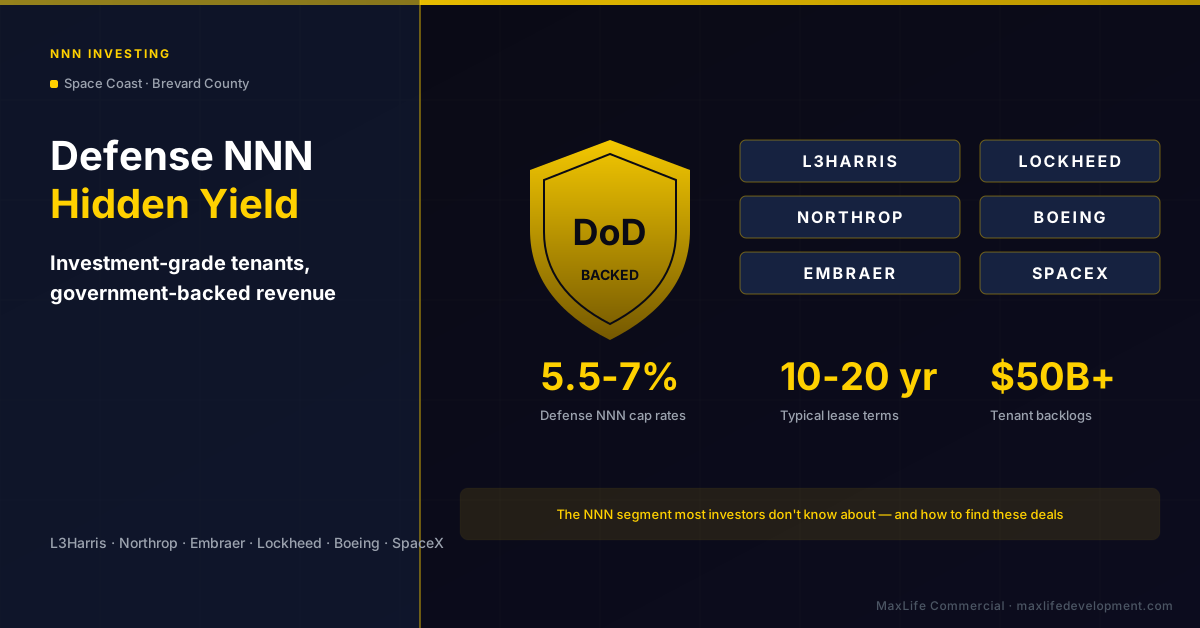
Space Coast NNN — Why Defense Contractors Are Elite Tenants
Most NNN investors chase Walgreens, Dollar General, fast food. The Space Coast offers something almost nobody talks about — defense contractor NNN leases backed by multi-year government program backlog. Here's how the segment works, what it pays, and how to actually find these deals.
What Makes a "Defense NNN" Different
On paper, a Walgreens NNN and a Northrop Grumman NNN look the same — single-tenant, long lease, tenant covers taxes / insurance / maintenance, landlord clips a coupon. In practice, they are different asset classes.
The differences come from three places:
- Credit source. Walgreens is repaying its lease out of retail sales and pharmacy reimbursements. A defense contractor is repaying its lease out of multi-year DoD program backlog. When you buy a Northrop NNN in Melbourne, you are functionally buying federal-contract credit.
- Lease length and predictability. Retail NNN typically 10-15 years. Defense contractor NNN often 15-25 years, frequently with renewal options that track program timelines. The renewals are far stickier than retail.
- Building specialization. Walgreens occupies a generic 13,000 SF box. A Northrop facility might be a clean-room assembly building with specialized power, HVAC, and security. That cuts both ways — harder to re-tenant if the contract leaves, but it also dramatically reduces the probability that the tenant ever leaves.
The result: a NNN asset class with credit characteristics that compete with the strongest retail credit tenants, lease terms that are typically longer, and a yield premium driven by market depth rather than tenant risk.
The Brevard Defense Tenant Roster
L3Harris Technologies
Headquartered in Melbourne. ~7,000 employees in Brevard County. Investment-grade rated (BBB+). Operates 12+ buildings across Melbourne and Palm Bay. The dominant aerospace and defense tenant in the county.
Northrop Grumman
Operations in Melbourne and KSC/Cape Canaveral area. Investment-grade. Multiple specialized aerospace facilities. Strong build-to-suit appetite.
Embraer Executive Jets
Major MRO and assembly facility at MLB airport. Brazilian aerospace OEM, publicly traded. Less obvious as a 'defense' tenant, but a significant industrial real estate user.
Lockheed Martin
Presence around Cape Canaveral and Titusville for legacy and Atlas / Vulcan support. Investment-grade. Government contract revenue.
Boeing
Commercial Crew (Starliner), CST-100, and other space-program facilities at and near KSC. Investment-grade. Long-tail government program revenue.
Aerojet Rocketdyne (L3Harris subsidiary)
Propulsion and engine work. Specialized facilities. Generally bundled into L3Harris credit since the 2023 acquisition.
SpaceX
Private company — no public credit rating, but the cash position and government contract backlog make it among the strongest non-rated credits in the industry. Operates significant footprint across Brevard.
Tier-2 suppliers (Moog, RUAG, Aerion, others)
Smaller specialized aerospace suppliers. Less credit, smaller footprints, but very long sticky leases tied to prime contractor programs. Higher cap rates available.
Tenant Credit Quality
The major Space Coast defense tenants carry credit ratings that compare favorably with the best retail NNN tenants. L3Harris is BBB+ from S&P. Northrop Grumman is BBB+. Lockheed Martin is A-. Boeing has had rating volatility but remains investment-grade. These are not Subway franchisees — these are companies with $50B+ in contract backlog, federal-government customers, and multi-decade defense programs.
For comparison, here is how the defense roster lines up with common retail NNN credit:
| Tenant | Credit (S&P) | Type |
|---|---|---|
| Lockheed Martin | A- | Defense prime |
| L3Harris | BBB+ | Defense prime |
| Northrop Grumman | BBB+ | Defense prime |
| Walgreens | BB- | Retail pharmacy |
| CVS | BBB | Retail pharmacy |
| Dollar General | BBB | Retail value |
The point: defense primes carry better credit than the most popular retail NNN tenants on the market today. Yet defense NNN caps run 50-150 basis points wider than the equivalent retail tenant. That spread exists because the segment is smaller, less liquid, and harder to find.
Lease Structure
Typical structural features of a Space Coast defense contractor NNN lease:
- Term: 10-20 years base, with multiple 5-year renewal options. Build-to-suit deals often go 15-25 years.
- Escalations: Typically 2-3% annual fixed, or CPI with a floor/cap. Investment-grade tenants push back on CPI-only structures.
- Lease type: Full triple net (taxes, insurance, maintenance to tenant) is the norm. Bondable absolute NNN is common on build-to-suit.
- Build-to-suit common: Many defense facilities are built to tenant specs — clean rooms, specialized power, security, RF-shielded space — with the landlord financing TI in exchange for higher base rent and term.
- ROFR / ROFO clauses: Defense tenants frequently negotiate rights of first refusal or first offer on a sale, which can constrain exit but signals a long-term tenant commitment.
- Subordination and assignment: Standard SNDA. Assignment / subletting typically permitted to affiliates without consent. Watch for change-of-control language tied to government contract performance.
How to Find These Deals
Defense contractor NNN deals rarely show up on LoopNet or Crexi. Most transactions are off-market and relationship-driven. The practical sourcing channels:
- Local Florida CRE brokers with active aerospace contractor relationships. The number of brokers genuinely active in this segment in Brevard County is small — a dozen or so.
- Tenant rep brokers who represent L3Harris, Northrop, or Embraer. They know which facilities are coming off lease, where build-to-suit demand is going, and which existing owners are sellers.
- 1031 exchange networks. Sellers of defense NNN often need replacement product — introducing a 1031 buyer with replacement inventory is a common deal-creation mechanism.
- Sale-leaseback initiatives. L3Harris has divested non-core real estate in the past. When tier-2 suppliers consolidate, sale-leasebacks are a common path. Watching corporate real estate divestiture announcements is a useful signal.
- Florida Space Coast contacts. Industry events, EDC meetings, and aerospace supplier conventions are where these deals get sourced — long before they hit a market listing.
Cap Rates Today
Risks to Underwrite
- Single-tenant concentration. One tenant, one credit. If the contract leaves or the program gets cancelled, you have an empty specialized facility. Build in a stress-test for "dark value" — what would this building sell for empty, on a per-square-foot basis?
- Customization risk. Specialized buildings — clean rooms, RF-shielded space, high power loads — cost more to convert. Generic flex is easier to re-tenant.
- Defense budget cycles. Government program funding has annual appropriation risk and multi-year program risk. Diversified-program tenants (L3Harris, Lockheed) are more resilient than single-program tenants.
- Geopolitical exposure. Increased global tension generally helps defense backlog; de-escalation can pressure it. The portfolio is correlated to policy.
- Insurance and capex. Specialized buildings can be costly to insure and have non-standard capital costs (e.g., specialized HVAC replacements).
Tax Advantages
Defense contractor NNN deals frequently include meaningful build-out and tenant-improvement allowance that can be cost-segregated. Specialized facilities tend to have higher 5/7/15-year property ratios than generic retail, which means greater accelerated depreciation benefits — particularly meaningful given 2026 bonus depreciation rules.
Florida's zero state income tax compounds the after-tax advantage for out-of-state investors using Florida NNN to absorb gains from higher-tax-state portfolios. Defense contractor NNN is one of the most attractive 1031 replacement vehicles for a high-net-worth investor looking to combine credit quality, long term, and accelerated depreciation.
Frequently Asked Questions
What is a defense contractor NNN lease?
A NNN lease where the tenant is a defense contractor (L3Harris, Northrop, Boeing, Lockheed) whose revenue base is largely DoD or government program backlog. The lease is functionally backed by federal contract revenue.
What are typical cap rates?
5.5-7.0% on investment-grade primes, 6.5-7.5% on tier-2 suppliers, 7.5-8.5% on shorter remaining terms. Build-to-suit specialized facilities can trade as tight as 5.0-5.5%.
How do I find these deals?
Relationship-driven market. Tenant rep brokers, local CRE brokers with aerospace relationships, 1031 exchange networks, and sale-leaseback initiatives are the primary sourcing channels. LoopNet won't help much.
What are the risks?
Single-tenant concentration, customization risk on specialized facilities, defense budget cycles, and program cancellation risk. Investment-grade credit and 15-25 year leases largely offset these — but you need to underwrite dark value.
Looking at Defense Contractor NNN?
Ryan Solberg is a Florida-licensed CRE broker and NMLS-licensed mortgage originator covering the Space Coast. We work the off-market defense NNN segment directly with aerospace tenants and corporate real estate teams.
Related Articles
The SpaceX Effect on Brevard Industrial RE
50+ Florida launches and Starship operations — what they're doing to industrial.
Melbourne FL Industrial Real Estate Guide
Sub-3% vacancy, L3Harris and Embraer anchors, Ellis Road corridor.
Titusville FL Commercial Real Estate Guide
From shuttle shutdown to commercial comeback — Titusville's recovery story.
Ultimate Guide to NNN Investing
11-chapter guide to triple net lease investing — tenant credit, structures, financing.
Get Off-Market CRE Deals in Your Inbox
Join our investor list for exclusive Central Florida opportunities, market reports, and deal analysis — delivered weekly. No spam, unsubscribe anytime.