Powered Shell Data Centers: The Developer's Investment Guide
Quick answer
A powered shell data center is a finished building with its power and cooling infrastructure in place and an empty interior. The developer delivers the shell and the tenant, usually a hyperscaler, builds out the white space to its own design.
- Delivery: about 18-24 months when the site is pre-permitted and power is secured
- Developer target: yield on cost above 8.5% on a hyperscale lease
- Gating item in Florida: utility interconnection, with queues of 18-36 months
- Pricing a stabilized asset instead? See data center cap rates for 2026
What Is a Powered Shell?
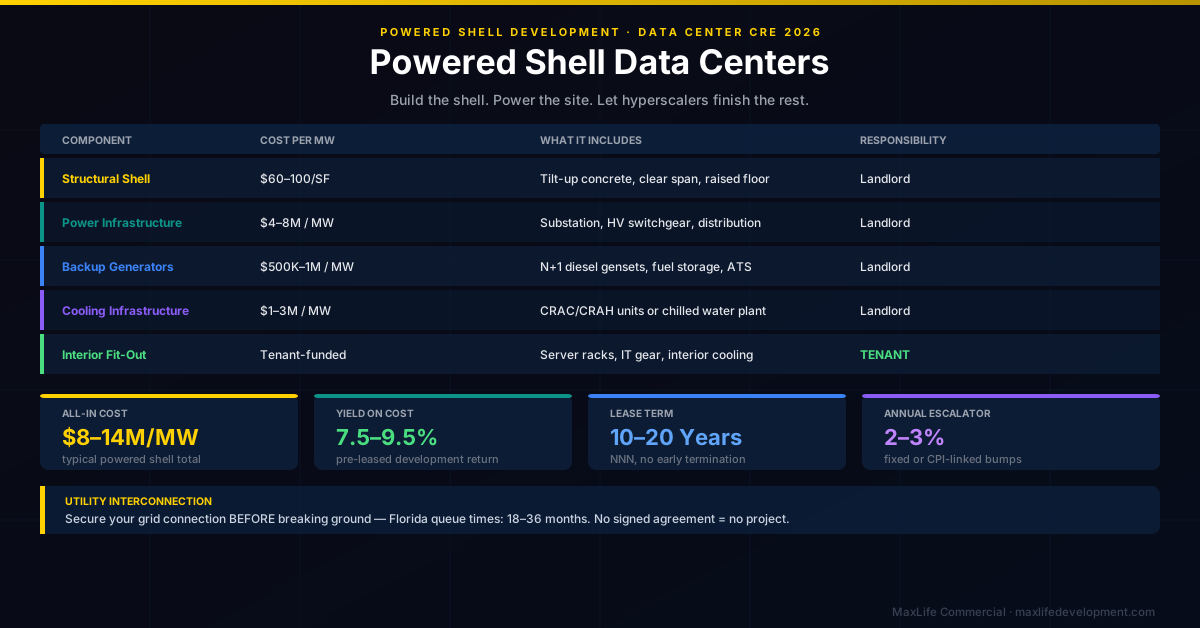
A powered shell is a data center delivery format in which the developer constructs the complete structural building envelope and installs all critical power and cooling infrastructure — but leaves the interior fit-out entirely to the tenant. The hyperscale operator takes occupancy of a ready-to-energize shell and finishes it to their own exacting specifications.
This model emerged because cloud hyperscalers — AWS, Google, Azure, Meta — realized they could scale faster and maintain tighter security controls by controlling their own interior deployments. Rather than taking fully fitted colocation space, they wanted a reliable infrastructure platform on which to build their proprietary server environments. The powered shell was the result.
From the developer's perspective, a powered shell is the most capital-efficient path to a signed hyperscale lease. You build what you know — civil, structural, electrical, mechanical — and leave the specialized interior buildout to a tenant whose entire business depends on getting that part right.
Why Hyperscalers Prefer the Powered Shell Format
Security is the first reason. Hyperscale operators do not want any third party — including the landlord — to have access to, or knowledge of, the server layout inside their facility. A powered shell lease gives them full physical control of the interior from day one.
The second reason is cooling customization. AWS liquid cooling requirements differ from Google's. Meta's Open Compute server designs have specific airflow profiles. None of these companies want to compromise their efficiency targets by occupying a pre-built interior that was designed for someone else's hardware generation.
Speed also matters. A developer who has pre-permitted a site, secured utility interconnection, and begun structural construction can hand off a ready shell in 18-24 months. A full build-to-suit — where the developer also finishes the interior — adds another 6-12 months and introduces coordination friction the hyperscaler does not want.
Industry data consistently shows that 60-70% of hyperscale expansions in North America are delivered in powered shell format. It is now the default expectation from Amazon, Microsoft, and Google when they approach a new campus market.
What the Developer Builds vs. What the Tenant Builds
Understanding the scope boundary is critical before signing any LOI. Disputes over scope are the most common source of powered shell deal failures.
| Developer Scope | Tenant Scope |
|---|---|
| Tilt-up concrete structural shell | Server rack rows and cabling |
| Utility substation (owned or easement) | Interior hot/cold aisle containment |
| HV/MV switchgear to demarcation point | PDUs and in-rack power distribution |
| Backup generators — N+1 minimum | IT equipment and UGS cooling units |
| UPS systems to white-space boundary | Interior security and access control |
| CRAC/CRAH units or chilled water plant | Network equipment rooms (NOC/SOC) |
| Security perimeter and guard booth | Interior fire suppression tie-in |
| Fiber conduit (empty) into facility | Generator fuel management systems |
| Loading dock and cross-dock capability | |
| Grounding grid and lightning protection |
The fiber conduit provision deserves special attention. Developers do not pull fiber — they install empty conduit stubbed to the building exterior at multiple diverse entry points. The hyperscale tenant contracts directly with Zayo, Lumen, or Crown Castle for the actual fiber. Attempting to control the fiber relationship will kill a hyperscale deal immediately.
Powered Shell vs. Turnkey vs. Build-to-Suit
The three formats differ in who finishes the interior, how fast the tenant can occupy, and how much of the data center the landlord underwrites.
| Format | Who builds the interior | Typical tenant | Landlord exposure |
|---|---|---|---|
| Powered shell | Tenant | Hyperscale operator | Shell, power and cooling infrastructure |
| Build-to-suit | Developer, to tenant spec | Hyperscale or large enterprise | Everything, plus 6-12 months of added schedule |
| Turnkey / fully fitted | Landlord or operator | Enterprise and colocation customers | Complete facility and its operations |
Cap rates differ across these formats because the lease structure and credit quality differ. The 2026 data center cap rate breakdown covers hyperscale NNN, colocation and powered shell pricing side by side.
Development Economics: Building the Business Case
Powered shell development economics are compelling when modeled correctly. The key metric is yield on cost — NOI at stabilization divided by total development cost. Anything above 8.5% in today's market represents strong risk-adjusted returns given the credit quality of hyperscale tenants.
Component Cost Breakdown (Per MW Critical IT Load)
| Component | Cost Per MW |
|---|---|
| Land and site work | $800K – $1.2M |
| Structural shell (tilt-up) | $1.5M – $2.0M |
| Utility substation / switchgear | $2.0M – $3.0M |
| Backup generators (N+1) | $1.2M – $1.8M |
| UPS systems | $800K – $1.2M |
| Cooling infrastructure | $1.5M – $2.5M |
| Security perimeter | $200K – $400K |
| Soft costs (design, permits, CM) | $1.0M – $1.5M |
| Contingency (10-15%) | $900K – $1.4M |
| Total | $10M – $15M per MW |
Worked Example: 10 MW Florida Powered Shell
| Line Item | Value |
|---|---|
| Total capacity | 10 MW critical IT load |
| All-in development cost | $12M/MW × 10 = $120M |
| NNN lease rate (Florida market) | $95/kW/month |
| Critical load (kW) | 10,000 kW |
| Annual gross rent | 10,000 × $95 × 12 = $11.4M |
| Operating expenses (NNN — tenant pays) | Minimal (insurance, mgmt) |
| Stabilized NOI | ~$11.1M |
| Yield on cost | 11.1M ÷ 120M = 9.25% |
| Exit cap rate (hyperscale credit) | 5.75% |
| Stabilized value | $11.1M ÷ 5.75% = $193M |
| Development profit | $193M – $120M = $73M (61%) |
Note: Values are illustrative. Actual lease rates, cap rates, and construction costs vary by market, power availability, and tenant credit. Always underwrite with current market data.
Utility Interconnection Is Everything
Nothing matters more in data center development than power. You can have the perfect site, a signed LOI from a hyperscale tenant, and $150M in equity lined up — and none of it means anything without a signed interconnection agreement with the utility.
Never begin land acquisition, permit applications, or construction on a data center site without first confirming the utility can deliver the required load and, ideally, without a signed or near-signed interconnection agreement in hand. This is the cardinal rule of data center development.
In Florida, interconnection queue times are running 18-36 months depending on the utility and substation. The process typically follows these steps:
- Pre-application meeting with utility transmission planning team
- Submit formal interconnection application with load study fee ($25K-$100K)
- Scoping study (2-4 months) — utility identifies transmission upgrades required
- Feasibility study (3-6 months) — cost allocation for any required system upgrades
- Interconnection agreement negotiation and execution (3-6 months)
- Substation and transmission upgrade construction (12-24 months)
Florida Power & Light (FPL) serves Osceola, Broward, Miami-Dade, and Palm Beach counties. Duke Energy Florida covers Pasco, Hillsborough, and parts of Polk. JEA serves Jacksonville. Each utility has different queue depths and cost-allocation methodologies. Work with a transmission attorney and power consultant before committing capital to any site.
One practical tip: large sites near existing 138kV or 230kV transmission lines are dramatically easier to interconnect than greenfield sites far from high-voltage infrastructure. Add "proximity to transmission corridor" to your initial site screening criteria and you will save months of wasted development effort.
Hyperscale Lease Structure Fundamentals
Powered shell leases are priced per kilowatt of critical IT load capacity — not per square foot. This is the foundational difference between data center leasing and conventional commercial real estate. The power capacity available to the tenant's servers is what they are paying for.
Current Florida market rates for hyperscale powered shell leases run $85-$130/kW/month on a triple-net basis, depending on location, power cost, and campus-level economics. Jacksonville, with JEA's competitive rates, tends to command lower per-kW rents because power costs are lower. Osceola and Polk markets, where land costs are also lower, can support mid-range pricing.
Key lease terms to negotiate and protect:
- Lease term: 10-20 years initial term with multiple 5-year extension options
- Annual escalators: 2-3% fixed annual increases — do not accept CPI-only escalators, which can underperform
- Guaranty: Corporate guaranty from the parent entity (AWS LLC, Google LLC, Meta Platforms) — not an SPE
- NNN structure: Tenant pays all operating expenses including property taxes, insurance, and utility costs
- No early termination: Hyperscale tenants expect firm terms; any termination right significantly impairs value
- ROFO/ROFR on expansion: Give the tenant a right of first offer on additional phases before going to market
The credit quality of a signed hyperscale lease — Amazon, Google, Microsoft, Meta — is genuinely investment-grade. These are balance sheets with hundreds of billions in assets. A 15-year NNN lease with a 2.5% escalator from AWS is one of the most defensible long-term income streams available in commercial real estate.
Florida Powered Shell Markets to Watch
Florida is one of the fastest-growing data center markets in the country, driven by population growth, disaster recovery demand from Northeast and Midwest enterprises, and increasingly, the proximity to Latin American internet exchange points. Four markets stand out for powered shell development today:
Osceola County — Greenfield Opportunity
Osceola is emerging as a major hyperscale campus corridor, with large industrial-zoned parcels available at land costs well below Tampa or Miami. FPL serves the county with competitive commercial rates. The county has been proactive about data center incentives, including property tax abatements under Florida's data center sales tax exemption program. Multiple 50-100MW campus sites are actively in development.
Pasco County — Duke Energy Emerging Market
Duke Energy Florida's Pasco service territory is seeing its first hyperscale inquiries as Tampa Bay land costs have risen sharply. Land in Pasco remains affordable, I-75 and I-275 provide logistics access, and Duke has been investing in transmission capacity ahead of anticipated demand. Watch for announcements in the Wesley Chapel and Zephyrhills corridors over the next 24 months.
Polk County — I-4 Corridor Positioning
Polk County sits at the geographic midpoint of the I-4 corridor connecting Tampa and Orlando. Large industrial parcels with FPL or Duke service are available, and the county's history as a distribution hub means fiber, road infrastructure, and construction labor are already here. Several build-to-suit data center projects are in early permitting stages.
Jacksonville — JEA and the Lowest Power Costs in Florida
Jacksonville consistently has the lowest commercial power rates in Florida through JEA, the municipally-owned utility. For data center operators where power is 40-60% of operating cost, this is a meaningful competitive advantage. The Northside industrial corridor has seen multiple large data center announcements, and the market has established fiber infrastructure and experienced construction trade labor.
Risks Every Developer Must Underwrite
Powered shell development offers exceptional returns — but only when risk is managed systematically. The following risks have killed projects that appeared fully underwritten on paper:
Construction Cost Overruns
Data center electrical and mechanical systems are highly specialized. General contractors without proven data center experience routinely miss scopes and generate change orders. Only use GCs with verifiable data center delivery experience and negotiate a GMP (guaranteed maximum price) contract with a well-defined scope.
Long Equipment Lead Times
Transformer lead times currently run 18-24 months from order to delivery. Generator sets are 12-18 months. UPS systems and switchgear are 9-12 months. You must order long-lead equipment immediately upon LOI execution — waiting for permit approval will add a year to your schedule and likely breach your delivery obligation to the tenant.
Utility Interconnection Delays
Even after signing an interconnection agreement, utility construction schedules slip. Budget 6-12 months of schedule contingency beyond the utility's committed date. Structure your tenant delivery commitment to include a utility force majeure carve-out — most sophisticated tenants will accept this.
Never Build Merchant
This is the paramount rule: do not begin construction of a powered shell without a signed LOI — and ideally a signed lease — from a creditworthy tenant. A speculative data center carrying $120M in construction cost with no tenant is not an investment vehicle; it is a bet that hyperscale demand will materialize before your lender calls the loan. Require a signed LOI before breaking ground and a signed lease before completing the structure.
Powered Shell Data Center FAQ
What is a powered shell data center?
A powered shell is a data center delivery format in which the developer builds the structural building envelope and installs the critical power and cooling infrastructure, then leaves the interior fit-out to the tenant. The hyperscale operator finishes the space to its own specifications.
What is the difference between a powered shell and a turnkey data center?
In a powered shell the tenant builds out the interior, including racks, containment, in-rack power distribution and security. In a turnkey or fully fitted facility the landlord or operator delivers that interior. Hyperscalers favor powered shells because they keep control of security, cooling design and equipment layout.
How long does it take to deliver a powered shell?
A developer who has pre-permitted the site, secured utility interconnection and begun structural work can hand off a shell in roughly 18 to 24 months. A full build-to-suit that also finishes the interior adds another 6 to 12 months.
What yield on cost should a powered shell developer target?
Yield on cost is stabilized net operating income divided by total development cost. In today's market anything above 8.5% represents a strong risk-adjusted return given the credit quality of hyperscale tenants.
Where in Florida are powered shells being developed?
Four markets stand out: Osceola County, which offers greenfield campus sites; Pasco County, served by Duke Energy Florida; Polk County on the I-4 corridor; and Jacksonville, which has the lowest commercial power rates in the state through JEA.
What is the biggest risk in powered shell development?
Utility interconnection. Florida interconnection queues are running 18 to 36 months depending on the utility and substation, and long-lead equipment such as transformers can take 18 to 24 months. Never build merchant: require a signed LOI before breaking ground and a signed lease before completing the structure.
Get Florida Data Center Site and Deal Updates
Powered shell sites, utility interconnection news and hyperscale lease activity across Florida, sent to investors and developers who ask for it. No spam, unsubscribe anytime.
MaxLife Academy
Free Course: Data Centers & AI Campus Real Estate
Go deeper on powered shell development, AI campus siting, hyperscale lease structures, and the Florida data center market in our free 7-lesson course. Designed for real estate investors, developers, and brokers entering the mission-critical asset class.
Start the Free CourseEvaluating a powered shell opportunity in Central Florida? Work with MaxLife Commercial — our team advises on data center site selection, utility interconnection strategy, and hyperscale lease structures across the Florida market.