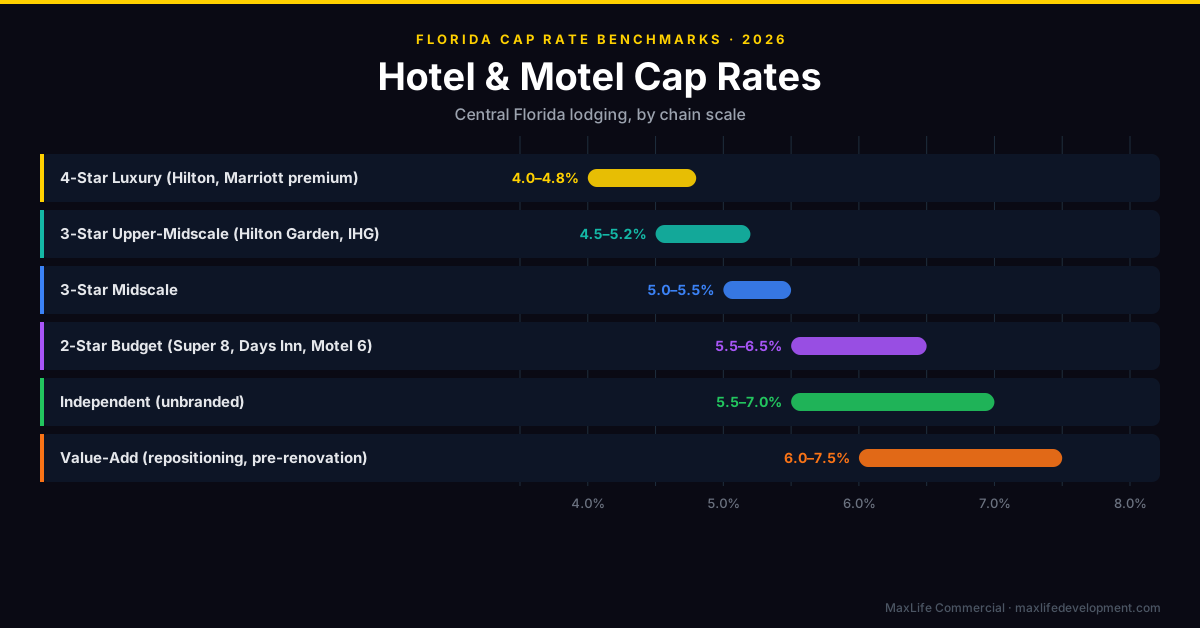
Hotel and Motel Cap Rates in Central Florida: 2026
Quick answer
Hotel cap rates in Central Florida (Orlando, Kissimmee, I-4 corridor) range from 4.5% to 7.5% depending on asset class, brand, and market. Stabilized branded 3-star properties in primary markets (I-Drive, downtown Orlando) trade at 4.5%-5.5% cap rates. Value-add repositioning opportunities (2-star to 3-star conversion) yield 6.0%-7.5%. Economy and unbranded properties trade 5.5%-7.5%.
- Stabilized 3-star branded (75%+ occ, $105+ ADR): 4.5%-5.5% cap rate
- Value-add 2-star repositioning (60-65% occ, $65 ADR at purchase): 6.0%-7.5% cap rate
- Economy/unbranded (65-70% occ, $60-80 ADR): 5.5%-7.0% cap rate
- Average RevPAR: $60-$85 (economy) to $110-$135 (3-star) to $150+ (4-star/luxury)
Hotel Cap Rates by Asset Class and Occupancy
| Hotel Type | Typical ADR | Occupancy Assumption | 2026 Cap Rate |
|---|---|---|---|
| 4-Star Luxury (Hilton, Marriott premium) | $140-$180+ | 80-85% | 4.0%-4.8% |
| 3-Star Upper-Midscale (Hilton Garden, IHG) | $105-$135 | 75-80% | 4.5%-5.2% |
| 3-Star Midscale (Hampton, La Quinta, Courtyard) | $95-$115 | 70-75% | 5.0%-5.5% |
| 2-Star Budget (Super 8, Days Inn, Motel 6) | $65-$85 | 65-70% | 5.5%-6.5% |
| Independent (unbranded) | $60-$90 | 60-70% | 5.5%-7.0% |
| Value-Add (repositioning, pre-renovation) | $70-$85 | 60-65% | 6.0%-7.5% |
Central Florida Hotel Markets: Submarkets and Cap Rates
International Drive / Convention Center: 4.5%-5.2% (Premium)
I-Drive is Central Florida's highest-RevPAR corridor. Theme park visitors, convention attendees, and tour groups drive occupancy to 80-85%. Branded 3-star and 4-star properties (Hilton, Marriott, Wyndham) command $110-$140+ ADR. New and recently renovated properties trade at 4.5%-5.0% cap rates. I-Drive generates 40% of Metro Orlando's hotel revenue.
Downtown Orlando / Lake Eustis: 4.8%-5.5% (Urban)
Downtown Orlando is attracting new development and repositioning. Business travel, conferences, and weekend leisure drive occupancy to 70-75%. ADR is $95-$125 depending on brand and quality. New-construction 3-star properties and branded hotels trade at 4.8%-5.2%. Older budget properties trade at 5.5%+.
Kissimmee / US-17/92: 5.5%-6.5% (Budget-Friendly)
Kissimmee is the budget and economy hotel corridor, 20 miles south of I-Drive. ADR is $65-$90. Properties are older (20-30 years), mostly 2-star or budget brands. Occupancy averages 65-70%. Cap rates run 5.5%-6.5% due to older assets and lower ADR. This is the value-add opportunity zone: repositioning and renovation can unlock 6.5%-7.5% yields.
I-4 Corridor (Daytona, Sanford, Lakeland): 5.0%-6.0% (Secondary)
Secondary markets along I-4 are growing but attract lower ADR ($70-$95). Business travel and highway pass-through drive occupancy to 65-70%. Properties are mix of economy and 2-3 star. Cap rates run 5.0%-6.0%. Less institutional buyer concentration than Orlando.
Stabilized vs. Value-Add: Where to Deploy Capital
Stabilized Branded Hotel
A well-maintained 3-star Hilton Garden Inn on I-Drive with 75% occupancy, $115 ADR, 140 rooms, and 8-year-old property generates $3.95M annual revenue. After operating expenses (45-50% of revenue), NOI is $2.0M. At a 5.0% cap rate, the property values at $40M.
Returns: Passive 5.0% yield, minimal management burden if outsourcing to an independent operator or management company. Upside limited to rent growth (1-2% annually) and modest occupancy/ADR improvements (15-20 bps annually). Most stabilized hotel buyers are institutional (REITs, Blackstone, Starwood Capital).
Risk: Tourism/recession downturns can drop occupancy 10-20%. Brand affiliation requires fee payments and renovations every 7-10 years.
Value-Add Repositioning
A distressed 2-star motel in Kissimmee: 90 rooms, 60% occupancy, $70 ADR, $2.27M annual revenue, $1.1M NOI (48% OpEx). Property trading at $17.6M on a 6.25% cap rate. You acquire for $15M, invest $400K in renovations, reposition to mid-scale brand (Hampton), and grow occupancy to 72% and ADR to $85.
Stabilized numbers: 3.05M revenue, 72% occ, $85 ADR. NOI improves to $1.6M (48% OpEx). At exit (year 3), property values at $24M on a 5.5% cap rate (brand improvement justifies tighter cap). Total profit: $24M - $15M - $0.4M = $8.6M on $15M equity = 19% IRR over 3 years.
This is operational and requires hands-on involvement: operator search, brand conversion, marketing, staff management. High upside but high risk.
Worked Example: 3-Star Stabilized Hotel on I-Drive
A 140-room Hilton Garden Inn on I-Drive, 8 years old, 76% occupancy, $118 ADR:
| Metric | Value |
|---|---|
| Rooms | 140 rooms |
| Occupancy | 76% |
| ADR (avg daily rate) | $118 |
| Daily revenue per room | $89.68 |
| Annual room revenue | 140 × 365 × $89.68 = $4,575,520 |
| F&B and ancillary revenue (20%) | $915,104 |
| Gross operating revenue | $5,490,624 |
| Operating expenses (47% of revenue) | -$2,580,593 |
| NOI | $2,910,031 |
| Capital expenditure reserve (5% of rev) | -$274,531 |
| Adjusted NOI | $2,635,500 |
| Purchase price at 5.0% cap | $2,635,500 ÷ 0.050 = $52.71M |
| Hold period: 5 years | |
| Year 2-5 occupancy and ADR growth (1.5% annually) | +$40K incremental NOI annually |
| Year 5 NOI (with growth) | $2,880,000 |
| Exit cap rate (4.8%) | $2,880,000 ÷ 0.048 = $60.0M |
| Profit (exit - acquisition) | $60.0M - $52.71M = $7.29M |
| Gross return (debt-free): 5% + $7.29M/52.71M = 18.8% total return over 5 years | |
| Levered IRR (35% down, 65% debt at 6.5%): ~10-12% |
This stabilized 3-star property on I-Drive generates strong cash flow and modest capital appreciation. Leverage amplifies returns to 10-12% IRR, making it attractive to investors with capital and low cost of debt.
Hotel Investment Risks
Cyclical Occupancy and ADR Volatility
A 5% occupancy swing (75% to 70%) on a 140-room property drops annual revenue $255K. A $10 ADR decline loses $511K. Economic downturns, competition, or travel disruption can swing cash flow 10-20% within months. Conservative underwriting assumes 2-3% ADR growth, not market recovery.
Capital Intensity and Cyclical Renovations
Branded hotels require major renovation every 7-10 years ($3K-$8K per room = $420K-$1.1M for 140-room property). This CapEx can be $1M-$2M and disrupt operations during execution. Plan renovation reserves and operational disruption.
Labor Cost Inflation
Housekeeping, front desk, and maintenance are labor-intensive. Wage inflation (3-5% annually in Florida) directly impacts operating expenses. Hotel operating margins compress when labor inflation exceeds revenue growth.
Brand Dependency and Franchise Fees
Brands like Hilton and Marriott charge 5% of gross room revenue in franchise and reservation fees. They dictate marketing spend, renovation budgets, and pricing power. Debranding a property to cut fees is possible but reduces occupancy and ADR 10-20%.
Disruption from OTAs and Travel Patterns
Online travel agencies (Expedia, Booking.com, Airbnb) reduce negotiating power and drive commissions to 15-20% of bookings. Direct-to-consumer booking rates are declining. Airbnb and short-term rentals compete for transient demand.
Hotel and Motel Cap Rates FAQ
What is a typical hotel cap rate in Central Florida right now?
Stabilized, branded 3-star hotels (Hilton, IHG, Marriott flags) in high-traffic areas trade at 4.5%-5.5% cap rates depending on ADR and occupancy. Value-add unbranded or repositioned 2-star properties trade at 6.0%-7.5%. Economy brands (Choice Hotels, Super 8, Days Inn) and boutique independents trade at 5.0%-6.0%. Cap rate variance is driven by operator covenant (flag vs. no flag), RevPAR stability, and market (Orlando strip vs. Kissimmee vs. I-4 corridor secondary markets).
Why are hotel cap rates so high compared to office or retail?
Hotels carry operational complexity: daily room turnover, payroll, utilities, housekeeping, front desk. Occupancy and RevPAR (revenue per available room) fluctuate daily, making cash flow less predictable than triple-net leases. Hotels are also sensitive to travel cycles, tourism, and labor inflation. A stabilized hotel at 70% occupancy with $95 ADR generates $2.1M annually on a 150-room property but requires active management. Cap rates reflect this operational risk and capital intensity.
What is RevPAR and why does it matter?
RevPAR = Average Daily Rate × Occupancy. A 150-room hotel at 70% occupancy with $95 ADR generates $9,975 daily revenue = $3.6M annually ($24K per room per year). Small changes in ADR or occupancy swing RevPAR 10-15%: a 5% occupancy drop loses $180K annually. Hotel valuation is RevPAR-based, not sqft-based. A property trading at 5.0% cap rate on $2M NOI is valued at $40M — small RevPAR changes swing value 5-10%.
Should I buy stabilized or value-add hotel?
Stabilized branded properties (4-5 star, Hilton/Marriott flags, 75%+ occupancy, $110+ ADR) trade at 4.5%-5.5% cap rates — passive income, predictable returns. Value-add opportunities (repositioning a 2-star to 3-star, operator change, brand conversion) can deliver 6.0%-8.0% returns if executed well. Value-add requires active management, capital investment ($500K-$2M+), and 2-3 year business plan before exit. Choose based on operating experience and capital availability.
What cap rate should I model for a value-add motel repositioning?
A distressed motel (60-65% occupancy, no flag, $65 ADR) that you reposition to 75% occupancy and $85 ADR should underwrite to 6.5%-7.5% yield on cost at stabilization. Value-add costs: $2K-$5K per room for renovations, systems upgrades, and flag affiliation. Plan 2-3 years to stabilization. Budget for operator change, staff training, and marketing spend ($200K-$500K annually).
Are independent hotels better or worse than branded?
Branded hotels (Marriott, Hilton, Wyndham flags) generate higher occupancy and ADR due to central reservation systems and brand loyalty. But they require 5% of gross room revenue in franchise fees, limit pricing power, and have strict renovation requirements. Independent hotels have lower overhead (no fees) but struggle with OTA (online travel agency) commissions, booking power, and consistent occupancy. Branded hotels trade at 4.5%-5.5% cap rates; independents at 5.5%-7.0%. Most investors prefer branded for stability.
Hotel and Hospitality Real Estate Deals in Your Inbox
Hotel and motel sales, cap rate benchmarks, and value-add opportunities across Central Florida. 2026 RevPAR data, operator comps, and market updates.
Looking to acquire or reposition a hotel in Central Florida? Work with MaxLife Commercial — we source hospitality properties, advise on value-add repositioning, and negotiate operator agreements throughout Central Florida.