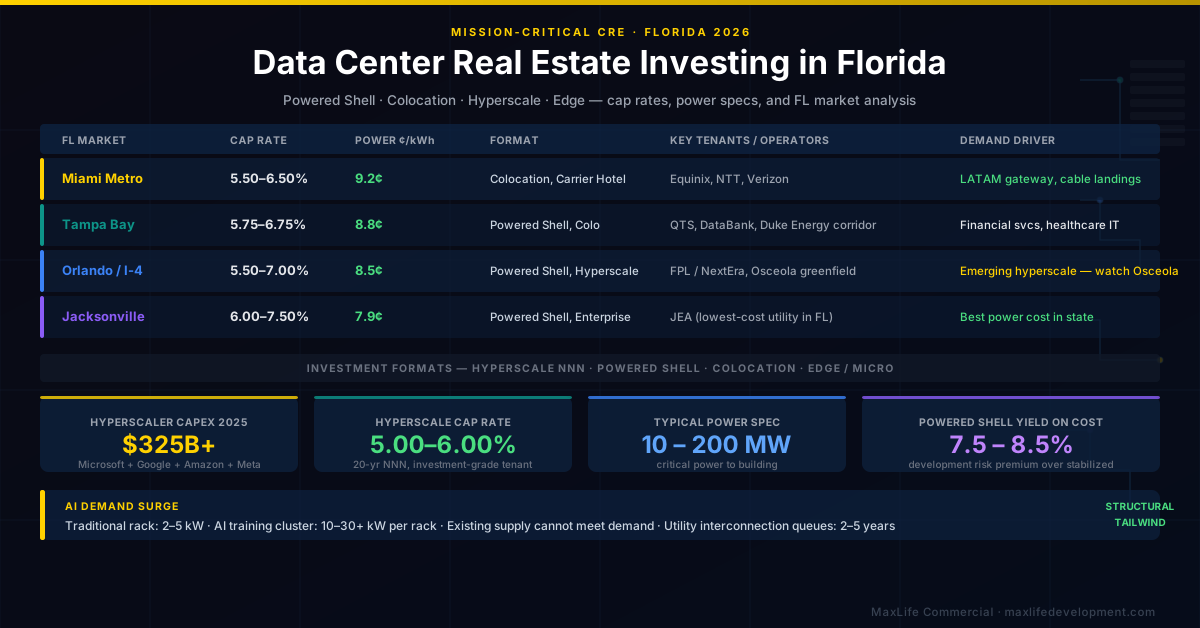
Data Center Real Estate Investing in Florida — The 2026 Guide
Data center real estate has emerged as the fastest-growing and most institutionally coveted category in commercial real estate. Driven by the AI buildout, cloud migration, and an unprecedented demand surge for computing power, data centers are drawing sovereign wealth funds, hyperscale tech giants, and private equity capital at a scale the CRE industry has rarely seen. This guide explains how data center real estate works, where the money is in Florida, and how to underwrite a deal.
The Fastest-Growing Category in Commercial Real Estate
In 2024 and 2025, global investment in data center real estate exceeded $200 billion — a figure that dwarfs the capital flowing into any other single CRE asset class. Microsoft, Amazon Web Services, Google, and Meta collectively announced more than $300 billion in data center capital expenditure commitments across a two-year period. That is not a real estate trend. It is a tectonic infrastructure shift.
The catalyst is artificial intelligence. Training a single large language model requires tens of thousands of GPUs running continuously for months. Inference — serving AI responses to end users — requires even more persistent compute. Every AI query you send consumes roughly 10 times the energy of a traditional Google search. The arithmetic is straightforward: as AI adoption scales from experimental to ubiquitous, power demand for data centers increases exponentially.
The 2024–2026 window is a historic inflection point because the supply of purpose-built, AI-capable data center space is structurally constrained. Long utility lead times (18–36 months for new grid connections), equipment shortages in switchgear and transformers, and a thin pipeline of shovel-ready sites with adequate power have created a multi-year supply deficit that is pushing hyperscalers to sign 15–20 year leases at historically tight cap rates. For real estate investors and developers who can deliver product into this window, the risk-adjusted returns are exceptional.
$200B+ in global data center real estate investment in 2024 alone — more capital than any other single CRE category, and the pipeline for 2025–2027 is larger still.
How Data Centers Work as Real Estate
Data center real estate is fundamentally different from every other CRE category because the primary unit of value is not square footage — it is megawatts (MW) of critical power. A 200,000 SF data center delivering 40 MW of IT load is worth more than twice as much as an identical building delivering 20 MW. When brokers and investors quote data center pricing, they price in dollars per kilowatt (kW) or per MW, not per square foot.
Tier Ratings (Uptime Institute)
Data centers are rated Tier I through Tier IV by the Uptime Institute, reflecting redundancy and availability guarantees:
| Tier | Availability | Redundancy | Use Case |
|---|---|---|---|
| Tier I | 99.671% | N (no redundancy) | Basic enterprise |
| Tier II | 99.741% | N+1 partial | SMB colocation |
| Tier III | 99.982% | N+1 concurrent maintainable | Enterprise / hyperscale standard |
| Tier IV | 99.995% | 2N fully redundant | Mission-critical / financial |
Most hyperscale and colocation data centers targeting enterprise leases are built to Tier III or Tier IV specifications. Critical power (the power delivered to IT equipment) is distinct from total facility power — the ratio between them is expressed as PUE (Power Usage Effectiveness). A PUE of 1.0 would mean 100% of power goes to IT loads; in practice, world-class modern data centers achieve PUE of 1.1–1.2. Older facilities may run PUE of 1.5–2.0, meaning half of all power consumed goes to cooling, lighting, and mechanical systems rather than compute.
Location decisions for data centers are driven by power availability, fiber density, cooling water access, and regulatory environment — not by proximity to population centers. A hyperscale campus in rural Virginia or suburban Phoenix can serve users globally because the internet routes packets, not trucks. The constraints are utility infrastructure and land cost, not demographics.
Cap Rates and Pricing
Data center cap rates are among the lowest in commercial real estate — comparable to trophy office or AAA grocery-anchored retail — because the tenant credit quality is exceptional, lease terms are long, and the replacement cost barrier to new supply keeps occupancy structurally high. Here is how the major data center investment categories price in 2026:
| Investment Type | Cap Rate / Yield | Lease Term | Typical Tenant |
|---|---|---|---|
| Hyperscale NNN | 5.25–6.00% | 15–20 years | AWS, Google, Microsoft |
| Colocation | 5.75–6.50% | 5–10 years | Equinix, CyrusOne, enterprise |
| Powered Shell Development | 7.00–8.50% YOC | 15–20 years NNN | Hyperscaler (tenant finishes interior) |
| Edge / Micro | 6.50–7.50% | 7–12 years | Telecom, CDN, edge compute |
Hyperscale tenants (Amazon, Google, Microsoft, Meta) are the most creditworthy tenants in all of commercial real estate. Their investment-grade credit ratings, multi-decade lease commitments, and global balance sheets compress cap rates to levels that reflect near-zero credit risk. A hyperscale NNN lease with 15 years of remaining term and annual 2–3% rent bumps is the CRE equivalent of a long-duration government bond — with superior yield.
Lease structures in data center NNN deals typically include 10–20 year primary terms, 2–3% annual rent escalations, corporate guarantee from investment-grade parent entities, tenant-responsible operating expenses (true NNN), and multiple renewal option periods extending total lease duration to 30–40 years. The combination of long duration and creditworthy guarantors is why institutional buyers accept cap rates that appear modest relative to other industrial categories.
Types of Data Center Investments
1. Hyperscale Campus (Built-to-Suit)
Hyperscale campuses are the largest data center deals in existence — purpose-built for a single tenant (AWS, Google, Microsoft, Meta) on campuses that can ultimately host 100+ MW of IT load across multiple buildings. These are true build-to-suit transactions where the developer acquires land, delivers power and site infrastructure, and constructs to the hyperscaler's exact specification.
Lease terms run 15–20 years NNN with corporate guarantees and multiple 10-year renewal options. Cap rates at stabilization are the tightest in data center CRE — 5.25–5.75% — reflecting the exceptional credit and duration. The development risk is significant (land cost, utility capacity, construction timeline) but the yield on cost spread over in-place cap rates creates meaningful value creation for developers who can execute at scale.
Best for: Large institutional developers with utility relationships and balance sheet capacity to carry 18–24 month development timelines.
2. Powered Shell (Best Risk/Reward for Developers)
The powered shell model is widely considered the optimal structure for data center developers seeking the best risk-adjusted return. The developer delivers a conditioned shell building with utility power delivered to the building (typically 20–100+ MW), generator infrastructure, UPS rough-in, and a fiber-ready environment. The hyperscale or colocation tenant then finishes the interior — installing their own cooling, servers, racks, and IT infrastructure — at their own capital expense.
The developer's job is to solve the hardest problem: securing utility capacity and delivering it to a shovel-ready site. In a market where the average utility connection lead time is 18–36 months, developers who have sites with secured power are sitting on the most valuable real estate asset in the country. Yield on cost for powered shell development tracks 7.00–8.50% — a 150–250 bps spread over in-place cap rates, representing the development premium.
Best for: Mid-size developers and investors who can navigate utility permitting and want the best risk/reward ratio in data center development.
3. Colocation (Multi-Tenant)
Colocation data centers are multi-tenant facilities where the operator (Equinix, CyrusOne, Switch, QTS, Flexential) owns and operates the building and leases space, power, and cooling to enterprise tenants on a per-rack, per-cage, or dedicated suite basis. The operator takes on more operational complexity than a NNN landlord, but commands a significant premium in power pricing — typically $100–200/kW/month versus $40–80/kW/month in a wholesale lease.
From an investment standpoint, stabilized colocation facilities trade at 5.75–6.50% cap rates, reflecting the higher yield from management-intensive operations and shorter tenant lease terms. Colocation REITs (Equinix, Digital Realty) are the dominant acquirers, and stabilized facilities with quality tenant rosters consistently attract institutional capital.
Best for: Investors with operational infrastructure or REIT/partnership structures that can absorb multi-tenant management complexity.
4. Edge / Micro Data Centers
Edge data centers are smaller facilities (1–10 MW) deployed close to end users to reduce latency for time-sensitive applications: autonomous vehicles, real-time gaming, 5G network functions, video streaming CDN nodes, and industrial IoT. Tenants are typically telecom carriers (AT&T, Verizon), content delivery networks (Cloudflare, Akamai), and enterprise edge-compute operators.
The edge category is emerging rather than established — lease structures, tenant credit, and pricing conventions are less standardized than hyperscale or colo. Cap rates of 6.50–7.50% reflect both the higher yield from shorter lease terms and the relative immaturity of the investment market. Edge sites in high-traffic urban locations (airports, dense urban cores, stadium districts) command premium pricing.
Best for: Investors comfortable with emerging categories who want exposure to distributed compute infrastructure at better yields.
Florida Data Center Markets
Florida is not traditionally cited in the same breath as Northern Virginia (the largest data center market in the world), Phoenix, or Dallas — but the state's infrastructure fundamentals are improving rapidly, and several Florida markets are attracting meaningful hyperscale and colocation investment for the first time.
Why Florida Is Emerging
- →Competitive electricity rates:Duke Energy and Florida Power & Light (NextEra) offer commercial power rates that are competitive with other Sun Belt data center markets. Large-load power purchase agreements (PPAs) for data center campuses are increasingly available in Florida as utility generation capacity has grown.
- →Solar and renewable energy growth: Florida's solar generation capacity has grown dramatically, and hyperscalers under pressure from sustainability commitments can increasingly source renewable energy certificates (RECs) and long-term renewable PPAs in the state — reducing the carbon footprint objection that previously limited Florida's attractiveness.
- →Fiber backbone and subsea cables: Florida's position as a gateway to Latin America and the Caribbean makes it a critical node in the global fiber network. Miami in particular is the landing point for dozens of subsea cable systems connecting North America, South America, and Europe — creating a world-class fiber backbone that data center operators require.
- →No state income tax: Florida's tax structure benefits data center operators' economics. Several counties also offer property tax abatements and economic incentive packages for large data center projects, reducing total cost of occupancy.
- →Latency for Florida's 23M residents:An AI application serving Florida's population benefits from in-state compute capacity. As edge inference workloads grow, proximity to Florida's large population base creates demand for regional data center infrastructure.
Key Florida Markets
Orlando / I-4 Corridor
Orlando is Central Florida's data center hub, anchored by Duke Energy's robust transmission infrastructure serving the theme park and hospitality corridor. The I-4 corridor from Daytona Beach to Tampa offers large-parcel industrial land with utility access — a rare combination that is attracting powered shell and hyperscale development interest. QTS Data Centers operates a major campus in the Orlando area, and hyperscale pre-lease activity is accelerating. The I-4 technology corridor, anchored by UCF's research park, is also driving enterprise colocation demand from Florida's growing tech sector.
Tampa / Hillsborough County
Tampa's DeZ (Data Center Zone) designation and financial services concentration create colocation demand from banks, insurance companies, and fintech firms that need Tier III and Tier IV facilities with financial-grade SLA requirements. Tampa Electric (TECO) has invested in transmission infrastructure supporting large commercial loads. The I-75 / SR-60 intersection area west of Tampa offers shovel-ready industrial sites with utility access that developers are targeting for powered shell product.
Jacksonville
Jacksonville is attracting data center development as a lower-cost alternative to Virginia and Atlanta, with land costs 60–70% below those markets and Florida Power & Light's NextEra infrastructure providing reliable large-load power. Several regional financial institutions and healthcare systems have built or leased enterprise data centers in the Jacksonville area. The city's position at the southern end of the Southeast data center corridor (Atlanta → Savannah → Jacksonville) is increasing its profile with colocation operators looking for geographic diversity.
Miami / South Florida
Miami is Florida's most established data center market, driven by its position as the premier Latin American internet gateway. NAP of the Americas (now CyrusOne Miami) and Equinix's MI1–MI3 campus are the anchor carrier hotel facilities, aggregating hundreds of network providers and creating a density of interconnection that competitors cannot replicate. Miami data center pricing is the highest in Florida, with colocation power rates 20–40% above Orlando and Tampa reflecting the interconnection premium. New development in Miami is constrained by land cost and utility capacity in the urban core — development activity has shifted to suburban Broward and Palm Beach counties.
Underwriting a Data Center Deal
Data center underwriting shares some elements with industrial real estate but requires significant additional technical diligence. The following are the critical factors that separate a well-underwritten data center deal from a conventional CRE analysis.
Power Capacity (MW) as Primary Value Driver
The critical underwriting metric is not rentable square footage — it is megawatts of critical IT power delivered to the white space floor. Determine the total utility feed capacity, the critical load capacity (after UPS and distribution losses), and the available load for lease. Price per kW per month is the standard rent metric for wholesale and colocation facilities.
Cooling System Redundancy
Verify the cooling system design — CRAC/CRAH units, chiller capacity, cooling tower capacity, and whether the system is N, N+1, or 2N. AI workloads are driving the transition from air cooling to liquid cooling (direct liquid cooling, rear-door heat exchangers, immersion cooling). Facilities without liquid cooling infrastructure face a technology obsolescence risk as GPU rack densities continue to increase.
Carrier Neutrality and Fiber Diversity
Enterprise and hyperscale tenants require access to multiple fiber providers through diverse physical paths into the building. A data center served by a single fiber provider through a single conduit path is not carrier-neutral — a significant deficiency that limits tenant quality and pricing power. Verify the number of fiber providers, entry point diversity, and whether the facility is interconnection-capable.
Generator and UPS Infrastructure
Tier III and IV data centers require N+1 diesel generator capacity to carry full IT load during utility outages, with on-site fuel storage for 24–72 hours of runtime. UPS systems (battery and/or rotary flywheel) provide ride-through power during the generator start sequence. Verify generator age, maintenance history, load bank testing schedule, and fuel supply chain reliability — particularly relevant in Florida where hurricanes create multi-day outage scenarios.
Lease Structure Analysis
Data center leases are more complex than standard NNN structures. Key terms to analyze: escalation clause (2–3% annual or CPI-based), renewal option pricing (fixed rent vs. fair market value reset), ROFO/ROFR on adjacent expansion space, tenant improvement allowance structure (particularly for powered shell deals where tenant self-builds interior), and power cost pass-through provisions (are power costs a pass-through NNN expense or embedded in the base rent?).
Tenant Credit Quality
Hyperscale tenants (AWS, Google, Microsoft, Meta, Oracle) are the strongest credit in all of CRE — investment-grade ratings, trillion-dollar balance sheets, and strategic dependency on owned data center infrastructure that creates structural lease renewal probability. Colocation operators vary in credit quality from Equinix/Digital Realty (investment-grade) to smaller regional operators with limited balance sheets. Enterprise colocation tenants (banks, healthcare systems) range from excellent credit to highly variable. Underwrite the tenant credit stack with the same rigor applied to net lease investing.
The AI Effect on Data Center Real Estate
The AI buildout is not just accelerating data center demand — it is fundamentally changing the physical requirements of data center infrastructure in ways that are creating both opportunity and obsolescence risk simultaneously.
Traditional enterprise server racks operate at power densities of 2–5 kW per rack. A GPU cluster running AI training or inference workloads demands 10–30 kW per rack — and next-generation AI accelerators from NVIDIA, AMD, and custom silicon are pushing toward 50–100 kW per rack in specialized configurations. This density increase is not incremental; it is a step change that makes the overwhelming majority of existing data center white space unsuitable for AI workloads without expensive retrofits.
Air cooling — the standard for traditional data centers — cannot remove heat fast enough at 30+ kW per rack densities. This is driving a rapid transition to liquid cooling technologies: direct liquid cooling (cold plates on CPUs and GPUs), rear-door heat exchangers (replacing hot-aisle/cold-aisle air containment), and immersion cooling (servers submerged in dielectric fluid). Facilities that cannot support liquid cooling infrastructure are becoming functionally obsolete for the highest-value AI workloads, even if they are physically sound buildings with years of useful life remaining.
The development pipeline is severely constrained by long utility lead times and equipment shortages. Electrical switchgear, medium-voltage transformers, and large diesel generators are on 12–24 month lead times globally. Utility interconnection agreements for large new loads (100+ MW) are taking 24–36 months in many markets. This means that developers who have already secured utility capacity and equipment commitments are in a structurally advantaged position relative to new entrants — the moat around existing sites with secured power is real and widening.
AI GPU cluster power densities of 10–30 kW per rack are making the majority of existing data center white space obsolete for the highest-value AI workloads — creating a once-in-a-generation development and redevelopment opportunity for investors who can deliver AI-ready infrastructure.
Who Is Buying Data Centers
The capital stack in data center real estate has broadened dramatically as the asset class has moved from niche to mainstream institutional. Understanding who is buying — and at what price — is essential for anyone evaluating entry points.
Data Center REITs
Digital Realty (DLR), Equinix (EQIX), and Iron Mountain (IRM) are the dominant REIT buyers of stabilized data center assets globally. They pay the tightest cap rates (5.00–5.75% for core hyperscale), have the lowest cost of capital, and apply institutional underwriting to every acquisition. These REITs are also the most likely exit for developers who stabilize a hyperscale or colocation facility.
Private Equity
Blackstone, KKR, Brookfield, and a dozen other major PE platforms have raised dedicated data center funds or made large portfolio acquisitions (QTS, CyrusOne, Vantage Data Centers). PE buyers target value-add and development opportunities where they can deliver yield on cost in the 7–9% range before exiting to REIT buyers or in IPO transactions.
Sovereign Wealth Funds
GIC (Singapore), ADIA (Abu Dhabi), Mubadala, and the Saudi PIF have all made large direct or JV investments in data center platforms globally. Sovereign capital seeks long-duration, inflation-protected income streams — which data center NNN leases with hyperscale tenants provide in abundance. Expect sovereign capital to be a growing presence at the top of the market.
Owner-Users & Family Offices
Smaller colocation and edge facilities (1–20 MW) attract family office capital through operating partner structures — typically a specialized data center operator brings the tenant relationships and operational expertise while the family office provides the equity capital. This structure allows non-institutional investors to access data center returns that would otherwise require operational infrastructure they do not possess.
How Ryan Can Help
MaxLife Commercial focuses on mission-critical and industrial real estate across Florida — including data center land, powered shell development opportunities, and NNN data center acquisitions. Ryan Solberg advises investors, developers, and family offices evaluating data center exposure in Florida on site selection, utility capacity assessment, market positioning, and transaction execution.
Whether you are a developer seeking a shovel-ready site with secured power, an investor underwriting a stabilized colocation acquisition, or an institution looking for Florida data center development JV opportunities, MaxLife Commercial can source and structure the right deal.
Data Center Real Estate Advisory — Florida
Site selection, powered shell development, hyperscale NNN acquisitions, and colocation investment across Orlando, Tampa, Jacksonville, and South Florida.