Data Center Cap Rates 2026 — Complete Investor Reference
Data center cap rates in 2026 span a wider range than any other commercial real estate category — from 5.00% for a hyperscale NNN lease signed by Amazon or Microsoft to 8.50% or higher for powered shell development yield-on-cost. Understanding where your deal sits in that range, and why, is the most important underwriting skill in mission-critical real estate investing. This reference covers every major segment, the five cap rate drivers that move pricing, the math behind $/kW valuation, and how Florida markets compare to primary data center hubs.
Why Hyperscale Now Prices Tighter Than Trophy Office
A decade ago, data center cap rates looked similar to industrial — 6.00–7.50% for stabilized colocation, with hyperscale NNN deals occasionally breaking below 6.00% for the strongest credits. That pricing regime is gone. By 2026, core hyperscale NNN transactions — Amazon Web Services, Google, or Microsoft signing 15-to-20-year leases — are trading at 5.00–5.50%, tighter than Class A multifamily in most Sun Belt markets and comparable to the best grocery-anchored retail in the country.
Three structural forces drove this compression. First, the AI buildout created a demand surge of historic proportions — hyperscalers collectively announced more than $300 billion in data center capital expenditure over 2024–2025, absorbing every available shovel-ready site with secured utility power. Second, new supply is structurally constrained: utility interconnection lead times of 18–36 months mean that the development pipeline cannot respond quickly to demand. Third, institutional capital — REITs, sovereign wealth funds, and pension funds — redirected massive allocations toward data center real estate as other categories softened, compressing risk premiums further.
For investors underwriting data center acquisitions in 2026, the question is no longer whether data centers deserve a premium to industrial — it is whether specific deals justify their position on that curve given tenant credit, lease structure, power capacity, and AI-readiness.
A hyperscale NNN lease signed by AWS in 2026 trades at 5.00–5.25% — tighter than a Walgreens ground lease (5.25–5.75%) and comparable to the tightest Class A multifamily in primary markets. The tenant credit and lease duration justify the compression.
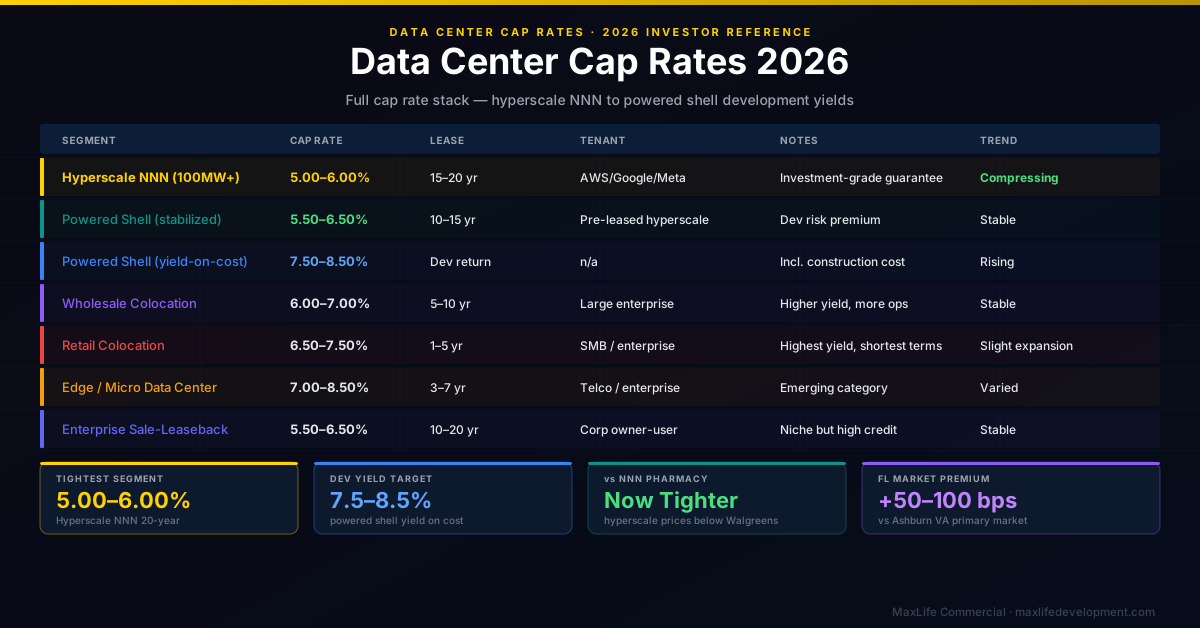
Cap Rates by Segment — Full 2026 Reference Table
The following table covers every major data center investment segment with cap rate range, trend direction, typical lease term, and representative tenants or operators. Trend indicators reflect directional movement over the prior 12 months.
| Segment | Cap Rate / YOC | Trend | Lease Term | Tenant / Operator |
|---|---|---|---|---|
| Hyperscale NNN 100 MW+ | 5.00–5.50% | ↓ Compressing | 15–20 yrs | AWS, Google, Microsoft, Meta |
| Powered Shell — Stabilized | 5.25–6.00% | ↓ Compressing | 15–20 yrs NNN | Hyperscaler (tenant finishes interior) |
| Powered Shell — Yield on Cost | 7.00–8.50% | → Stable | 15–20 yrs NNN | Development premium over stabilized |
| Wholesale Colocation | 5.50–6.25% | → Stable | 5–10 yrs | CyrusOne, QTS, Vantage, Switch |
| Retail Colocation | 5.75–6.50% | → Stable | 3–7 yrs | Equinix, regional enterprise |
| Edge / Micro | 6.50–7.50% | ↑ Slight expansion | 7–12 yrs | Telecom, CDN, edge compute operators |
| Enterprise Sale-Leaseback | 5.75–7.00% | → Stable | 10–15 yrs NNN | Corporate owner-operators (banks, healthcare) |
Cap rates reflect stabilized assets with in-place leases in primary and secondary U.S. markets. Yield on cost (YOC) figures reflect development returns, not stabilized values. Individual transactions vary based on lease structure, location, and power capacity.
Five Cap Rate Drivers That Move Data Center Pricing
Cap rates in data center real estate are not driven by the same factors that price industrial or retail assets. Five variables account for the vast majority of pricing variance within and across segments.
1. Tenant Credit Quality
No factor compresses cap rates more than tenant credit. An AWS or Google NNN lease carries the full weight of a trillion-dollar investment-grade balance sheet — structural lease renewal probability is near-certain because the tenant cannot practically relocate a 100 MW campus. That credit and operational dependency justify cap rates in the 5.00–5.25% range for best-in-class deals.
Moving down the credit stack — from hyperscaler to investment-grade colocation REIT to enterprise operator to regional colocation — adds 50–150 bps of cap rate premium for each credit step down. A regional colocation operator with a single facility and no public equity backing should trade at a meaningful discount to an Equinix or Digital Realty tenancy even with identical lease structures.
2. Lease Term and Escalation Structure
A 20-year hyperscale NNN with 2.5% annual rent bumps and corporate guarantee is fundamentally a different risk profile than a 5-year colocation lease with market renewal at expiration. Longer initial term compresses cap rates because buyers are acquiring a longer-duration income stream with less near-term re-leasing risk.
Escalation structure matters almost as much as initial term. Fixed 2–3% annual bumps in a 20-year hyperscale lease create substantial NOI growth that makes today's cap rate look conservative in hindsight. Flat rent structures or CPI-based bumps with low caps deserve a higher going-in cap rate to compensate for inflation exposure.
3. Contracted vs. Stranded Power
The single most important technical factor in data center cap rate underwriting is the distinction between contracted power — utility capacity committed under a signed service agreement with a delivery timeline — and stranded power, where a site has a utility allocation on paper but no executed agreement or construction milestone.
Stranded power is worth far less than contracted power because the delivery risk is real. Assets with contracted, shovel-ready power trade at tight cap rates reflecting scarcity value. Assets where the power allocation is aspirational or uncontracted deserve a 50–100 bps cap rate premium to compensate for execution risk.
4. Facility Tier and Redundancy
Tier III (N+1 concurrent maintainable) and Tier IV (2N fully redundant) facilities command premium cap rates — meaning lower cap rates, higher pricing — compared to Tier I and II. Enterprise and hyperscale tenants will not sign long-term leases in below-Tier-III facilities. The operational standard of the building directly drives tenant quality, which drives cap rate.
Investors underwriting existing colocation or enterprise facilities should verify actual operating uptime history, not just design specs. A Tier III certificate from the Uptime Institute reflects design intent; actual operational performance may differ if the facility has deferred maintenance or aging mechanical systems.
5. AI-Readiness and Liquid Cooling Capability
In 2026, AI-readiness has become a discrete pricing factor. Facilities capable of supporting 30+ kW per rack densities with liquid cooling infrastructure — direct liquid cooling, rear-door heat exchangers, or immersion cooling loops — command a meaningful premium over facilities limited to air-cooled rack densities of 5–15 kW per rack.
AI workloads are the highest-value, fastest-growing category of data center demand, and tenants willing to sign long-term leases at the tightest rates are overwhelmingly running GPU clusters. A facility that cannot support those workloads is competing for lower-margin enterprise IT business under pressure from cloud migration. AI-readiness is increasingly a prerequisite for best-in-class cap rate compression.
How Data Center Cap Rates Compare to Other CRE Categories
The following comparison places data center cap rates in context against the major commercial real estate asset classes that institutional investors routinely compare. The hyperscale NNN column now prices tighter than Walgreens — a statement that would have been implausible five years ago.
| Asset Class | Cap Rate Range | Typical Lease Term | Credit Profile |
|---|---|---|---|
| Hyperscale NNN Data Center | 5.00–5.50% | 15–20 yrs | Trillion-dollar IG (AWS, Google) |
| NNN Pharmacy (Walgreens / CVS) | 5.25–5.75% | 10–25 yrs | IG, but sector headwinds |
| NNN QSR (McDonald's / Chick-fil-A) | 4.75–5.50% | 15–20 yrs | Franchisee or corporate IG |
| Industrial / Logistics | 5.25–6.25% | 5–10 yrs | Variable; institutional tenants IG |
| Class A Multifamily | 4.75–5.50% | 1 yr (residential) | N/A — income diversification |
| Medical Office (MOB) | 5.50–6.50% | 5–15 yrs | Healthcare system or private practice |
Key takeaway: Hyperscale NNN data centers now price tighter than Walgreens pharmacy NNN — a historic milestone reflecting the structural demand shift driven by AI infrastructure investment. The lease duration (15–20 years vs. 10–15 for pharmacy), escalation cadence (2–3% annual vs. flat or 10% bumps every 5 years), and tenant credit depth (trillion-dollar tech vs. investment-grade retail) all support the differential.
Cap Rate Math — Two Worked Examples
The fundamental cap rate formula: Value = NOI ÷ Cap Rate. What makes data center deals unusual is the scale of the numbers and the compounding effect of annual rent escalations over long lease terms.
Example A — Hyperscale NNN
Hyperscaler with IG corporate guarantee. 18-yr term, 2.5% annual bumps, true NNN. 120 MW campus, Tier III.
Example B — Wholesale Colocation
Regional wholesale colo operator, non-IG credit. 7-yr term, 2% annual bumps, NNN. 8 MW stabilized, Tier III. Secondary Florida market.
Example A prices at approximately $9.1M per MW of IT load capacity; Example B at $9.4M per MW — a narrower spread than the cap rate differential might suggest, reflecting the premium lease structure of the hyperscale campus. In smaller secondary-market wholesale deals, $/MW can drop to $6M–$8M depending on tenant credit and remaining lease term.
Why $/kW Matters More Than $/SF in Data Center Pricing
Commercial real estate investors trained on industrial or office deals default to price per square foot as the primary valuation metric. In data center real estate, this metric is close to meaningless as a comparability tool. Two 200,000 SF buildings on the same street can have a 3:1 value differential if one delivers 40 MW of critical IT power and the other delivers 12 MW.
Wholesale data center leases in 2026 range from $40–$80/kW/month depending on market, lease term, and tenant credit. Retail colocation commands $100–$200/kW/month. Forpowered shell development, the yield-on-cost formula uses total development cost per kW:
The spread between yield on cost (7.00–8.50%) and stabilized cap rate (5.25–6.00%) is the developer's margin for risk, execution, and time. In 2026, that spread is wider than historic norms because stabilized cap rates have compressed faster than development costs have risen, expanding the development value-creation window.
Florida vs. Primary Data Center Markets — Cap Rate Comparison
Florida data center cap rates trade at a 25–75 bps premium to the primary markets (Northern Virginia, Chicago, Phoenix, Dallas) for comparable asset quality. That premium is narrowing as Florida attracts its first wave of large hyperscale commitments and utility infrastructure improves.
| Market | Hyperscale NNN | Wholesale Colo | Powered Shell YOC | Market Depth |
|---|---|---|---|---|
| Ashburn / NoVA | 4.75–5.25% | 5.25–5.75% | 6.50–7.50% | World's largest market |
| Chicago | 5.00–5.50% | 5.50–6.00% | 6.75–7.75% | Major Tier 1 hub |
| Phoenix | 5.00–5.50% | 5.50–6.25% | 7.00–8.00% | Major hyperscale campus market |
| Dallas / Fort Worth | 5.00–5.50% | 5.50–6.25% | 7.00–8.00% | Fast-growing hyperscale destination |
| Orlando / Tampa | 5.50–6.25% | 6.00–6.75% | 7.25–8.50% | Emerging; hyperscale activity accelerating |
| Jacksonville | 5.75–6.50% | 6.25–7.00% | 7.50–8.50% | Early-stage; lowest land cost in FL |
Miami is excluded because it is dominated by colocation interconnection hubs (Equinix MI1–MI3, CyrusOne NAP of the Americas) that price on an interconnection premium rather than pure power economics. Hyperscale development in Miami proper is constrained by land cost and utility capacity.
The land cost advantage in Orlando and Jacksonville versus Ashburn or Phoenix is substantial — shovel-ready sites in Central Florida can be acquired at 30–50% below comparable Phoenix or Dallas parcels. For developers whose primary value-add is delivering contracted power to a finished site, Florida offers better development margins than the most competitive primary markets.
Cap Rate Trends and Five-Year Outlook
The dominant directional trend is continued compression at the top of the quality spectrum. The most likely scenario for the best hyperscale NNN assets is cap rate compression to 4.75–5.25% for long-duration deals with the strongest credits.
The middle of the market — wholesale and retail colocation, edge, enterprise sale-leaseback — is more interest-rate-sensitive than hyperscale NNN. If the 10-year Treasury stabilizes in the 4.00–4.50% range, wholesale colocation cap rates in the 5.50–6.25% range offer reasonable spread over risk-free rates and should hold. Further rate increases would likely push secondary and tertiary colocation assets to 6.50–7.25%.
Development yield on cost is the most stable element of the cap rate stack. As long as the development pipeline stays constrained relative to demand, yield on cost for powered shell and hyperscale campus development should remain in the 7.00–8.50% range for well-located Florida sites with contracted power.
Five-year outlook: Hyperscale NNN likely compresses to 4.75–5.25% for best assets in primary markets. Florida closes 25–50% of its premium gap versus Phoenix and Dallas as hyperscale activity establishes track record. Development YOC remains 7.00–8.50% in Florida through at least 2028 as utility constraints limit supply response.
Due Diligence Checklist — 10 Questions Before You Underwrite a Cap Rate
Cap rate is the output of underwriting, not the starting point. Before accepting any quoted cap rate for a data center acquisition or development, get answers to these ten questions.
- 1
What is the contracted (not design or permitted) critical IT power capacity in MW, and is it confirmed under a signed utility service agreement?
- 2
What is the tenant's credit rating, and is the lease guaranteed by the operating entity or a parent holding company?
- 3
What is the remaining lease term and exact escalation structure — fixed percentage, CPI, or CPI with cap/collar?
- 4
Is the facility Tier III or Tier IV certified by the Uptime Institute, and what is the operational uptime track record for the past 36 months?
- 5
Does the cooling infrastructure support liquid cooling, and what is the maximum rack density (kW per rack) the facility can currently support?
- 6
Are there expansion rights (ROFO, ROFR, option parcels) and do they include the right to develop additional power capacity?
- 7
What is the fiber entry diversity — how many providers, and through how many physically separate conduit paths into the building?
- 8
Is the lease structure true NNN (tenant pays all OpEx including power, maintenance, and property taxes) or a modified gross or managed gross structure?
- 9
What is the current rent relative to market — is the lease at, above, or below market for this power capacity and lease term in this submarket?
- 10
What is the exit strategy — who are the realistic acquirers (REIT, PE fund, sovereign wealth fund) and what cap rate will they underwrite at deal maturity?
MaxLife Academy
Data Center & AI Real Estate — Full Course
Go beyond cap rates. The full Academy course covers hyperscale campus development from site selection to lease execution, powered shell underwriting, colocation investment structuring, and how AI infrastructure demand is reshaping the Florida industrial market. Includes worked underwriting models and deal case studies.
Start the CourseData Center Advisory — Florida
MaxLife Commercial advises investors and developers evaluating data center real estate across Florida — including hyperscale site selection, powered shell development underwriting, colocation acquisitions, and NNN data center investment from Orlando and Tampa to Jacksonville and South Florida. Whether you are underwriting your first data center cap rate or scaling an existing portfolio into Florida's emerging market, we can help you find, structure, and close the right deal.
The Florida data center opportunity is early relative to primary markets — which means the development spreads are wider, the competition is thinner, and the long-term upside of being an early mover in a market only beginning to attract hyperscale capital is real. The window to develop at 7.00–8.50% yield on cost while stabilized cap rates sit at 5.50–6.25% will not stay open indefinitely.
Explore Florida Data Center Opportunities
Site selection, hyperscale NNN acquisitions, powered shell development, and colocation investment across Central Florida and the state.
Get Florida Data Center Deal and Cap Rate Updates
Data center cap rate changes, Florida site news and hyperscale lease activity, sent to investors who ask for them. No spam, unsubscribe anytime.