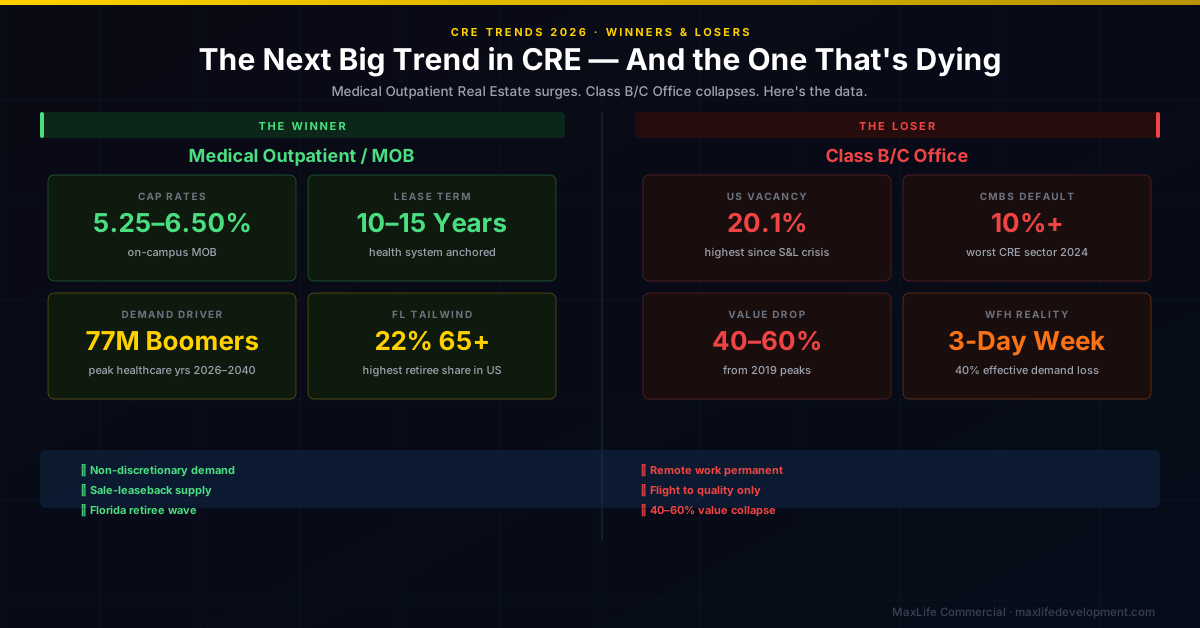
The Next Big Trend in CRE — And the One That's Dying
Commercial real estate is not a monolith. While one asset class is experiencing the most dramatic value destruction in a generation, another is sitting on top of the most powerful demographic tailwind in American history. Here's what smart Florida investors are moving toward — and what they're running from.
The Winner: Medical Outpatient Real Estate
The demographic math is unavoidable
77 million baby boomers — born between 1946 and 1964 — are now aged 62 to 80. Peak healthcare consumption hits at age 75–85, and we are entering that window right now. It lasts through 2040. This is not a speculative thesis. It is arithmetic.
Healthcare spending per capita roughly doubles between age 65 and age 80. The US elderly population (65+) will grow from approximately 57 million today to 80 million by 2040 — an increase of more than 40% in the core healthcare-consuming cohort over 15 years. No other asset class has a demand driver this visible, this durable, or this well-documented.
Florida amplifies this nationally. The state's 65+ population stands at 22% of total residents — the highest retiree concentration of any major state. That is not a trend awaiting confirmation. It is a structural feature of the Florida economy, baked in by decades of migration patterns that are still accelerating.
What is medical outpatient real estate?
Medical Office Buildings (MOBs) are standalone structures or medical campuses that house physician practices, specialist clinics, ambulatory surgery centers (ASCs), imaging centers, infusion suites, and outpatient rehabilitation facilities. They sit at the intersection of healthcare delivery and commercial real estate — and right now, both of those industries are pushing capital in the same direction.
The CMS (Centers for Medicare & Medicaid Services) has spent the last 15 years systematically shifting reimbursement away from expensive hospital inpatient settings toward lower-cost outpatient facilities. This is not reversing — it is accelerating. Procedures that once required a three-day hospital stay now happen in a two-hour outpatient surgery center. The result is that healthcare operators need less inpatient hospital square footage and dramatically more outpatient clinic and MOB square footage.
The numbers reflect this structural shift clearly. In 2000, roughly 50% of surgical procedures were performed on an outpatient basis. Today that figure is above 70%. Industry projections put it at 80%+ by 2030. Each percentage point of that shift represents millions of additional patient visits routed through outpatient facilities — and each of those facilities needs real estate.
Why MOBs are the ideal investment vehicle
Medical outpatient real estate combines several characteristics that are individually attractive and collectively rare in a single asset class:
| Factor | What it means | MOB | Comparison CRE |
|---|---|---|---|
| Tenant credit | Health systems (HCA, AdventHealth, Orlando Health, Mayo, Cleveland Clinic) are investment-grade operators signing 10–15 year leases | Excellent | NNN retail: Good |
| Lease structure | Typically modified gross or NNN with health system guarantee or strong local practice covenant | 10–15 yr | Office: 3–5 yr |
| Recession behavior | Healthcare demand is non-discretionary — people get sick regardless of the economy | Counter-cyclical | Retail: Cyclical |
| Supply constraints | Medical buildouts require specific zoning, infrastructure, and proximity to hospital campuses — structurally hard to overbuild | Supply constrained | Industrial: Active supply |
Cap rates and pricing
MOB cap rates in 2026 are ranging from 5.25% to 6.50% for on-campus (hospital-affiliated) assets and 6.00% to 7.25% for off-campus freestanding facilities. The premium for on-campus locations reflects something measurable: hospital-adjacent outpatient facilities capture 30–40% more patient volume than freestanding locations, which translates directly into tenant revenue and lease sustainability.
One of the most interesting acquisition channels right now is sale-leaseback. Health systems across Florida are selling buildings and leasing them back to redeploy capital into clinical operations — new equipment, additional service lines, expansion into underserved geographies. For investors, this creates a reliable pipeline of purpose-built medical facilities with long-term health system leases already in place. AdventHealth, HCA Florida, Orlando Health, Moffitt Cancer Center, and Mayo Clinic Florida are all in active expansion mode. They need real estate, and they are willing to let investors own it.
What to look for in an MOB deal
- On-campus vs. off-campus: On-campus commands a premium for good reason — volume, visibility, and referral capture are all higher adjacent to a hospital campus.
- Health system anchor percentage: What share of revenue comes from the health system anchor vs. independent practice tenants? Higher health system concentration means more durable credit.
- NPI verification: Each tenant's National Provider Identifier (NPI) is public record. Verify that tenants are active billing providers — a non-billing NPI is a yellow flag on practice viability.
- Lease expiry vs. physician age: An independent primary care physician with a 5-year lease expiring at age 68 is a different credit story than a multi-specialty group on a 12-year health system lease. Know the difference.
- Parking ratio: Healthcare facilities require 4–5 spaces per 1,000 SF of leasable area. Standard office underwriting at 3–4 spaces per 1,000 SF is insufficient for a medical conversion or repositioning.
The Loser: Class B and C Office
The numbers don't lie
US office vacancy hit 20.1% in Q1 2026 — the highest rate recorded since the Savings & Loan crisis of the early 1990s. Class B and C buildings are averaging 25–35% vacancy in most major metro areas. These are not cyclical numbers. They are structural ones, and the gap between stabilized Class A trophy product and commodity B/C office widens every quarter.
CMBS office loan delinquencies exceeded 10% in late 2024 — the highest of any CRE sector by a wide margin, worse than retail at its worst during the 2017–2020 department store collapse. Downtown office values in many cities have fallen 40–60% from their 2019 peaks. Chicago and San Francisco towers have traded at $50–100 per square foot — less than the value of a parking garage on the same land. These are not rumors or projections. They are closed transactions.
Why remote work is permanent, not cyclical
The “return to office” narrative has been declared imminent three times since 2020. It has not happened at scale. Office occupancy in major US markets peaked in 2023 at roughly 50% of pre-COVID levels and has not materially recovered. The mandate playbook has been tried extensively and the result is consistent: companies that required full-time in-office attendance lost their best people to competitors that did not. The talent market imposed a hybrid equilibrium, and that equilibrium is now embedded in employment contracts, real estate footprints, and organizational design.
The structural math is straightforward. Most knowledge workers now work in-office 2–3 days per week. A 3-day office week represents an effective 40% reduction in peak space demand compared to a 5-day week. Apply that to 20 years of cumulative new office supply and the result is 20–35% structural vacancy for the foreseeable future — with the burden concentrated heavily in the B and C tiers where landlords have the least pricing power.
The Class B/C specific problem
This is not an office problem distributed evenly across quality tiers. Class A, well-located trophy office — buildings with food halls, fitness centers, outdoor terraces, and conference amenities — is actually performing reasonably well relative to the market. Tenants are upgrading: they're taking less space, but they're paying up for better buildings. The phrase used in every institutional market report is “flight to quality,” and it is real.
Class B and C office absorbs all of the structural damage. These buildings lose tenants to Class A above — tenants who are downsizing but upgrading — and they lose tenants permanently to WFH below. There is no recovery path at current rents because the capital required to upgrade a Class B suburban building to Class A spec runs $150–200 per square foot. That capital investment cannot be recouped through achievable rent increases in markets already oversupplied at the Class A level.
Florida nuance: Orlando and Tampa have performed measurably better than the national average because strong population growth created genuine new corporate demand — companies expanding into Florida, relocating from higher-tax states, or establishing Southeast US regional headquarters. Even here, however, Class B suburban office parks built in the 1980s through the early 2000s are functionally obsolete. The demand that would have absorbed them over the past decade has instead been captured by new Class A product and hybrid-work policies that eliminated the marginal need.
The conversion trap
Converting office to residential sounds obvious when vacancy is above 25% and housing supply is tight. The economics are brutal in practice. Conversion costs run $200–400 per square foot depending on building vintage and scope. The floor plates in typical suburban and mid-rise office buildings — 20,000 to 50,000 SF per floor — are too deep to provide natural light access to interior residential units without extensive structural modification. Plumbing and electrical runs do not align with residential unit layouts. Core and shell configurations built for open-plan office bear little resemblance to what multifamily requires.
Industry estimates suggest only 15–20% of the existing US office stock is structurally and economically convertible to residential use. The math works only when the building is acquired at a deep enough discount — which means the original lender takes the loss. An investor buying a distressed note or foreclosed asset at $80 per square foot can sometimes make conversion pencil. The original equity owner at $300 per square foot cannot. The conversion narrative is a distressed debt story, not a passive investment story.
What to do with existing office exposure
The strategy depends entirely on which tier you own. If you hold Class A, well-located office with a strong weighted-average lease term (WALT) remaining, hold it. The flight-to-quality trade is creating genuine demand for best-in-class product, and your vacancy risk is materially lower than the headline market numbers suggest.
If you own Class B or C: resist the impulse to deploy additional capital chasing occupancy. The rational path is cash flow management — extend leases at market rates to preserve income, operate lean, and conduct an honest feasibility analysis on conversion options. Most will not convert economically. Plan for a long workout, and position for an orderly exit when the basis allows it.
As a buyer: Class B/C office is a special-situation trade requiring a minimum 50% discount to replacement cost, a clear and underwritten conversion path or demolition rights for land basis, and a capital partner with patience for a multi-year repositioning. This is not a passive income strategy. It is a workout strategy for experienced operators with distressed debt access and development capability.
The Florida Lens
Florida sits at the intersection of both trends in ways that amplify their divergence more sharply than in any other major state. The medical outpatient opportunity here is arguably the strongest in the country: the highest retiree concentration of any large state, three major health system expansions underway simultaneously (AdventHealth, HCA, Orlando Health), warm-weather migration that continues to add to the 65+ cohort, and a regulatory environment that has historically been favorable to outpatient care site development. Florida is not merely exposed to the MOB tailwind — it is the leading edge of it.
On the office side, Florida is more insulated than gateway markets like Chicago, San Francisco, and New York — but not immune. The state's population-growth-driven corporate demand has buffered the suburban office market better than most. That said, suburban Class B corridors in Orlando (Maitland, Altamonte Springs, Airport submarket), Tampa (Westshore, Carillon, Rocky Point), and Jacksonville (Deerwood, Baymeadows) are all showing the same patterns as national comps: rising vacancy, declining effective rents, and lengthening lease-up timelines. The insulation is real but limited; it buys time, not immunity.
For Florida investors in 2026, the actionable takeaway is clear: allocate toward asset classes with the demographic wind at their back — medical outpatient, necessity retail, industrial, and well-located NNN — and approach office with extreme selectivity, focusing only on Class A product with strong current occupancy or distressed B/C at a basis that makes the downside survivable. The divergence between these two asset classes is not narrowing. It is widening, and the investors who position ahead of that divergence rather than in reaction to it will capture the best entries of this cycle.
MaxLife Commercial
Looking at Healthcare or Industrial Real Estate in Florida?
Ryan Solberg specializes in income-producing commercial real estate across Central Florida — medical outpatient, NNN, industrial, and data center properties. Whether you're allocating capital toward the trends that are working or exiting positions in assets that aren't, MaxLife Commercial can help.
Thanks for reading. If you found this analysis useful, forward it to a fellow investor or developer navigating the same questions — the more clearly we all see these divergences, the better the decisions we make with capital.