Colocation Data Center Investing: The Complete Guide
Colocation data centers are the multi-tenant retail strips of the data center world — higher cap rates than hyperscale NNN, diversified income across dozens or hundreds of tenants, and significant ancillary revenue from cross-connects and managed services. This guide explains how colocation facilities work as real estate, how to underwrite the income, who the major operators are, and where Florida fits in the colo investment landscape.
What Is Colocation — and How Does It Work as Real Estate?
Colocation — colo — is the model in which a data center operator owns and manages the building, power, cooling, physical security, and network connectivity infrastructure, while tenants bring their own servers, storage, and networking equipment and pay to house it in the facility. The operator supplies the four essentials every tenant needs: space (measured in cabinet slots, cages, or dedicated suites), power (measured in kilowatts of contracted capacity), cooling (integrated into the facility), and connectivity (multiple carrier fiber options, cross-connects to other tenants and network providers).
Tenants pay a monthly recurring revenue (MRR) contract — typically 1 to 5 years — for their contracted space and power allocation. Unlike a hyperscale NNN lease where a single tenant (Amazon, Google, Microsoft) occupies an entire building under a 15–20 year lease, a colocation facility distributes risk across dozens to hundreds of tenants with staggered lease expirations. The income profile is meaningfully different: more granular, more diversified, shorter in duration, and higher-yielding.
Colo vs. Hyperscale: A Structural Analogy
Hyperscale NNN
Like a single-tenant ground lease NNN. One massive tenant, 15–20 year term, near-zero operating responsibility, maximum income stability, lowest cap rate. Credit risk is binary — if the tenant leaves, revenue drops to zero.
Colocation
Like multi-tenant retail. Dozens of tenants, 1–5 year contracts, active operations team required, higher cap rate, cross-connect upside. No single tenant controls more than 5–10% of revenue in a well-diversified colo.
The colocation model demands active management — the operator is responsible for 24/7 operations, security, power and cooling maintenance, customer support, and network interconnection services. This operational intensity is why colocation cap rates run 50–100 bps higher than hyperscale NNN. The investor takes on more complexity in exchange for higher yield and income diversification.
Colocation Pricing Tiers: From Retail Colo to Carrier Hotels
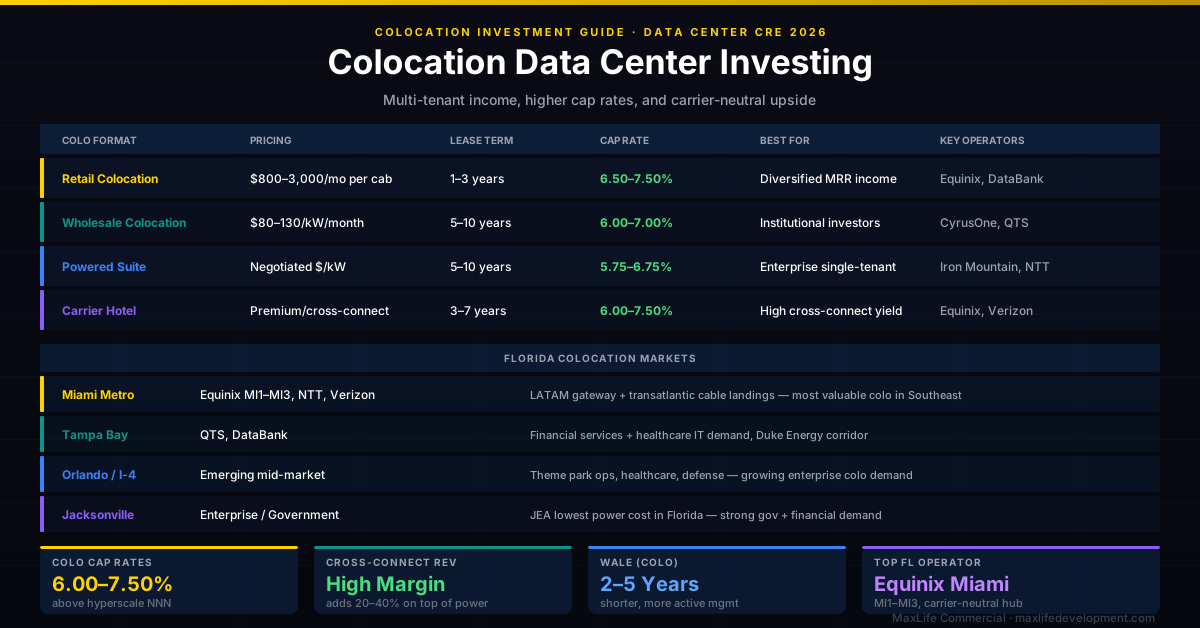
Colocation facilities are not a single product — they range from shared cabinet retail colo serving small businesses up to large wholesale deployments and carrier hotels that form the backbone of the internet. Each tier has distinct pricing, lease terms, cap rate expectations, and investor profiles.
| Colo Format | Pricing | Lease Term | Cap Rate | Best For |
|---|---|---|---|---|
| Retail Colo | $800–3,000/mo per cabinet | 1–3 yr | 6.50–7.50% | SMB, enterprise IT, edge workloads |
| Wholesale Colo | $80–130/kW/month | 5–10 yr | 6.00–7.00% | Large enterprise, managed service providers |
| Powered Suite | Negotiated $/kW | 5–10 yr | 5.75–6.75% | Large enterprise dedicated environments |
| Carrier Hotel | Premium per cross-connect | 3–7 yr | 6.00–7.50% | Telecom carriers, ISPs, content networks |
Retail colo commands the highest power pricing per kW because it serves the largest number of smaller tenants — each paying a premium for the flexibility of a 1–3 year term and the convenience of a fully managed environment. Wholesale colo trades higher volume for lower per-kW pricing but secures longer leases, producing a more stable but lower-yielding income stream.
Carrier hotels occupy a special category: their primary value is not space or power pricing but interconnection density. A carrier hotel in Miami or New York charges $150–500 per cross-connect per month — a high-margin recurring revenue stream that can contribute 20–30% of total facility NOI from a relatively small physical infrastructure footprint. The most valuable carrier hotels are irreplaceable because the network effects of concentrated connectivity cannot be replicated by building a new facility nearby.
Major Colocation Operators and Why REIT Ownership Matters
The colocation industry has consolidated significantly over the past decade, with institutional capital — REITs, private equity, and sovereign wealth funds — acquiring most major independent operators. Understanding the ownership landscape is essential for benchmarking cap rates and identifying exit paths.
Equinix (EQIX) — The Global Standard
Equinix operates more than 250 data centers globally, making it the most geographically diversified and liquid publicly traded colocation REIT. Its International Business Exchange (IBX) campuses anchor the interconnection ecosystem in every major market — including Miami, where Equinix MI1, MI2, and MI3 form the critical Latin American internet gateway. Equinix's interconnection revenue (cross-connects, virtual fabric) constitutes roughly 20% of total revenue and grows independently of power utilization, providing a durable high-margin income stream.
Cap rate benchmark: 5.50–6.25% for stabilized Equinix-anchored facilities. Most liquid exit market in the colo sector.
CyrusOne — Wholesale Focus (KKR, 2022)
CyrusOne was acquired by KKR and Global Infrastructure Partners in 2022 for approximately $15 billion. The platform focuses on wholesale colocation and hyperscale deployments, with campuses in Dallas, Chicago, Phoenix, Northern Virginia, and internationally. CyrusOne's acquisition set a benchmark cap rate for large-scale stabilized wholesale colo portfolios and established private equity as a major force in the colocation market alongside public REITs.
Cap rate benchmark: 5.75–6.50% for comparable wholesale colo acquisitions.
QTS Realty Trust — Government and Enterprise (Blackstone, 2021)
QTS was acquired by Blackstone in 2021 for approximately $10 billion, one of the landmark transactions that signaled mainstream institutional acceptance of data center real estate. QTS operates large campus facilities in Richmond, Atlanta, Dallas, and the I-4 corridor (Orlando area), with a significant government and enterprise client mix. The government tenant profile — federal agencies, defense contractors — provides exceptionally stable, long-duration income.
Cap rate benchmark: 5.50–6.25% for government-anchored colo; slightly higher for pure enterprise retail.
DataBank — Edge Colocation (Digital Bridge)
DataBank, backed by Digital Bridge (formerly Colony Capital), specializes in edge colocation — mid-size facilities in secondary and tertiary markets that serve regional enterprises, healthcare systems, financial institutions, and government agencies. The edge colo model trades the premium pricing of carrier-neutral interconnection hubs for a broader geographic footprint and regional market dominance. DataBank operates facilities in more than 70 markets across the US.
Cap rate benchmark: 6.25–7.25% for edge colo in secondary markets.
Iron Mountain (IRM) — Archive to AI-Ready
Iron Mountain has been one of the most aggressive REIT transformations in recent data center history — transitioning from a physical records storage company to an operator of 80+ data centers globally, with an explicit strategy to build AI-ready high-density facilities. IRM's existing enterprise customer relationships (serving 94% of the Fortune 1000 for records management) provide a built-in colo customer pipeline. Iron Mountain data center acquisitions are priced at 6.00–7.00% cap rates reflecting the combination of stabilized income and operational upside.
Cap rate benchmark: 6.00–7.00% for IRM-comparable enterprise colo assets.
REIT ownership matters for colocation investors because the major REITs (Equinix, Digital Realty, Iron Mountain) are the most active and liquid acquirers of stabilized colocation facilities. Their acquisition pricing sets the cap rate floor for the sector, provides a credible exit path for developers and value-add investors, and creates transparent comparable transaction data that supports underwriting.
Underwriting a Colocation Facility
Colocation underwriting differs from both hyperscale NNN and traditional industrial analysis in several important ways. The income stream is operationally driven rather than lease-driven, which means the analyst must assess the quality of the operating platform as well as the real estate.
Revenue Stability: MRR vs. Annual NNN
Colocation revenue is denominated in monthly recurring revenue (MRR) contracts, not annual NNN rent. MRR contracts are inherently more granular and more frequently renewing than NNN leases — which creates both risk (higher churn probability) and opportunity (frequent mark-to-market). Underwrite revenue at the contract level, segregating power revenue (most stable), cross-connect revenue (high-margin, stickiest), and managed services (variable, execution-dependent).
Churn Analysis
Monthly churn rate — the percentage of contracted MRR lost each month — is the most important operating metric in colocation. World-class operators maintain gross churn of 0.5–1.0% per month (6–12% annually), meaning they replace 6–12% of their revenue base each year. Facilities with gross churn above 1.5–2.0% monthly signal fundamental competitive or operational problems. Analyze historical churn by tenant size, tenure, and reason for departure to distinguish structural from one-time churn.
Power Utilization Percentage
Contracted power utilization (contracted kW ÷ available critical kW) is the capacity metric that drives NOI. A facility contracted at 75% utilization has significant upside as it fills to 90–95%. Facilities at 95%+ contracted utilization are stabilized but have limited organic growth without expansion. Note the distinction between contracted utilization (revenue under contract) and actual draw utilization (real-time power consumption) — enterprise tenants often contract for more power than they actively draw, which affects utility cost management.
WALE: Colocation vs. Hyperscale
Weighted average lease expiry (WALE) for a well-operated colocation facility runs 2–5 years — dramatically shorter than the 15–20 year WALE for hyperscale NNN assets. This shorter duration is both the primary risk (income less predictable) and the primary opportunity (rents mark to market frequently, allowing capture of market rate increases). In a rising-rate environment for colo power pricing, short WALE is actually a performance advantage.
Cross-Connect Revenue: High-Margin Ancillary Income
Cross-connects — physical fiber connections between tenants within the same facility or between a tenant and a network provider — are priced at $150–500 per connection per month with near-100% gross margins. In a carrier-neutral colo with strong interconnection density, cross-connect revenue may represent 15–25% of total facility NOI. This revenue is extremely sticky because disconnecting a cross-connect requires physical migration of dependent workloads — creating a switching cost that reinforces tenant retention.
Normalizing NOI for Underwriting
To arrive at a clean underwriting NOI: strip non-recurring revenue (one-time installation fees, termination fees), normalize managed services revenue at steady-state rather than growth-phase assumptions, normalize occupancy at 85–90% of contracted capacity rather than peak, and separate operator management fee (if a third-party operator is engaged) from property-level expenses. Colocation expense ratios run 35–45% of gross revenue — far higher than the near-zero expense ratio of a true NNN hyperscale lease.
The Colocation Income Model: A Worked Example
Consider a 10 MW colocation facility operating at 85% contracted utilization with a diversified tenant roster of enterprise, SMB, and carrier customers:
The critical difference from hyperscale NNN is the 35–45% expense ratio. A hyperscale NNN facility with equivalent NOI would have a gross revenue near the NOI figure itself — the tenant pays all operating expenses. In colocation, the operator bears all facility operating costs: power (the single largest line item, often 20–25% of gross revenue at current utility rates), labor, maintenance, security, insurance, property tax, and management overhead. Colocation NOI is a net number arrived at after substantial operational infrastructure, not a passive lease payment.
This expense structure means that utility rate increases flow directly through to NOI — a 10% increase in utility power costs can compress NOI by 2–3 percentage points without compensating revenue increases. Strong operators manage this exposure through power cost pass-through provisions in tenant contracts, long-term utility PPAs, and on-site generation or storage deployment.
Colocation vs. Hyperscale: Side-by-Side Comparison
| Factor | Colocation | Hyperscale NNN |
|---|---|---|
| Cap Rate | 6.00–7.50% | 5.25–6.00% |
| Lease Term | 1–5 years (MRR) | 15–20 years NNN |
| Income Stability | Moderate — diversified across many tenants | Very High — single IG tenant, long duration |
| Operating Complexity | High — 24/7 ops, multi-tenant management | Low — tenant responsible for operations |
| AI-Readiness Upside | Moderate — can upgrade density per suite | High — tenant builds AI-specific interior |
| Tenant Churn Risk | Ongoing — enterprise IT migration to cloud | Very Low — 15–20 yr commitment |
| Mark-to-Market Upside | High — frequent lease rollovers | Low — rents locked for 15–20 years |
| Cross-Connect Revenue | Yes — significant ancillary upside | No |
The right choice between colocation and hyperscale depends on the investor's operational capability, risk tolerance, and return objectives. Hyperscale NNN is the bond-like allocation — maximum income predictability, minimum operational involvement, lowest yield. Colocation is the equity-like allocation — higher yield, active management, meaningful upside from mark-to-market and interconnection revenue, and more complex risk management.
Investors without an established colocation operating platform should consider acquiring stabilized facilities with an in-place operator or management agreement rather than attempting to run colocation operations without domain expertise. Unlike hyperscale NNN, where an investor can passively clip coupon, colo underperforms without competent 24/7 operations.
Florida Colocation Landscape: Four Markets
Miami — The LATAM Gateway (Most Valuable Carrier Hotels in the Southeast)
Miami hosts the most strategically valuable colocation real estate in Florida — and arguably in the entire southeastern United States. NAP of the Americas (now CyrusOne Miami) and Equinix's MI1, MI2, and MI3 campus are carrier-neutral interconnection hubs that aggregate hundreds of network providers, content delivery networks, financial institutions, and Latin American telecom carriers. Miami is the landing point for dozens of subsea cable systems connecting North America, South America, the Caribbean, and Europe — a fiber density advantage that no competing Florida market can replicate.
Cap rates: 5.75–6.50% for carrier-neutral Miami colo. Cross-connect revenue premium versus non-interconnection-focused facilities: 20–30% of NOI. New development constrained by urban land cost and utility capacity — premium pricing for existing carrier-neutral infrastructure is structural.
Tampa — Growing Enterprise Market
Tampa's financial services sector, healthcare concentration, and insurance industry hub create consistent colocation demand from enterprise tenants with stringent availability requirements. QTS Data Centers operates a major Tampa facility serving government and enterprise clients. Tampa Electric's transmission infrastructure supports large commercial loads, and the market has attracted multiple mid-size colocation operators. Tampa colo is primarily an enterprise play rather than a carrier hotel or interconnection market.
Cap rates: 6.25–7.00% for stabilized Tampa enterprise colo.
Orlando — Mid-Market Enterprise and Government
Orlando's colocation demand comes from an unusually diverse mix: theme park operators (Disney, Universal, SeaWorld) with enterprise IT requirements, the UCF research corridor driving healthcare and biotech demand, significant government and defense contractor presence, and the growing I-4 technology corridor. QTS operates a major campus in the Orlando area serving government clients. Mid-size regional colo operators have found a durable niche serving the Central Florida enterprise market at price points between Miami premium colo and pure commodity hosting.
Cap rates: 6.50–7.25% for stabilized Orlando enterprise colo.
Jacksonville — Enterprise and Government, Lowest Cost
Jacksonville is the lowest-cost major colocation market in Florida. Land costs are 50–60% below Miami, utility rates are competitive, and the regional financial services and healthcare industries provide steady mid-market demand. Jacksonville has attracted several enterprise-focused colo operators serving regional banks, insurance companies, and government agencies. The market lacks Miami's interconnection premium but offers the highest cap rates in the Florida colo landscape for investors comfortable with a more concentrated regional tenant base.
Cap rates: 6.75–7.50% for stabilized Jacksonville enterprise colo.
Acquisition Structures: How Investors Enter Colocation
Direct Acquisition
Acquiring a stabilized colocation facility outright — either an independent operator or a facility carved out from a larger portfolio. Requires either an in-place operator management agreement or proprietary operational infrastructure. Best for investors with colocation operating experience or established management partnerships.
Enterprise Sale-Leaseback
Large enterprises (financial institutions, healthcare systems, insurance companies) that own their own data centers often sell the real estate to investors and leaseback operational control. This structure provides the investor with a known tenant quality and operational history while giving the enterprise capital to redeploy from real estate into their core business.
REIT Spinoff / JV
Non-core data center assets occasionally come to market as REITs rationalize portfolios — facilities in secondary markets that don't fit a REIT's core strategy but are fully stabilized with institutional-quality operations. These assets often trade at slight discounts to core market pricing but with proven operating platforms in place.
Independent Operator Portfolio
Independent regional colo operators — facilities built in the 2000s–2015s by entrepreneurs who lacked the institutional balance sheet to scale — represent a rich acquisition pipeline. These operators often have strong local market positions, loyal tenant bases, and significant value-add potential from technology upgrades, pricing optimization, and operational improvement under institutional management.
Colocation Investment Risks
Enterprise IT Cloud Migration Churn
The primary structural risk for retail colocation is the ongoing migration of enterprise IT workloads to public cloud (AWS, Azure, Google Cloud). When an enterprise shuts down its private server infrastructure in favor of cloud-hosted applications, its colocation footprint shrinks or disappears entirely. Facilities heavily dependent on legacy enterprise IT tenants face secular demand headwinds that no amount of operational excellence can fully offset.
AI Transition Obsolescence Risk
Legacy air-cooled colocation infrastructure — designed for 2–8 kW per rack densities — is structurally unsuitable for AI training and inference workloads that demand 30–100+ kW per rack. Facilities that cannot be retrofitted for high-density liquid cooling face functional obsolescence for the fastest-growing segment of data center demand. This risk is most acute for older facilities built before 2010 with constrained floor load ratings and cooling plant capacity.
Carrier Consolidation
Carrier hotels derive significant value from the density of network providers they host. Telecom industry consolidation — mergers between carriers, CDN providers, and ISPs — reduces the number of distinct entities requiring physical interconnection points, compressing the cross-connect revenue growth that drives carrier hotel premium valuations. Miami's subsea cable dominance provides partial insulation from this risk.
Operational Complexity and Execution Risk
Colocation requires 24/7 on-site technical staff, sophisticated power and cooling management, active sales and customer success operations, and complex billing systems. Unlike hyperscale NNN where income is a passive lease receipt, colocation NOI is entirely dependent on operational execution. Management team quality and institutional infrastructure are critical diligence factors that real estate-focused investors sometimes underweight relative to the physical asset analysis.
Go Deeper: Data Center and AI Real Estate Course
The MaxLife Commercial Academy course on data center and AI real estate covers colocation underwriting, hyperscale development, powered shell deal structuring, and the full Florida mission-critical investment landscape — with worked examples and transaction case studies.
View Data Center CourseMaxLife Commercial advises investors evaluating colocation and data center real estate across Florida — from Miami carrier hotels and enterprise sale-leasebacks to regional colo acquisitions in Orlando, Tampa, and Jacksonville. Whether you are underwriting a stabilized facility or sourcing development sites with utility capacity for a new colo build, explore our Florida data center advisory services to understand how we can support your transaction.