AI Campus Real Estate in Florida: The New Frontier
AI campuses did not meaningfully exist as a real estate category before 2022. By 2024 they had become the single largest destination for CRE investment capital on the planet — drawing hundreds of billions of dollars from hyperscalers, sovereign wealth funds, and private equity in a span of months. This guide explains the asset class from the ground up: what makes an AI campus different, why Florida is emerging as a destination, and how investors are accessing the opportunity.
A Brand-New CRE Category — Born in 2022
The AI campus did not exist as a commercial real estate asset class before the launch of ChatGPT in November 2022. Prior to that inflection point, "data center real estate" meant primarily colocation facilities and traditional enterprise server farms — important infrastructure, but modest in scale and power density compared to what followed.
The transformer-based large language model (LLM) architecture that powers ChatGPT, Gemini, Grok, Claude, and Llama requires a fundamentally different class of infrastructure. Training a frontier model is not a software problem that can be solved with incremental additions to existing data centers. It requires purpose-built campuses designed from the ground up to deliver 50 to 500 megawatts of continuous power to tens of thousands of GPU accelerators — operating 24 hours a day, seven days a week, for months on end.
In 2024 and 2025, global hyperscalers — Microsoft, Amazon Web Services, Google, Meta, and Oracle — committed a combined $325 billion or more in capital expenditure to AI infrastructure, the vast majority of which flows into real estate: land, buildings, power infrastructure, and cooling systems. This is not an incremental expansion of the traditional data center market. It is a new asset class, and it became the largest single CRE investment category in the world in a time frame that has no historical precedent.
AI campuses went from virtually nonexistent to the largest single CRE investment category in the world between 2022 and 2026 — a capital cycle compression with no historical parallel in commercial real estate.
What Makes an AI Campus Different from a Traditional Data Center
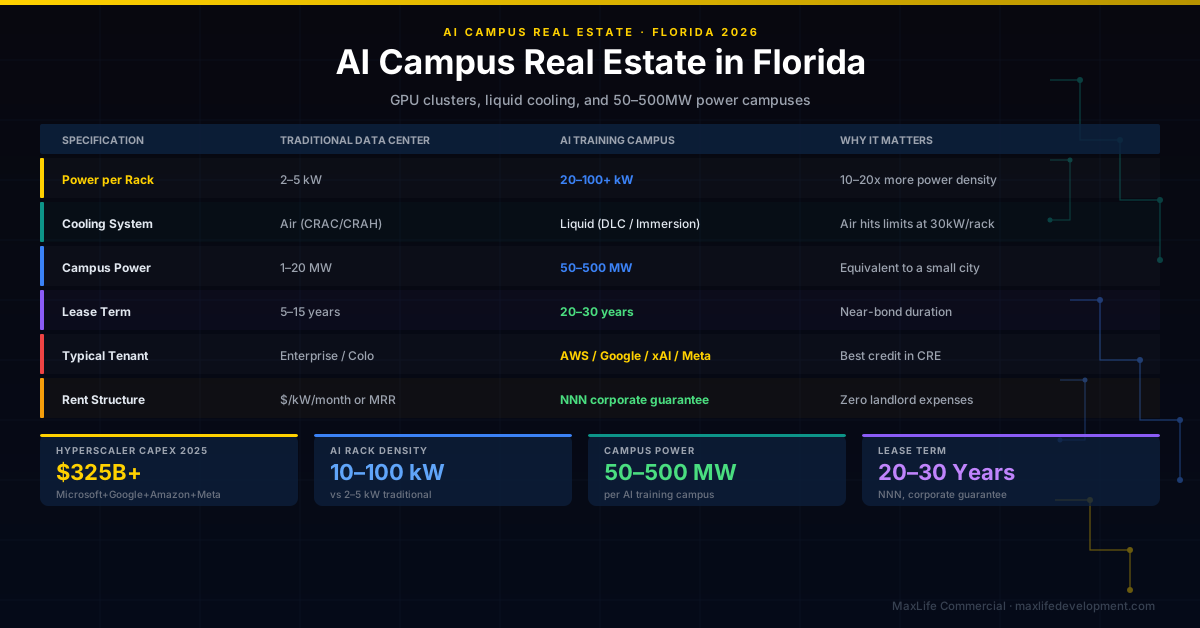
The difference between a traditional data center and an AI training campus is not a matter of degree — it is a categorical distinction in power, cooling, scale, and lease structure. Understanding these differences is prerequisite to underwriting AI campus real estate.
| Attribute | Traditional Data Center | AI Training Campus |
|---|---|---|
| Power per rack | 2–5 kW | 20–100+ kW |
| Cooling method | Air cooling (CRAC/CRAH) | Liquid cooling required |
| Total campus power | 1–20 MW | 50–500 MW |
| Lease term | 5–15 years | 20–30 years |
| Typical tenant | Enterprise, colocation operators | Hyperscaler (Microsoft, Google, xAI) |
| Rent structure | $/SF or $/kW/month (retail rate) | $80–120/kW/month wholesale NNN |
| Site selection driver | Fiber density, urban proximity | Power grid capacity, land area, water |
The power density difference is the most consequential. A traditional enterprise rack running standard servers consumes 2 to 5 kilowatts. An AI training rack loaded with NVIDIA H100 or H200 GPUs consumes 20 to 100 kilowatts — or more in specialized liquid-cooled configurations. This is not a problem that can be solved by upgrading a conventional data center's cooling plant. It requires infrastructure designed from the foundation to handle orders of magnitude more heat rejection per square foot than anything built before 2022.
The Compute Stack Driving Real Estate Demand
To understand why AI campus real estate requirements are so extreme, it helps to trace the energy demand from the model down to the kilowatt.
Every major frontier AI model — OpenAI's ChatGPT, Google's Gemini, Elon Musk's Grok, Anthropic's Claude, and Meta's Llama — is trained on GPU clusters. The dominant training accelerator as of 2025–2026 is the NVIDIA H100 or H200, each of which draws approximately 700 watts of power at full load. A modest training cluster of 10,000 H100s draws 7 megawatts just for the compute cards — before accounting for networking switches, storage, power conversion losses, or cooling.
Frontier model training clusters are not 10,000 GPUs. The xAI Colossus cluster in Memphis launched with 100,000 NVIDIA H100s — 70 megawatts of compute alone — and scaled to 200,000 GPUs in subsequent expansion phases. Microsoft's AI training infrastructure is measured in hundreds of thousands of GPUs spread across multiple campuses. Google's TPU pod deployments for Gemini training involve custom silicon at similar scale. When you add power conversion losses, networking infrastructure, storage, and cooling overhead, a 100,000-GPU cluster requires 150 to 200+ megawatts of total facility power.
The inference side — serving AI model responses to users — is even more demanding in aggregate. Where training is an intensive but finite process (a model is trained once, then deployed), inference runs continuously at scale as users interact with AI products. As AI adoption grows from experimental to ubiquitous, inference workloads multiply in ways that training workloads do not. This is why analysts project AI-driven data center power demand to double between 2025 and 2030, even assuming significant efficiency improvements in model architectures and hardware.
Power math for a 10,000-GPU cluster
This is why AI campuses start at 50 MW — actual production clusters are 5–20× this size.
Notable AI Campus Projects, 2024–2026
The scale of AI campus development underway globally has no precedent in commercial real estate history. A partial list of the most significant projects illustrates the magnitude:
xAI Colossus — Memphis, Tennessee
Elon Musk's xAI leased and retrofitted a former Electrolux appliance factory in Memphis in under four months — an almost incomprehensible construction timeline for a facility deploying 100,000 NVIDIA H100 GPUs drawing 150+ megawatts. Colossus became the world's largest known AI training cluster at launch in 2024 and has since expanded toward 200,000 GPUs. The project demonstrated that hyperscalers will accept non-traditional real estate solutions (retrofitted industrial, accelerated timelines) in exchange for immediate power delivery.
Microsoft + Constellation Energy — Three Mile Island
In a landmark deal that foreshadows the nuclear energy + AI campus convergence, Microsoft signed a 20-year power purchase agreement with Constellation Energy to restart Unit 1 of the Three Mile Island nuclear plant in Pennsylvania — rebranded Crane Clean Energy Center — to supply dedicated carbon-free power to Microsoft's AI data center expansion in the Mid-Atlantic region. The deal signals that hyperscalers are willing to fund nuclear restart projects to secure reliable, dispatchable, carbon-free power at the gigawatt scale required for AI campus buildout.
Google, Amazon, Meta — Hyperscale Buildout
Google committed $75 billion in 2025 capital expenditure, the majority directed toward AI infrastructure. Amazon Web Services has announced data center campuses in Virginia, Ohio, Indiana, Oregon, and internationally at a pace exceeding $50 billion annually. Meta is building multi-gigawatt AI infrastructure clusters in Louisiana, Texas, and internationally to support Llama model training and Meta AI inference. Combined, the five largest hyperscalers were on pace to invest $325+ billion in AI infrastructure capital expenditure in 2025 alone — a figure that exceeds the annual GDP of many developed nations.
Stargate — The $500B US AI Infrastructure Initiative
In early 2025, OpenAI, SoftBank, Oracle, and MGX announced the Stargate initiative — a joint venture committing $500 billion over four years to build AI infrastructure across the United States. The first $100 billion was to be deployed immediately, with projects anchored in Texas but expanding nationally. Stargate represents the formalization of AI campus real estate as strategic national infrastructure, with the federal government actively facilitating site selection, utility permitting, and permitting streamlining to accelerate deployment.
How AI Campuses Work as Real Estate
AI campuses are real estate in the same fundamental sense as any other CRE category — land, buildings, leases, and cash flow — but the economics, lease structures, and valuation metrics are distinct from conventional commercial real estate.
Lease Structures
The dominant lease structure for AI campus real estate is a 20 to 30-year NNN lease (or build-to-suit) with a corporate guarantee from an investment-grade hyperscaler parent entity. Lease terms are substantially longer than any other commercial real estate category — reflecting the hyperscaler's multi-decade commitment to the infrastructure and the developer's need to amortize land, utility, and construction costs over an extended period.
Annual rent escalations of 2 to 3% are standard. The primary rent metric is dollars per kilowatt per month for the critical IT power delivered — typically $80 to $120/kW/month in wholesale NNN structures. A 100 MW (100,000 kW) campus at $100/kW/month generates $10 million per month in gross rent — $120 million annually — from a single tenant on a single lease.
Buy vs. Lease
Unlike most CRE categories, hyperscalers frequently choose to own their AI campus real estate outright rather than lease. When a company is committing $500 million or more to a single campus and signing a 25-year lease anyway, the economics of fee simple ownership often favor buying — particularly when the hyperscaler has a sub-3% cost of capital and views the real estate as strategic infrastructure rather than an operating expense. Developer exit opportunities exist primarily in the 12 to 24-month window between site preparation and stabilized occupancy, when the hyperscaler is motivated to deploy capital into the operating asset rather than carry development risk.
REIT Involvement
Data center REITs — Digital Realty (DLR), Equinix (EQIX), and Iron Mountain (IRM) — are the most active institutional buyers of stabilized AI-capable campus assets. Digital Realty has announced AI-ready campus developments in Virginia, Texas, and internationally in JV with hyperscalers. Equinix is retrofitting existing xScale facilities to support higher density AI workloads. Iron Mountain launched its Project Matterhorn initiative to build 1+ gigawatt of AI-ready data center capacity. REIT involvement both validates the asset class and provides a clear exit path for developers who reach stabilization.
A 100 MW AI campus at $100/kW/month generates $120M in annual rent — from a single investment-grade tenant on a 20–30 year NNN lease. There is no other CRE structure that produces this combination of scale, duration, and credit quality.
Liquid Cooling: The Infrastructure Requirement That Changes Everything
Air cooling — the default method for traditional data centers — hits a physical wall at approximately 30 kilowatts per rack. Above that threshold, the volume of conditioned air required to remove heat from a single rack exceeds what any practical hot-aisle/cold-aisle containment configuration can deliver. AI GPU racks operating at 40 to 100+ kW are simply not compatible with air cooling.
Three liquid cooling technologies are being deployed in AI campuses today, each with different infrastructure requirements:
Direct Liquid Cooling (DLC)
Cold plates are attached directly to CPUs and GPUs, with liquid coolant circulating through them via manifolds running through the rack. Heat is transferred to a facility coolant loop and rejected via cooling towers. DLC supports rack densities up to 100+ kW and is the preferred approach for NVIDIA H100/H200 and next-generation AI accelerators. Requires purpose-built plumbing infrastructure in the floor, ceiling, and rack rows — not economically retrofittable in most existing data centers.
Immersion Cooling
Servers are submerged in tanks of dielectric fluid (single-phase) or fluorocarbon liquid (two-phase), which absorbs heat directly from components and either circulates to an external heat exchanger or boils off and recondenses. Immersion supports the highest rack densities (200+ kW per tank is achievable) and eliminates the need for traditional raised-floor air circulation. Requires specialized tanks, fluid management systems, and servers designed for immersion — not compatible with standard server hardware without modification.
Rear-Door Heat Exchangers (RDHx)
A water-cooled heat exchanger replaces the standard rear door of a server rack, intercepting hot exhaust air as it leaves the rack and cooling it before it enters the room. RDHx is the most retrofit-compatible liquid cooling option — it can be added to standard racks without modifying individual servers — but its heat removal capacity tops out at approximately 30–40 kW per rack, making it insufficient for the densest AI GPU configurations.
The practical implication for real estate is significant: the overwhelming majority of existing data center white space in the United States cannot support AI training or inference workloads at commercial scale. Facilities built before 2022 were not designed for liquid cooling infrastructure. The cost of retrofitting — ripping out raised floors, running coolant piping, upgrading chiller plants, and installing facility-wide coolant distribution — is typically 40 to 70% of the cost of new construction. Most existing facilities will not be economically retrofitted for AI. The demand is going to new builds.
Why Florida for AI Campuses
Florida is not the largest AI campus market in the United States — that distinction belongs to Northern Virginia, Texas, and Arizona — but the state is emerging as a legitimate destination for hyperscale and large-scale AI infrastructure investment. The reasons are structural, not speculative.
- →NextEra / Florida Power & Light — the world's largest renewable energy operator.FPL's parent NextEra Energy operates more renewable generation capacity than any other utility in the world. For hyperscalers under intense pressure from investors and regulators to achieve 100% renewable energy commitments, FPL's ability to offer long-term renewable power purchase agreements — backed by real solar and wind generation in Florida — is a material differentiator over Southeastern utilities with coal-heavy generation mixes. The sustainability argument for Florida is not marketing; it is megawatts of renewable capacity that can be contracted today.
- →Land cost advantage in Osceola, Pasco, and Polk counties.AI campuses require large contiguous parcels — 100 to 500+ acres for a fully built-out multi-gigawatt campus. In Northern Virginia (the dominant market), shovel-ready large parcels near utility infrastructure are exhausted; land that remains trades at premiums that compress development margins. In Osceola, Pasco, and Polk counties — the Central Florida growth corridor — comparable parcels are available at 30 to 50% of Virginia pricing with adequate utility transmission infrastructure. This cost differential is meaningful enough to influence hyperscaler site selection decisions for geographic-diversity campuses.
- →Competitive commercial power rates.Florida commercial and industrial power rates are competitive with other Sun Belt AI campus markets. Large-load power purchase agreements for 50+ MW industrial customers are available through both FPL and Duke Energy Florida, with rates that benchmark favorably against Georgia, Texas, and Arizona for comparable renewable content requirements.
- →Geographic diversity from Virginia and Texas.Hyperscalers with critical AI infrastructure concentrated in Northern Virginia and Texas face geographic concentration risk — a single major grid event, natural disaster, or regulatory disruption could impact multiple campuses simultaneously. Florida provides genuine geographic diversification as a Southeast market with independent utility grids, different climate risk profiles (hurricane vs. winter storm/drought), and distinct regulatory jurisdictions.
Hurricane Risk Design Requirement
AI campuses in Florida must be designed to withstand Category 4 hurricane wind loads — a requirement that adds 10 to 15% to structural costs but is non-negotiable for any hyperscaler building long-lived infrastructure in the state. Florida Building Code wind speed requirements in coastal and near-coastal counties exceed those of any other US data center market. Developers must account for hurricane-resistant construction in proforma assumptions and structural specifications from day one.
Investment Thesis: Four Ways to Access AI Campus Real Estate
Not every investor in AI campus real estate needs to develop a 200 MW campus from scratch. The asset class has developed enough breadth that meaningful exposure is available across a wide range of risk-return profiles.
1. Development (Highest Risk / Highest Reward)
50–200 MW projectsGround-up AI campus development — acquiring large parcels, securing utility capacity, and delivering powered shell or full turnkey build-to-suit product to hyperscale tenants — offers the best yield on cost in the asset class. Developers who can execute at 50 to 200 MW scale and deliver product in a supply-constrained market are earning yield-on-cost spreads of 200 to 400 basis points over in-place cap rates. The risk is commensurate: utility permitting delays, equipment lead times, construction cost escalation, and execution risk are all significant.
Target yield on cost: 7.5–9.0% against in-place cap rates of 5.0–5.75%. Best suited for institutional developers with utility relationships and $200M+ project capacity.
2. Stabilized Acquisition (Lowest Risk)
Rare, sub-5.5% capAcquiring a stabilized AI campus under a 20+ year NNN lease with a hyperscale tenant (Google, Microsoft, Amazon) is the lowest-risk play in the asset class — and correspondingly the lowest-yield. Stabilized hyperscale AI campuses trade at sub-5.5% cap rates when they transact at all, which is rarely. Most hyperscalers building at this scale are choosing to own rather than sell and leaseback. The acquisition opportunity set is thin and dominated by institutional capital.
Cap rate range: 5.0–5.5% for Google/Microsoft/Amazon credit. 5.5–6.0% for emerging hyperscalers (xAI, Oracle, Anthropic). Requires institutional deal flow.
3. REIT Access (Most Accessible)
DLR, EQIX, IRMFor investors who want AI campus real estate exposure without direct deal access, publicly traded data center REITs provide liquid, diversified exposure to the asset class. Digital Realty Trust (DLR) has the most direct AI campus exposure through its JV platforms with hyperscalers. Equinix (EQIX) benefits from AI-driven interconnection demand. Iron Mountain (IRM) is the most aggressive in pursuing AI-ready campus development. All three trade at premiums to NAV reflecting the market's recognition of AI-driven growth.
Dividend yield: 2–3%. Total return thesis is NAV growth from AI campus buildout and development spread capture. Liquid, no minimum investment.
4. Private Credit
Construction & bridge lendingThe AI campus development boom has created significant demand for construction and bridge financing — particularly for developers who have secured hyperscale pre-leases but need debt capital to fund the 18 to 24-month development timeline before permanent financing is available. Private credit lenders to AI campus developers are earning returns of 8 to 12% on first-lien construction loans backed by pre-signed hyperscale leases — a risk-return profile that compares favorably with most credit alternatives.
Target return: 8–12% on first-lien construction debt with hyperscale pre-lease backing. Accessible through private credit funds with data center mandates.
What Comes Next: The Future of AI Campus Real Estate
The AI campus real estate category is evolving faster than any CRE sector in history. Three structural trends are likely to define the next phase of development:
Nuclear Energy + AI Campus
The Microsoft / Three Mile Island deal is not an outlier — it is the template for how hyperscalers will solve the dispatchable 24/7 clean power problem at gigawatt scale. Existing nuclear plants facing decommissioning decisions are being evaluated by every major hyperscaler. SMR (small modular reactor) developers — NuScale, Kairos, TerraPower, X-Energy — are in active discussions with Microsoft, Google, and Amazon for dedicated power supply agreements. The nuclear + AI campus combination solves the hyperscaler's sustainability commitment without the intermittency of solar and wind. In Florida, NextEra's existing nuclear assets (Turkey Point, St. Lucie) are positioned to benefit from this trend.
Offshore Wind-Powered Campuses
Hyperscalers in coastal markets are evaluating dedicated offshore wind capacity paired with AI campuses in locations where onshore power capacity is constrained. The concept: contract a 500 MW offshore wind farm and co-locate a 400 MW AI campus at the grid interconnection point, achieving both renewable energy purity and proximity to the generation source. This model is being actively studied for Southeast US markets including the Mid-Atlantic and Florida coasts.
AI Inference Edge Facilities Near Population Centers
While AI training requires massive centralized campuses in locations optimized for power cost and land, AI inference — serving model responses to users — benefits from proximity to population centers to reduce round-trip latency. The next phase of AI infrastructure buildout is expected to involve distributed inference edge facilities of 5 to 50 MW in or near major metros. Orlando, Miami, Tampa, and Jacksonville are all logical candidates for Florida inference edge deployments as AI application adoption deepens in the state's 23 million residents.
MaxLife Academy
Deep-Dive Course: Data Center & AI Real Estate
The MaxLife Academy course on data center and AI real estate covers the full investment lifecycle — from site selection and utility procurement through lease underwriting, construction oversight, and exit strategy. Purpose-built for CRE investors and developers entering the mission-critical real estate category.
Explore the CourseWork with MaxLife Commercial
MaxLife Commercial advises investors, developers, and family offices evaluating AI campus and data center real estate exposure in Florida. Whether you are sourcing development land with secured power, underwriting a stabilized colocation acquisition, or seeking market intelligence on Florida's emerging AI infrastructure corridor, Ryan Solberg and the MaxLife team can help you navigate the most capital-intensive CRE category of this decade.
Explore Florida's AI and data center real estate landscape at our Florida data centers hub or contact us directly to discuss a specific opportunity.