Quick Navigation
What Is a 1031 Exchange?
A 1031 Exchange (named after Section 1031 of the Internal Revenue Code) is a tax strategy that allows you to sell an investment property, defer all capital gains taxes, and reinvest 100% of your proceeds into a replacement property.
Here's the power: When you sell a commercial property for $3.5M with a $1.7M gain, you typically owe 20-35% in federal taxes ($340K-$595K). A 1031 exchange lets you avoid that entire tax bill, keeping all $3.5M to reinvest.
Key benefit: You compound your wealth faster because you're reinvesting full equity instead of 65-70% after taxes.
1031 Exchange Timeline: The Rules You Must Follow
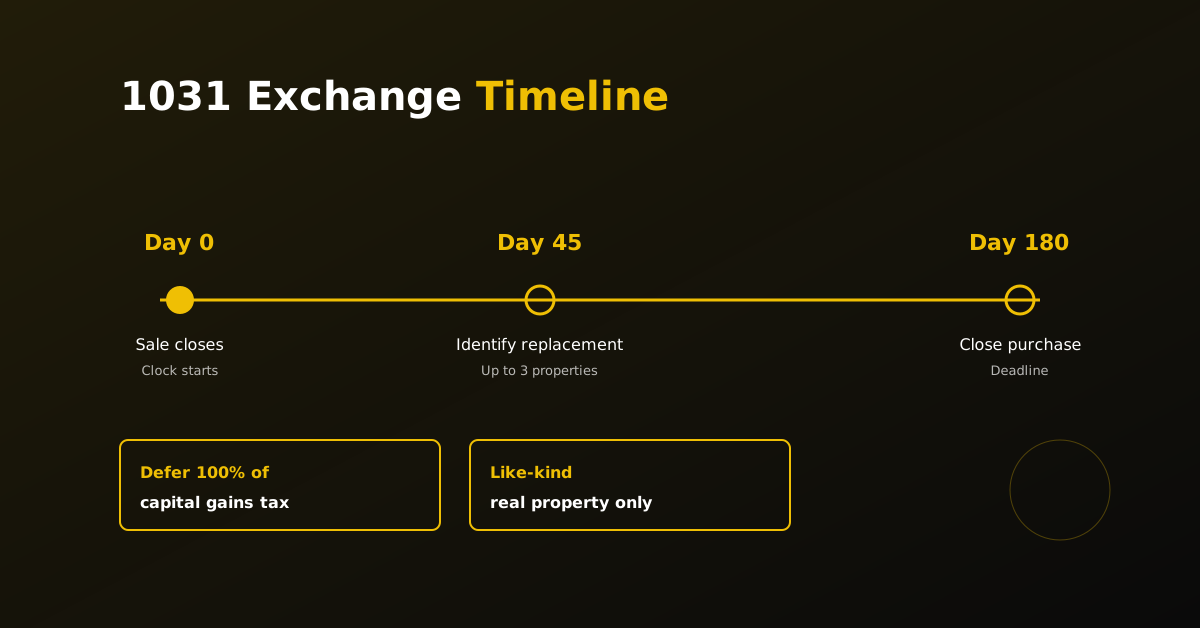
Day 0 → 45
Identification Period
Identify up to 3 replacement properties in writing to your Qualified Intermediary
Day 45 → 180
Closing Period
Close on at least ONE identified property before Day 180 (absolute deadline)
⚠️ Critical Rule: These deadlines cannot be extended. Missing either deadline = 1031 fails, you owe all taxes.
The 45/180 Timeline: Don't Miss These Deadlines
This is the single most important rule in a 1031 exchange. You have exactly 45 calendar days from closing your sale to identify replacement properties in writing. You have exactly 180 calendar days from closing to complete purchase of a replacement property.
Both deadlines are hard stops. No extensions. No exceptions. Even if the property closes on Day 181, the 1031 is void and you owe all taxes.
Pro strategy: Start identifying replacement properties before you close your sale. The 45-day clock starts at sale closing, but having deals lined up means you can close faster and reduce execution risk.
On a 1031 Timeline?
The 45-day clock is unforgiving. Start your replacement property search now.
Ryan specialises in identifying NNN, industrial, and multifamily replacement properties for Florida 1031 exchangors — often before they hit the market.
"Like-Kind" Property Rule: What Qualifies?
✅ What Qualifies
- • Commercial building → warehouse
- • Retail center → multifamily
- • Office → industrial flex
- • NNN property → any CRE
- • Raw land → developed property
❌ Does NOT Qualify
- • Real property → personal property
- • Real property → intangible assets
- • Investment property → your home
- • Property held for resale
- • Stocks, bonds, notes
How Much Can You Save? Real Tax Calculations
Let's be concrete. You sold a Miami retail center for $3.5M. Your adjusted basis was $1.8M. Your capital gain is $1.7M.
Scenario: $1.7M Capital Gain on $3.5M Sale
| Cost Component | Without 1031 | With 1031 |
|---|---|---|
| Federal Capital Gains (20%) | $340,000 | $0 |
| Depreciation Recapture (25%) | $75,000 | $0 |
| NIIT / Surtax (3.8%) | $64,600 | $0 |
| Total Tax Owed | $479,600 | $0 |
| Capital to Reinvest | $3,020,400 | $3,500,000 |
* Assumes $250K depreciation recapture, 20% CG rate, NIIT on high earner. Consult your CPA for your specific situation.
Bottom line: You keep an extra $479,600 that would have gone to the IRS. Over a 10-year hold, that $479K reinvested at 8% returns compounds to over $1M in additional wealth.
Why Florida Is the Perfect 1031 Market
1. No State Income Tax
Florida has zero state income tax. Combined with 1031 federal deferral, your rental income is maximally protected.
2. Population Boom: 1,400/Week Moving In
Central Florida growing 2.4%+ annually. Consumer demand = warehouse demand = rent growth.
3. Economic Diversification
No longer just tourism. Tech, healthcare, logistics creating diverse tenant base and recession resistance.
4. Logistics Hub
I-4 corridor connects Tampa, Orlando, Daytona. MCO airport = international access. Industrial yields 5.4-5.8%.
Real Deal Examples: How to Structure Your 1031
Example 1: Retail → Industrial (Higher Yield Play)
Original: Retail center Miami, sell $3.5M, net $3.3M
Capital gain: $1.7M (would cost $480K in taxes)
1031 into: Industrial warehouse, Lake Nona, $3.3M
Cap rate: 5.6% = $184,800/year NOI
Result: Upgrade to higher-yielding asset, defer $480K in taxes, keep full equity.
Example 2: Single NNN → Portfolio (Diversification Play)
Original: Single Walgreens NNN, Tampa, sell $2.5M
1031 into three properties:
• Lake Nona industrial: $1.2M
• Winter Garden CVS (NNN): $1.0M
• Horizon West NNN: $0.2M
Result: Diversify across industrial growth + stable NNN income, spread risk.
Step-by-Step: How to Execute Your 1031
Step 1: Hire a Qualified Intermediary (Before You Close)
Find an IRS-recognized Qualified Intermediary. Cost: $500-1,500. They hold your proceeds in escrow. You cannot touch the money.
Step 2: Sell Your Property
Close on sale. Proceeds go to QI. Your 45-day and 180-day clocks both start TODAY.
Step 3: Identify Replacement Properties (Days 0-45)
Formally identify up to 3 properties in writing to your QI. Can be any real property in the US. No price limits.
Step 4: Due Diligence & Negotiate (Days 45-160)
Get financing approved. Phase 1 environmental. Appraisal. Rent roll review. Validate cap rates with deal analyzer.
Step 5: Close on Replacement (By Day 180)
QI wires funds. You own replacement property. Capital gains taxes deferred indefinitely.
Validate Every 1031 Deal
Don't overpay for replacement properties. Use our free deal analyzer to validate cap rates, cash-on-cash returns, IRR, and equity multiples before you commit.
Use Deal Analyzer →Critical Mistakes to Avoid
❌ Touching Your Proceeds
If you receive sale proceeds directly, even temporarily, the 1031 fails. QI must hold all funds.
❌ Missing the 45-Day Deadline
You must identify properties in writing by Day 45. Day 46 = too late.
❌ Missing the 180-Day Deadline
You must close by Day 180. Day 181 = 1031 fails.
❌ Overpaying for Replacement Property
Don't rush due diligence. Analyze every deal. Overpaying to meet timeline = negative ROI.
❌ Reinvesting in Wrong Asset Class
Tax deferral ≠ bad investment. Reinvest in equal or better-yielding properties.
Finding Off-Market 1031 Opportunities
The best 1031 deals are off-market. Listed properties get competition and cap rates compress. Off-market deals get less attention.
Build broker relationships — Work with brokers who specialize in pocket listings
Network with CPAs/attorneys — They know clients doing 1031s before announcement
Target distressed properties — Vacancy, deferred maintenance = motivated owners
Direct mail campaigns — Reach owners in your target markets before listings
Property manager networks — PMs know owners thinking about selling
Ready to Execute Your 1031?
Schedule a free consultation with our team. We'll help you identify the best Central Florida markets for your 1031, access off-market deals, and structure deals that maximize tax efficiency and returns.
Running a 1031? Get Florida Replacement Property Ideas.
We send curated NNN, multifamily, and industrial replacement properties to Florida investors on 1031 timelines. Weekly. No spam.
Disclaimer: This guide is educational content and not tax or investment advice. Consult with your CPA, tax attorney, and financial advisor regarding your specific situation. 1031 exchange rules are complex; improper execution can result in loss of tax deferral and penalties.