CCIM Designation: What It Means for Commercial Real Estate Investors
The CCIM (Certified Commercial Investment Member) designation is widely considered the gold standard in commercial real estate education. Here is a complete breakdown of what CCIM means, what it takes to earn it, and why it matters when evaluating your broker or investment team.
What Is the CCIM Designation?
CCIM stands for Certified Commercial Investment Member. The designation is awarded by the CCIM Institute, which was founded in 1967 and now has over 9,000 active designees in more than 30 countries.
The CCIM program is built around a graduate-level curriculum that covers the core disciplines of commercial real estate investment: financial analysis, market analysis, user decision analysis, and investment analysis. Candidates must complete four core courses (CI 101 through CI 104), plus elective coursework, before sitting for the comprehensive examination.
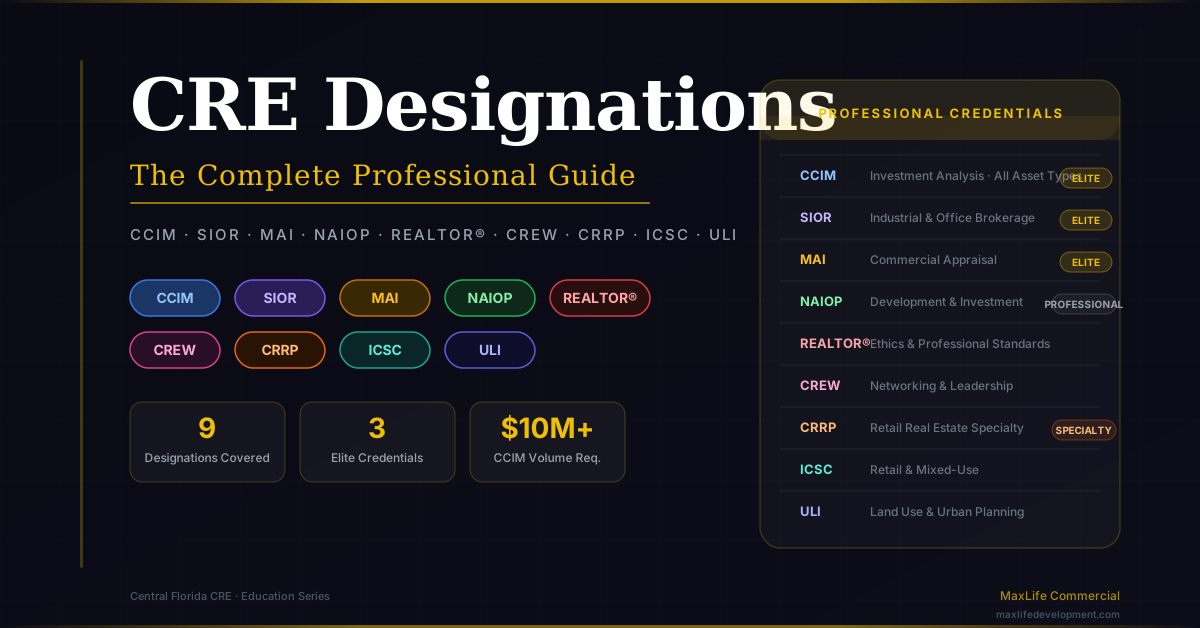
What sets CCIM apart from most real estate credentials is the transaction portfolio requirement — candidates must document a minimum of $10 million in qualifying commercial real estate transactions. This means a CCIM is not just educated in theory; they have a documented track record of closing real deals.
Why CCIM Matters for CRE Investors
The Investor Advantage
Commercial real estate investing is fundamentally a numbers game. Cap rates, internal rate of return (IRR), debt service coverage ratio (DSCR), net present value (NPV), cash-on-cash return — these metrics determine whether a deal is a winner or a trap. A CCIM has spent hundreds of hours learning to calculate, interpret, and stress-test these figures.
When you work with a CCIM-designated broker, you are working with someone who can run the same financial models that institutional investors use — and explain them to you in plain terms. For investors evaluating NNN properties, multifamily, industrial, or retail assets, this analytical depth is invaluable.
CCIM designees are also trained in market analysis — understanding supply and demand dynamics, absorption rates, submarket trends, and demographic drivers. This goes far beyond simply pulling comparable sales; it is a systematic approach to understanding why a market is moving and where it is likely to go.
Requirements to Earn the CCIM Designation
CI 101: Financial Analysis for Commercial Investment Real Estate
Covers time value of money, IRR, NPV, cash flow analysis, and investment decision frameworks.
CI 102: Market Analysis for Commercial Investment Real Estate
Covers supply/demand fundamentals, absorption analysis, and market cycle interpretation.
CI 103: User Decision Analysis for Commercial Investment Real Estate
Covers lease vs. own analysis, tenant decision-making, and occupancy cost modeling.
CI 104: Investment Analysis for Commercial Investment Real Estate
Covers portfolio management, leverage analysis, tax implications, and exit strategies.
Elective coursework or portfolio credit
Candidates may substitute qualifying experience or approved courses for some elective requirements.
$10M+ qualifying transaction portfolio
Must document commercial real estate transactions (as principal, broker, or advisor) meeting CCIM Institute criteria.
Comprehensive examination
A proctored, case-study-based exam testing applied knowledge across all curriculum areas.
Membership in the CCIM Institute
Ongoing annual dues and ethics compliance required to maintain active designation status.
How to Verify a CCIM Designation
The CCIM Institute maintains a publicly searchable directory of all active designees. You can verify any broker's CCIM status — and view their specialty areas — at:
CCIM Designee Directory
ccim.com/find-a-ccimSearch by name, city, state, or specialty. The directory shows designation year and contact information.
CCIM vs. Other CRE Credentials
CCIM vs. SIOR
CCIM emphasizes financial and investment analysis across all commercial property types. SIOR focuses on production volume and professional standing in industrial and office brokerage specifically. CCIM is more analytical; SIOR is more production-volume-oriented. Many elite industrial and office brokers hold both.
CCIM vs. MAI
CCIM is a brokerage and investment analysis credential. MAI is an appraisal credential. A CCIM broker advises on buying, selling, and leasing commercial assets. An MAI appraiser provides independent valuations. They serve different functions — an investor typically needs both a CCIM broker and an MAI appraiser on any significant acquisition.
Frequently Asked Questions
How long does it take to earn the CCIM designation?
Most candidates complete the CCIM program in 2–4 years. The four core courses (CI 101–104) can be completed in about one year of focused study. Meeting the $10M+ qualifying transaction portfolio requirement depends on deal volume and may take additional time for brokers earlier in their careers.
Is the CCIM designation worth it?
For brokers and investors who are serious about commercial real estate, the CCIM designation is widely considered one of the highest-ROI credentials available. Studies by the CCIM Institute have shown that CCIM designees earn significantly more than non-designated peers. The analytical framework taught in the program — IRR, NPV, DSCR, hold-period analysis — applies to every investment decision throughout a career.
How many CCIMs are there in Florida?
Florida typically has several hundred active CCIM designees, concentrated in major markets including Orlando, Miami, Tampa, Jacksonville, and Fort Lauderdale. Florida's large commercial real estate market supports one of the larger state-level CCIM chapters in the country.
Related Designations
Work with MaxLife Commercial
Ready to Work with a Credentialed CRE Broker?
Ryan Solberg is a licensed Florida commercial real estate broker bringing institutional-grade deal analysis to every transaction in Central Florida.
Get Off-Market CRE Deals in Your Inbox
Join our investor list for exclusive Central Florida opportunities, market reports, and deal analysis — delivered weekly. No spam, unsubscribe anytime.