Why Orlando Is a Top Multifamily Market
Orlando has consistently ranked among the top multifamily investment markets in the United States, and for good reason. The metro area's population growth rate significantly outpaces the national average, driven by domestic migration from higher-cost states, a growing international population, and a diversifying economy that extends well beyond tourism and hospitality. The Orlando-Kissimmee-Sanford MSA now exceeds 2.7 million residents and continues to add roughly 50,000 new residents per year, placing it among the fastest-growing metros in the country. That sustained population growth directly translates into apartment demand that few competing markets can match.
The demand side of the equation is particularly compelling for apartment investors. Orlando's median household income has risen steadily, yet homeownership costs have also escalated, keeping a large share of the workforce in the renter pool. Young professionals, healthcare workers, technology employees, and university students all contribute to a deep and varied tenant base that supports strong occupancy across multiple product types. Orlando's renter-occupied housing share hovers near 44%, meaningfully above the national average, and housing affordability pressures continue to push would-be buyers toward leasing.
Employment diversification is another pillar supporting the multifamily thesis. While tourism and hospitality remain important, Orlando has developed significant employment clusters in healthcare, aerospace and defense, financial services, modeling and simulation technology, and logistics. Major employers including AdventHealth, Lockheed Martin, Northrop Grumman, and Electronic Arts provide stable, well-paying jobs that underpin apartment demand across a range of price points. The University of Central Florida, with enrollment exceeding 70,000 students, further anchors tenant demand in the eastern corridor.
From a supply perspective, while new apartment deliveries have increased, absorption has remained healthy in well-located submarkets. The Orlando commercial real estate market offers multifamily investors a combination of yield, growth, and liquidity that is difficult to find in other Sun Belt metros at comparable price points. Unlike gateway cities such as Miami or Tampa, where per-unit pricing has compressed cap rates to levels that strain cash-on-cash returns, Orlando still offers a favorable spread between acquisition yields and borrowing costs for well-sourced deals.
Multifamily Submarkets to Watch
Not all Orlando submarkets perform equally for multifamily investors. Location fundamentals — including employment centers, transportation access, school quality, and household income levels — determine which neighborhoods command the strongest rents and experience the lowest vacancy. Here are the submarkets that deserve the closest attention.
Downtown Orlando / Mills 50
Urban core living continues to attract young professionals and empty nesters seeking walkability, dining, and nightlife. Older garden-style apartments in this area present value-add opportunities through renovation and repositioning. Average rents for renovated one-bedroom units in the downtown core range from $1,600 to $2,000 per month, while unrenovated units in adjacent neighborhoods like Colonialtown and Mills 50 often lease in the $1,200 to $1,400 range, representing meaningful upside for value-add operators.
Lake Nona / Medical City
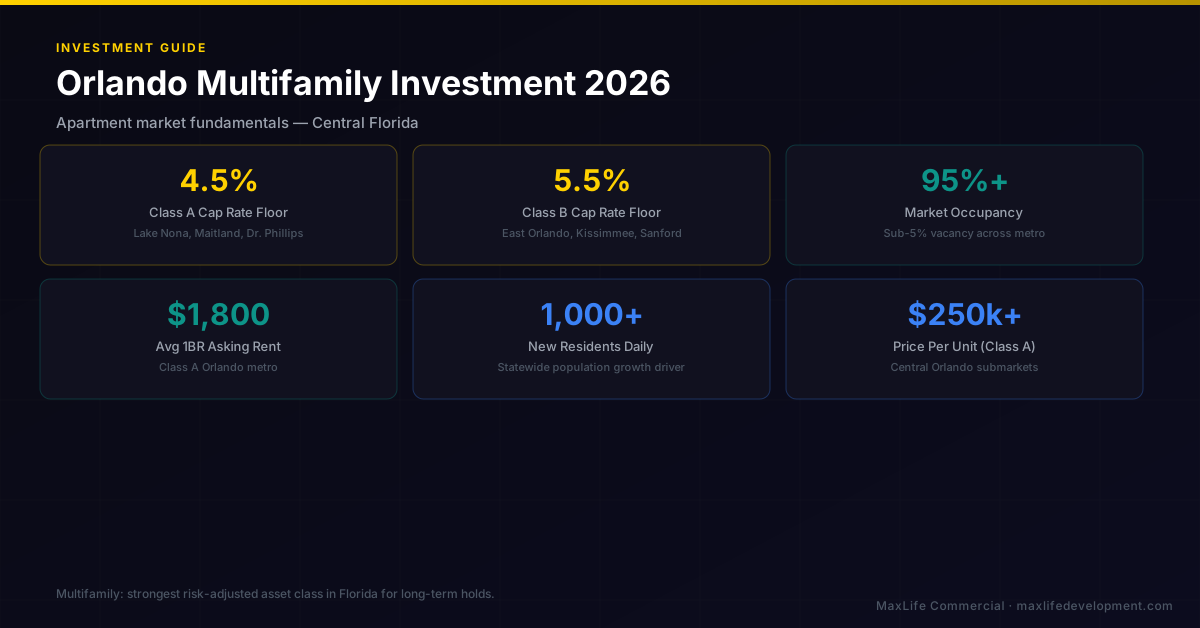
The Lake Nona area benefits from a rapidly expanding employment base anchored by healthcare, life sciences, and technology companies. The VA Medical Center, Nemours Children's Hospital, and UCF College of Medicine together employ thousands of workers who need housing within commuting distance. New Class A apartment communities have leased up quickly, and rent growth has outpaced the metro average. Per-unit pricing in Lake Nona often exceeds $250,000 for newer product, reflecting investor confidence in the submarket's long-term trajectory.
Winter Park / Maitland
Established affluent suburbs with strong school systems and high barriers to new construction. Multifamily properties here benefit from stable occupancy and a tenant base with above-average income levels. Typical Class B apartments in Winter Park achieve occupancy rates above 95%, and the limited availability of developable land constrains new supply, protecting existing owners from competitive pressure. Median household incomes in Winter Park exceed $70,000, supporting premium rents relative to the broader metro.
Kissimmee / Osceola County
The fastest-growing county in the metro offers lower per-unit acquisition costs and a large renter population. Workforce housing in this submarket serves hospitality, healthcare, and logistics employees. Investors can acquire 1990s-vintage communities at $100,000 to $140,000 per unit, well below metro averages, with two-bedroom rents typically ranging from $1,400 to $1,700. The extension of SunRail commuter service and ongoing road infrastructure improvements are improving connectivity and long-term investment appeal.
UCF / East Orlando
Proximity to the University of Central Florida and the Research Park creates consistent student and young professional demand. This submarket offers both purpose-built student housing and conventional apartment investments. The Research Park houses more than 100 companies and 10,000 employees across defense, simulation, and technology sectors, providing a stable employment anchor beyond the university itself. Two-bedroom conventional apartments in the Alafaya corridor typically lease between $1,500 and $1,800 per month.
Our Downtown Orlando market page and Lake Nona market overview provide deeper analysis of two of the most active multifamily corridors in the region.
Beyond these primary submarkets, investors should also monitor emerging corridors along the I-4 corridor between Orlando and Tampa, the Apopka and Mount Dora growth path in northwest Orange County, and the Sanford area in Seminole County where commuter rail access and lower land costs are attracting new development interest. Each of these secondary submarkets presents distinct risk-return profiles that merit evaluation based on individual investment criteria.
Multifamily Rent Trends in Orlando
Tracking rent trends is essential for underwriting multifamily acquisitions accurately and identifying the strongest opportunities in the Orlando market. Over the past five years, Orlando apartment rents have increased at an annualized rate that meaningfully outpaces the national average. While the pace of growth moderated after the extraordinary increases seen in 2021 and 2022, rental rates across the metro remain on an upward trajectory supported by population growth and constrained single-family affordability.
As of early 2026, average effective rents across the Orlando MSA range from approximately $1,500 for a one-bedroom unit to $1,800 for a two-bedroom unit in Class B product. Class A communities in premium locations such as Lake Nona, Baldwin Park, and downtown Orlando command a significant premium, with one-bedroom rents often exceeding $1,900 and two-bedrooms reaching $2,300 or more. At the other end of the spectrum, Class C workforce housing in Osceola County and parts of Pine Hills offers one-bedroom rents in the $1,100 to $1,300 range, providing accessible cash flow yields for investors willing to manage older product.
Rent growth has not been uniform across the metro. Submarkets anchored by strong employment nodes — particularly Lake Nona, the downtown core, and the UCF corridor — have demonstrated the most resilient rent growth even during periods of elevated new supply deliveries. In contrast, submarkets with high concentrations of new construction, such as portions of the I-Drive corridor, have experienced temporary rent concessions as new communities compete for tenants during initial lease-up. Savvy investors use our Deal Analyzer to model submarket-specific rent growth assumptions rather than relying on metro-wide averages.
Looking ahead, several factors support continued rent growth in the Orlando multifamily market. The gap between the monthly cost of renting versus owning a median-priced home remains wide, keeping renters in the apartment market longer. New household formation driven by domestic and international migration continues to outpace housing production. And the ongoing diversification of Orlando's employment base means that rental demand is less vulnerable to disruption from any single industry downturn than in previous economic cycles.
Value-Add vs Core Strategies
Multifamily investment strategies in Orlando generally fall along a spectrum from core stabilized assets to opportunistic value-add plays. Understanding where your investment thesis falls on this spectrum is critical for setting expectations around returns, risk, and time horizon.
Core / Core-Plus
Newer Class A or well-maintained Class B properties in prime locations with stabilized occupancy. These assets offer lower risk and predictable cash flow, typically trading at cap rates in the 4.5-5.5% range. Ideal for investors prioritizing capital preservation and steady income.
Value-Add
Older Class B and Class C properties with below-market rents and deferred maintenance. Investors acquire these assets at higher cap rates, invest capital in unit renovations and amenity upgrades, and drive rent increases of 15-30% or more. This strategy requires more active management but can generate total returns significantly above core.
The value-add strategy has been particularly popular in Orlando over the past several years. The metro's strong rent growth fundamentals and large inventory of 1980s and 1990s vintage apartment communities have created abundant opportunities to acquire, renovate, and reposition properties at attractive risk-adjusted returns. Orlando's apartment stock includes thousands of units built between 1985 and 2000 that have not undergone significant renovation, representing a deep pipeline of potential value-add acquisitions.
Common value-add improvements in the Orlando market include updating unit interiors with modern finishes, adding in-unit washers and dryers, upgrading common areas and amenity spaces, improving landscaping and curb appeal, and implementing professional property management to reduce operating expenses and improve tenant retention. Typical interior renovation budgets range from $8,000 to $15,000 per unit for a standard scope that includes new flooring, countertops, cabinet refacing, lighting fixtures, and appliance packages. More extensive renovations that reconfigure floor plans or add smart-home technology can push per-unit costs to $20,000 or higher but command proportionally greater rent premiums.
Investors should also consider exterior and amenity improvements that increase property-wide appeal. Adding a dog park, upgrading the fitness center, installing a package locker system, or creating a coworking lounge can attract higher-quality tenants and reduce turnover. In the Orlando market, properties that offer a modern amenity package consistently achieve occupancy rates 2-4 percentage points above comparable communities that have not been updated. These improvements also strengthen the property's competitive position during periods when new Class A supply enters the submarket.
For a comprehensive look at how cap rates differ between core and value-add multifamily product, see our Orlando cap rates investor guide, which breaks down current pricing across all major asset classes and submarkets in the metro area.
Financing and Cap Rate Analysis
Multifamily properties benefit from the most favorable financing terms in commercial real estate. Government-sponsored enterprises including Fannie Mae and Freddie Mac provide agency debt with competitive interest rates, higher leverage, and longer terms than are available for other property types. This financing advantage is a significant reason why multifamily attracts such a broad investor base. Agency lenders typically offer loan-to-value ratios of 65-80% with fixed-rate terms of 5, 7, or 10 years, and interest-only periods are available for qualified borrowers on stabilized properties.
In the current Orlando market, multifamily cap rates vary meaningfully by product quality and location. Class A properties in prime submarkets trade at the tightest cap rates, while Class C workforce housing in secondary locations offers higher going-in yields. Investors should evaluate cap rates in the context of rent growth potential, operating expense ratios, and the cost and availability of debt. As of early 2026, stabilized Class A multifamily assets in Orlando's strongest submarkets are trading in the 4.75% to 5.25% cap rate range. Class B value-add opportunities typically price between 5.5% and 6.5% on trailing income, with projected stabilized yields of 6.5% to 7.5% after renovation. Class C workforce housing can be acquired at going-in cap rates of 6.5% to 7.5%, though these assets carry higher operational risk and capital expenditure requirements.
Beyond agency debt, multifamily investors in Orlando have access to a range of financing options depending on deal size and strategy. Bridge lenders provide short-term financing for value-add acquisitions where the property does not yet qualify for permanent agency debt. Local and regional banks offer portfolio loans for smaller deals under 50 units. Life insurance companies compete for stabilized assets above $10 million, often offering the lowest rates in exchange for lower leverage and longer commitment periods. CMBS lenders provide non-recourse options for borrowers seeking maximum flexibility.
For a detailed breakdown of current capitalization rates across all major property types in the Orlando metro, visit our Orlando cap rates investor guide. You can also run your own financial projections using our Deal Analyzer tool to model acquisition scenarios with different leverage and rent growth assumptions.
Due Diligence for Orlando Apartments
Thorough due diligence is the foundation of successful multifamily investing, and Orlando's climate, building stock, and regulatory environment create specific considerations that out-of-state investors must understand. The due diligence period on a typical Orlando apartment acquisition runs 30 to 60 days and should encompass financial review, physical inspections, environmental assessments, title and survey analysis, and market validation.
Financial due diligence begins with a detailed audit of trailing 12-month operating statements, current rent rolls, lease expiration schedules, and accounts receivable aging. Investors should compare in-place rents to market rents on a unit-by-unit basis to quantify the loss-to-lease opportunity. Evaluate historical occupancy trends, concession patterns, and bad debt levels to understand the property's true economic performance. Request copies of all service contracts, utility bills, real estate tax assessments, and insurance policies to verify operating expenses and identify areas for cost reduction after acquisition.
Physical inspections deserve particular attention in the Orlando market. Florida's heat, humidity, and hurricane exposure create wear patterns that differ from other regions. Flat roofs on garden-style apartment buildings require regular maintenance and typically have 15- to 20-year replacement cycles. HVAC systems work harder in Central Florida's subtropical climate and may need replacement sooner than in cooler markets. Inspect for evidence of water intrusion, mold, stucco deterioration, and termite damage — all common issues in Florida multifamily properties. Older buildings constructed before current wind-load codes may require structural upgrades to comply with current insurance requirements.
Insurance costs represent a critical line item for Orlando apartment investors. Property insurance premiums in Florida have increased substantially in recent years due to hurricane risk reinsurance costs and carrier withdrawals from the state market. Obtain preliminary insurance quotes during due diligence and factor realistic premium escalation into your underwriting. Wind mitigation inspections and improvements can help reduce premiums, and properties with newer roofs, impact-resistant windows, and hurricane shutters typically qualify for meaningfully lower rates.
For a step-by-step walkthrough of the commercial property acquisition process in Central Florida, including due diligence checklists and timelines, read our guide to buying commercial property in Orlando. Understanding these Florida-specific factors before entering a contract will help you avoid costly surprises and underwrite deals with greater confidence.
Getting Started
Whether you are a first-time multifamily investor or an experienced operator expanding into the Orlando market, a disciplined approach to acquisition and underwriting is essential. Start by defining your investment criteria: target unit count, property class, geographic focus, return thresholds, and hold period. These parameters will narrow the universe of available opportunities and allow you to evaluate deals efficiently. Most institutional and private investors targeting Orlando multifamily focus on communities between 50 and 300 units, as properties in this size range offer sufficient scale for professional management while remaining accessible to a broader buyer pool at exit.
Building a local team is equally important for investors who are not based in Central Florida. Your team should include a commercial real estate broker with multifamily specialization, a real estate attorney experienced in Florida commercial transactions, a property management company with a portfolio in your target submarkets, and a lender or mortgage broker familiar with agency and bridge financing for apartment properties. Having these relationships in place before you begin making offers allows you to move quickly when attractive opportunities arise, which is essential in a competitive market.
Due diligence on a multifamily acquisition should include a thorough review of historical financials, rent rolls, lease expiration schedules, capital expenditure needs, and comparable property performance. Physical inspections of roofing, HVAC systems, plumbing, and electrical infrastructure are critical for older properties where deferred maintenance can significantly impact post-acquisition costs. Walk every unit type during your inspection, not just a sample, and bring qualified contractors to estimate renovation costs if you are pursuing a value-add strategy.
Underwriting discipline separates successful apartment investors from those who overpay. Model conservative rent growth assumptions, budget adequate reserves for capital expenditures and vacancy, and stress-test your returns against interest rate increases and economic slowdowns. Use our Deal Analyzer to run multiple scenarios and ensure your acquisition price provides an adequate margin of safety across a range of market conditions.
Our guide to buying commercial property in Orlando outlines the full acquisition process from initial screening through closing. You can also explore the broader Orlando commercial real estate landscape to understand how multifamily fits within the full spectrum of investment opportunities in the metro. MaxLife Commercial works with multifamily investors at every stage of the process, from market research and deal sourcing to underwriting support and transaction management.
Browse Multifamily Properties for Sale
See current multifamily investment opportunities in Florida and explore related asset classes.
Multifamily Properties
Garden-style, mid-rise, and Class A apartments across Florida.
Garden-Style Apartments
2-3 story suburban multifamily — the bread and butter of value-add.
Apartment Complexes
Institutional-scale apartment communities — Class A through value-add Class C.
Orlando Market Overview
Market data, cap rates, and submarket analysis for Orlando.
Ready to Invest in Orlando Multifamily?
MaxLife Commercial specializes in multifamily investment opportunities across Central Florida. Let us help you find, evaluate, and acquire your next apartment property.
Contact UsGet Off-Market CRE Deals in Your Inbox
Join our investor list for exclusive Central Florida opportunities, market reports, and deal analysis — delivered weekly. No spam, unsubscribe anytime.