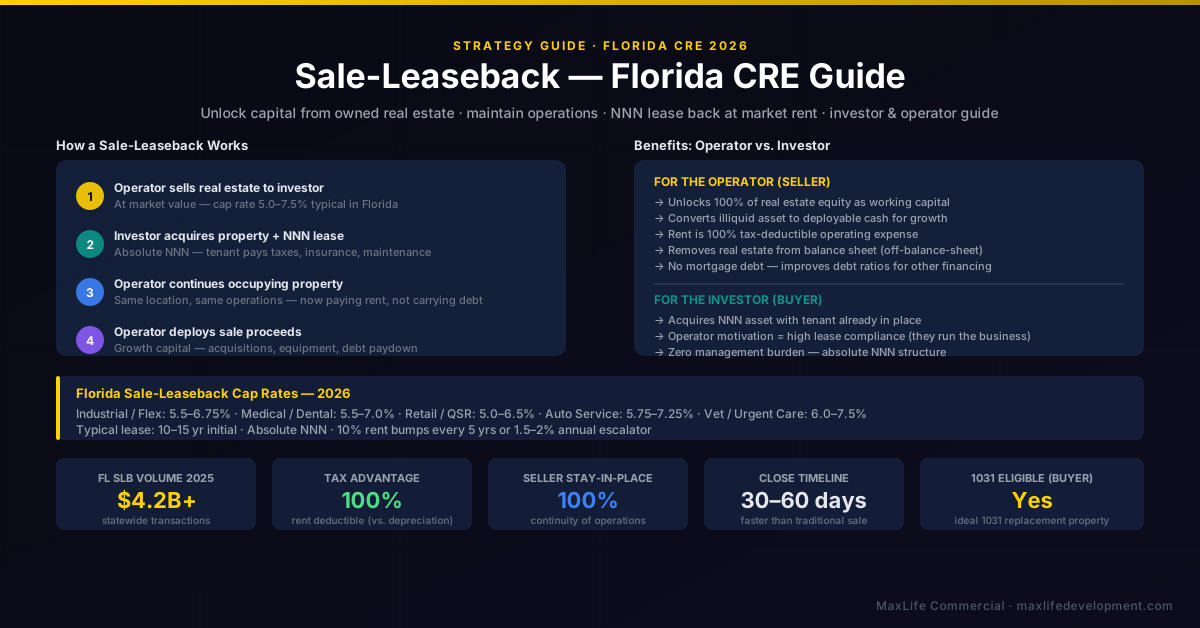
How a Florida Sale-Leaseback Works
The mechanics of a sale-leaseback are straightforward, but the strategic implications for both parties are significant:
- 1
Operator sells the real estate
The business owner sells their commercial property to an investor at market value — determined by the prevailing cap rate for the asset type and lease structure. A medical practice in Florida with a 10-year NNN lease might sell at a 6.0% cap rate, generating a lump-sum payment equal to annual NOI divided by 0.06.
- 2
Simultaneous NNN lease is signed
At closing, the operator signs a long-term NNN lease — typically 10–15 years initial term with renewal options. Absolute NNN structure means the tenant pays all operating costs including taxes, insurance, and maintenance. The investor acquires the property with a fully-executed lease already in place.
- 3
Operator continues operations, now as tenant
Nothing changes for customers or employees. The business operates exactly as before — the only difference is that the operator pays rent instead of a mortgage payment. For most operators, the rent payment is lower than their prior debt service, improving monthly cash flow immediately.
- 4
Operator deploys the sale proceeds
This is the strategic core of the sale-leaseback. The lump-sum proceeds — typically representing 10–20 years of accumulated equity — become deployable capital. PE-backed operators use proceeds to fund acquisitions. Private practice owners use capital for equipment, debt paydown, or personal liquidity. Business owners use it to fund geographic expansion.
Florida Sale-Leaseback Cap Rates by Asset Type — 2026
| Asset Type | Cap Rate | Key Credit Factor |
|---|---|---|
| Industrial / Flex | 5.5–6.75% | Replacement cost, tenant revenue |
| Medical / Dental | 5.5–7.0% | Practice revenue, equipment investment |
| Retail / QSR | 5.0–6.5% | Franchise system, AUV performance |
| Auto Service | 5.75–7.25% | Fleet accounts, repeat customer base |
| Veterinary / Urgent Care | 6.0–7.5% | PE parent guaranty, visit volume |
| Childcare / Education | 6.0–7.25% | Enrollment rate, license status |
Why Florida Operators Choose Sale-Leasebacks
Unlock Locked-Up Equity
Florida business owners who purchased commercial real estate 10–20 years ago may have 5–10× their original investment tied up in real estate while their operating business still needs capital for growth. A sale-leaseback converts that illiquid equity into deployable cash at full market value, without selling the business or disrupting operations.
Tax Efficiency: Full Rent Deduction
Post-sale, rent payments are 100% deductible as a business operating expense. This is often more tax-efficient than the depreciation deduction available on owned real estate, particularly for businesses that have already taken significant depreciation. In Florida's no-state-income-tax environment, the federal deduction is the full story — no additional state tax layer to navigate.
Improve Credit Profile and Balance Sheet
Removing owned real estate from the balance sheet can improve financial ratios that lenders use for business credit. A medical practice that owns its building has real estate debt on its balance sheet; after a sale-leaseback, it has an operating lease liability (often off-balance-sheet under certain accounting treatments) and a stronger current ratio — making it easier to qualify for equipment financing, lines of credit, and SBA loans for the operating business.
Estate Planning and Partnership Liquidity
For family-owned Florida businesses with real estate, a sale-leaseback can simplify estate planning by converting a single illiquid asset (the real estate) into diversified investment or cash. It also resolves partnership disagreements about real estate — partners who want liquidity receive their share of proceeds while the business continues operating at the location.
Get Off-Market CRE Deals in Your Inbox
Join our investor list for exclusive Central Florida opportunities, market reports, and deal analysis — delivered weekly. No spam, unsubscribe anytime.
Underwriting a Sale-Leaseback: The Buyer's Checklist
Sale-leasebacks differ from traditional NNN acquisitions in one critical way: the tenant is the former owner, meaning the real estate value and the business value are intertwined. Thorough business underwriting is non-negotiable.
- →Business revenue and EBITDA: Request 3 years of P&L statements. The business must generate sufficient revenue to sustain rent at market rate. Rent-to-revenue ratio should typically be below 8–10% for retail/medical and below 5% for industrial.
- →Rent coverage ratio: Calculate EBITDA ÷ annual rent. A ratio above 2.5× is healthy; below 1.5× is a red flag. The business needs significant headroom above rent to absorb revenue fluctuations without lease stress.
- →Market rent validation: Ensure the agreed rent is at or below market for the location. An operator motivated to maximize sale proceeds may agree to above-market rent — a lease that is a financial burden from day one creates renewal and restructuring risk.
- →Personal guaranty: For private operators (not PE-backed), require a personal guaranty from the individual owner. This aligns incentives and provides recourse if the business declines.
- →Lease term and renewal options: Minimum 10-year initial term. Shorter terms create re-leasing risk that should be compensated with 75–100 bps wider cap rate.
- →Property condition: The operator-owner may have deferred maintenance that a landlord would not tolerate. Commission a full property condition assessment and require the seller to remediate issues before closing or escrow a reserve.
- →Alternative use: Underwrite the property's value as a re-leasing opportunity if the operator vacates. Specialty buildout (medical, auto service) narrows the replacement tenant universe — factor this into reversionary value.
Sale-Leaseback as a 1031 Exchange Replacement Property
Sale-leaseback transactions are ideal 1031 exchange replacement properties for several reasons:
- →Tenant is already in place at closing — no lease-up period or vacancy risk
- →Absolute NNN structure requires zero management — appropriate for 1031 exchangers who want passive income
- →Close in 30–60 days — well within the 180-day 1031 exchange acquisition deadline
- →Florida's no-state-income-tax advantage improves after-tax yield versus replacement properties in tax-heavy states
- →Wide range of deal sizes ($1M–$20M+) accommodates most exchange equity amounts
Execute a Florida Sale-Leaseback
Whether you're a Florida business owner considering monetizing real estate or an investor seeking NNN sale-leaseback opportunities, MaxLife Commercial advises both sides of these transactions. Our relationships with operators across medical, industrial, retail, and specialty categories generate consistent sale-leaseback inventory before it reaches the public market.
Sale-Leaseback Advisory — Florida
Ryan Solberg advises operators considering a sale-leaseback and investors seeking Florida NNN sale-leaseback acquisition opportunities across industrial, medical, retail, and specialty categories.